We are at the stage where Nvidia must create artificial chip demand by financing its future customers to keep the music going 🎶
JPM: “Our sense is that NVIDIA believes that:
1) the hyperscalers are not investing enough to keep up with token demand because of fcf concerns;
2) the hyperscalers can’t get land power shell outside the US and are increasingly getting pressure in the US so the world needs new spenders; and
3) the structure here will drive tens of billions of annuity revenue with limited downside.
Of course, the more cynical view is it is simply creating artificial demand from customers without the scale to use asic or AMD, but it only works if compute demand is ahead of supply.”
Source: @FTAlphaville
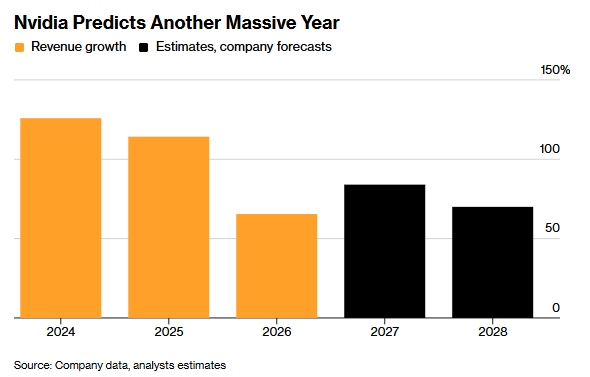
Interesting: Nvidia US revenue was $60.1 billion vs estimate of $67.5 billion. Yet overall revenue of $96.2 billion beat consensus by almost $4 billion.
Weakness in the US offset by Asia and potential China sanctions smugglers?
NVIDIA $NVDA IS NOW PROVIDING CREDIT SUPPORT ON UP TO $105 BILLION OF OPENAI’S DATA CENTER LEASE OBLIGATIONS
In August 2026 NVIDIA entered guarantees on the land, power and shell buildout to secure roughly 4.25 gigawatts at SB Energy’s PORTS-Pike Technology Campus in Ohio.
The site will exclusively host NVIDIA infrastructure under 20-year leases to OpenAI, subject to limited exceptions.
- Guarantee obligations capped at $105B
- Effective in phases, the first expected in fiscal 2029
- Exposure declines as OpenAI fulfills lease payments
- NVIDIA holds an option to provide credit support for roughly 3.8 additional gigawatts as the site scales
NVIDIA says each generation of infrastructure deployed at PORTS-Pike could represent roughly 1.5 million GPUs, or $150B-$200B in NVIDIA revenue.
Total guarantee exposure across all agreements is now $108.5B, up from $3.5B excluding this deal.
Nvidia forecasts a margin between 73.5% and 74.5%, versus analyst estimates of about 75%. Some estimates were as high as 76.5%. That won’t help worries about increasing component costs, especially after the company is raising prices on many of its customers; BBG
HP CEO: "We delivered another strong quarter, with record third quarter revenue, EPS above the top of our guidance range, and are raising our guidance for FY26..."
$HPQ: -11% AH
HP $HPQ FISCAL Q3 ADJUSTED EPS BEATS BY $0.14, RAISES FY GUIDANCE ABOVE ESTIMATES
- Adjusted EPS: $0.83 vs $0.69 est, beat
- Adjusted net income: $770M vs $610M est, beat
- GAAP EPS: $0.71, net income $660M
- Income from operations: $892M
- Free cash flow: $1.57B
Q4 guidance: adjusted EPS $0.69-$0.79 vs $0.67 est, GAAP EPS $0.74-$0.84.
FY guidance: adjusted EPS $3.19-$3.29 vs $3.04 est, GAAP EPS $2.52-$2.62, free cash flow $3.0B-$3.2B.
NVDA's implied move for August 27th is ~5.4%
Implied vol is at 40.8, the lowest pre-earnings volatility setting in the past two years. Last August, it printed at a similar level (~41) before crushing to 31 after the earnings date.
NVDA's 20-day moving average of total retail notional has fallen to $2.8B, one of its lowest levels in two years.
Revenue guidance has beaten Street consensus by an average of 4% over the past four quarters, while the stock has traded down 3%/5% on average over the subsequent 7/30 days.
The put-call skew is relatively low compared to 1y levels, sitting around 0.02. Options markets are not pricing in significant tail risk into earnings
META $META TO PAY $18B OVER 10 YEARS IN SETTLEMENT, TAKES $10B CHARGE IN Q3
Financial terms, per Meta:
- $18B total over 10 years for youth online safety initiatives
- $12.7B to the states, with $5.3B contingent on conditions
- $10B legal expense to be accrued in Q3 2026
- Guidance ranges from the July earnings release remain unchanged
- An independent auditor reviews compliance for five years
Product terms, per California AG Rob Bonta:
- Default daily time limit of two hours for users under 18, liftable only by a parent
- Default nighttime block between midnight and 6am for users under 18, liftable by a parent
- Option for users under 18 to have a non-personalized feed
- Meta must respond to 90% of teen reports on potentially harmful content within six hours
- If other platforms adopt similar terms, the teen daily limit drops to one hour
Meta is urging TikTok and YouTube to join the states in adopting the standards. YouTube is owned by Alphabet $GOOGL.
The deal ends the federal trial in Oakland in its second week, where 29 states alleged Meta designed Facebook and Instagram to drive compulsive use among young people. Terms are proposed and subject to court approval.