🎁 WEEKEND GIVEAWAY! 🎁
💡This week we introduced Pay with XP so you can buy any account with your XP!
⁉️ Guess how many XP were redeemed since launching Pay with XP!
🎁 50K 2-Stage PWP.
Rules:
Comment just one answer 👇
Follow, like & repost 🤝❤️🔁
Answer before NY Open on Monday
A NEW CHAPTER AT THE FEDERAL RESERVE | June 18, 2026
─────────────────
Yesterday was Kevin Warsh's first press conference
as Chairman of the Federal Reserve.
It will be remembered as a turning point,
not because of what was decided,
but because of what was dismantled.
─────────────────
WHAT HAPPENED
Rates were held unchanged at 3.5% to 3.75%.
The vote was unanimous, a notable contrast
to April's 8 to 4 split, the most divided
FOMC in three decades.
But the substance was in the architecture,
not the decision.
The Fed's policy statement was cut to roughly
one third of its previous length.
Warsh called it "curt," deliberately so.
Forward guidance was dropped entirely.
He submitted no dot plot projection himself,
telling reporters: "For me it's not helpful."
And he announced five task forces that will
review the Fed's communication strategy,
its data sources, its inflation frameworks,
and its balance sheet.
─────────────────
THE END OF FORWARD GUIDANCE
Since Ben Bernanke formalized the practice
after 2008, forward guidance became the
central operating instrument of Fed communication.
Markets did not just react to what the Fed did.
They positioned months in advance
based on what the Fed said it would do.
The "Fed Put" became the foundation
of every investment thesis for 18 years.
If markets fell hard enough, the Fed would act.
If growth slowed enough, the Fed would signal relief.
The market's job was not to read the economy.
It was to read the Fed.
Warsh ended that yesterday with a single sentence.
"Financial markets perform best when they react
to incoming data, and work less efficiently
when they ask: how will the Federal Reserve
react to that incoming information?"
That is not a technical adjustment.
It is a philosophical reorientation
of the relationship between the central bank
and financial markets.
─────���───────────
THE TASK FORCE QUESTION
Five task forces. Communications, data sources,
inflation frameworks, balance sheet, productivity.
In German political tradition, there is a saying
that roughly translates as:
when you do not know what to do, you form a committee.
That observation is not entirely unfair here.
The Fed is acknowledging, in institutional terms,
that its existing frameworks may not be adequate
for the environment it now faces.
Warsh's own AI-driven disinflation thesis,
which he advocated as recently as last year,
has not materialized. Inflation is at a three-year high.
Nine FOMC members now project a rate hike this year.
Six of those project two hikes.
The dot plot has moved further hawkish
in a single quarter than at any point since 2022.
─────────────────
THE BERNANKE PARALLEL
In March 2007, Ben Bernanke testified before
Congress that the economy was growing at
roughly 2 percent and that he saw no recession.
The recession had officially begun in December 2007.
The Fed's own models missed it in real time.
That is not a criticism of Bernanke personally.
It is a structural observation about the Fed's
data infrastructure, which has not fundamentally
changed since then. The same models
that missed the financial crisis, that called
the 2021 inflation "transitory," and that were
still projecting cuts six months ago,
are now projecting hikes.
The task forces Warsh announced are an implicit
acknowledgment of this.
─────────────────
WHAT THIS MIGHT ACTUALLY MEAN
There is a reading of yesterday that goes
beyond the surface.
The savings rate stands at 3.6%, against
a long-term average of 8.4%.
The LEI/CEI ratio is at 2008 levels.
Consumer sentiment is at a 74-year low.
Debt to GDP exceeds 130%.
And then there is the labor market, viewed
not through the headline but through the lens
of what it is actually producing.
In 1999, the US economy created an average
of 265,000 jobs per month with a workforce
of 128 million people. In 2007, it created
93,000 per month with 138 million workers.
Today, with 159 million people in the workforce,
a 24% larger labor force than 1999
and 15% larger than 2007, the economy
is creating an average of 59,000 jobs per month.
That is 78% fewer jobs per month than 1999
and 37% fewer than 2007, relative to a
significantly larger workforce.
An economy in that condition cannot absorb
the rate hikes that nine FOMC members now project.
It could not absorb them in 2007 either.
The difference is that Bernanke had room
to cut to zero and launch QE.
That room no longer exists in the same form.
A Fed Chairman who has full access to
the data behind these numbers, and who sees
where the cycle is heading, might choose
exactly this moment to remove the implicit
promise that the Fed will save markets.
Not because he wants to raise rates
into a weakening economy.
But because he knows that what is coming
may exceed the capacity of the tools available,
and that shifting responsibility toward the markets
now is preferable to being held accountable later.
─────────────────
THE SETUP FROM HERE
Markets have spent 18 years asking
"what will the Fed do?"
Warsh is now telling them to ask
"what does the data say?"
Those are very different questions.
Last night, a framework agreement was signed
to reach a future agreement on Iran.
That is not a resolution. It is a direction.
But it is enough to give markets a reason
to price in lower energy costs, easing
inflation pressure, and reduced urgency
around rate hikes.
Add strong Q1 earnings, a fractal structure
that is still pointing higher, and a Fed
that just told markets to follow the data,
and the data right now still includes
a parabolic equity structure that wants to run.
The party is not officially over.
The task forces are still being formed.
The geopolitical knot is loosening.
And the current market structure has unfinished
business to the upside.
As long as no new clouds appear on the horizon,
the final phase will most likely be celebrated
before the bill arrives.
─────────────────
CIF: 82/90 — Warning Level Orange.
@TheBigCycleGame
Not financial advice. DYOR.
#Fed #Warsh #FOMC #Stagflation
#CIF #MacroAnalysis #EndCycle #DotComFractal
#RateHike #CentralBank #TheBigCycleGame
Since processing our first payout in May 2024, thousands of traders have received payouts from PipFarm.
Here's a look at some of the numbers that helped us reach this milestone. 🔎
💸 $4,108,193 paid out
💼 $265M in SIM-funding issued
👥 5,435 traders funded
💰 4,047 payouts processed
🤝 2,117 unique traders paid
📊 7M trades placed
This milestone was achieved by a community. Not a company. That's why we're celebrating with you.
Today, every trader received 4 XP. Hundreds were promoted to a new rank and received gift vouchers, discounts and much more.
#Natgas Bazooka blocks continue to show accumulation price is above those institutional area's
Bulls continue to have a strong case as long as one key area holds.
The level I'm watching closely:
🚨 3.05 A pivot Support Level
Technical backdrop:
• Bazooka blocks continue to show accumulation price is above those institional area's
• Bazooka blocks continue to show accumulation price is above those institutional area's
• Structure still favors upside
• Dips continue to look buy-able while support holds making lower lows while price continues to rise
Bullish roadmap:
🎯 Close above 3.30 and the probability increases for a move toward 3.50 (L Pivot) Line in the Sand
🎯 Clear 3.50 and the next major target comes into focus near 3.98-4.00
Risk levels:
⚠️ Lose 3.05 and support levels below come into play:
3.00
2.80
2.70-2.75
2.65-2.66
Overall, the structure still favors higher prices while 3.05 remains intact.
Full breakdown in the video below 👇
🎁 $200,000 PipFarm Giveaway 🎁
We're giving away 20 × $10K Pay with Profits accounts.
With this model, you pay a fraction today. The rest comes from your future profits. That's it. No big upfront fee.
To enter:
🟡 Follow @thepipfarm & @jamesglyde
🟡 Like + Repost
🟡 Tag a trader who deserves funding
🟡 Register 👉 https://t.co/QjllRwO63S
🟡 Join our Discord 👉 https://t.co/mERvAlUn3A
⏳ 72 hours. 20 Winners!
🎁 WEEKEND GIVEAWAY! 🎁
💡EUR/USD is the most traded FX pair.
⁉️ Guess the percentage of PipFarm traders who traded EUR/USD in May.
🎁 $100 PipFarm voucher.
Rules:
Comment just one answer 👇
Follow, like & repost 🤝❤️🔁
Answer before NY Open on Monday
Trump doesn’t want a treaty. He wants a cinematic surrender. And Tehran isn't just rejecting the deal—they are actively dismantling his credibility to prevent the spectacle.
This isn’t just hardball. It’s narrative assassination.
Iran knows exactly what Trump is desperate for: a staged photo-op in Geneva where his team waves a piece of paper, proving his "strongman" dominance to his domestic base. By flatly denying the meeting exists, Tehran is exposing the "Art of the Deal" as the "Art of the Delusion."
State-owned Mehr News Agency:
"New details of a 14-point draft memorandum of understanding between Iran and the United States have been released by a source close to the Iranian negotiating team. The details of this draft are as follows:
1. Immediate and permanent cessation of hostilities on all fronts, including Lebanon.
2. A commitment by the United States not to interfere in Iran's internal affairs and to respect the sovereignty of the Islamic Republic of Iran.
3. Complete lifting of the maritime blockade within 30 days.
4. A commitment by the United States to withdraw its forces from around Iran.
5. Reopening of the Strait of Hormuz within 30 days under Iranian arrangements.
6. Suspension of sanctions on oil and petrochemical product sales, and full Iranian access to its financial resources.
7. The necessity for the United States and its allies to present reconstruction plans for Iran totaling at least $300 billion.
8. 60 days of negotiations to reach a final agreement based on nuclear issues and the complete lifting of primary and secondary sanctions imposed by the US, UN Security Council resolutions, and IAEA Board of Governors resolutions.
9. Reiteration of Iran's commitment under the NPT not to produce nuclear weapons.
10. During the negotiation period, the United States has committed not to increase its forces in the region and not to impose new sanctions.
11. Release of $24 billion of Iran's blocked funds during the 60-day final negotiation period. Half of this amount must be made available to Iran before the start of negotiations.
12. Establishment of an oversight mechanism for the implementation of the agreement.
13. The final agreement will be affirmed by a UN Security Council resolution.
14. Final negotiations will not commence before the release of half of Iran's blocked funds ($24 billion), the suspension of Iranian oil sanctions, and the lifting of the maritime blockade.
The final agreement will exclusively address the fate of enriched materials and enrichment, sanction relief, and a plan for Iran's economic reconstruction.
Discussions regarding Iran's missile program and support for resistance groups have been definitively removed from the agenda."
Jeff Bezos just bet $12 billion that you'll be able to support your whole family on a single paycheck again.
his reasoning: AI will let companies make more stuff with fewer people and less money.
and when something gets cheaper and easier to produce, and lots of companies can do it, they compete and the price drops.
it's why a flatscreen TV that cost $2,000 a decade ago is $300 today.
bezos thinks AI will do that to almost everything you buy.
in his words, it raises "the basket of goods people can afford."
your paycheck buys more without anyone handing you a raise.
the problem: look at which prices have actually dropped.
so far, AI has only made *digital* things cheap, like code and content.
but the stuff that really eats your paycheck is *physical*.
rent, cars, medicine. cheaper code doesn't lower your rent.
that's exactly what bezos just spent $12B on.
Prometheus, his new company, is building AI tools that help engineers design and manufacture physical products faster
things like cars, machines, and medicine.
the goal is to make building physical things as fast and cheap as writing software.
if it works, 1 income starts covering what used to take 2.
which is when his prediction kicks in:
"perhaps one of those earners will choose not to be in the job market, so they'll become a one-earner household." or "some people who are working overtime will stop working overtime, because they don't want to."
one paycheck covering a whole family again, like the 1950s.
Being a trader is a combination of a chess grandmaster, a professional boxer, and a WW2 soldier storming the beaches on D-Day.
There are long periods of sitting around while fuck all happens, you're going to suffer brain damage, and you're almost certainly going to get blown up.
🎁 WEEKEND GIVEAWAY! 🎁
💡Everyone knows you should use a stop loss, but does everyone do it?
⁉️ Guess the percentage of PipFarm traders who used a Stop Loss in April.
🎁 $100 PipFarm voucher.
Rules:
Comment just one answer 👇
Follow, like & repost 🤝❤️🔁
Answer before NY Open on Monday
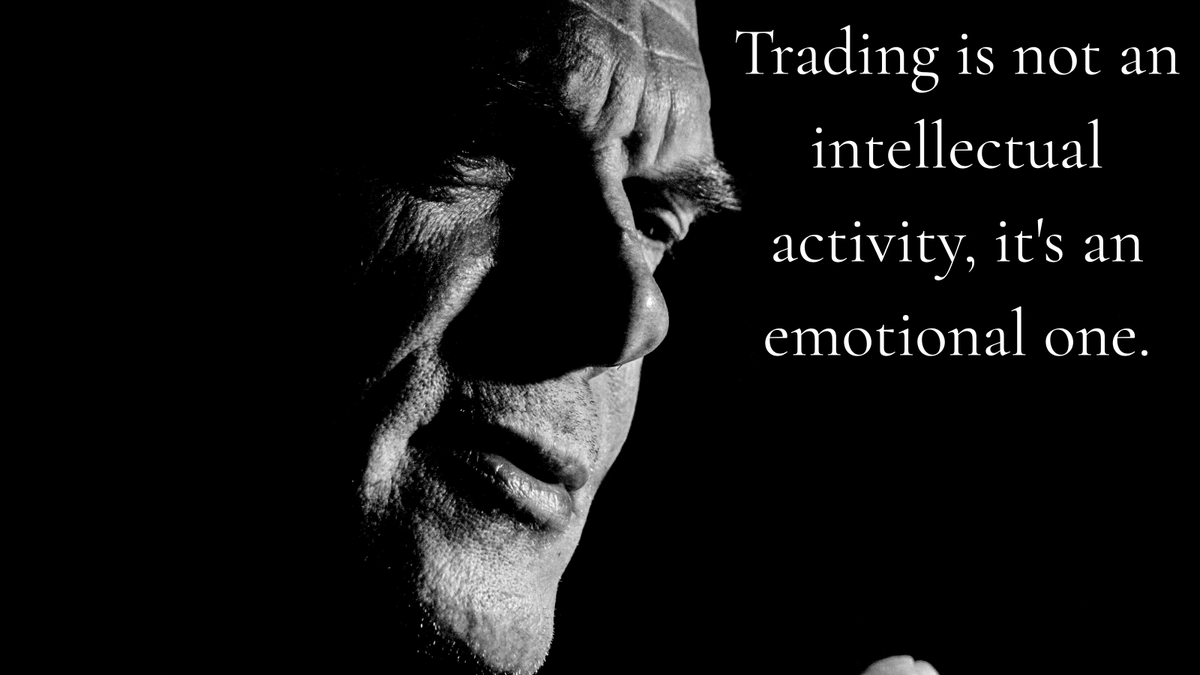
Trading is not an intellectual activity. It's an emotional one.
The decisions that cost you money aren't analytical failures. They're emotional ones. Fear. Greed. Ego. The inability to pull the trigger. The inability to let go.
Over-intellectualising pulls you toward analysis and perfectionism and away from the one thing that actually matters: taking risk.
The best traders don't eliminate the emotional side. They learn to work with it. Ignore it at your peril — it's always there, and it will always find you.
🎁 WEEKEND GIVEAWAY! 🎁
💡We're so excited to have introduced our brand new Pay with Profits program!
⁉️ Guess how many PWP challenges were purchased on the very first day.
🎁 $100 PipFarm voucher.
Rules:
Comment just one answer 👇
Follow, like & repost 🤝❤️🔁
Answer before NY Open on Monday