A margin of safety isn't how cheap something looks.
It's how wrong you're allowed to be.
Start from the price. Work out what it requires. Then ask how far that sits from what could plausibly go wrong.
Measuring margin of safety in assumptions, not just price:
https://t.co/wd8VSEPfXb
Buffett's first stock purchase, age 11: three shares at $38. He sold at $40.
The stock later reached about $200.
A profitable trade can still be the costly mistake. The gain is visible. The compounding you gave up isn't.
@themotleyfool In investing, impatience often disguises itself as productivity. More trades, more opinions and more activity don't necessarily mean better decisions.
"The iron rule of nature is: you get what you reward for. If you want ants to come, you put sugar on the floor."
~ Charlie Munger
Unpopular view: most bad corporate behavior isn’t bad people. It’s a bonus plan working exactly as designed.
Before I judge management’s character, I check what they’re paid on. The answer is usually in the proxy statement.
@F_Compounders Debt doesn't just increase risk. It removes flexibility precisely when you need it most. Staying solvent gives you the luxury of waiting for better opportunities.
@CharlieMunger00 In investing, envy is particularly expensive.
Following blindly someone else's returns often means buying what you don't understand at a price you haven't questioned.
My test for a moat: can the company double in size without its operating margin slipping?
If yes, the advantage scales. If margin falls with each new market, it was local, and I paid a moat multiple for a niche business.
Buffett has said investing isn’t a game where a 160 IQ beats a 130 IQ.
Mostly true. You need enough intelligence to value a business. Past that, the edge is behavioral.
Where would you push back?
"Avoid 'hot' stocks in 'hot' industries; the competition will kill the growth."
~ Peter Lynch
Lynch’s warning: avoid hot stocks in hot industries.
My version: the louder the crowd says “can’t lose,” the harder I look for who’s about to compete.
High growth is an invitation. Margins are the bill that arrives later.
What’s the hottest industry you’re staying out of?
@dmuthuk The lesson isn't to ignore price. It's to avoid letting a small price difference distract you from a massive gap between price and intrinsic value. Cheapness matters, but so does opportunity cost.
Before I touch a model, I ask two things: what does the next customer cost, and how long do they stay?
Cheap and long means each extra dollar of capital works harder. Expensive and short means growth eats cash.
Everything else is detail.
@themotleyfool The best bargains often appear when the headlines are worst, but cheap prices alone aren't enough. You still need a business worth owning when the dust settles.
@InvestInAssets Buying well matters. But constantly interrupting compounding through unnecessary selling can be far more costly than most investors realize.
Consensus portfolio, consensus return.
If everyone owns the same stocks, the best outcome is average, before fees.
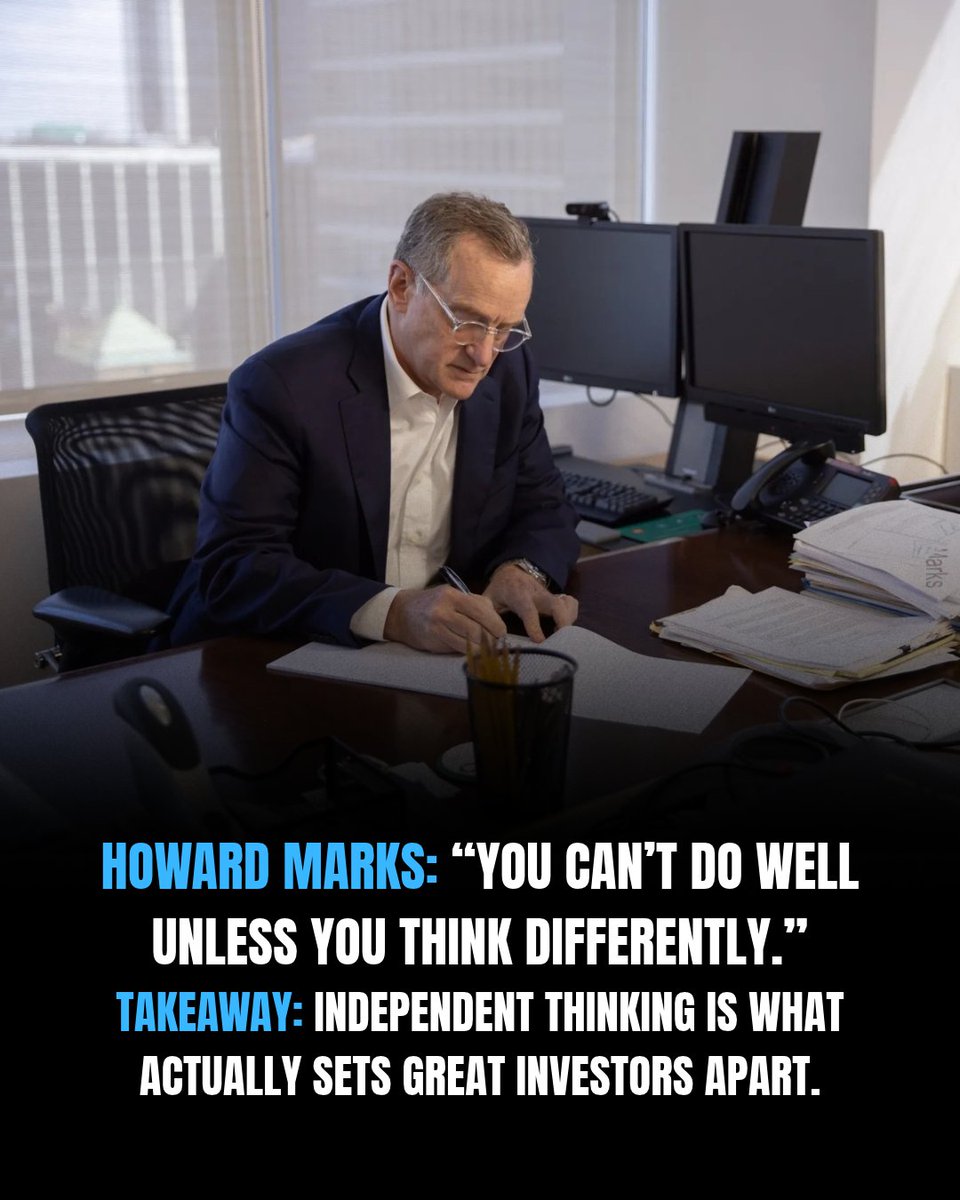
Howard Marks: you can’t do well unless you think differently.
The hard part: different feels wrong for years.
"If we buy something and it goes down, you check and recheck your work, and then if nothing's different, you should like it more, it's a better bargain."
~ Seth Klarman
My rule after any drop: write down why I bought, then try to break it.
Thesis broken? Sell. Thesis intact? Buy more.
Klarman: if nothing’s different, like it more.
The price fell. The facts didn’t.
@MoneyWisdom_ Cutting expenses creates breathing room. Increasing income creates leverage. The biggest financial breakthroughs usually come from expanding what you earn while keeping lifestyle inflation under control.
The input that moves my compounder valuations most isn’t growth or margins. It’s the year excess returns start to fade.
Same 20% ROIC. Fade at year 8 or year 15? Very different fair multiple.
The S&P 500 fell about 57% from October 2007 to March 2009.
Bogle asked you to imagine 20%, roughly a third of that.
If you can’t picture the mild version, you won’t hold through the real one.
@QCompounding The best risk management happens before you buy. Position sizing, liquidity, and understanding the business matter far more once panic hits.