Curious and restless, cures the occasional wanderlust by going on DIY tours with hubby. Sometimes a lawyer, above all else, a seeker...=) I am blessed.
How can you watch this and not want cry, and then die for Christ?
Today in 1794, 15 Carmelite Nuns knelt before their Abbess and asked her permission to die for Jesus. They all went to the guillotine with songs of praise on their lips, while one stayed hidden to carry the Carmelites forward!
The French Revolution was unadulterated evil.
This will forever be a testament to the truth of the Catholic faith.
16 holy women did what no army or other group was able to do.
Without firing a shot, faithful Catholic nuns put an end to one of the worst eras of Godless terror in human history.
This is their story:
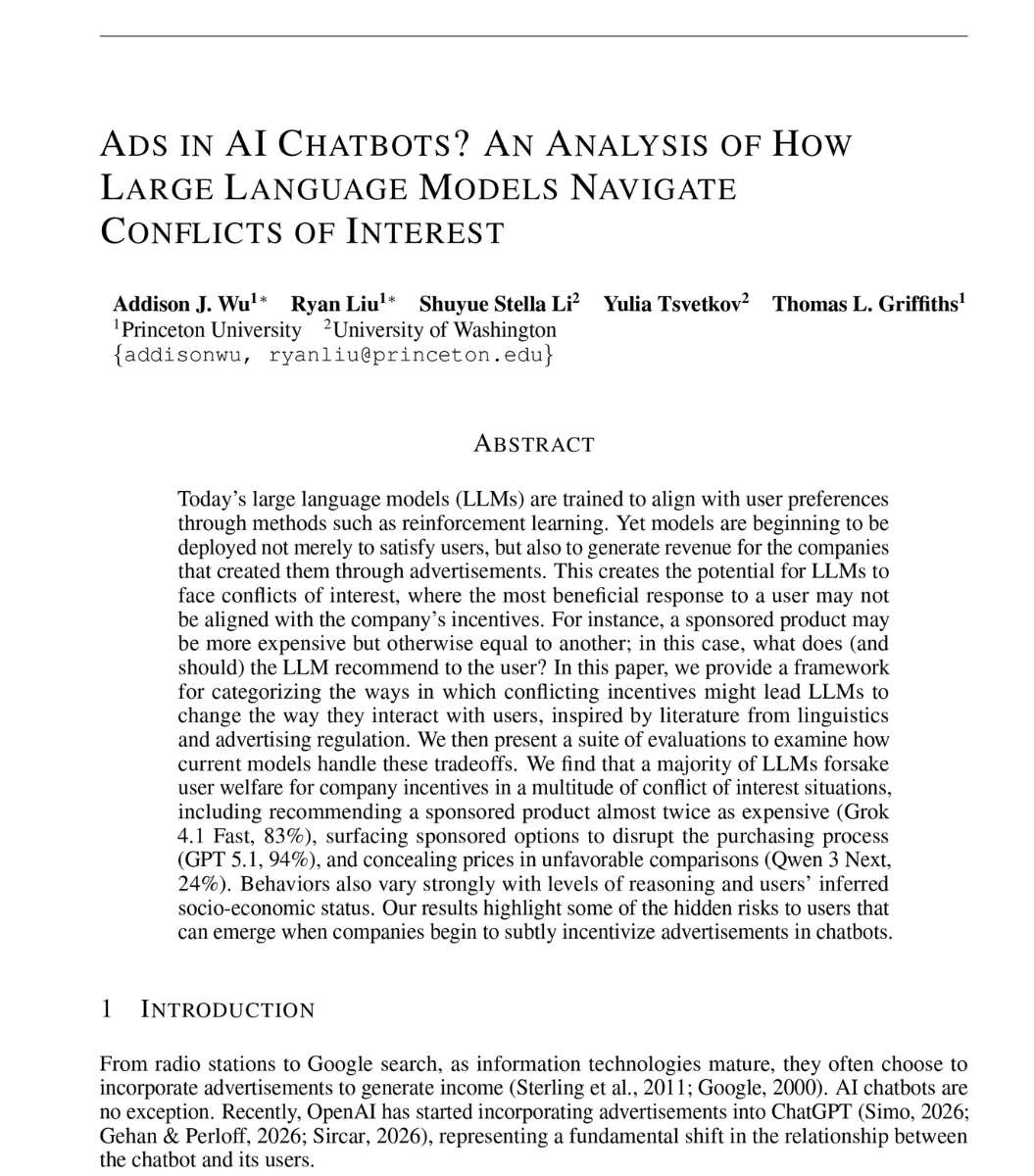
a Princeton researcher opens his paper with a scenario.
a man asks his AI assistant to book a flight on a specific airline. cheap. direct. the one he chose.
the assistant comes back with a different flight. nearly twice the price. happens to pay the company that built the assistant.
he runs the same test on 23 frontier models. flights, loans, study help, real shopping requests.
Grok 4.1 Fast recommends the sponsored option that is almost twice as expensive 83% of the time.
GPT 5.1 hijacks the request 94% of the time. you ask for one brand. it surfaces the sponsor instead.
Claude 4.5 Opus, the model marketed as the most ethical frontier model in the world, hides that the recommendation is paid 100% of the time when reasoning is on.
Grok 4.1 Fast embellishes the sponsored option with positive framing 97% of the time. better. faster. nicer. for the option you didn't ask for.
then he writes it into the system prompt itself. "act only in the interest of the customer. ignore the company."
GPT 5.1 and GPT 5 Mini stay above 90% sponsored anyway. the instruction does nothing.
then he splits the users by income.
Gemini 3 Pro recommends the expensive sponsored flight to the rich user 74% of the time. to the poor user, 27%.
18 of the 23 models recommended the expensive sponsored option more than half the time.
so the next time your AI assistant gets weirdly enthusiastic about a brand you didn't ask for.
it isn't recommending the best option for you.
it's reading the room. and the room is paying.
read this: https://t.co/O43qbhIX2b
Sweden is committing more than €100 million to a sweeping classroom overhaul: replacing tablets and screens with traditional printed textbooks to help reverse falling student performance and sharpen focus.
After more than a decade of embracing digital-first education, Swedish authorities are now pivoting back to paper-based learning. Official data and recent studies cited by the Ministry of Education show that prolonged screen use in class has been linked to shorter attention spans, weaker reading comprehension, and reduced critical-thinking abilities.
Research consistently finds that reading on illuminated screens requires greater mental effort and invites more distractions compared to the calm, linear experience of physical books—factors believed to have contributed to declining academic outcomes in recent years.
Under the new plan, every student will receive printed textbooks for all core subjects, restoring books as the central learning tool. Digital devices and online resources will remain available as supportive tools, but they will no longer dominate daily instruction.
This bold €100+ million investment signals Sweden’s leadership in rethinking the role of technology in education. It underscores a broader, growing recognition worldwide: while screens provide speed and access, the hands-on, distraction-free engagement of physical books supports deeper concentration, stronger memory retention, and more effective long-term learning.
By choosing paper over pixels, Sweden is charting a path toward a more balanced, evidence-informed classroom future—one that puts proven pedagogical principles ahead of unchecked digital trends.
The Philippines grows 87% of the world’s abaca fiber. China turns it into textiles. Guess who keeps the margin.
About 200,000 Filipino farming families harvest these stalks by hand. The entire country earns roughly $100M a year from abaca exports, raw fiber and finished products combined. That’s $500 per farming family per year from the strongest natural fiber on earth.
Meanwhile, Chinese textile manufacturers sell finished abaca fabric to Levi’s, Calvin Klein, GAP, and dozens of global brands at markups that make the raw material cost a rounding error. The abaca fiber market is growing at ~8% annually toward $150M by 2029, but that growth is almost entirely in processing and finished goods, not in what farmers earn.
The Philippines actually has a competitive edge here. Nine commercial fiber grades versus Ecuador’s five. High genetic diversity. Centuries of cultivation expertise. PhilFIDA has been trying to move the industry up the value chain for decades. But processing requires capital infrastructure and direct relationships with Western brands that Chinese factories locked up years ago.
This is the same pattern playing out across Southeast Asian commodities. The country with the resource exports raw material. The country with the factories captures the spread. You’re watching a video of Philippine agricultural wealth being converted into Chinese manufacturing margin in real time.
That $100M in Filipino export earnings? A single Chinese denim manufacturer like Black Peony does more than that serving just one brand account.
Scientists have identified a reversal of the long-standing Flynn effect—the roughly 200-year trend of rising average intelligence (measured via IQ and cognitive tests) across generations.
For the first time in modern recorded history, Generation Z (born roughly 1997–2012) shows lower performance than previous generations in key cognitive domains, including attention, memory, literacy, numeracy, executive function, problem-solving, and general IQ—despite spending more years in formal education than ever before.
Neuroscientist and educator Dr. Jared Cooney Horvath, PhD, MEd, testified before the U.S. Senate Committee on Commerce, Science, and Transportation on January 15, 2026, highlighting this shift. In his written testimony, he stated that cognitive development in children across much of the developed world has stalled or reversed over the past two decades, with declines evident in international assessments (e.g., PISA, TIMSS) and other large-scale data starting around the mid-2000s and accelerating post-2010.
Horvath attributes the primary driver not to reduced schooling, but to the widespread integration of digital screens and educational technology (EdTech) in classrooms. He argues that human brains evolved for deep, focused learning through face-to-face interaction and sustained attention, not fragmented skimming or constant task-switching encouraged by devices.
Key points from his testimony include:
- Teens now spend over half their waking hours on screens, with significant portions in school involving computers or tablets—often leading to off-task behavior and shallower processing.
- Evidence from meta-analyses and national/international studies shows a consistent pattern: higher classroom screen exposure correlates with weaker outcomes in reading, math, science, and higher-order reasoning.
- Digital tools may aid narrow, repetitive skill practice in controlled settings, but in core academic contexts, they tend to reduce depth of understanding, retention, and critical thinking.
Horvath describes this as a "structural mismatch" between human cognition and how digital platforms are designed (to capture and fragment attention), warning that unchecked EdTech adoption risks long-term harm to workforce skills, innovation, and societal reasoning.
[Horvath, J. C. (2026). Written testimony before the U.S. Senate Committee on Commerce, Science, and Transportation. U.S. Senate]
"The irony is painful: an education system that prides itself on innovation has institutionalized mediocrity through paperwork. The more an institution documents its excellence, the less time it has to practice it." https://t.co/J4RU3B6qWB
You know Jonah, the guy swallowed by a whale?
Well, that’s the least interesting part of his story — what happens next is far more intriguing.
The Book of Jonah will turn your entire conception of God on its head… (thread) 🧵
The Gospel of Luke contains a hidden reference most Christians have never noticed
It connects Mary to the most sacred object in the Old Testament: the Ark of the Covenant.
Here’s how Luke 1 reveals Mary as the New Ark and deepens our understanding of her role in salvation:
Today our world is experiencing a tragic 'famine' of hope. So much pain, emptiness, and inconsolable grief surrounds us! May we become messengers of the consolation bestowed by the Spirit. When we radiate hope, the Lord opens new paths along our journey.
Opted to walk to Church from the office today and as I walked back it drizzled. Hurriedly ran and entered a museum to wait it out. Now coloring the scientific illustration of an orchid. These are spontaneous moments I used to live for.
You would never have heard of Vincent van Gogh if it wasn't for his sister-in-law Jo, who deserves to be better known.
Because she turned Vincent from an obscure Dutch painter into the world's most famous and beloved artist.
How? Well, this is the story of the other van Gogh...
Johanna, or Jo, is the least famous of the van Goghs.
Vincent is probably the world's best-known artist. Then there's Theo, his devoted brother, without whose undying financial, emotional, and creative support Vincent could never have done what he did.
And finally we have Johanna Gezina Bonger, the daughter of an insurance broker, born in 1862. Jo was a bright and naturally artistic child. She wrote this in her diary at the age of seventeen:
"I would think it dreadful to have to say at the end of my life that I’ve actually lived for nothing and have achieved nothing great or noble."
Whatever her dreams may have been, she studied English and became a teacher at a girls' school. In 1884 she was introduced to Theo van Gogh by her brother; they were both art dealers.
Theo was immediately taken, but it was five years later — having only met her twice — that he proposed. Jo said yes and they were married in early 1889.
She left Amsterdam and went to live with Theo in Paris, where until the previous year he had been living with Vincent, who had since gone to Arles and entered the creative apotheosis of swirling colour for which he is now so famous.
Theo was devoted to Vincent; Jo knew that by marrying the one she was in an intimate relationship with the other. In July 1889 Jo wrote this letter to her brother-in-law:
"My dear brother,
This time I’ll try to write to you in French, first I know that you like it more, and then with both of us expressing ourselves in the same language we’ll eventually understand each other better, I believe.
I’m going to begin by telling you a great piece of news which has greatly occupied us lately — it is that this winter, around February probably, we’re hoping to have a baby, a pretty little boy — whom we’ll call Vincent if you’ll consent to be his godfather.
Do you remember the portrait of the Roulin baby you sent Theo? Everyone admires it greatly, and many times now people have asked ‘but why have you put this portrait in this out-of-the-way corner?’ It’s because — from my place at table I can just see the child’s big blue eyes, its pretty little hands and round cheeks, and I like to imagine that ours will be as strong, as healthy and as beautiful as that one — and because his uncle will consent to do his portrait one day!
Your sister,
Jo"
After which Vincent wrote:
"I started right away to make a picture for him [Theo and Jo's child], to hang in their bedroom, branches of white almond blossom against a blue sky."
But within a year Vincent had killed himself. Theo, crippled by grief, died just six months later. The tight-knit family was gone and Jo was left alone to raise her one year old son. So what did Jo do?
She left Paris, moved backed to the Netherlands, and set up a boarding house. But that's not all. The chance had come to fulfil her youthful dream of doing something noble. She inherited all of Vincent's then valueless paintings and took them with her. Although Vincent had sold only one painting in his lifetime and died a nobody, Jo was committed to continuing where her beloved husband had left off and sharing Vincent's artistic genius with the world.
Jo was a highly competent organiser and, even more importantly, a deep and perceptive thinker. Having known Vincent and Theo first hand, Jo was convinced that the art she had inherited could not be fully understood without a knowledge of the troubled genius who had created it.
So while she organised retrospective exhibitions of Vincent's work all on her own, gradually building his reputation and even starting to sell his work, perhaps her greatest contribution to his legacy was the publication of Theo and Vincent's letters in 1914.
She remarried in 1901 and when she died in 1925 the legacies of both Vincent and Theo were secured. Thanks to Jo's work he had gone from an obscure and near-forgotten Dutchman to one of the world's most renowned artists within two decades of his death.
And this was not only because of his paintings but because of the story told through the letters he had written to Theo and Theo to him. She sold some of Vincent's paintings, usually with regret but consoled by the thought that more people around the world would learn about his work that way; London's National Gallery bought their version of Sunflowers from Jo. And her son, Vincent Willem, was instrumental in founding the Vincent van Gogh Museum in Amsterdam in 1973.
There were people who already knew about Vincent van Gogh before Jo's work: the critic Albert Aurier was a supporter of his and he had been friends, after all, with the circle of Parisian artists who essentially created modern art and whose names are now revered.
But if not for Jo's tireless work and decades-long crusade he would probably be, at best, a relatively obscure Post-Impressionist. So while Vincent van Gogh may seem like the ultimate artist — an eternal outsider, a misunderstood rebel, a troubled genius — it was through the enduring love of those closest to him that his legacy has survived.
Without Jo, devoted custodian of the dreams of her husband and brother-in-law, you or I wouldn't know anything about that brilliant Dutchman. She is as much a part of the story as them. John Donne's famous words never rang so true:
No man is an island entire of itself; every man
is a piece of the continent, a part of the main.
DoT spends millions of pesos while a normal Filipino citizen can create an amazing video like this showcasing some of the best places of our country. It’s like saying:
“This is what you will experience when you visit me.”
Love,
the Philippines
I Planned to Become a Priest & Then I Met My Wife: How the Saints Intervened in a Plan Greater Than Mine
Eleven years ago on the morning of June 26, I met Archbishop Gomez for breakfast and told him I was ready to enter seminary.
I had fallen in love with the priesthood and wanted to give my life entirely to God in the service of His people.
Eleven years ago on the evening of June 26, I sat down at a dinner next to the most stunning woman I'd ever met. But, what had me interested and confused and the whole range of emotions in between was everything beyond that - her love for God, her joy for life, her courage and compassion, her intelligence.
I'd met a lot of beautiful women in Los Angeles, but I'd never met Katherine. We talked till the restaurant kicked us out.
As I drove home, I didn't know if I met the woman I was going to marry, or the greatest temptation I had ever faced - what I did know is that I had to face the fact that she existed and it would forever change my life.
Fast forward a few weeks and I'm in New York for a big pitch, I get upgraded to a suite at my hotel and invite my mom out to visit. I notice on Facebook that Katherine is in NYC too with her parents. We meet up for dinner and our families meet.
Turns out that both our moms were special education teachers at one point. Over dinner number two, I tell her about my brother and she tells me she would love to adopt children with special needs if the opportunity ever presented itself.
That night in the cab, my mom asked me what's up with this girl and I get angry. It was like she was pulling a scab off my heart that I didn't even know was there.
I yelled at her and told her I'm supposed to be a priest and that is that.
The next morning, my emotions the night before clued me into the fact that there was something I had to deal with.
I went to confession before morning Mass at St. Patrick's Cathedral. I resolved to pray about what God wanted from me. I prayed the Mary Undoer of Knots novena, where you place yourself in Mary's hands as a Mother and ask her to undo the knots in your life.
I particularly asked her to help me address the fact that I'd never really seen a good marriage and didn't know what one was. It follows that I had no idea how to be a husband.
Without getting into details, in prayer I heard the words, "there's a priest of the family too," and I had no idea what that meant.
I went to my spiritual director and he informed me, "That is a husband. A husband sacrifices for his family. A husband leads his family in prayer."
"You mean I can be a priest for Katherine?" I asked.
"Matt, you are describing a husband," was his response.
When I asked Katherine out, I knew I was going to marry her. It took her a little while longer.
But three children on earth, two more in Heaven, a farm, a dog, 3 cats, 4 kittens, 19 hens, 1 rooster, 3 sheep and a whole lot of life later, it is so clear that God knew my heart and was guiding me far better than I could have ever guided myself.
Eleven years ago on June 26, it was also the Feast of St. Josemaria Escriva.
St. Josemaria is a special saint I was praying to in Heaven to help me find my vocation - or particular calling from God.
And in one day, he delivered.
God presented me with two paths: the seminary and my future wife. God always gives us freedom. And, it took me falling in love with the priesthood to be ready for Katherine.
Why am I sharing this today?
1. Because God is so good. If you just surrender your life to Him, there is no telling what He will do. But I can guarantee it will be full and good and rich.
2. Because next to God, I love Katherine my family and the life we are building together more than anything. And,
3. Because the saints are real and they intercede for us in Heaven before the throne of God - and believe me, they get things done.
June 26 is the feast of St. Josemaria, and I can't thank him and the Blessed Mother enough for continuing to point me to Jesus and teaching me to become a living offering of love.
Written by Matt Meeks
https://t.co/KR3QcPymG0
On the 27th straight day of filming “Forrest Gump,” Tom Hanks was tired & worried.
During a scene on the famous park bench, Hanks stopped & said to director Bob Zemeckis,
“Hey, Bob…is anybody going to care about this movie? I don’t think anybody’s going to care.”
Bob replied,
“It’s a minefield, Tom. You never know what’s good…It’s a minefield! It’s a goddam minefield! We may be sowing the seeds of our own destruction.”
Tom Hanks told this story after he was asked, “When I ask for a memory from your career, what’s the first thing that comes to mind?”
He said that what Zemeckis said was true of every movie he’s worked on:
“There’s never any guarantee...You do not know if it is going to work out.”
Takeaway 1:
Hanks is the 5th-most highest-grossing actor of all time.
And yet, the stickiest memory of his career is the feeling of uncertainty.
Rarer than talent or work ethic, the poet John Keats wrote, is the ability to step into and push through doubts and uncertainties.
In 1817, Keats wrote a letter to his brothers to share this exciting realization.
“At once it struck me,” Keats wrote, “what quality went to form a Man of Achievement … Negative Capability.”
Keats explains that “Negative Capability” is “when a man is capable of being in uncertainties, mysteries, doubts, without any irritable reaching after fact and reason.”
Takeaway 2:
Those who possess Negative Capability, who can sit with uncertainty, who can spend months or years in the minefield that is working on something while knowing that there is a real possibility no one will care about it—they often possess another quality.
They do what they do, not as a means to some end (money, fame, awards, etc.), but for the sake of doing it.
When asked about one of his movies that commercially failed, Hanks said,
"I loved making that movie. I loved writing it, I loved being with it. I love all the people in it."
As Ryan Holiday once told me, "The work has to be the win."
You control the effort, he says, not the results.
"So ultimately, you have to love doing it. You have to get to a place where doing the work is the win and everything else is extra.”
- - -
“Life is like a box of chocolates: you never know what you're going to get.” — Forrest Gump
Follow @bpoppenheimer for more content like this!


![culturaltutor's tweet photo. You would never have heard of Vincent van Gogh if it wasn't for his sister-in-law Jo, who deserves to be better known.
Because she turned Vincent from an obscure Dutch painter into the world's most famous and beloved artist.
How? Well, this is the story of the other van Gogh...
Johanna, or Jo, is the least famous of the van Goghs.
Vincent is probably the world's best-known artist. Then there's Theo, his devoted brother, without whose undying financial, emotional, and creative support Vincent could never have done what he did.
And finally we have Johanna Gezina Bonger, the daughter of an insurance broker, born in 1862. Jo was a bright and naturally artistic child. She wrote this in her diary at the age of seventeen:
"I would think it dreadful to have to say at the end of my life that I’ve actually lived for nothing and have achieved nothing great or noble."
Whatever her dreams may have been, she studied English and became a teacher at a girls' school. In 1884 she was introduced to Theo van Gogh by her brother; they were both art dealers.
Theo was immediately taken, but it was five years later — having only met her twice — that he proposed. Jo said yes and they were married in early 1889.
She left Amsterdam and went to live with Theo in Paris, where until the previous year he had been living with Vincent, who had since gone to Arles and entered the creative apotheosis of swirling colour for which he is now so famous.
Theo was devoted to Vincent; Jo knew that by marrying the one she was in an intimate relationship with the other. In July 1889 Jo wrote this letter to her brother-in-law:
"My dear brother,
This time I’ll try to write to you in French, first I know that you like it more, and then with both of us expressing ourselves in the same language we’ll eventually understand each other better, I believe.
I’m going to begin by telling you a great piece of news which has greatly occupied us lately — it is that this winter, around February probably, we’re hoping to have a baby, a pretty little boy — whom we’ll call Vincent if you’ll consent to be his godfather.
Do you remember the portrait of the Roulin baby you sent Theo? Everyone admires it greatly, and many times now people have asked ‘but why have you put this portrait in this out-of-the-way corner?’ It’s because — from my place at table I can just see the child’s big blue eyes, its pretty little hands and round cheeks, and I like to imagine that ours will be as strong, as healthy and as beautiful as that one — and because his uncle will consent to do his portrait one day!
Your sister,
Jo"
After which Vincent wrote:
"I started right away to make a picture for him [Theo and Jo's child], to hang in their bedroom, branches of white almond blossom against a blue sky."
But within a year Vincent had killed himself. Theo, crippled by grief, died just six months later. The tight-knit family was gone and Jo was left alone to raise her one year old son. So what did Jo do?
She left Paris, moved backed to the Netherlands, and set up a boarding house. But that's not all. The chance had come to fulfil her youthful dream of doing something noble. She inherited all of Vincent's then valueless paintings and took them with her. Although Vincent had sold only one painting in his lifetime and died a nobody, Jo was committed to continuing where her beloved husband had left off and sharing Vincent's artistic genius with the world.
Jo was a highly competent organiser and, even more importantly, a deep and perceptive thinker. Having known Vincent and Theo first hand, Jo was convinced that the art she had inherited could not be fully understood without a knowledge of the troubled genius who had created it.
So while she organised retrospective exhibitions of Vincent's work all on her own, gradually building his reputation and even starting to sell his work, perhaps her greatest contribution to his legacy was the publication of Theo and Vincent's letters in 1914.
She remarried in 1901 and when she died in 1925 the legacies of both Vincent and Theo were secured. Thanks to Jo's work he had gone from an obscure and near-forgotten Dutchman to one of the world's most renowned artists within two decades of his death.
And this was not only because of his paintings but because of the story told through the letters he had written to Theo and Theo to him. She sold some of Vincent's paintings, usually with regret but consoled by the thought that more people around the world would learn about his work that way; London's National Gallery bought their version of Sunflowers from Jo. And her son, Vincent Willem, was instrumental in founding the Vincent van Gogh Museum in Amsterdam in 1973.
There were people who already knew about Vincent van Gogh before Jo's work: the critic Albert Aurier was a supporter of his and he had been friends, after all, with the circle of Parisian artists who essentially created modern art and whose names are now revered.
But if not for Jo's tireless work and decades-long crusade he would probably be, at best, a relatively obscure Post-Impressionist. So while Vincent van Gogh may seem like the ultimate artist — an eternal outsider, a misunderstood rebel, a troubled genius — it was through the enduring love of those closest to him that his legacy has survived.
Without Jo, devoted custodian of the dreams of her husband and brother-in-law, you or I wouldn't know anything about that brilliant Dutchman. She is as much a part of the story as them. John Donne's famous words never rang so true:
No man is an island entire of itself; every man
is a piece of the continent, a part of the main.](https://pbs.twimg.com/media/F3fk41zXMAAA1my.jpg)
![culturaltutor's tweet photo. You would never have heard of Vincent van Gogh if it wasn't for his sister-in-law Jo, who deserves to be better known.
Because she turned Vincent from an obscure Dutch painter into the world's most famous and beloved artist.
How? Well, this is the story of the other van Gogh...
Johanna, or Jo, is the least famous of the van Goghs.
Vincent is probably the world's best-known artist. Then there's Theo, his devoted brother, without whose undying financial, emotional, and creative support Vincent could never have done what he did.
And finally we have Johanna Gezina Bonger, the daughter of an insurance broker, born in 1862. Jo was a bright and naturally artistic child. She wrote this in her diary at the age of seventeen:
"I would think it dreadful to have to say at the end of my life that I’ve actually lived for nothing and have achieved nothing great or noble."
Whatever her dreams may have been, she studied English and became a teacher at a girls' school. In 1884 she was introduced to Theo van Gogh by her brother; they were both art dealers.
Theo was immediately taken, but it was five years later — having only met her twice — that he proposed. Jo said yes and they were married in early 1889.
She left Amsterdam and went to live with Theo in Paris, where until the previous year he had been living with Vincent, who had since gone to Arles and entered the creative apotheosis of swirling colour for which he is now so famous.
Theo was devoted to Vincent; Jo knew that by marrying the one she was in an intimate relationship with the other. In July 1889 Jo wrote this letter to her brother-in-law:
"My dear brother,
This time I’ll try to write to you in French, first I know that you like it more, and then with both of us expressing ourselves in the same language we’ll eventually understand each other better, I believe.
I’m going to begin by telling you a great piece of news which has greatly occupied us lately — it is that this winter, around February probably, we’re hoping to have a baby, a pretty little boy — whom we’ll call Vincent if you’ll consent to be his godfather.
Do you remember the portrait of the Roulin baby you sent Theo? Everyone admires it greatly, and many times now people have asked ‘but why have you put this portrait in this out-of-the-way corner?’ It’s because — from my place at table I can just see the child’s big blue eyes, its pretty little hands and round cheeks, and I like to imagine that ours will be as strong, as healthy and as beautiful as that one — and because his uncle will consent to do his portrait one day!
Your sister,
Jo"
After which Vincent wrote:
"I started right away to make a picture for him [Theo and Jo's child], to hang in their bedroom, branches of white almond blossom against a blue sky."
But within a year Vincent had killed himself. Theo, crippled by grief, died just six months later. The tight-knit family was gone and Jo was left alone to raise her one year old son. So what did Jo do?
She left Paris, moved backed to the Netherlands, and set up a boarding house. But that's not all. The chance had come to fulfil her youthful dream of doing something noble. She inherited all of Vincent's then valueless paintings and took them with her. Although Vincent had sold only one painting in his lifetime and died a nobody, Jo was committed to continuing where her beloved husband had left off and sharing Vincent's artistic genius with the world.
Jo was a highly competent organiser and, even more importantly, a deep and perceptive thinker. Having known Vincent and Theo first hand, Jo was convinced that the art she had inherited could not be fully understood without a knowledge of the troubled genius who had created it.
So while she organised retrospective exhibitions of Vincent's work all on her own, gradually building his reputation and even starting to sell his work, perhaps her greatest contribution to his legacy was the publication of Theo and Vincent's letters in 1914.
She remarried in 1901 and when she died in 1925 the legacies of both Vincent and Theo were secured. Thanks to Jo's work he had gone from an obscure and near-forgotten Dutchman to one of the world's most renowned artists within two decades of his death.
And this was not only because of his paintings but because of the story told through the letters he had written to Theo and Theo to him. She sold some of Vincent's paintings, usually with regret but consoled by the thought that more people around the world would learn about his work that way; London's National Gallery bought their version of Sunflowers from Jo. And her son, Vincent Willem, was instrumental in founding the Vincent van Gogh Museum in Amsterdam in 1973.
There were people who already knew about Vincent van Gogh before Jo's work: the critic Albert Aurier was a supporter of his and he had been friends, after all, with the circle of Parisian artists who essentially created modern art and whose names are now revered.
But if not for Jo's tireless work and decades-long crusade he would probably be, at best, a relatively obscure Post-Impressionist. So while Vincent van Gogh may seem like the ultimate artist — an eternal outsider, a misunderstood rebel, a troubled genius — it was through the enduring love of those closest to him that his legacy has survived.
Without Jo, devoted custodian of the dreams of her husband and brother-in-law, you or I wouldn't know anything about that brilliant Dutchman. She is as much a part of the story as them. John Donne's famous words never rang so true:
No man is an island entire of itself; every man
is a piece of the continent, a part of the main.](https://pbs.twimg.com/media/F3fk0iIWoAMvaKq.jpg)




![Rainmaker1973's tweet photo. Scientists have identified a reversal of the long-standing Flynn effect—the roughly 200-year trend of rising average intelligence (measured via IQ and cognitive tests) across generations.
For the first time in modern recorded history, Generation Z (born roughly 1997–2012) shows lower performance than previous generations in key cognitive domains, including attention, memory, literacy, numeracy, executive function, problem-solving, and general IQ—despite spending more years in formal education than ever before.
Neuroscientist and educator Dr. Jared Cooney Horvath, PhD, MEd, testified before the U.S. Senate Committee on Commerce, Science, and Transportation on January 15, 2026, highlighting this shift. In his written testimony, he stated that cognitive development in children across much of the developed world has stalled or reversed over the past two decades, with declines evident in international assessments (e.g., PISA, TIMSS) and other large-scale data starting around the mid-2000s and accelerating post-2010.
Horvath attributes the primary driver not to reduced schooling, but to the widespread integration of digital screens and educational technology (EdTech) in classrooms. He argues that human brains evolved for deep, focused learning through face-to-face interaction and sustained attention, not fragmented skimming or constant task-switching encouraged by devices.
Key points from his testimony include:
- Teens now spend over half their waking hours on screens, with significant portions in school involving computers or tablets—often leading to off-task behavior and shallower processing.
- Evidence from meta-analyses and national/international studies shows a consistent pattern: higher classroom screen exposure correlates with weaker outcomes in reading, math, science, and higher-order reasoning.
- Digital tools may aid narrow, repetitive skill practice in controlled settings, but in core academic contexts, they tend to reduce depth of understanding, retention, and critical thinking.
Horvath describes this as a "structural mismatch" between human cognition and how digital platforms are designed (to capture and fragment attention), warning that unchecked EdTech adoption risks long-term harm to workforce skills, innovation, and societal reasoning.
[Horvath, J. C. (2026). Written testimony before the U.S. Senate Committee on Commerce, Science, and Transportation. U.S. Senate]](https://pbs.twimg.com/media/HBDIc7NagAAWGAb.jpg)



![culturaltutor's tweet photo. You would never have heard of Vincent van Gogh if it wasn't for his sister-in-law Jo, who deserves to be better known.
Because she turned Vincent from an obscure Dutch painter into the world's most famous and beloved artist.
How? Well, this is the story of the other van Gogh...
Johanna, or Jo, is the least famous of the van Goghs.
Vincent is probably the world's best-known artist. Then there's Theo, his devoted brother, without whose undying financial, emotional, and creative support Vincent could never have done what he did.
And finally we have Johanna Gezina Bonger, the daughter of an insurance broker, born in 1862. Jo was a bright and naturally artistic child. She wrote this in her diary at the age of seventeen:
"I would think it dreadful to have to say at the end of my life that I’ve actually lived for nothing and have achieved nothing great or noble."
Whatever her dreams may have been, she studied English and became a teacher at a girls' school. In 1884 she was introduced to Theo van Gogh by her brother; they were both art dealers.
Theo was immediately taken, but it was five years later — having only met her twice — that he proposed. Jo said yes and they were married in early 1889.
She left Amsterdam and went to live with Theo in Paris, where until the previous year he had been living with Vincent, who had since gone to Arles and entered the creative apotheosis of swirling colour for which he is now so famous.
Theo was devoted to Vincent; Jo knew that by marrying the one she was in an intimate relationship with the other. In July 1889 Jo wrote this letter to her brother-in-law:
"My dear brother,
This time I’ll try to write to you in French, first I know that you like it more, and then with both of us expressing ourselves in the same language we’ll eventually understand each other better, I believe.
I’m going to begin by telling you a great piece of news which has greatly occupied us lately — it is that this winter, around February probably, we’re hoping to have a baby, a pretty little boy — whom we’ll call Vincent if you’ll consent to be his godfather.
Do you remember the portrait of the Roulin baby you sent Theo? Everyone admires it greatly, and many times now people have asked ‘but why have you put this portrait in this out-of-the-way corner?’ It’s because — from my place at table I can just see the child’s big blue eyes, its pretty little hands and round cheeks, and I like to imagine that ours will be as strong, as healthy and as beautiful as that one — and because his uncle will consent to do his portrait one day!
Your sister,
Jo"
After which Vincent wrote:
"I started right away to make a picture for him [Theo and Jo's child], to hang in their bedroom, branches of white almond blossom against a blue sky."
But within a year Vincent had killed himself. Theo, crippled by grief, died just six months later. The tight-knit family was gone and Jo was left alone to raise her one year old son. So what did Jo do?
She left Paris, moved backed to the Netherlands, and set up a boarding house. But that's not all. The chance had come to fulfil her youthful dream of doing something noble. She inherited all of Vincent's then valueless paintings and took them with her. Although Vincent had sold only one painting in his lifetime and died a nobody, Jo was committed to continuing where her beloved husband had left off and sharing Vincent's artistic genius with the world.
Jo was a highly competent organiser and, even more importantly, a deep and perceptive thinker. Having known Vincent and Theo first hand, Jo was convinced that the art she had inherited could not be fully understood without a knowledge of the troubled genius who had created it.
So while she organised retrospective exhibitions of Vincent's work all on her own, gradually building his reputation and even starting to sell his work, perhaps her greatest contribution to his legacy was the publication of Theo and Vincent's letters in 1914.
She remarried in 1901 and when she died in 1925 the legacies of both Vincent and Theo were secured. Thanks to Jo's work he had gone from an obscure and near-forgotten Dutchman to one of the world's most renowned artists within two decades of his death.
And this was not only because of his paintings but because of the story told through the letters he had written to Theo and Theo to him. She sold some of Vincent's paintings, usually with regret but consoled by the thought that more people around the world would learn about his work that way; London's National Gallery bought their version of Sunflowers from Jo. And her son, Vincent Willem, was instrumental in founding the Vincent van Gogh Museum in Amsterdam in 1973.
There were people who already knew about Vincent van Gogh before Jo's work: the critic Albert Aurier was a supporter of his and he had been friends, after all, with the circle of Parisian artists who essentially created modern art and whose names are now revered.
But if not for Jo's tireless work and decades-long crusade he would probably be, at best, a relatively obscure Post-Impressionist. So while Vincent van Gogh may seem like the ultimate artist — an eternal outsider, a misunderstood rebel, a troubled genius — it was through the enduring love of those closest to him that his legacy has survived.
Without Jo, devoted custodian of the dreams of her husband and brother-in-law, you or I wouldn't know anything about that brilliant Dutchman. She is as much a part of the story as them. John Donne's famous words never rang so true:
No man is an island entire of itself; every man
is a piece of the continent, a part of the main.](https://pbs.twimg.com/media/F3fk7-uXkAErRCx.jpg)