GOOD CATCH 👌
Agnimitra Paul, BJP MLA and Minister.
Yes, Kolkata is filled with transgenders and street beggars. Everyday we face this problems, and it is gradually increasing in the Kolkata City.
Areas they dominate and active in
1. Prince Anwar Shah Road
2. Tollygunge Phari
3. Rashbehari
4. Rabindra Sadan
5. Park Street
6. Esplanade
7. Park Circus
8. Lake Gardens
9. Golpark
10. Jadavpur
𝗢𝗞𝗔𝗬 𝗚𝗢𝗢𝗚𝗟𝗘, 𝗕𝗘𝗡𝗚𝗔𝗟?
In a meeting with the officials from Google, Government of India has proposed that they should keep West Bengal in mind while investing more in India in the near future. Sources claim that they have received a firm assurance in this regard from Google. A high-ranking UnionGov bureaucrat added, "Google's potential investment can be considered an exceptional step in the overall development of Bengal."
Google LLC. is currently exploring investments in India, spanning artificial intelligence infrastructure as well as server and drone manufacturing. Government of India has urged global tech companies, including Google, to localize the production of servers, GPUs, and chips in the country.
Bundles of white sarees were found inside a TMC office. This is not just about sarees.
In 2024, in Sandeshkhali, a white saree and flowers were sent to a BJP worker’s home with the message, “You say Hari, I will say Hari Bol,” a slogan chanted during funeral processions.
In February 2026, in Birbhum, a white saree, flowers, and agarbatti were sent to a BJP worker’s home with the same message.
White sarees are worn by widows. By sending white sarees, TMC gives the message that they will kill your husband and make you a widow.
TMC is more criminal than you can imagine.
🚨 Do you understand what Iran just did to the global economy less than 24 hours before Trump's deadline..
they hit Jubail Industrial City.. Saudi Arabia's largest petrochemical complex.. the zone that produces 60,000,000 tons of petrochemicals a year.. 6 to 8 percent of EVERYTHING the world makes..
this isn't a military target.. this is the chemical backbone of modern civilization..
> SABIC.. the fourth largest petrochemical manufacturer on Earth.. is on fire
> Dow Chemical's Sadara complex.. 26 production units.. already suspended operations weeks ago
> Saudi Aramco paid $70,000,000,000 for their stake in SABIC.. that investment is literally burning right now
> 85 percent of Saudi Arabia's non-oil exports come from this ONE zone
here's what nobody is framing correctly..
Iran didn't hit a refinery.. they hit the feedstock that becomes your plastic.. your fertilizer.. your packaging.. your medical supplies..
and they did it the night before Trump said he'd turn Iran into rubble..
you're not watching a war.. you're watching two countries racing to see who can destroy the other's economy first while yours pays $4.12 a gallon to watch..
if you're not following me you're finding out about this 24 hours late from someone who read my post.. it's only getting crazier from here..
The West poured $50 billion into fast breeder nuclear reactors and abandoned every single one. India poured $900 million and just achieved criticality on the first commercially viable one outside Russia.
The US spent $15 billion. Gave up. Japan spent $12 billion. Their Monju prototype had one sodium fire in 1995 and never recovered. The UK spent $8 billion. Germany spent $6 billion. France, Italy, all walked away. Six of the richest nations on Earth concluded this technology was too hard and too expensive to pursue.
India started building in 2004 with an initial budget of $420 million. Twenty-two years, a dozen missed deadlines, and a cost doubling later, the Prototype Fast Breeder Reactor at Kalpakkam just sustained a controlled fission chain reaction. The reactor is now alive.
The reason India never quit is a constraint most people have never thought about. India has only 1-2% of the world's uranium reserves. For a country of 1.4 billion people trying to build energy independence, that's a death sentence if you're running conventional nuclear.
But India has 25% of the world's thorium. The single largest national reserve on Earth.
The problem: you can't just burn thorium the way you burn uranium. A physicist named Homi Bhabha designed a three-stage nuclear program in the 1950s specifically to solve this. Stage 1: burn natural uranium in heavy water reactors, collect plutonium as a byproduct. Stage 2: feed that plutonium into fast breeder reactors, where it breeds MORE plutonium AND converts thorium into fissile uranium-233. Stage 3: burn thorium directly at scale.
India just entered Stage 2. Seventy years after Bhabha drew it up on paper.
The math on the thorium endgame is wild. At current energy consumption rates, India's thorium reserves could power the country for over 700 years. Most nuclear nations are playing a uranium game with maybe 80-100 years of runway. India is playing a completely different game with a 7x longer fuel supply.
The West quit because uranium stayed cheap and sodium coolant is terrifying. It catches fire on contact with air. It explodes on contact with water. Russia's BN-600 had 27 sodium leaks and 14 sodium fires between 1980 and 1997. And Russia kept going anyway because Russia doesn't quit nuclear projects. India watched all of that and kept going too.
When you have 1% of the uranium but 25% of the thorium, the engineering difficulty stops being a reason to quit. It becomes the price of admission to a 700-year energy supply that nobody else can access.
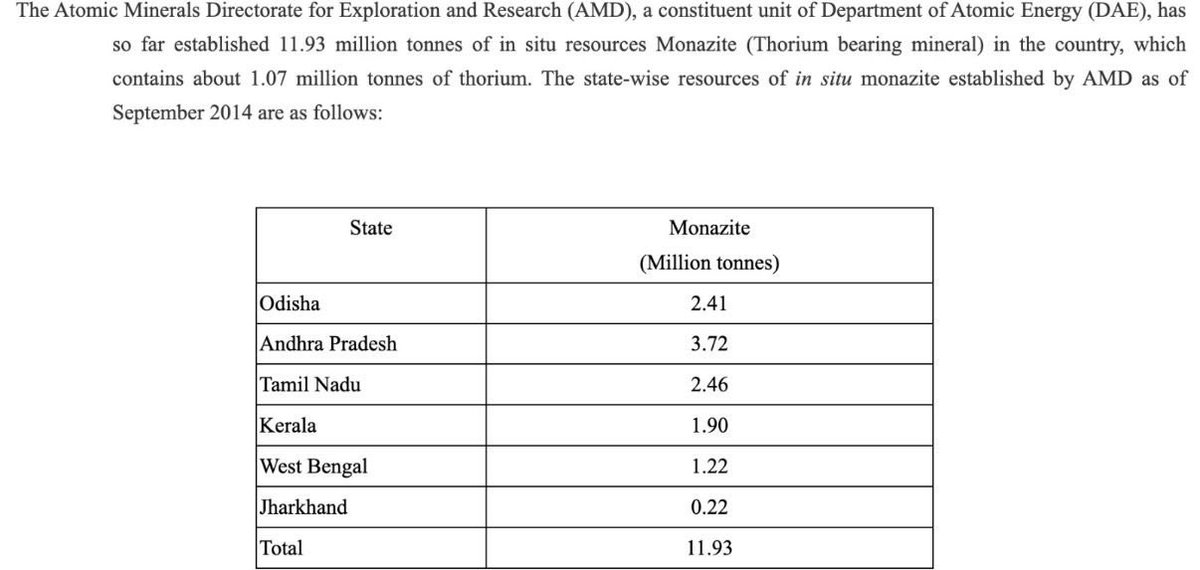
Most of India’s thorium (monazite) reserves are concentrated in states like Odisha, Andhra Pradesh, Tamil Nadu, Kerala, West Bengal and even Jharkhand.
Now connect the dots: large parts of this belt were heavily Naxal-infested for decades.
When you see where strategic resources lie, you begin to understand why certain regions were kept unstable for so long.
Not a coincidence.
Today, India takes a defining step in its civil nuclear journey, advancing the second stage of its nuclear programme.
The indigenously designed and built Prototype Fast Breeder Reactor at Kalpakkam has attained criticality.
This advanced reactor, capable of producing more fuel than it consumes, reflects the depth of our scientific capability and the strength of our engineering enterprise. It is a decisive step towards harnessing our vast thorium reserves in the third stage of the programme.
A proud moment for India. Congratulations to our scientists and engineers.
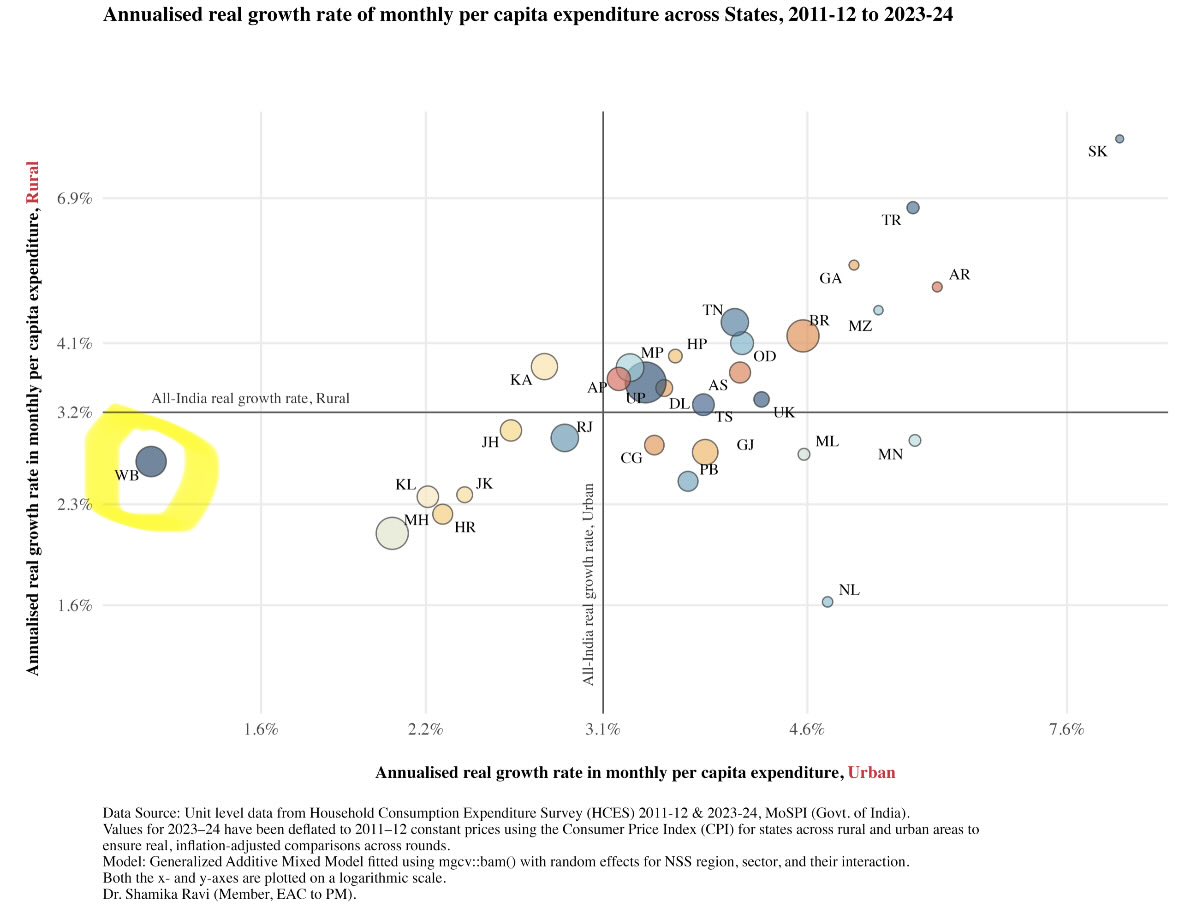
What is holding West Bengal back?
While the rest of India has enjoyed real growth in consumption levels over the last decade, WB has experienced near stagnation, specially in urban areas. In fact, the top 20% of urban WB population has seen a decline in their real consumption (CAGR of -0.4%!) during this time period. Hope to learn more on this from fellow economists, especially from Bengal.
मैं ममता जी को कहना चाहता हूँ जितना रोना हैं रो-धो लो । हम एक-2 बांग्लादेशी का ना बल्कि वोट हटवाएँगे बल्कि उन्हें चुन चुन कर देश से निकालेंगे #AmitShahOnTimesNow