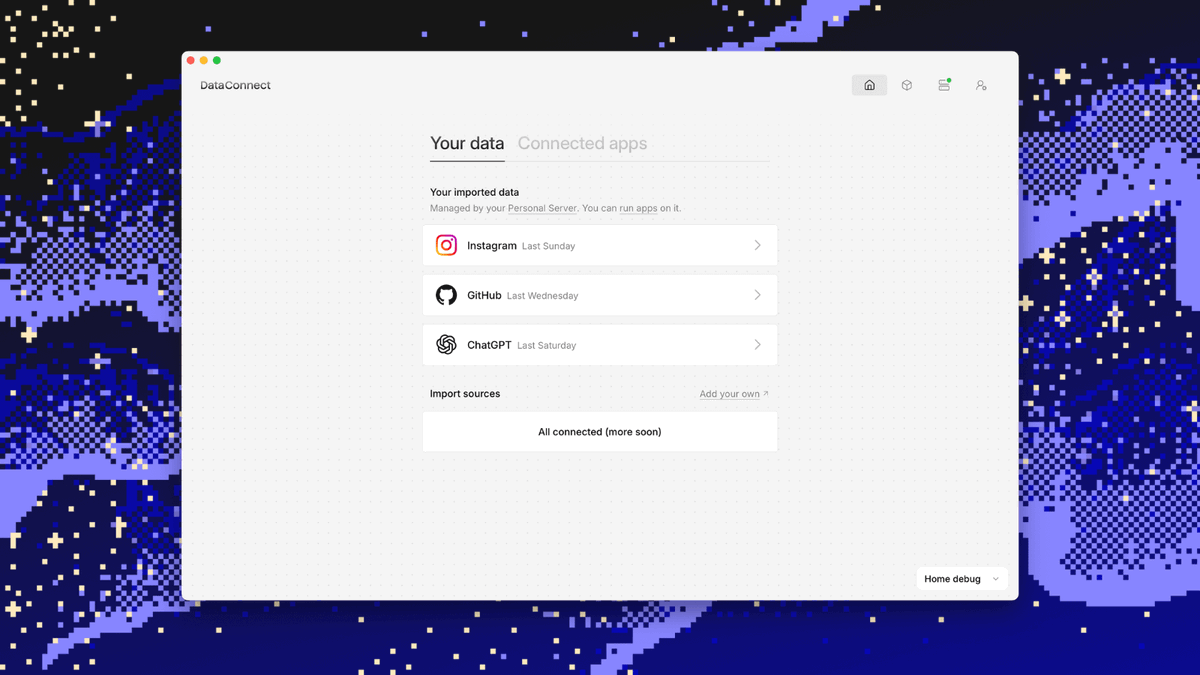
Announcing DataConnect: an open source desktop app that pulls your cross-platform data in one click.
Platforms lock your context in: there's no API to get your Shopify purchases, ChatGPT memories + conversations, or Spotify listen history.
Try it out: https://t.co/DeLtY3Z5fV
The new Vana App is now live.
It sits behind the apps you use. When one of them asks for your data, you see exactly what it wants and decide. Say yes and the data moves with your permission, and the move is recorded.
See it work in OpenPet: connect an Oura Ring, get a pet that reads your sleep back to you.
Trying it this week earns XP.
Full write up: https://t.co/KxsKKv0Zu5
@cryptopunk7213 The bank one is the different kind of problem. Breaches are someone taking data.
Agents acting unapproved is data and authority that people handed over without a scoped, revocable grant.
The fix for that one is design, not patching.
@puneetmehtanyc@MadisonMills22@axios The aggregator move is the right precedent too. Get agents off the person's password and onto a grant that says what, how much, for how long, and that the person can revoke.
That has to hold for data as much as for payments.
@Paul__Walsh The second half is the part people miss.
Consent only works if it covers the person whose data it is, not just the person who clicked share. A message about you is still your data.
@crypto_bitlord7 That's the problem with consent as a TOS checkbox. It covers everything once, forever. Consent that means anything is per use, visible and revocable.
@nft_dreww The useful line here is "telling an AI what it can do isn't the same as enforcing it."
The grant has to live outside the agent, scoped to what was asked, and revocable from one place.
@LingoAITech@Paul__Walsh The difference comes down to asking first.
Show people what's being requested and let them refuse, and an assistant doesn't have to work like surveillance.