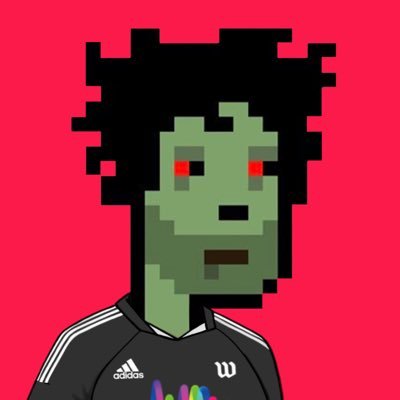
Now that it’s had its IRL debut at Marfa, proud to introduce cloudpainter to the timeline.
Travel with us across the Southwest in the coming years as we search for meaning in its endless horizons.
Most early AI art is natively digital. But there are notable exceptions. I've added 3 works to the collection that I think are some of the most interesting machine-made early AI works across three periods of AI development: Symbolic, Computational, and Neural
Harold Cohen's Coloring Machine #14, which is the only series from Cohen where the machine physically drew and colored the works
Patrick Tresset's Paul drawing Patrick himself, a camera and an embodied robot arm draw it's subject
Pindar Van Arman's Emerging Faces, where a GAN imagines a face and a robot paints it
@schmrypto AI Art is the only genre that hasn't been explored in depth. Simply because the gpus didn't exist. Everything else has been thouroughly explored to death actually.
@tuukzs@andreasgysin You say you didn't monetize, and that you gave credit.
That is perfectly expectable in most art traditions.
Just keep on doing what you are doing.
@kev_esh@BardIonson I am not sure sleeping with someone qualifies as a hostile act.
People aren't talking about it as an act of war. Because its not. Even out allies spy on us.
I've recently relearned to cry and random things turn the faucets on. Most recent emotional moment came from this Veterans Day Ceremony footage.
Thank you Veterans.
https://t.co/IJlxaxPY54
People used to be able to corwd source a painting and take over my robots, something I saw the legendary PUMApaint do couple years earlier.
Whats cool about this video is it documents a cyber attack on my robot, where they got control.
https://t.co/tWxNyZl0cg
My feedback loops 2009 fit in here somewhere. Interestingly example before me were trained on single image, while I was first to train on the artist.
Around 1999–2003, Freeman, Tenenbaum and Pasztor (MERL/MIT). They learned the line style of a drawing from examples and transferred it to new drawings.
2001, “Image Analogies” (Hertzmann et al.). It learned a visual style from an example pair of images.
2009, ME
2012, Kalogerakis et al. They trained a system on an illustrator’s example to reproduce that artist’s pen-and-ink hatching style.
2012, “Artist Agent” (Xie, Hachiya and Sugiyama). It used reinforcement learning on brushstroke data to generate strokes in East Asian ink painting.
2015, Gatys et al.’s neural style transfer made learned style imitation widespread.
Getting emails recently from companies courting me, and saying flattering stuff like I am the
"Father of AI Slop".
I have been training my robots to replace me since adding feedback loops in 2009.
Can anyone find an earlier artist doing this?
I know Cohen of course, but he disavowed machine learning and didn't use feedback loops.
So I used this lead to go deeper with claude and chatgpt...
---
Few projects combine physical robot, style, and feedback loops, and you were early there. Sougwen Chung’s D.O.U.G._2 (2017) is the closest parallel I know, trained on her own drawings and run on robotic arms.
So the most defensible version is something like “one of the first robotic painting systems to combine a learned personal style with visual feedback.”
---
I was excited when Sougwen entered the scene, but that was 10 years after I started.