Founder & CEO at Artificial Neural Computing with interests in neural physics, cosmology, quantum gravity, quantum computing, machine learning and biology.
The very fact that a primitive artificial intelligence algorithm can do what is commonly considered in our society to be an indicator of a high level of intelligence says more about “our society” than about “the level of intelligence.”
@k_sonin I was only referring to the simplified model where weaker teams are added. In that model, I don’t see why this would increase the chance of stronger teams reaching the final/semifinal. Empirically, the opposite seems to happen, possibly due to other random or systematic effects.
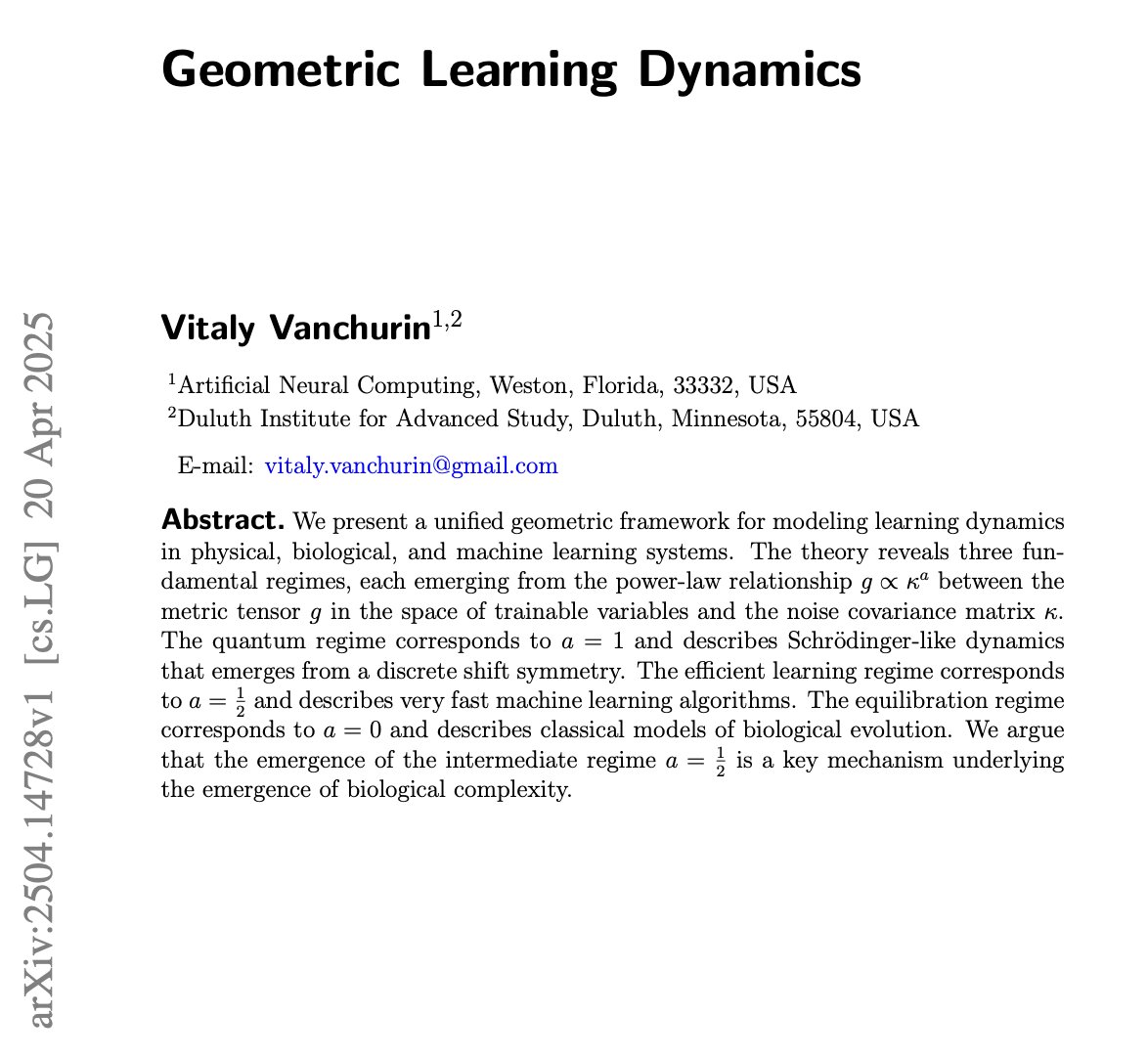
Here, I develop a generally covariant description of evolution, show that the metric should be identified with the inverse covariance matrix, and argue that it may be possible to experimentally determine whether nature uses an efficient learning algorithm such as Adam. Enjoy!
What if physics is just the universe learning? Most Theories of Everything episodes are mind‑bending for their math, physics, philosophy, or consciousness implications. This one hits all four simultaneously. Professor Vitaly Vanchurin joins me to argue the cosmos isn't just modeled by neural networks—it literally is one. Learning dynamics aren't a metaphor for physics; they are the physics. Vanchurin shows why we need a three‑way unification: quantum mechanics, general relativity, and observers.
I’m thinking of organizing an online Neural Physics conference, covering everything from physics-inspired machine learning (learning from physics) to using learning theory to model physical systems (physics from learning). Would you be interested in:
Perhaps it's time for physicists to explore machine learning algorithms, biologists to learn differential geometry, and machine learning scientists to study quantum mechanics.