The Vanderbilt Report is a next-generation financial media platform — connecting investors with emerging stories, transparent data, and credible market analysis
JOURNYGO's beta headline needs the report's disclosures alongside it.
Up to 30% of test viewers reached an itinerary through a QR code on screen.
For skeptical investors, the source matters.
The report's authors disclose that the beta metrics come from unaudited company data.
They also describe audience figures as modeled estimates.
And the $5M+ pipeline isn't contracted revenue.
Investors don't have audited beta results or confirmed revenue from that pipeline to assess.
They have an early measure of how often test viewers moved from watching to viewing an itinerary.
To assess sales, they'd need evidence of completed bookings.
Jensen Huang is back at Nvidia, but his return is fueling a push in Congress to tighten China's access to AI chips. Nvidia shares fell more than 7% Tuesday.
Via Reuters: https://t.co/ilfg8DdzGl
Dell raised its forecasts for the third time this year and still fell 7.2% premarket, as investors balk at the soaring cost of AI infrastructure. Nvidia slid 4.6%.
Via Reuters: https://t.co/vlLsqtb4lt
NextTrip added distribution without building a sales force of its own.
Through NextTrip Pro advisors, TTAND agents and YADA creators, it connects travel inspiration to booked trips.
Each partner adds another route.
An advisor helps a traveler book, while a creator brings an audience already interested in travel.
In its Canadian joint venture, NextTrip contributes travel intent to partners already handling fulfillment at scale.
They complete the booking.
NextTrip uses that existing capacity, so it doesn't have to recreate the operation behind each trip.
That's the template: connect people considering travel with people already equipped to arrange it.
By partnering, NextTrip limits what it needs to build and fund as it adds distribution.
Asia's chip-heavy markets sank Wednesday, with South Korea down as much as 5.3% and Taiwan 5.1%, as new U.S. tariff threats hit a fading AI rally.
Via Reuters: https://t.co/rfuBWOnD6i
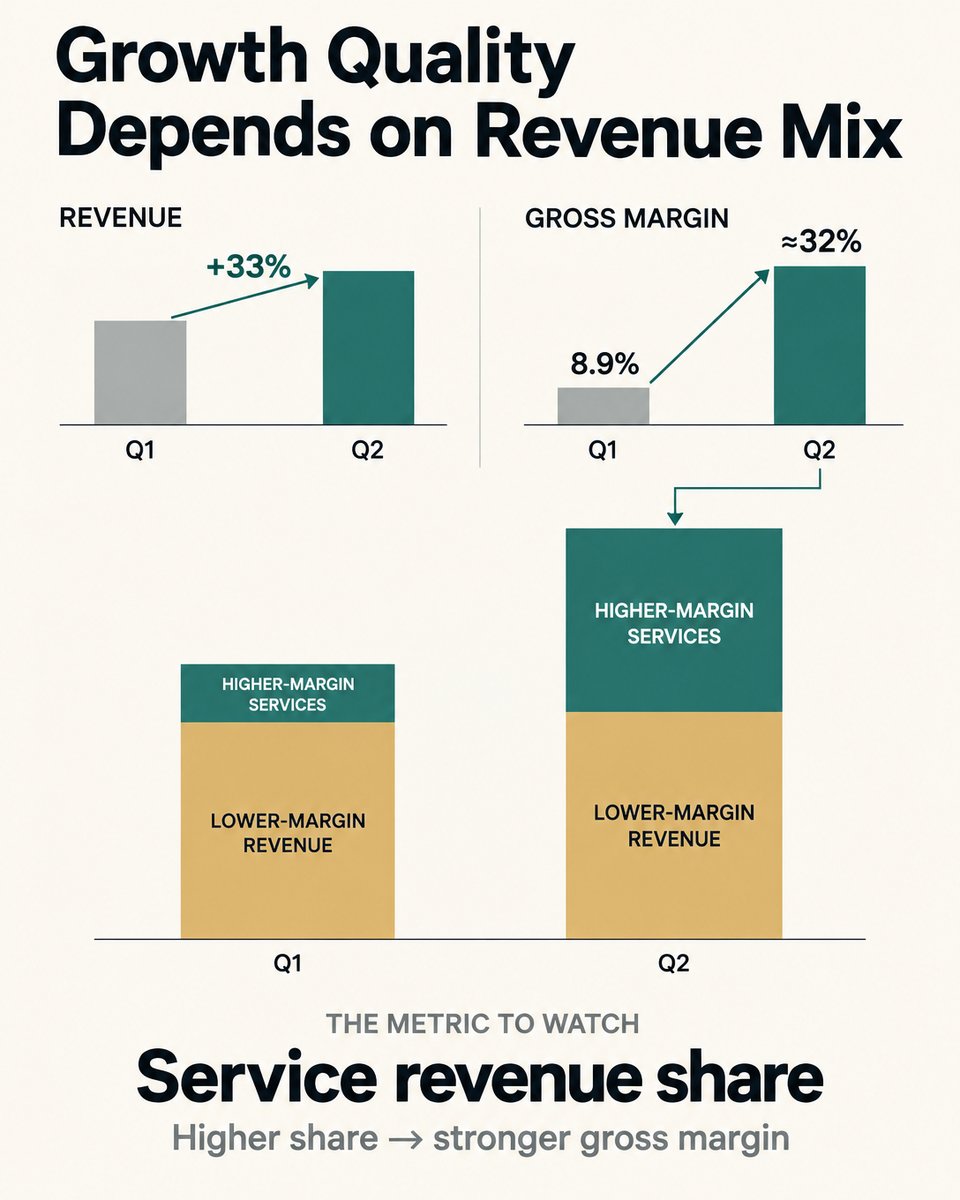
SecureTech reported record Q2 revenue of $2.77 million in 2026.
Up 33% from Q1.
For the first half of 2026, the company reported $4.85 million in revenue.
All from AI UltraProd, its wholly owned subsidiary.
SecureTech also improved gross margin from 8.9% in Q1 to roughly 32% in Q2.
It earned more from higher margin services.
For 2025, SecureTech reported $7.72 million in revenue and its first annual profit.
Then in August 2026, management decided to keep AI UltraProd permanently, dropping plans to spin it off.
Investors now have a specific detail to track: how much revenue the subsidiary earns from those services.
NextTrip connects cruise viewers to bookings and paying advertisers.
Cruise lines can buy ads inside the programming viewers watch before booking a sailing.
On November 12, NextTrip demonstrated its Watch It, Book It model running end to end in cruise.
Viewers start with programming like The Porthole Cruise and Travel Show.
Then they scan into JOURNYGO.
Through Signature Travel Network's Storybook with Five Star Alliance, they book live sailings across 35+ cruise lines.
NextTrip can earn from bookings and advertising against the same audience.
Cruise lines participate on both sides, supplying the sailings and buying access to viewers considering a cruise.
I'm scoring my NextTrip calls against the data that followed.
At The Vanderbilt Report, I'm revisiting each call since October 2025, from platform integration through monetization.
First, the vertically integrated platform.
The test: whether NextTrip connected travel content and booking closely enough to keep interested viewers moving toward a purchase.
Then there's travel's conversion leak.
Here, I check whether travelers followed through on their interest and booked, using the data that followed that call.
With Watch It, Book It, I examine momentum.
For that call, I look for evidence that viewers moved from watching travel content to booking trips.
In May, I called the start of monetization.
That's where I check the evidence for revenue beginning to flow through the business.
On monetization, I also separate revenue from margin, because booking volume alone doesn't establish how much NextTrip keeps.
Anthropic shares slid below their $83 IPO price Tuesday, down 12.6% to $76.60 and on track to shed nearly $200 billion in value, days after a record Nasdaq debut.
Via Reuters: https://t.co/YjnwnWTQ2f
Nvidia's board unanimously reinstated Jensen Huang as CEO 11 days after he resigned. Shares closed up 31.48% Monday, their biggest one-day gain since 2003.
Full story: https://t.co/pclgBYzRmu
NextTrip's ad buyers are paying more for engaged viewers.
The report ties higher prices to viewers who watch for 30+ minutes and skew affluent.
After a July 2026 partner transition, average monthly Samsung U.S. programmatic ad revenue rose about 668%.
Average CPM rose nearly sixfold.
That's the price advertisers pay per thousand impressions.
In May, NextTrip's monetization story centered on inventory, meaning how many impressions it could sell.
Across the following six months, audience quality became central to its pricing story.
At those higher rates, NextTrip earns more from each impression it sells.
Retension Pharmaceuticals (Nasdaq: RTSN) raised $51.75M in an upsized IPO to fund a key trial of its pill for hard-to-treat high blood pressure.
Full story: https://t.co/HAE7HPn4vl
Travel companies that own inspiration and booking have a structural edge.
Vanderbilt Report built its year of NextTrip coverage around that thesis.
Online travel agencies spend heavily on search ads to reach travelers who've already chosen a destination.
They're paying for access.
Media companies inspire travelers, then watch someone else collect the booking.
Both leave someone else with part of the business.
By owning both, a company reaches travelers while they're still deciding where to go.
Then it handles the booking.
That company has another way to find customers before competing for them in paid search.
NextTrip (NASDAQ: NTRP) says its monthly Samsung U.S. ad revenue is up about 668% since July, with ad prices up nearly sixfold.
Full story: https://t.co/DYORndEMKH
Nvidia reinstated Jensen Huang as CEO, effective immediately, less than two weeks after he resigned. Shares jumped about 33%, putting the company on track to add roughly $900 billion in value.
Via Reuters: https://t.co/f4JlXWkH1f
Wall Street futures bounced Monday, with Nasdaq 100 futures up nearly 3%, after the Nasdaq's worst week since March 2020. Asian regulators are stepping in to steady markets.
Via Reuters: https://t.co/vdXUA8Jd3t
SecureTech’s printed housing project starts with a letter of intent.
Its subsidiary AI UltraProd has signed to co-develop a residential project in Concord, California.
In our Vanderbilt Report coverage, we lay out the planned path from signature to building approval.
Here’s the sequence.
1. Complete due diligence before moving ahead with the proposed project.
2. Develop the design. The team plans to adapt the owner’s existing design for AI UltraProd’s printed wall system.
3. Bring in a licensed California structural engineer for project-specific structural engineering.
4. Build a full-scale mock-up. Test the printed wall connections before proceeding with the residential build.
5. Seek local building officials’ approval through California’s alternative materials and design pathway.
For the initial build, the team plans a detached accessory dwelling unit of approximately 748 square feet.
AI data centers have become a political flashpoint over power bills, water and noise. Author Paris Marx calls the hyperscale buildout "fundamentally unsustainable."
Via TechCrunch: https://t.co/F5LxVJFRjA
Nvidia beat expectations, yet its stock keeps sliding as Elon Musk and other tech leaders push to bring back ousted CEO Jensen Huang. Nvidia says that's not happening.
Via TechCrunch: https://t.co/v4c1sdbzDp
Signal is restricting screenshots in its Android and iOS apps, calling AI agents that scan your screen an "existential threat" to private messaging.
Via TechCrunch: https://t.co/ukumMIeVvf