Akshayakalpa has 13 years of data showing that simply introducing bee boxes increases the average coconut yield per farm by 20%. It’s such a massive win-win that they’ve now integrated 7,500 bee boxes across all their farms.
Shashi from @akshayakalpa recently brought over two bee boxes for my home to get us started with beekeeping. In this clip (full video in comments), he walks through how incredibly simple it is to set up a bee home, even in smaller or semi-urban spaces.
The bigger takeaway here is about how we view sustainability. We often look for grand, complex technological solutions to environmental issues. But the reality is that our survival is deeply tied to basic, interconnected ecosystems.
Without pollinators, our food systems collapse; roughly a third of what we eat depends entirely on them. Taking care of them isn't just a good deed; it's an absolute necessity for our own survival. And I think education is the key, which maybe the bee boxes in urban spaces can do.
Can’t be prouder of everything that the Akshayakalpa team is doing for improving the quality of life of farmers, their economics, their cows, and everything else.
In the last 2 years, an Upper Middle Class Indian has lost at least 30% of his/her wealth.
Reason: due to currency depreciation & poor investment returns.
The claim might look exaggerated. But, trust me it is not. Ask your friends, relatives, who are NRIs. Compare their wealth growth vs yours'.
You will get the real facts.
The upper middle class is a very neglected community.
They pay Sweden level taxes for Sudan level services.
And, are now quietly seeing their wealth erode.
In a landmark judgment on May 22, 2026, the Delhi High Court held Google liable for trademark infringement.
The case was between Hindware and Google. The court held that, by allowing competitors of Hindware to purchase the keyword “Hindware” (a trademarked name) through Google Ads, Google enabled trademark infringement. The court said that “Hindware” is not a generic English word but a specific brand trademark. By allowing competitors to place ads on that keyword, Google is enabling competitors to divert traffic that should have legitimately gone to Hindware.
This has been a big challenge for companies, both big and small. Even today, if you search for Zerodha, you will see search results from competitors. This has been happening for well over a decade.
Although it is hard to quantify, we have lost a lot of business to this. Think about what happens. Whenever someone searches for "Zerodha", the traffic should rightfully come to Zerodha. But what often happens is that the first couple of results on Google Search are ads, leading the customer to a competitor's website. In the process, we lose business that should have come to us.
This is made worse by the fact that we do not advertise.
There is also an even more ironic thing here. A lot of brands, just to capture the traffic that should have come to them organically, end up bidding on their own keywords. Think about it. If you own a business and have a trademarked name for your business, you still have to pay Google just to hopefully make your name too expensive for your competition to run ads on it.
But now, thanks to the Delhi High Court judgment, we have the option of taking legal action whenever we come across instances of other companies squatting on our keyword.
The other brilliant part about this judgment is that it levels the playing field. And this matters even more for startups, who are already starved for resources and have the odds stacked against them. The last thing they need is for competitors to bid on their brand keywords and steal their traffic.
This judgment now opens up a route for legal recourse whenever such deceptive practices occur.
While keyword squatting is most visible in Google web results, it is an even bigger problem when it comes to app stores. Whenever someone searches for your brand, the first couple of results, both above and below your app listing, often tend to be those of your competitors. And in the case of app stores, I think the ads are even more problematic. When a user clicks on an app-store ad, they often end up installing an app. That is a much higher-commitment action than clicking on a competitor’s web search result and then just closing the page. Because the user has installed an application, the conversions, at least anecdotally, tend to be much higher.
Again, brands that do not advertise are at the receiving end of this. So I welcome this ruling and hope this changes the unfair norms we've been living by for so long.
2026 is turning out to be a case of when it rains, it pours.
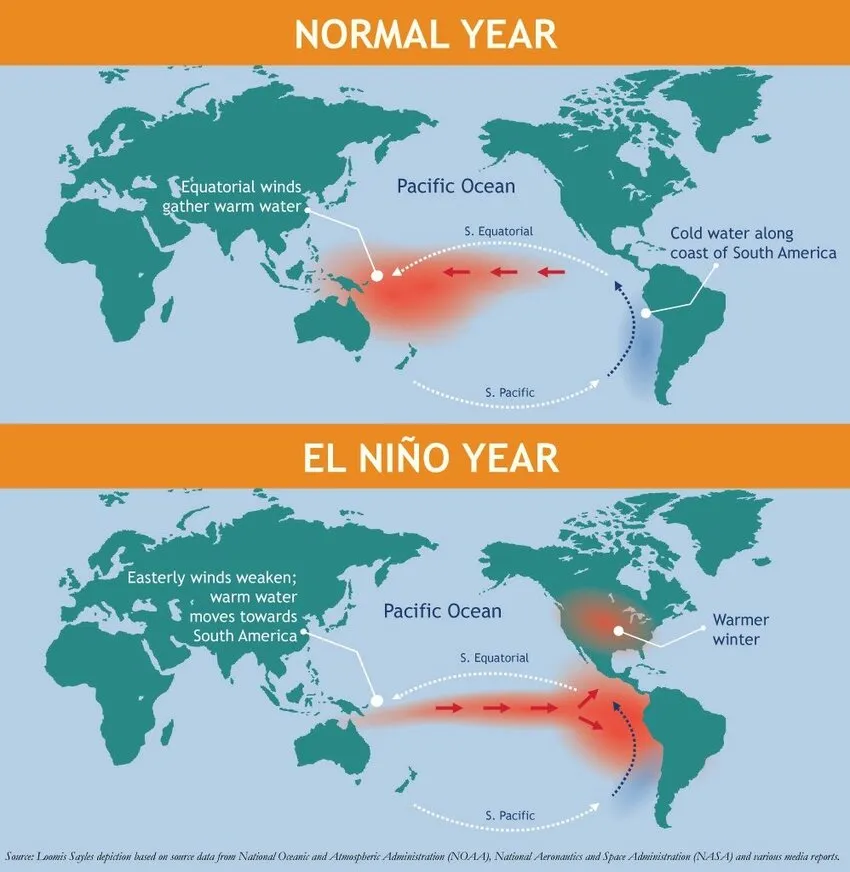
Every few years, the Pacific Ocean warms up abnormally, and that phenomenon is called El Niño. When it happens, India's monsoon weakens. This year, it looks like a super El Niño is developing, and the IMD is already forecasting rainfall 6% below normal for 2026.
It may not sound like much, but remember, 70% of India's annual rainfall comes from the monsoon, and 60% of farmers depend entirely on it. If history is any guide, we may have a terrible year ahead. In 60% of El Niño years since 1951, India has seen below-average rain. In 2009, rainfall fell to just 78% of normal, the worst in 37 years.
A weak monsoon means weaker harvests, and weaker harvests mean higher food prices and higher inflation. Food is one of the biggest expenses in a household budget. This is now layering on top of the unholy mess created by the closure of the Strait of Hormuz.
Trump's war with Iran has effectively shut a channel that carries 20% of the world's oil and 20% of its LNG. India imports 80 to 90% of its oil and 40 to 50% of its gas, and we are already seeing steady price hikes and WFH advisories going out around the world. The Indian crude basket averaged $114 in April and is at $106 in May — still far above comfortable levels, and this crisis may drag on for longer.
When food and energy prices rise together, the RBI cannot stay quiet. Beyond a point, it will have to start hiking rates, and that is when a bad situation starts to feel like a crisis.
It's still May😬
I'll admit this might sound odd coming from me, maybe even clichéd. But it's something I've been sitting with for a while, so here goes.
When I started out, like most people, I had a simple wealth goal. I'd actually written it down: hit ₹5 crore, retire in Goa, beach shack, done. That was the dream.
After the Zerodha journey, I find myself on a very different side of that equation, and the dark inequalities of wealth and opportunity are harder to ignore than ever. We all know the numbers on inequality. The concentration of wealth among the top 1% is severe and getting worse, and it's even starker among the top 0.1%. The post-2008 era of rising asset prices has likely made this worse, because the people who hold financial assets are, by definition, people who already have money.
This isn't unique to India. Barring a few exceptions, it's a global phenomenon.
I'm cautious about attributing every socio-political problem we face today to inequality, but it's hard to deny the role it's played in the political upheavals we're seeing across the world. History rarely shows that sustained, extreme inequality ends well. To me, it increasingly feels like sitting in a car with the brakes cut, watching a cliff approach. Btw, all of this even before AI, which has a non-trivial probability of making things worse.
I'll stop short of prescribing solutions. It's too easy to reach for simple answers to complicated problems, and that's a separate conversation entirely. But I think we need to collectively acknowledge this: wealth that just sits in financial assets whose value keeps compounding upward doesn't do much good for anyone beyond those who already have it. And if that wealth isn't in motion, if it isn't doing some social good, the fabric that holds us together will only continue to fray and lead to cynicism, resentment, and worse yet, nihilism. We're already seeing all of it.
What I am saying is that even if a portion of that wealth were channelled into things that could materially improve lives, that seems worth doing. Hoarding wealth, in the grand scheme of things, doesn't really help anyone.
𝗬𝗲𝗮𝗿 𝟭 𝗦𝗮𝗹𝗮𝗿𝘆: 80,000
𝗬𝗲𝗮𝗿 𝟮 𝗦𝗮𝗹𝗮𝗿𝘆: 100,000
𝗬𝗲𝗮𝗿 𝟯 𝗦𝗮𝗹𝗮𝗿𝘆: 120,000
At the start of Year 3, the employee decides to resign.
Suddenly, the same company that was “budget constrained” offers 250,000 to make him stay.
He still leaves.
Joins another company at 200,000
Not because money didn’t matter.
But because respect 𝗺𝗮𝘁𝘁𝗲𝗿𝗲𝗱 𝗺𝗼𝗿𝗲.
For 2 years, he delivered results.
For 2 years, he proved his worth.
Yet his value was only recognized 𝘄𝗵𝗲𝗻 𝗵𝗲 𝗱𝗲𝗰𝗶𝗱𝗲𝗱 𝘁𝗼 𝘄𝗮𝗹𝗸 𝗮𝘄𝗮𝘆.
That’s when it hit him:
“So the budget was always there… just not for me.”
Corporate 𝗥𝗲𝗮𝗹𝗶𝘁𝘆
𝗖𝗼𝗺𝗽𝗮𝗻𝗶𝗲𝘀 𝗱𝗼𝗻’𝘁 𝗿𝗲𝘄𝗮𝗿𝗱 𝗹𝗼𝘆𝗮𝗹𝘁𝘆.
𝗧𝗵𝗲𝘆 𝗿𝗲𝘄𝗮𝗿𝗱 𝗹𝗲𝘃𝗲𝗿𝗮𝗴𝗲.
Know your worth.
And don’t wait for a resignation email to be valued.
In 2020, we did something very odd. Well, K (Kailash, CTO) did. He helped open-source Alar, a Kannada–English dictionary. It's a little absurd, considering we're a stockbroking company, but the project itself is one of monumental importance.
The story of how Alar came to be is even more inspiring. It was essentially the life's work of one man: V. Krishna.
Alar is the online version of what he had built over 40 years—researching, writing, and cataloguing more than 150,000 Kannada words and 240,000 English definitions, complete with all their attendant details. Just thinking about someone spending four decades relentlessly pursuing one single project is beyond inspiring. Oh, and he is still working on adding to the corpus. That @zerodha had even a small role to play in this is deeply gratifying.
It has now been five years since Alar launched, and over two lakh people visit it every month. It also just received a major update, faster than ever. And K has been working on improving dictpress, the underlying open-source technology that powers the creation of online dictionaries includng Alar.
So if, by any chance, you're obsessed with languages and dictionaries and have been wondering how to build one online, you should definitely check it out. (link in comments)
@JioCare I applied for porting from BSNL to JIO for Rs.349/- with transaction ID CK000000XDWN. My process was delayed as my SIM is under CUG. I visited jio store for portability, they again asked for Rs349/- and said the amount previously paid will be refunded within 40 days.
@VishnuP62266357@JioCare Why are you asking again and again for the same thing for which I don't have an answer. Pl.refund my amount or issue new sim without insisting for repeated payment.
@JioCare@JioCare let me know if the issue can be handled or if I should try providers like @airtelindia. Do not waste my time, all I need is clarity. Do not keep asking questions for which my answers don't even matter. It actually feels like I'm talking to bots. #CustomerServiceFail
Different people from @JioCare keep sending DMs on twitter asking for the samething over and over. I keep informing them the same details. It's frustrating having to answer the same questions when there's no progress in the issue handling. #CustomerServiceFail#CustomerRights
If there’s one thing I wish I had done differently when I was hit by a stroke last January, it would be to go to the hospital immediately, within the Golden Hour (<4.5 hours), instead of thinking I could just sleep it off.
This “nothing will happen to me” attitude is common, especially among those under 50. But the truth is, strokes are rising sharply, up to nearly 30% of all strokes in the last few years, among 30 to 50-year-olds.
When it comes to strokes, time is brain; every minute counts.
Thanks to @timesofindia for featuring this on World Stroke Day today.
@tgspdcl@TgspdclCorpora Filed online application for titel transfer for USC No.114801535 on 31.07.2025. Even after 55days it's showing open status. How much time it will take for title transfer? Contact no.09154909294
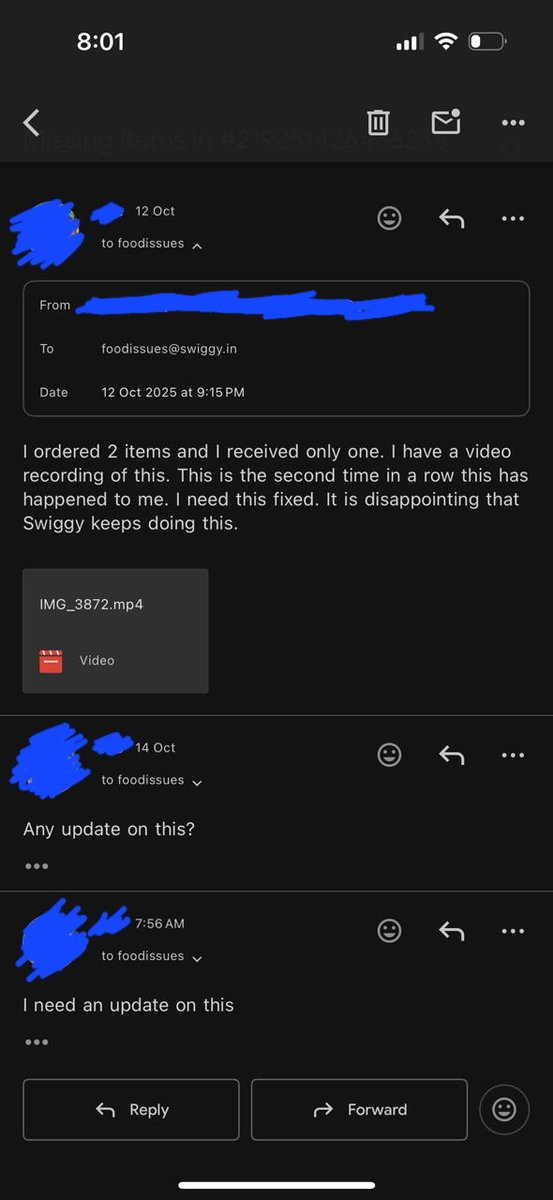
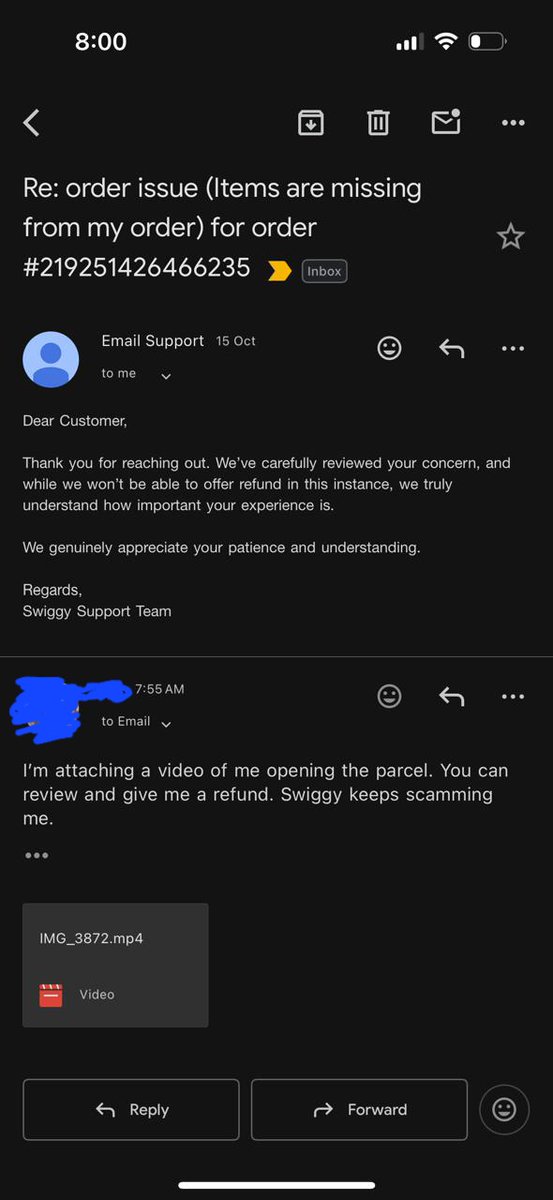
@Swiggy@SwiggyCares@Swiggy@SwiggyCares Her emails to the other account went unanswered. Frustrated, she raised a new complaint on Swiggy, as the previous one couldn't be reopened—but that too was closed mid-conversation. Incredibly rude. Hope #Swiggy checks this and does the needful
#BadService
@Swiggy@SwiggyCares What’s going on with Swiggy’s customer service? My daughter ordered a 500g cake and a cheesecake but didn’t receive the cheesecake. She shared a detailed recording as evidence, yet they refused to help. #BadService#Swiggy
@Swiggy@SwiggyCares Customer service refused to listen, ended the chat mid-conversation, and later emailed saying they couldn't help. By then, she had already contacted another Swiggy email she'd used before—details in the next post.
#BadService#Swiggy