“Second thoughts about first principles in biology”: Trends in Ecology & Evolution. Thought-provoking paper to be part of that was fun to work on with since heart other scientists. https://t.co/dOfXbTnBY0
The brain has evolved a voracious appetite for energy, consuming about 20% of our daily total. So what makes that cost worth it?
At a recent SFI working group, researchers from across disciplines examined how the high energetic cost of intelligence is balanced against its evolutionary advantages, and began charting a mathematical foundation for understanding that tradeoff.
https://t.co/bXwaOHoGuS
New work on fitting temperature respsonses using minimal parameters w/ easily biologically interpretable & intuitive parameters for most any observed shape: A flexible model for thermal performance curves - Cruz‐Loya - 2026 - Ecology - Wiley Online Library https://t.co/4jXxbegV9T
Buttigieg: In a country that amended its constitution so you could not purchase a beer and then realized it was a bad idea and amended it back, surely we can have an amendment clarifying that a corporation is not a person and money is not speech.
Now accepting applications for SFI’s 2026 Complex Systems Summer School (CSSS).
CSSS is a three-week experience that brings together graduate students, postdoctoral fellows, and professionals to explore foundational theory and methods, engage in collaborative projects, and connect with a global research community.
Deadline: February 4, 2026
Apply here: https://t.co/bOlHg7LSKa
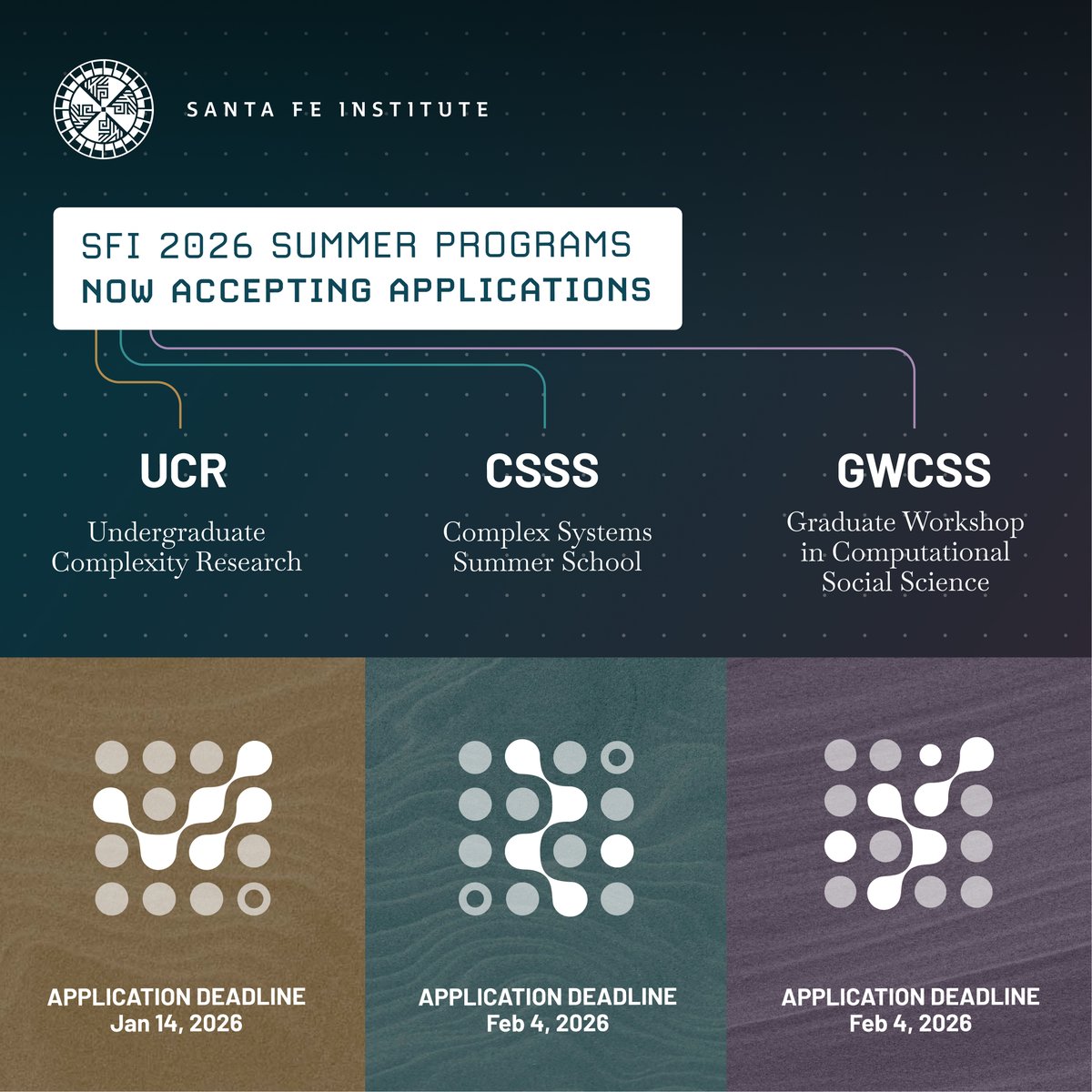
Applications are open for SFI’s 2026 summer education programs.
Three residential programs in Santa Fe, NM, offering research and training opportunities in complexity science:
– Undergraduate Complexity Research (UCR) / Ten-week research experience for undergraduates.
Apply by Jan 14, 2026
– Complex Systems Summer School (CSSS) / Three-week intensive program for grad students, postdocs, and professionals.
Apply by Feb 4, 2026
– Graduate Workshop in Computational Social Science (GWCSS) / Two-week workshop for Social Science Ph.D. students and early-career researchers.
Apply by Feb 4, 2026
Learn more: https://t.co/hZH9IoFpAY
I understand that p in ideal cases --> 0 as N --> inf. But that is not the issue. With real data collected from real experiments these values - for reasons others have explained - are likely massive overestimates of the confidence in rejecting the null. This is almost certainly the case with the example I was pointing to.
https://t.co/sh1chOOEvp
Biology is not random. And so if you measure any aspect of it a lot of times and compare your data to a random model you will eventually rederive this fact. The problem with absurdly small p-values is that, because you can essentially always get them by juicing your sample size, when you see something like p < 10^-300 what it’s really saying is THAT biology is non-random, which we already knew, and not HOW it is non-random, which is what we really care about.
As an undergraduate researcher at SFI in 2018, Sahana Subramanyam encountered a place where ideas moved freely between disciplines and mentors encouraged exploration. Her experience in the Undergraduate Complexity Research (UCR) program helped shape her path to a Ph.D. at Stanford and a research career focused on social inequality.
For undergraduates curious about complex systems research, applications are now open for the 2026 UCR program — a fully funded, 10-week summer research experience at the Santa Fe Institute.
- Read Sahana’s essay: https://t.co/dXMKj3lcRM
- Apply by Jan. 14, 2026: https://t.co/3b3mp4evuj
@RafSarnataro Yes I definitely wonder this as well! One complication is that body temperature also affects metabolic rate, so potential temperature impacts would have to be understood and acccounted for, which is more variable in inverts, including how temperature might affect electon leak.
And this deep follow-up that adds in evolution and focuses on temperature. These papers show that intermediate plasticity can be best (even without an explicit physiological cost to plasticity), and how plasticity and evolution can work together. https://t.co/ni7ZV1B6ks
I also want to highlight work (1 in JTB and 1 abt to appear in AmNat) that I found right before my PNAS commentary came out that I wish I’d referenced. Shout out to Kevin Archibald, Stephanie Dutkiewicz, Charlotte Laufkötter, and Holly Moeller @mixotrophe on this fantastic work!
This one starts w/ similar equations to understand how environment (e.g. temperature) drives tradeoffs in plasticity, memory, & nutrient storage to let mixed metabolic strategies coexist thru seasons, thus going beyond equilibrium/optimal physiology https://t.co/g5j52kpf5d
My new commentary extolling a new PNAS paper about temperature and phenotypic memory in phytoplankton by Anderson, Fey, Meier, Vasseur, and Kremer! Remembrance of phytoplankton’s past | PNAS https://t.co/LEIFE8rseN
1/ 🚨 Our new paper is online in @Nature !
As its first author, I’m enthusiastic to finally share it with you all!🎉
🧠 We discovered a mechanistic link between cellular energy metabolism and the control of the need to sleep 💤
👉 https://t.co/eBUKpM3zJa
@OxfordDPAG 🧵👇
I can’t get this line out of my head since reading it at the end of the abstract for this paper:
“Sleep, like aging, may be an inescapable consequence of aerobic metabolism.”
https://t.co/B6RV0Bc9Ic