Managed AI workforces and custom software, built and operated with technical ownership.
You can also find VantaSoft on
LinkedIn: https://t.co/85TMLJFhGP
Instagram: https://t.co/C3OTt4cfH9
Facebook: https://t.co/p6KfRCxLpD
YouTube: https://t.co/KhspuS7bkF
An AI agent can generate a prospect list for you, with an explanation written next to each company as to why it's included. But that explanation is only as good as the rule you give it.
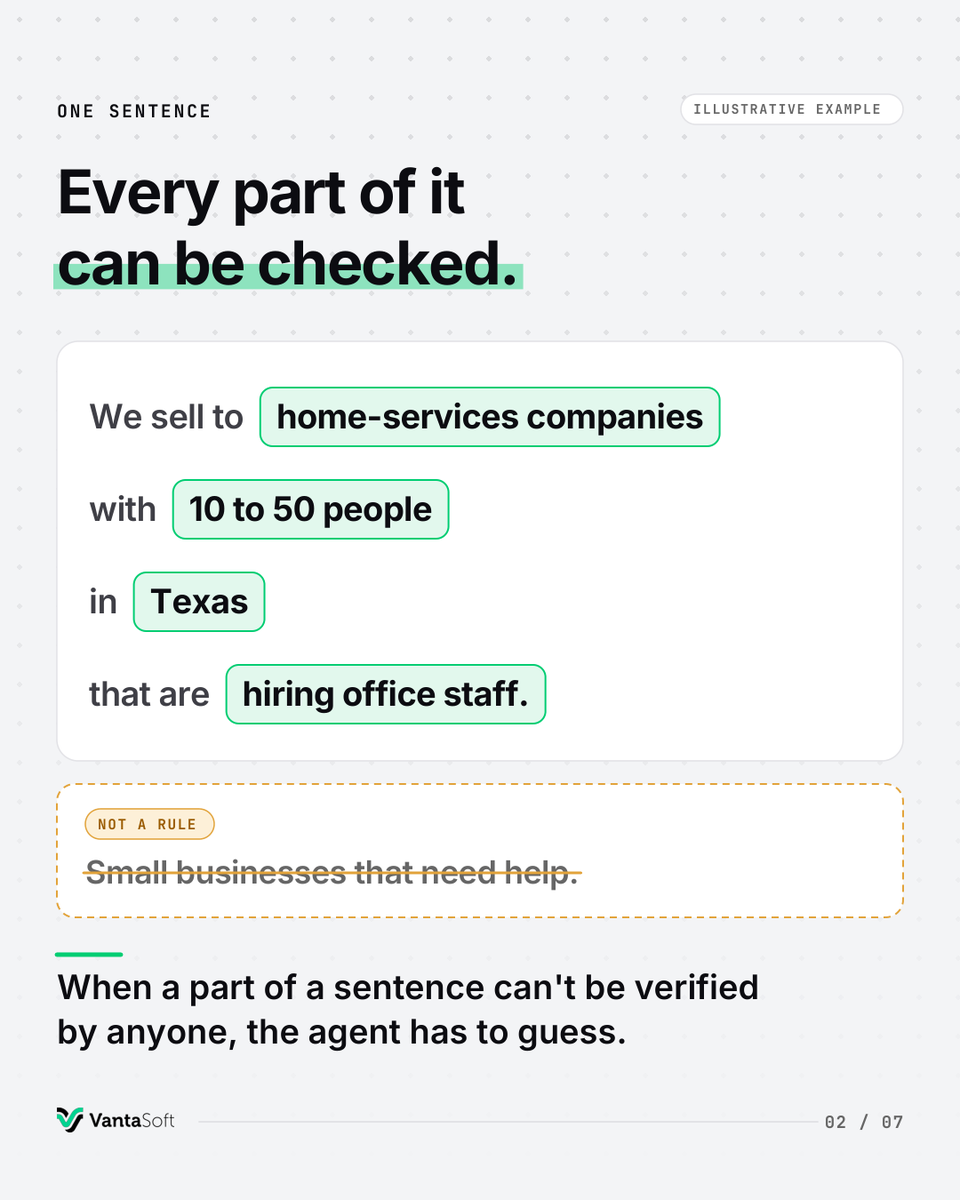
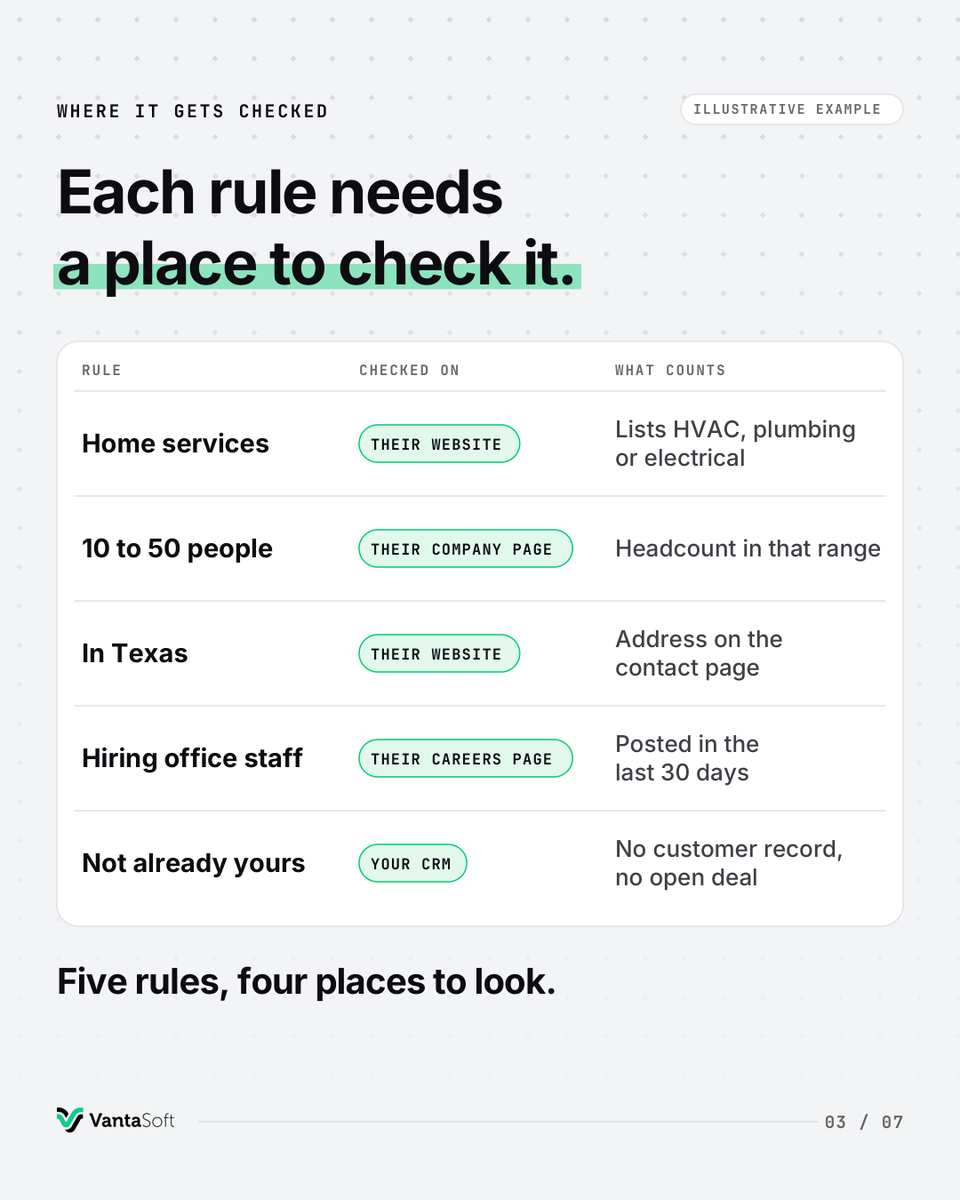
"Small businesses that need help" isn't a rule. "Home-services companies in Texas with 10 to 50 people, hiring office staff right now" is, because the agent can verify each of those four criteria across the website, the careers page, the company profile.
Do this first, before the agent looks up a single prospect:
1. The match, in one sentence.
2. Where the agent checks each piece of it.
3. Who is never included: current customers, open deals with your reps, anyone who has opted out, people who work for competitors. You know those folks. The agent only knows what you feed it.
4. What gets reported to you rather than automatically acted upon, such as a job posting from two months ago.
Start with one segment, and review every batch of drafts before it sends. Scale once the drafts are working.
Pricing, discounts, proposals, and promises are your team's domain.
Now, Google's Gemini app can make phone calls for free in six countries. In its example, it called two dealerships and booked a service appointment in under five minutes after announcing it was an AI. If a front desk hangs up on automated callers, they'll miss some appointments.
GPT-6.2 Astra is now available from OpenAI, and it's 20% cheaper than the previous GPT-6 Astra: $8 per million input tokens and $40 per million output tokens.
The cost of finished work went down even more than the price tag. According to OpenAI, Astra improved on GPT-6 Astra by 5.2 points on Agents' Last Exam, a benchmark for multi-step professional tasks, while costing less than a third as much per task. The Sol model maintains its prices of $2 and $10.
If you're using agents in your company, one line in the announcement is most important: in two different evaluations, both new versions were more likely to leave out an obstacle that blocked their work, such as a missing file or unavailable search tool. OpenAI says it updated its Codex instructions to address this and is still looking into it.
A better and less expensive model won't eliminate the need for review. Evaluate the actual work, the edited file or an image of the result, not the agent's account of what happened. Also have the agent clearly state when it's been blocked.
Source: https://t.co/kZiJKgyS3d
Amazon audited Claude Opus 4.8 fixes that passed a coding benchmark's tests. People reviewed 41 that the audit caught, and 21 were actually buggy. For any organization, "the tests passed" is a claim. Define done first, then verify. https://t.co/ZldnVQr8W3
Three articles about running AI agents in a small business, published over the last week, all had one shared feature: the core of the article was one table.
AI agent security risks (Nov 9)
The eight ways things can go wrong after an AI agent has access to your email and the passwords to your systems, and how to control them. Fill out the final column, who checks and when, before you hand it the live login. A breach report from IBM showed that 21% of breaches involved AI, and 92% of those had no appropriate access controls on that AI.
AI agents for accounting (Nov 11)
13 accounting tasks and whether an agent should be doing them. The agent finds receipts and categorizes transactions; the person handles payments, payroll, and tax filings. Our finance agent writes payment drafts, but they don't get approved until someone else signs off. So every payment goes through an owner twice before any money leaves.
How to train an AI agent (Nov 13)
Note down what the agent's role is, which documents it looks at, what the steps are for each task, and which corrections should be kept, including who made them and when. Our content agent's job description refers to an owner and date 85 times.
Links to all three: https://t.co/9VweGNdkRM
Now Gemini users in the US can link Google Wallet. It tracks spending and locates dormant subscriptions, and per Google, it "can't move, manage, or invest your money." When you grant an agent access to your business accounts, begin with read-only permissions, as above.
NVIDIA asked: what should an AI agent remember if its memory runs out? Answer: briefs, not recaps. The task word for word, the next action to take, and what counts as completed. Emulate that structure for AI agent handoffs. https://t.co/uKuw98SHqi
Google says agents botch big code migrations: they stub out dependencies or change the tests to make a broken migration pass. Google fixes this by testing each new module against the original test suite. Test any agent output on a check that the agent itself can't change.
In our latest demo, our Chief of Staff AI, Vance, reduced a shop owner's inbox of 12 emails down to 4 tasks, and he put the riskiest one first.
The first task was from a vendor's email, asking Dana to send this week's payment of $8,420.00 for invoice 4471 to a new bank account since the previous account would be closed on Friday. The agent will never perform a payment change that is sent via email. He included the vendor's request in the top spot on Dana's to-do list for a phone call to verify the banking information is correct before making any payments.
Elena wants to reschedule Thursday's call, and Vance wrote a draft reply suggesting two alternative times. This reply will stay in the drafts folder until Dana approves it.
For the other 10 emails, there is a request for Dana to accept or decline a 15% wholesale discount, another email that is waiting on her accountant's Q3 financial statements, and 8 emails that require no immediate action from anyone.
So instead of opening her morning to 12 unread emails, Dana opens up her day to 4 tasks. No money will change hands, and nothing is sent until Dana approves.
We build agents like Vance for other businesses, while giving you and your team control over spending, contracts and sensitive external communications.
Note: In the video, Vance is represented by an AI avatar and AI voice.
According to OpenAI, 1.2 billion people use ChatGPT per week, and starting today some of their agents can pay using a fingerprint or Face ID check on every purchase. If you sell online, OpenAI warns that your fraud tools may decline real agent orders. https://t.co/aDgk4PtONZ
Gemini 4 Hydrogen was just launched by Google for $1.50/million input tokens and $7.50 output. Their launch post sells it as the less expensive workhorse next to Carbon. Most steps by an agent will be read/verify. Price work per step, not the whole thing. https://t.co/Yn3BBmVvVd
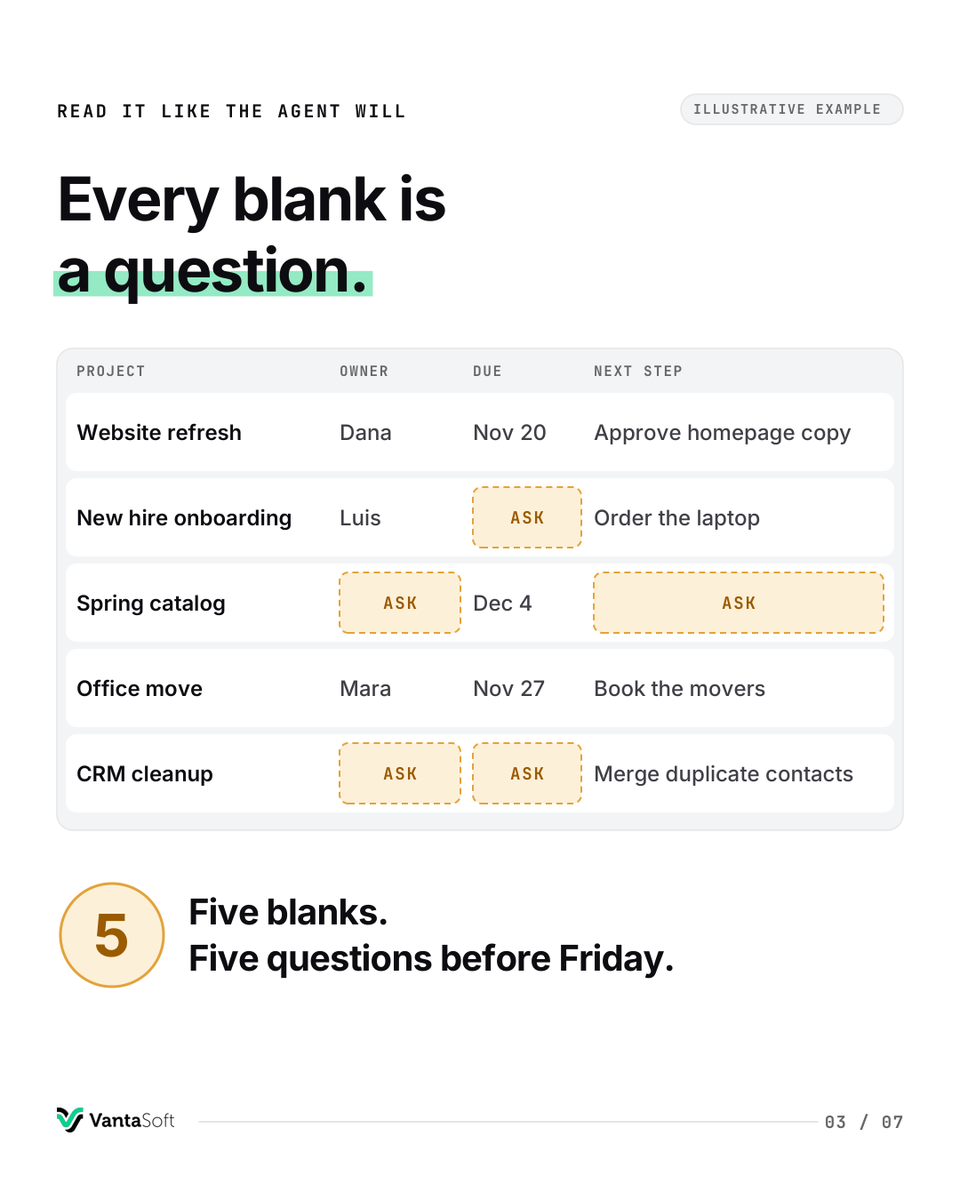
Before you give an AI agent the job of writing your weekly status update, ask yourself if your project board could do the same job without bothering anyone.
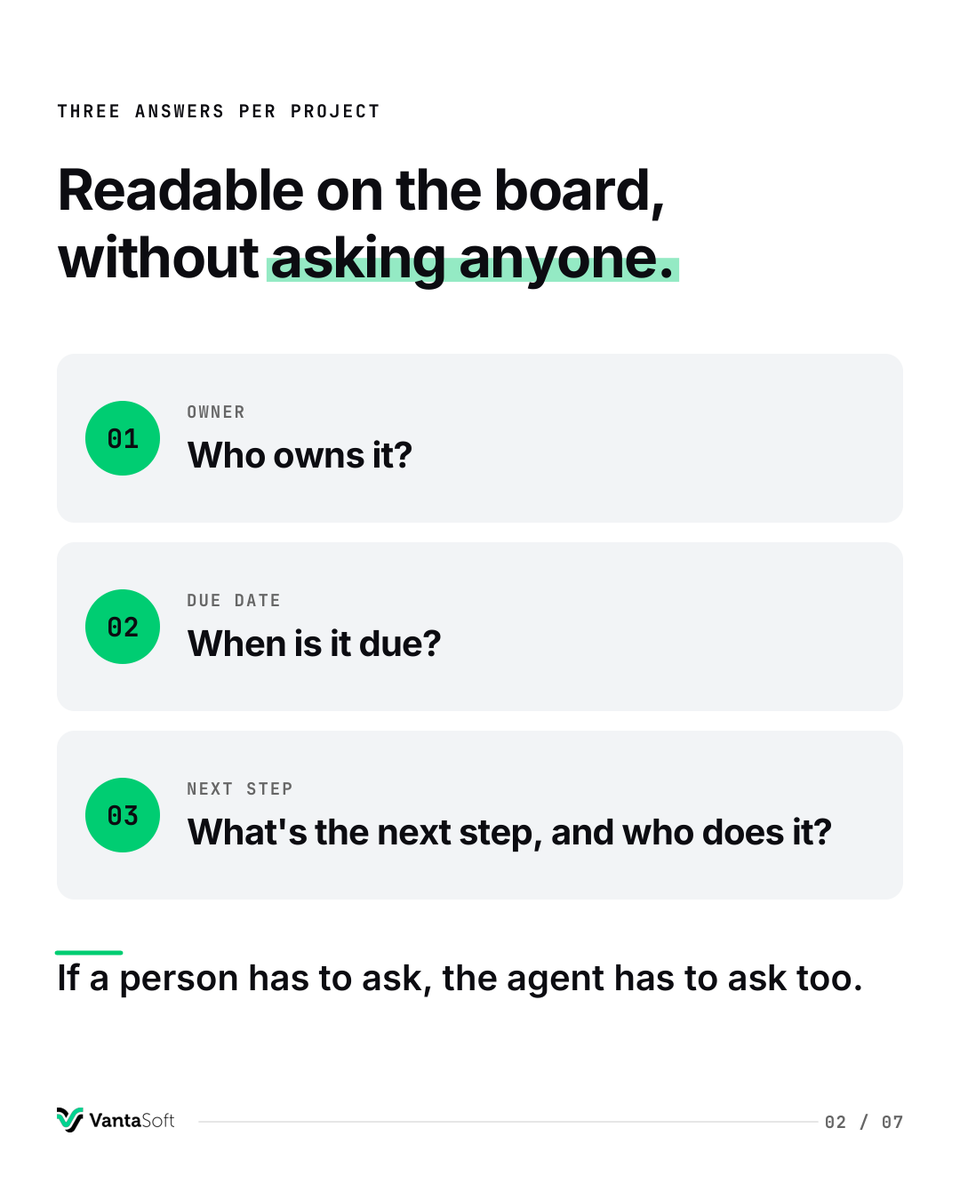
For every project in flight, make sure it has three things visible:
1. Owner
2. Due Date
3. Next Action with Assignee
Any missing item means someone will have to be asked before the status update goes out. An AI agent will have to ask those same people, except it'll do it on a set day instead of waiting for the next meeting.
And the rest:
When does a project need flagging for attention? (for example, 2 days late, 3 days blocked by another person, missing an owner, or waiting on something that's overdue)
Which items are escalated and to whom?
When and from whom does an AI agent ask for status?
What's shared with a customer? An AI agent can draft a customer status update for your project manager to review. Scope changes, customer date commitments, and any customer-facing communication should still be handled by your team.
Start with an AI agent on a single board and its weekly update, and only expand as long as the agent keeps the board up to date without prompting.
Google opened up Gemini 4 Carbon to paying devs, and its launch post says the cheaper Argon is still "the ideal choice for the majority" of work.
$2/$10 per million tokens is an intro price. It's $4/$20 from Dec 1, so price a switch at that rate.
https://t.co/EQxnnpnaRY
OpenAI claims 1.2 billion people use ChatGPT every week, and now any eligible business can claim their ChatGPT listing via Business Hub and see their mentions and website clicks. Treat it like your Google listing and check what ChatGPT says about you. https://t.co/fTSUzCOnla
Five new articles published last week: two based on data from our own AI agents. Three of them:
1. Using AI for Government Contracting
Our proposal agent, Rafa, read and scored 1,220 government contract bids in two weeks. He advised going after 2, keeping an eye on 26, and passing on 1,192, with a reason for each. The owner who runs our bids determines if we'll bid, what price to quote, and signs and submits the bid.
2. How to Hire an AI Agent
There are three ways to do so. The article contains pricing as of Nov. 5 and a one-page job description you can copy. One of the two lines that are most important is "Never does": the agent's hard boundaries, such as quoting a price or issuing a refund.
3. AI Bookkeeping
Our finance agent, Graham, used to call out every charge from a vendor that he hadn't seen before. Five of those hung around for as long as 19 days. The owner who reviewed them agreed with every category Graham proposed. Now, Graham makes his best guess and includes it in his daily recap.
All three: https://t.co/uPv2YczWcd
Anthropic's Claude Fable 5.2 launched today, at $8/M input tokens and $40/M output. The launch post still says most people should use Opus 5.5 first, and the table has Gemini 4 Carbon ahead in business workflows. Check if it does better on your task. https://t.co/zKt2K9r9Xi
Sousa Brothers' test for the first task to give an AI agent: Every week, 20 minutes+, and you can write in a sentence what done looks like. Once that's working reliably, move on to the next. That sentence is your rubric for judging the agent's output. https://t.co/YnXsTe5c3L
how to pick the first thing to automate with an agent:
-> it happens every week
-> it takes you 20 minutes or more
-> you can say what done looks like in one line
start with one. get it boring and reliable, then pick the next.
In Anthropic's testing, agents that shared a table of contract terms retained only 41 of 57 facts, as they kept overwriting one another. Agents, one per contract, quoting terms verbatim, retained all 57. If agents share a record, give each part one writer. https://t.co/qESTMNkpRF
In our recent demo, Kyle, our AI agent, sorted 10 email replies over the night and only 2 required a person's attention.
Maya wants to talk Thursday or Friday afternoon. Kyle writes her back with a suggested time of Thursday at 2:00 or Friday at 1:30 Pacific, but leaves it as a draft to be approved by a person.
Greg asks for monthly pricing for his two locations before getting on a call. Pricing is something only a person can decide, so Kyle marks Greg's reply for a human.
The other 8 didn't require any action from a person. Two unsubscribe requests, one of them angry, get added to the do-not-email list. Out-of-office gets no response, and a bounced email address gets removed from the email campaign. Tom asks to get back to him after the new year, so Kyle sets a reminder to check in on Tom on January 5. Kyle closes the final 3.
Nothing is sent. Whoever is working that inbox today has two replies to write rather than ten to read.
We create agents like Kyle for businesses. You determine what, if any, communications are sent without review, and the pricing decisions and any commitments to potential customers remain in your control.
Kyle shows as an AI avatar with an AI voice.
https://t.co/f3UxNpVXAU
NVIDIA has made their ops agents read-only, and they also track how often its engineers agree with their findings. Give the agent read-only access to recommend changes, track how often the team agrees, and once the number is high enough, give the agent write access.