@YusufTrader1 i am asking you respectfully do you know how to learn fundamentals ? Its been 3 years and i am not profitable yet . Then I learned vsa and passed funding twice but never make the payout. Help if you can. I am close i think
@jtuno122 i am learning to trade for 3 years roughly but 1 year seriously. Want my living on this. However, i stuffed my brain with all useless knowledge now it is hard to unlearn to learn the real methods and psychology.
Trading isn’t a game of prediction, it’s a game of risk management
It’s not about how much money you will make if you are right
It’s about how much money you will lose if you are wrong
If you want to keep your account alive for longer, then you need to focus more on open to risk
How much of your account are you leaving open to risk for each trade?
The less you risk, the less likely you are to go into tilt when a trade doesn’t go in your favour and the longer you will stay in the game
That’s your breakthrough to longevity right there
@CanadaImmigra20@MarcMillerVM The way they fucked up before at covid they will do this time too. What Canada has if there is no immigration flow in ? this country cannot manage high population even though there are enough resources and options to choose.
For anyone who doesn't know when to be on the chart on each specific pair. I have something that can be useful for you all. Thanks to @BabyPips for creating this🙏!
A tutorial🧑🏻💻
@YusufTrader1 i have read all these reports for pairing fundamentals with technical but sometimes it is hard to rely only on these. but now i get it . dollar has to be cheap for the liquidity in the world market. Bad money has to get out.
Why the US cannot afford a recession:
At the end of the day, a government is no different than a business. It has costs (expenditures) and it has revenue (tax receipts). Because of the bleak fiscal position of the United States, a recession will act as a margin call on the debt and deficit. The US government is way out over its skis and over-leveraged, and a recession will act as a margin call.
Here’s how:
During a recession, expenditures go up and revenues go down- the last thing you want when you are already running a historic deficit (during peacetime and full employment)
Current situation
Currently, tax receipts (revenue) stands at $4.4T and spending is $7.7T
Of this $7.7T in spending, Social Security and Medicare are $3.2T, defense is $900B and interest is $1T, leaving us with $5.1T that cannot be cut
Expenditures
During the Dotcom bubble of 2000, expenditures increased by 13%
During 2008, expenditures increased by 9%
This leaves us an average increase of 11% and would take our total expenditures up to $8.6T
Revenue (tax receipts)
During the Dotcom bubble, revenue fell by 24%
During 2008, revenue fell by 32%
This leaves us an average decrease of 28% and would take our total revenue down to $3.2T
Deficit
Currently, we are running a $1.7T pro-cyclical deficit, (during “good times”)
Using the numbers outlined above, our deficit would blow out to $5.4T.
Each and every year.
That is a 215% increase in the deficit
GDP and the Deficit
Remember, the government cannot create anything on its own- it must leech off the economic activity of the businesses and citizens within that country. This “income”, as I always put it, is the GDP. GDP is what allows the government to service its debt and to operate
Our GDP is currently $27T and with a deficit of $1.7T, is 7% of GDP (again, during peacetime and full employment- this is unprecedented)
In the GFC, GDP fell by 4% and during COVID, by 10%
Split the difference at 7%, and our GDP will fall to $25T
The deficit of $5.4T, as a share of GDP, would be 21%
This is full-blown emerging market, money printing bonanza, imminent insolvency sort of a number
Return on debt
The return on each dollar of debt decreases as the debt to GDP increases. If you can get a $1.50 return on each $1 of debt, that’s actually a great deal.
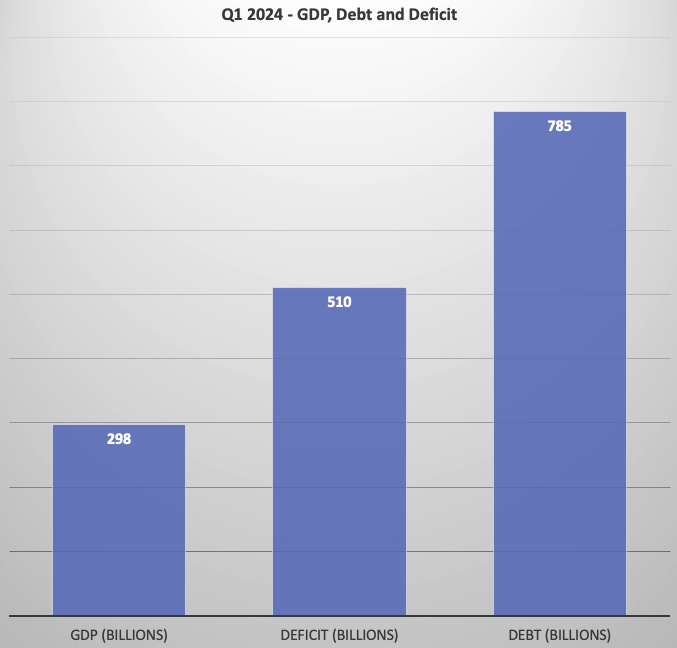
However, in Q1 of 2024, our debt increased by $785B and we got $300B of return (GDP)
That’s a $0.35 return on every $1.00 of debt
Put another way, we now need to spend $2.60 to get a $1.00 return
And the worst part, is this return keeps getting lower (Q4 was $0.40 per $1.00 of debt) and the trend would only accelerate massively during a recession, meaning more and more debt/money needs to be issued to sustain a given amount of economic activity
Assuming this 0.35 return rate (it would likely be even lower), the government would need to issue/print $5.8T, just to keep the GDP propped up at what it was (0% GDP growth rate).
Because expenditures are (and have been for decades) growing significantly faster than receipts, we cannot sustain anything other than positive GDP growth. In fact, GDP must grow faster than expenditures, just to get back to break even (as outlined in my pinned post)
What it means
In the situation I outline above, bond yields will likely go up, not down. The bond market understands that a "normal" recession (given current fiscal picture as outlined above) requires the US to print insane sums of money, just to break even and stay stagnant. The numbers I outlined above are all public, and the math is simple.
If some nerd in his pajamas, like me, can figure this out, best believe the smartest traders in the world (bond traders) can see all of this, too.
It's not a "normal" recession. These are not "normal" numbers.
Because yields would go up, this means that the interest expense of $1T (which is already 25% of receipts) would increase, rapidly. This makes the situation exponentially worse as each dollar of debt will 'cost' that much more. And not only are these vicious cycles (negative feedback loops), but they are exponential.
This is the doom loop. This is the sovereign debt crisis of any emerging market over the past 100 years.
This is why they cannot a recession. It is an existential threat to their very existence, and best believe they will act that way. If you thought 40% M2 growth during COVID was a lot, this would make that look like child's play.
Not only is significant inflation needed to just service the debt, but even more inflation will be needed to delever
https://t.co/LMmkRoNLFk
The sovereign debt crisis is already here. The Fed and US government are completely trapped.