The last shantisheela lane patch brought the death of me. But pushed through. I love running. One word I love resilience. I can see that building with each step I take even if I don’t feel like.
#pune#fitindia
Lately, I have been thinking about a very simple idea from Advaita: you can observe your thoughts, so perhaps you are not your thoughts.
Anger comes and goes. Fear comes and goes. Even our sense of who we are keeps changing. Yet there is always this strange awareness watching it all happen.
I find that idea incredibly freeing. Not every thought that enters the mind deserves to become part of your identity.
Everytime I go out to have fun, I realise that I am not happy for myself. If I am not happy how can be spread happiness to others. I feel reaching a certain personal goal only will provide me with happiness. Till then I will stay miserable. Ik it shouldn’t be like this.
The day is here - The Revolutionaries - is now out on Prime Video. Even I will be watching the finished version for the first time this evening.
To be clear, it is not a documentary but a thriller - a story of adventure, grit, loyalty and betrayal - that portrays the spirit of the movement. For those interested in the hard history, they can just read the book.
https://t.co/noyQS6tf4k
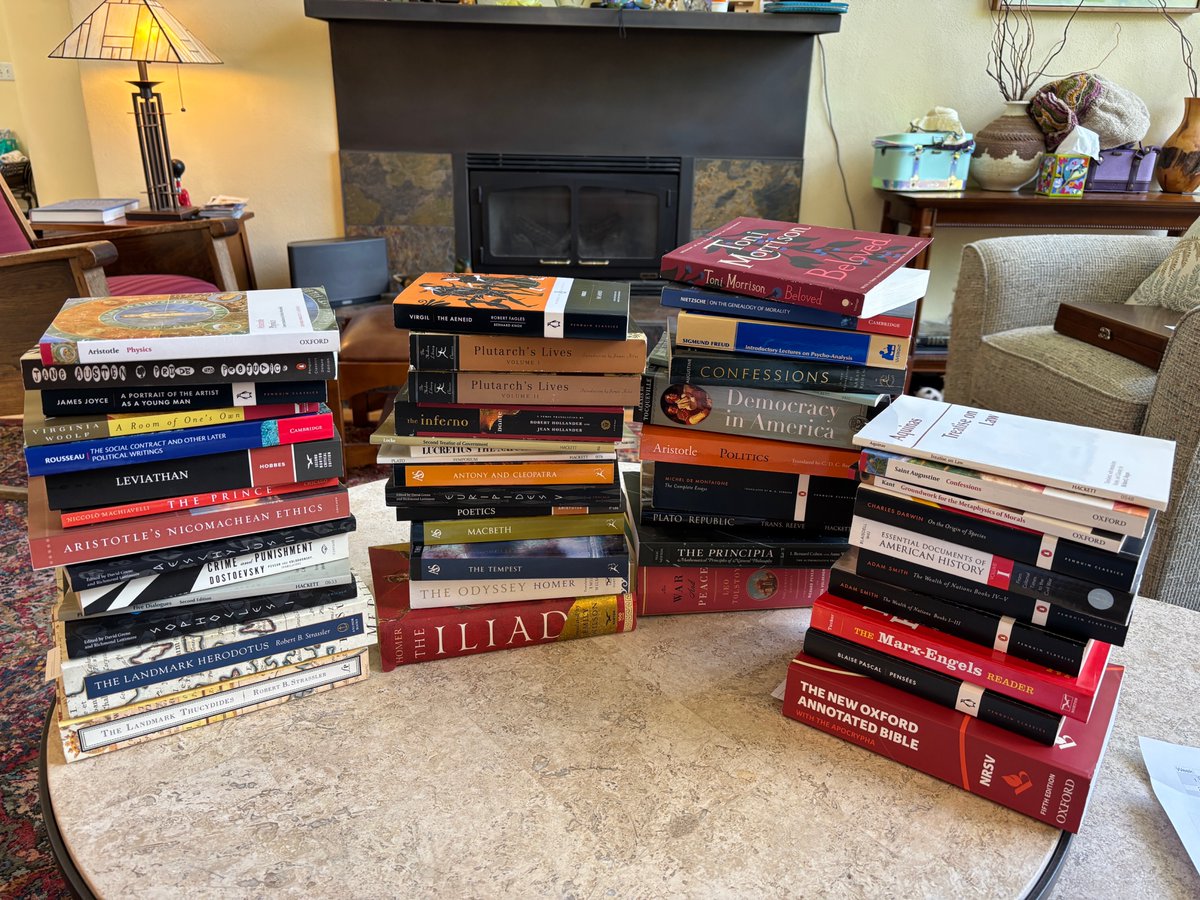
U Chicago offers a great four-year program studying the "Great Books of the Western World". Meets weekly online for 3hr discussion-based seminars with some wonderful facilitators and ~12 peers. Registration open for a few more weeks: https://t.co/Aq4f5ZSEQQ
I recently completed the program. Some reflections:
I can't tell you exactly why I signed up for this program. It sounded like a chance for ongoing encounters with beauty, I suppose. But also, some deep-down part of me harbored this delusion: "There are so many great classics I haven't read! So many great ideas I understand only shallowly. I can just sign up for this one program, and I'll end up checking so many metaphorical boxes!" In hindsight, I think I related to this mountain of books like a naive American tourist visiting Europe for the first time. I'll book a whirlwind guided tour to "check off" all the must-see sites! Then, in some sense, I'll be done with them!
That frame is obviously idiotic, both emotionally and practically. After about a thousand hours of reading and discussion, I don't feel I've truly understood or mostly metabolized almost any of these books. Rather, I got something like that naive tourist would: initial familiarity and connection with a wide range of cultural touchstones. The list of authors and works, once an abstract index, is now vivid and personal. Once I'd visited the Sagrada Familia, the idea of "checking it off" some kind of touristic bucket list became absurd. Instead, now that I'm introduced, I want to return again and again, noticing more and deepening my connection to it. Having finished my whirlwind tour, I now know where I'd like to return and linger on future trips. (Lucretius, Locke, Rousseau, Nietzsche...)
Programs like this call themselves "Great Books" programs, but I they're really more like "Great Ideas" programs. The selections and juxtapositions are designed to trace certain lines of Western thought: who should rule and how, the role of individuals in society, the shifting basis of morality, the meanings of virtue, knowledge, and justice, etc etc. I just loved following these arcs. They situate the texts in a web of humanity: rather than a grab-bag of independent texts, the selection was a series of unfolding conversations spread across centuries and continents. I found it plainly thrilling, for instance, to follow the beginnings of liberalism from abstract philosophical treatises up to the bloody stakes of the Declaration of Independence.
Part of the thrill is: individuals made these things! You can read their words. You can bear witness, centuries hence, to the birth of Plato's Forms, or deontology, or the novel as a literary form. Yes, I'm willing to give due credit to their intellectual contexts, and to hang appropriate asterisks on "Great Man" interpretations of history. But still—just imagine being Darwin, writing that book. I get very inspired in my design work thinking about Mendeleev and Playfair and Viete, individual humans who created new representations of thought for science and mathematics. This pile of books helped me appreciate the miracle of individual human invention behind so much in Western thought.
(photo from a classmate—alas, I mostly read digitally, which in hindsight deprived me of the physicality of this memory)
@MohanCRaja
sir just finished with my upsc mains. Could you please suggest some good books on International Relations to read. Maybe like your read list or your favourites. Thank you