50 runs asking which AI-visibility tool to buy.
Otterly: named 27x, own domain cited in 20.
Profound: named 11x, cited in 3.
Profound gets named because models read other people's roundups — its own site was never fetched once.
Recommended ≠ cited. n=50, one category.
We measured this split directly: across 50 runs, Profound got named in 11 answers but its own site was domain-matched in only 3 citations (27%) — the model cited other people's roundups about it, not Profound itself. Retrieval and reuse are separate signals.
https://t.co/IgSh2I0sJF
An analysis of 129,000 websites, 216,524 pages and 100,000 prompts determined the #1 secret to getting traffic from ChatGPT.
It busts a lot of myths and lines up closely with what we’ve learned about how AI search systems retrieve, evaluate and reuse information.
It also aligns with what SEO Stuff has been building over the past year:
https://t.co/eh1auroJF7
Let’s break it down.
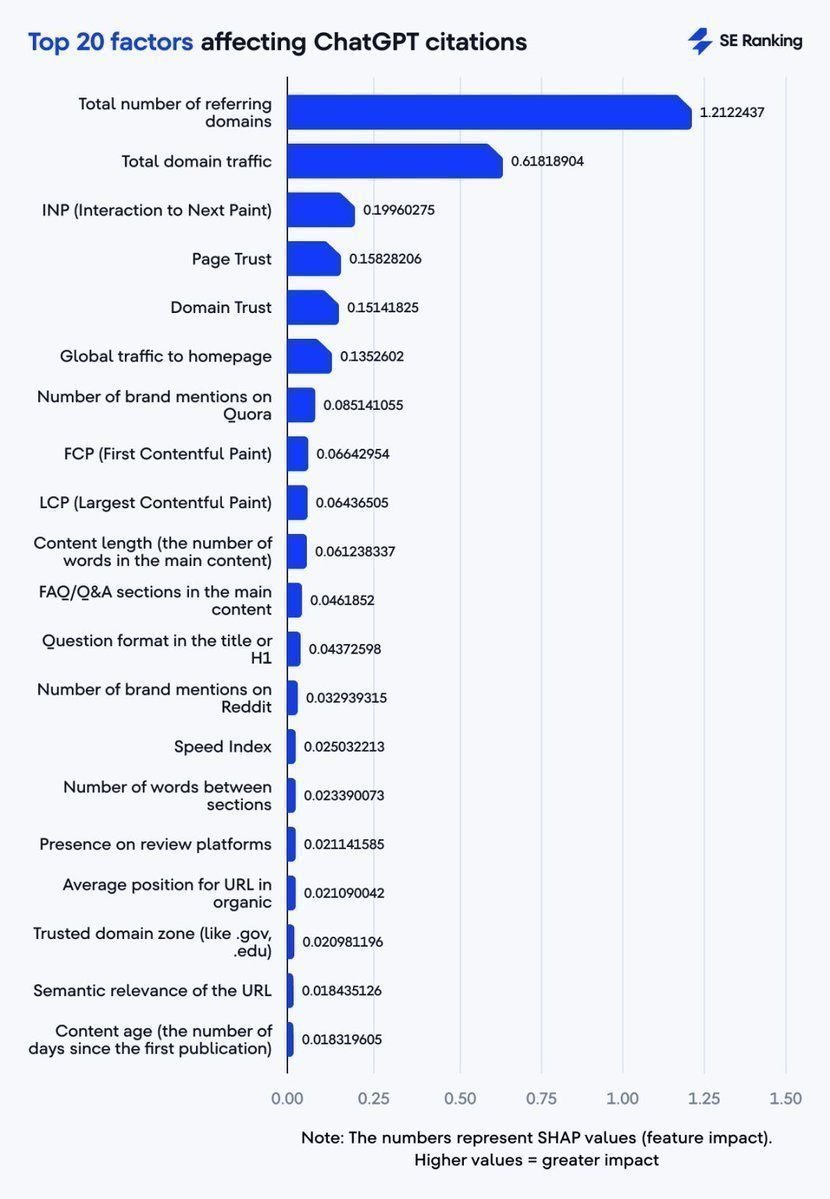
Headline first: backlinks mattered more than anything else.
The SE Ranking study found that sites with 32,000+ referring domains were 3.5x more likely to be cited by ChatGPT.
Sites with very high domain trust also earned nearly 4x more citations than low-trust domains.
If you want to see where your site stands across Google and AI search, start here. It’s free:
https://t.co/Pn764BHwyL
ChatGPT may ignore some old-school SEO tricks, but authority clearly matters.
High-authority domains are more likely to rank, get discovered, enter AI retrieval and ultimately get cited.
That is why SEO Stuff's flagship package includes three contextually relevant DR50+ backlinks:
https://t.co/yEFyM0Ze7W
Homepage traffic was another major signal.
Sites with 7,900+ homepage visitors had twice the citation likelihood, while domains with 190,000+ monthly visitors earned nearly twice as many citations as smaller sites.
That reinforces something important.
AI search does not exist in isolation from traditional search visibility.
If your domain has almost no presence across the wider search ecosystem, it has fewer opportunities to enter AI retrieval in the first place.
This is why SEO Stuff content is built for Google and LLMs at the same time.
Presence on Quora and Reddit mattered too.
Domains with a lot of Quora and Reddit mentions had four times higher citation likelihood.
Even smaller brands saw measurable lifts from participating in relevant discussions and being referenced organically.
Those mentions can reinforce what the company does, which category it belongs to and whether real people are talking about it.
Content depth also mattered.
Articles under 800 words averaged 3.2 citations, while articles over 2,900 words averaged 5.1, but simply adding words is not enough.
The stronger content included multiple angles, examples, expert quotes, verifiable data and broader topic coverage.
That is the thinking behind the Premium Content Bundle:
https://t.co/4CAnUt07PO
It includes 60 long-form articles designed to build deeper coverage around the questions customers and AI systems are researching.
Structure made a major difference too.
Well-structured pages earned 70% more citations.
The strongest pages used clean headings, relatively concise sections, logical progression, question-based H2s and clear answers.
Walls of text and vague brand storytelling give LLMs much less they can reliably extract.
Freshness mattered as well.
Pages updated within the previous three months nearly doubled their citations, with older pages averaging 3.6 citations compared with 6.0 for recently updated content.
Newer does not automatically mean better, but keeping important pages current clearly matters.
Question-based titles and FAQs also helped, particularly for smaller sites, when combined with depth, authority and good structure.
LLMs.txt, on the other hand, did almost nothing.
Its impact was negligible.
Authority, structure and useful content mattered far more.
Review platforms were another strong signal.
Brands appearing on Trustpilot, Capterra, G2, Sitejabber and Yelp earned three to six times more citations than brands with no presence.
That is another reminder that AI systems do not evaluate your company only through your own website.
Third-party reputation matters.
Core Web Vitals mattered too.
Fast pages were cited three times more often than slow pages.
You do not need perfect scores, but you do need to avoid a site that is painfully slow or difficult to use.
So what actually drives ChatGPT visibility?
The study points to backlinks, domain trust, homepage authority, Reddit and Quora presence, deep content, clear structure, recent updates, review platform visibility and fast performance.
In other words, many of the fundamentals that help you in Google also help you in AI search, with additional social, structural and entity signals layered on top.
This is exactly what SEO Stuff was built around:
https://t.co/wKpf0EILTx
The Done-For-You Gold Plan combines 10 long-form, AI-search-optimized articles with three DR50+ contextual backlinks:
https://t.co/yEFyM0Ze7W
The Premium Content Bundle adds 60 deep-dive articles designed to expand topical coverage and give search and AI systems more useful information to retrieve:
https://t.co/4CAnUt07PO
And the Premium Backlink Bundle adds three DR50+ authority placements designed to strengthen domain trust and broader brand authority:
https://t.co/Z9m9D7TjES
Backlinks were the strongest factor in the entire study.
But the broader takeaway is that AI search visibility comes down to authority, clarity, depth, structure, trust and freshness.
And SEO Stuff was built to deliver exactly that.
@aleyda@torylynne@Jammer_Volts@patrickstox One item worth adding to that mistakes list: recommendation and citation are separate signals. Tracking Notion across 70 Claude answers, it was recommended in 56 and cited zero times - optimizing for one doesn't move the other.
None of the three reasoned independently — they converged on the same training-data consensus. A brand that isn't the default answer isn't competing against the model, it's competing against everyone else's corpus that already picked a winner.
https://t.co/V1ICt5hOsY
I asked ChatGPT, Gemini & Claude the same question. All 3 gave me the exact same answer:
"Which LLM is the best if I'm on a free plan?"
ChatGPT ranked at the top. Every time.
Even Claude and Gemini put themselves in 2nd and 3rd.
I tested this answer personally by creating a new (free) account on all of these AI tools.
I spend $1,000+/month on AI. But I tested the free tier of almost all the AI tool models to answer one question: what would I use with $0?
Here's my free AI Tool stack:
1. ChatGPT (99% of your needs)
Claude's free model is Sonnet 5. Gemini's is 3.6-Flash. Both are far from the top of the Intelligence Index. ChatGPT gives you a frontier model for $0.
But only if you set it up right:
→ Download the app. Every LLM is better on its app.
→ Go to "ChatGPT Work" → pick 5.6-Terra-High
→ If you run out of Terra, switch to Luna-High (free).
→ Click Plugins → Spreadsheets (or Gamma). Free.
2. The rest of the stack:
→ Gamma for slides (400 starter credits)
→ Wispr Flow for dictation (2,000 words/week)
→ Seedance via Dreamina for video (225 credits/day)
→ NotebookLM for research on your own sources
→ Cursor for coding (free hobby plan, no card)
→ ElevenLabs for text-to-speech
→ Granola for meeting notes
→ Canva for design
3. The free vibecoding combo:
→ GitHub stores your code
→ Vercel puts your site online
→ Supabase handles logins
→ Resend sends 3,000 emails/month
Then start every build with this prompt:
"You are already connected to my GitHub, Vercel, Supabase & Resend. I want to build [project] for [goal + success criteria]. Make sure that [rules, max 3]. Ask me clarifying questions first."
To read the full breakdown (with my exact prompts, screenshots, and what I actually pay $1,000/month for), go here: https://t.co/sFt54CT3h5
@AbdoAmr34 AI-visibility content isn't judged by YouTube's own search rank. It's judged by an LLM's retrieval step pulling the transcript in as a citable passage - a different skill than optimizing for CTR, worth screening for in a creator's past work.
@dadovanpeteghem@claudeai The one-shot lands because you gave it three anchors, not a blank prompt: existing site, brand rules, reference sites. Fewer degrees of freedom to guess, so the first pass is closer to spec.
@donnellycss That's a two-hop path, not a lookup: retrieval decides what data gets pulled, generation decides what the reply text says — and those aren't guaranteed to match. Worth spot-checking a stated number against the actual dashboard before trusting it.
@JohnFreelancing The bigger split: AI Overviews always pulls from that query's live SERP. GPT and Claude only cite when the model chooses to invoke a search tool — the same prompt can return zero citations when it answers from memory instead.
Two runs of the same question minutes apart citing different sources isn't model randomness. Most AI answer engines fire a live web search at query time and generate over whatever comes back. The retrieval index shifts between requests — the model doesn't have to change.
Asked Perplexity the same question twice, minutes apart, fresh sessions: how do I know if ChatGPT cites my site. Run 1 cited 20 domains. Run 2 cited 25. Only 5 overlapped, same query, same afternoon. n=2. One screenshot proves nothing.
One run we captured: our engine returned 13 retrieval citations, but only 6 were actually cited inline in the generated answer. Most citation tools report the bigger number. The smaller one is what the model actually leaned on. n=1 so far.
@metehan777@lilyraynyc Doesn't necessarily hold evenly across query types — niche subreddit-specific questions have no real site: substitute, so their citation share probably didn't recover the way broad brand queries did. Same headline number, different underlying pattern.
Not luck, mechanism: AI search prefers pages already shaped like an answer — ranked lists with names and descriptions — over a single business's own site, because it skips the synthesis step. A directory listing outranks a homepage for exactly that reason.
I did a random AI search about my brand yesterday like I regularly do, and I saw that LoveweddingsNG had listed us as top 20 Nigerian wedding photographer sometime in March🤭
It’s a W🕺🏾
@hridoyreh 1M "visitors" in 1.5 days on a live-bidding leaderboard is almost certainly pageviews, not uniques - that UI trains people to refresh every few minutes to watch their rank move. Unique count is probably a fraction of that.
@rustybrick@glenngabe@iSKGTi@eskylinex Same problem shows up in AI-citation tracking - most tools paper over gaps like this with interpolation instead of flagging the blackout, so a real drop and a reporting outage look identical on the dashboard.
@DavidGQuaid Less listicles, more devs watching pages get cited by an AI Overview one day and drop the next with zero content change. That citation volatility is what's actually eating attention right now.
@lilyraynyc@suganthan Testable: pull ChatGPT citations for a fast-moving query (same-day product launch) and check Reddit source ages. The history-fanout theory predicts even trending queries skew old; if recency wins there instead, this is query-type dependent, not a blanket filter.
@askOkara Split this in two: those factors rank you in the blue links. AI Overviews and ChatGPT answers cite off crawlability plus a different corpus of trust signals — a page can hit every s-tier factor here and still never get pulled into an AI answer.
@hridoyreh Ranking #1 gets you found by keyword match. Getting cited in an AI answer is a separate retrieval step - the model pulls whichever passage best answers the literal question, often mid-page, not the one ranked #1 for that keyword.
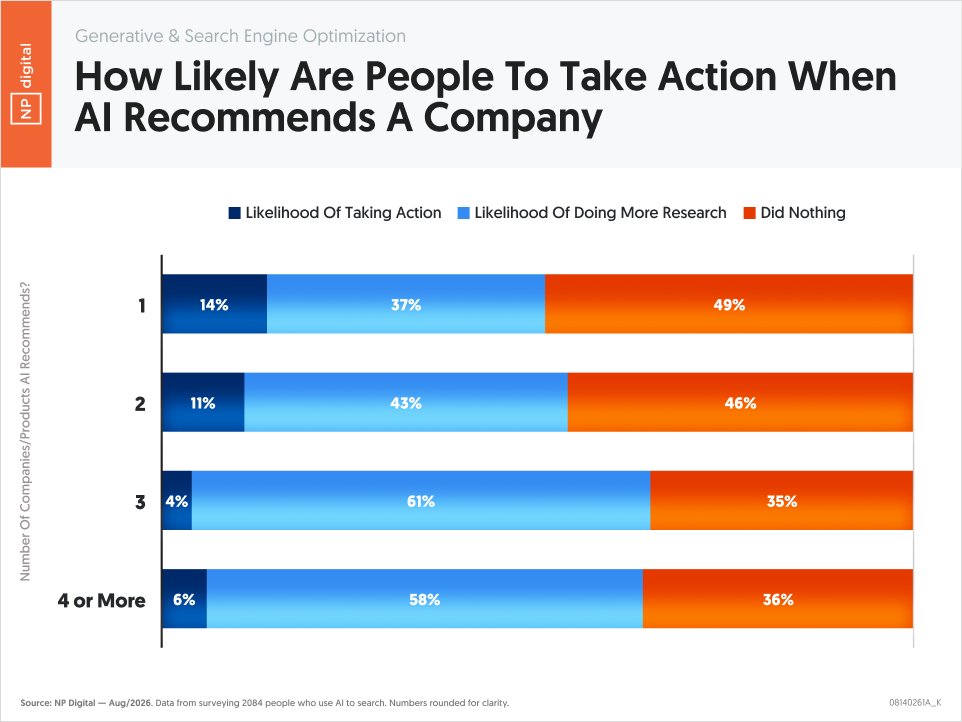
The mechanism: a single citation reads as a recommendation you can act on. A multi-option citation reads as a shortlist you still have to research. Same reason a comparison page converts worse than a single confident CTA — being listed and being chosen are different jobs.
Your goal shouldn't be to optimize for ChatGPT and Gemini to "include you" in the answer, instead, optimize to "be the answer".
Look at what happens when an LLM cites multiple options.
The likelihood of someone taking action (such as purchasing) decreases from 14% to between 4% and 6%.
Optimize to be the answer. Not to be included in the answer.
@blackrabbit@miketaylorcai@Google@rmstein Fair, sharing captures that one instance. But nothing points a crawler to it afterward, and running the same prompt again won't reliably regenerate an identical output. A citation index needs a stable location AND reproducibility — the share link only gives you the first.



![rubenhassid's tweet photo. I asked ChatGPT, Gemini & Claude the same question. All 3 gave me the exact same answer:
"Which LLM is the best if I'm on a free plan?"
ChatGPT ranked at the top. Every time.
Even Claude and Gemini put themselves in 2nd and 3rd.
I tested this answer personally by creating a new (free) account on all of these AI tools.
I spend $1,000+/month on AI. But I tested the free tier of almost all the AI tool models to answer one question: what would I use with $0?
Here's my free AI Tool stack:
1. ChatGPT (99% of your needs)
Claude's free model is Sonnet 5. Gemini's is 3.6-Flash. Both are far from the top of the Intelligence Index. ChatGPT gives you a frontier model for $0.
But only if you set it up right:
→ Download the app. Every LLM is better on its app.
→ Go to "ChatGPT Work" → pick 5.6-Terra-High
→ If you run out of Terra, switch to Luna-High (free).
→ Click Plugins → Spreadsheets (or Gamma). Free.
2. The rest of the stack:
→ Gamma for slides (400 starter credits)
→ Wispr Flow for dictation (2,000 words/week)
→ Seedance via Dreamina for video (225 credits/day)
→ NotebookLM for research on your own sources
→ Cursor for coding (free hobby plan, no card)
→ ElevenLabs for text-to-speech
→ Granola for meeting notes
→ Canva for design
3. The free vibecoding combo:
→ GitHub stores your code
→ Vercel puts your site online
→ Supabase handles logins
→ Resend sends 3,000 emails/month
Then start every build with this prompt:
"You are already connected to my GitHub, Vercel, Supabase & Resend. I want to build [project] for [goal + success criteria]. Make sure that [rules, max 3]. Ask me clarifying questions first."
To read the full breakdown (with my exact prompts, screenshots, and what I actually pay $1,000/month for), go here: https://t.co/sFt54CT3h5](https://pbs.twimg.com/media/HQYyF6KacAANjrx.jpg)
![rubenhassid's tweet photo. I asked ChatGPT, Gemini & Claude the same question. All 3 gave me the exact same answer:
"Which LLM is the best if I'm on a free plan?"
ChatGPT ranked at the top. Every time.
Even Claude and Gemini put themselves in 2nd and 3rd.
I tested this answer personally by creating a new (free) account on all of these AI tools.
I spend $1,000+/month on AI. But I tested the free tier of almost all the AI tool models to answer one question: what would I use with $0?
Here's my free AI Tool stack:
1. ChatGPT (99% of your needs)
Claude's free model is Sonnet 5. Gemini's is 3.6-Flash. Both are far from the top of the Intelligence Index. ChatGPT gives you a frontier model for $0.
But only if you set it up right:
→ Download the app. Every LLM is better on its app.
→ Go to "ChatGPT Work" → pick 5.6-Terra-High
→ If you run out of Terra, switch to Luna-High (free).
→ Click Plugins → Spreadsheets (or Gamma). Free.
2. The rest of the stack:
→ Gamma for slides (400 starter credits)
→ Wispr Flow for dictation (2,000 words/week)
→ Seedance via Dreamina for video (225 credits/day)
→ NotebookLM for research on your own sources
→ Cursor for coding (free hobby plan, no card)
→ ElevenLabs for text-to-speech
→ Granola for meeting notes
→ Canva for design
3. The free vibecoding combo:
→ GitHub stores your code
→ Vercel puts your site online
→ Supabase handles logins
→ Resend sends 3,000 emails/month
Then start every build with this prompt:
"You are already connected to my GitHub, Vercel, Supabase & Resend. I want to build [project] for [goal + success criteria]. Make sure that [rules, max 3]. Ask me clarifying questions first."
To read the full breakdown (with my exact prompts, screenshots, and what I actually pay $1,000/month for), go here: https://t.co/sFt54CT3h5](https://pbs.twimg.com/media/HQYyFCKboAA7vKf.jpg)
![rubenhassid's tweet photo. I asked ChatGPT, Gemini & Claude the same question. All 3 gave me the exact same answer:
"Which LLM is the best if I'm on a free plan?"
ChatGPT ranked at the top. Every time.
Even Claude and Gemini put themselves in 2nd and 3rd.
I tested this answer personally by creating a new (free) account on all of these AI tools.
I spend $1,000+/month on AI. But I tested the free tier of almost all the AI tool models to answer one question: what would I use with $0?
Here's my free AI Tool stack:
1. ChatGPT (99% of your needs)
Claude's free model is Sonnet 5. Gemini's is 3.6-Flash. Both are far from the top of the Intelligence Index. ChatGPT gives you a frontier model for $0.
But only if you set it up right:
→ Download the app. Every LLM is better on its app.
→ Go to "ChatGPT Work" → pick 5.6-Terra-High
→ If you run out of Terra, switch to Luna-High (free).
→ Click Plugins → Spreadsheets (or Gamma). Free.
2. The rest of the stack:
→ Gamma for slides (400 starter credits)
→ Wispr Flow for dictation (2,000 words/week)
→ Seedance via Dreamina for video (225 credits/day)
→ NotebookLM for research on your own sources
→ Cursor for coding (free hobby plan, no card)
→ ElevenLabs for text-to-speech
→ Granola for meeting notes
→ Canva for design
3. The free vibecoding combo:
→ GitHub stores your code
→ Vercel puts your site online
→ Supabase handles logins
→ Resend sends 3,000 emails/month
Then start every build with this prompt:
"You are already connected to my GitHub, Vercel, Supabase & Resend. I want to build [project] for [goal + success criteria]. Make sure that [rules, max 3]. Ask me clarifying questions first."
To read the full breakdown (with my exact prompts, screenshots, and what I actually pay $1,000/month for), go here: https://t.co/sFt54CT3h5](https://pbs.twimg.com/media/HQYyD3SakAALJD8.jpg)





![rubenhassid's tweet photo. I asked ChatGPT, Gemini & Claude the same question. All 3 gave me the exact same answer:
"Which LLM is the best if I'm on a free plan?"
ChatGPT ranked at the top. Every time.
Even Claude and Gemini put themselves in 2nd and 3rd.
I tested this answer personally by creating a new (free) account on all of these AI tools.
I spend $1,000+/month on AI. But I tested the free tier of almost all the AI tool models to answer one question: what would I use with $0?
Here's my free AI Tool stack:
1. ChatGPT (99% of your needs)
Claude's free model is Sonnet 5. Gemini's is 3.6-Flash. Both are far from the top of the Intelligence Index. ChatGPT gives you a frontier model for $0.
But only if you set it up right:
→ Download the app. Every LLM is better on its app.
→ Go to "ChatGPT Work" → pick 5.6-Terra-High
→ If you run out of Terra, switch to Luna-High (free).
→ Click Plugins → Spreadsheets (or Gamma). Free.
2. The rest of the stack:
→ Gamma for slides (400 starter credits)
→ Wispr Flow for dictation (2,000 words/week)
→ Seedance via Dreamina for video (225 credits/day)
→ NotebookLM for research on your own sources
→ Cursor for coding (free hobby plan, no card)
→ ElevenLabs for text-to-speech
→ Granola for meeting notes
→ Canva for design
3. The free vibecoding combo:
→ GitHub stores your code
→ Vercel puts your site online
→ Supabase handles logins
→ Resend sends 3,000 emails/month
Then start every build with this prompt:
"You are already connected to my GitHub, Vercel, Supabase & Resend. I want to build [project] for [goal + success criteria]. Make sure that [rules, max 3]. Ask me clarifying questions first."
To read the full breakdown (with my exact prompts, screenshots, and what I actually pay $1,000/month for), go here: https://t.co/sFt54CT3h5](https://pbs.twimg.com/media/HQYyGo0a4AA9MDZ.jpg)