Dear Sibi,
You have a bright future in Indian politics🔥The confidence & authority with which you say these things!💪
U should start as party spokesperson today (that way you’ll embarrass yourself at home and not the nation abroad)🙏🏼
The fact that the governor is trying to get @TVKVijayHQ to prove its numbers before they swear in shows you how desperate the BJP is to stop @actorvijay from coming to power.
Governor discretion only in situations where no single party or alliance has a clear majority. In a hung assembly, the Governor does have a role. But the question is: how much of a gatekeeper can he be?
The Supreme Court's Clear Answer: No, the Governor cannot demand proof of numbers upfront
The Supreme Court has consistently held that:
1. The floor of the House is the only legitimate test of majorityIn Rameshwar Prasad v. Union of India (2006) and especially S.R. Bommai v. Union of India (1994), the Court categorically held that the strength of a government can only be tested on the floor of the Assembly, not in the Raj Bhavan. The Governor has no constitutional authority to conduct his own headcount.
2. The Governor is not an umpire of legislative arithmeticHe cannot summon MLAs, demand letters of support, or privately assess who has how many. That would make the Governor's office a site of horse-trading and manipulation — precisely what the Constitution seeks to avoid.
3. The Nebam Rebia case (2016) further reinforced that the Governor's discretionary powers are narrow and must be exercised within constitutional bounds — he cannot act as a political actor.
4. Shivraj Singh Chouhan v. Speaker (2020) — the Court again reiterated that trust votes must happen swiftly and that governors cannot drag their feet or impose conditions.
What can the governor legitimately do?
-Invite the single largest party first (by convention, not absolute rule)
-Invite a pre-poll alliance that clearly commands a majority
-Set a reasonable deadline for proving majority on the floor
The Constitution doesn't specify an order of precedence. Governors have used this ambiguity politically — in Goa (2017), Manipur (2017), Karnataka (2018), and Maharashtra (2019) — sometimes inviting the largest party, sometimes a coalition, in ways that appeared partisan.
The Supreme Court intervened dramatically in Karnataka (2018), ordering a floor test within 24 hours.
@Ahmedshabbir20@Stalin__SP@INCTamilNadu@girishgoaINC
In the last 10-12 years, we’ve normalised Modi’s grotesque state election campaigning features to an extent where now nobody even questions why the sitting PM is on a boat in Hooghly midst a global crisis, burning Manipur, LPG shortage, migrant crisis, workers’ protest etc. etc.
#BREAKING Election duty officers move Supreme Court saying they themselves are not on West Bengal #SIR List
Se Adv MR Shamshad: These are 65 petitioners who are on election duty. Their duty orders mention EPIC numbers. Now those numbers are deleted. Now the persons conducting elections cannot vote ! This is on the face arbitrary. Many not given reasons.
CJI: Make these arguments before the appellate tribunal. Let the tribunal look into it
Justice Bagchi: Appropriate orders will be passed by the tribunal .. this election yes perhaps they can't vote. The more valuable right to remain on the rolls shall be preserved.
BOOM here is the transcript (word by word) of what transpired between the TMC & the CeC with the infamous “get lost” from the EC
The four member Trinamool Congress delegation consisting of Derek O’Brien, Sagarika Ghose, Menaka Guruswamy and Saket Gokhale take their seats at 10.03 on 8 April 2026. Full bench of EC present in conference room.
Meeting begins.
I. The same nine letters written by the Chief Minister of West Bengal (which the CEC ignored and not reply to) over the last few months, were handed over directly to the CEC.
II. Derek O’Brien read out portions from the memorandum of AITC, outlining five specific instances of the appointment of officers on election duty in Bengal. O’Brien then said:
(VERBATIM from here on)
“We live in the hope that there would be free and fair elections. Our memorandum will now be handed over to you directly. In the memorandum, we have expressed grave concern regarding politically compromised officials and observers undermining electoral neutrality in West Bengal were highlighted…
CEC: Just one minute from my side. The election commission is committed...
Derek O’Brien: See Mr. Kumar we have been here 8-9 times before and your fellow commissioners have not uttered a word. Dr. Joshi, Dr. Sandhu have not uttered a word in the last 8-9 meetings. But that is your call. We have heard enough of (hollow) words from you but we are not seeing any action on the ground
CEC: Are you done? Then I'll speak.
Derek O’Brien: (normal tone)
I thought we would congratulate you for being the first CEC in history to have a notice for removal against you (submitted in both houses of Parliament).
CEC: Don't speak loudly.
Derek O’Brien: (now raising voice) Don’t tell me whether to speak loudly or not.
CEC: You don't speak loud in this room. Thank you. GET LOST!
Derek O’Brien: You said ‘Get lost’. You told us to ‘Get Lost’. You actually told us to ‘Get Lost’
CEC: You cannot shout.
Derek O’Brien: You can't tell us to ‘Get Lost’
(Delegation leaves room saying: “Sleep well. Sleep well”)
A NEW DICTAT!
Another directive from the #ElectionCommission and this one raises serious questions about practicality and basic rights.
If your housing complex is designated as a polling booth, the order says that 48 hours before polling, no “non-voter” will be allowed to stay inside. Think about what that actually means in real life.
Have guests visiting? Ask them to leave because Godfather has passed a new order.
Live-in domestic help who are not registered voters at that address? They are now “outsiders.” For 48 hours you live without any help because you have to help the ECI
Family members who haven’t transferred their vote yet? Suddenly, they don’t belong.
Take a simple example: a couple living together. The husband is a registered voter in that constituency. The wife has recently moved from Gujarat and hasn’t updated her voter ID yet. For those 48 hours, she is effectively treated as an outsider in her own home. Is that reasonable? Is that even humane?
In cities like #Kolkata, thousands live in apartment complexes where residents frequently move in from different parts of the country or the state. Many have upgraded to a condoville living while they haven’t moved their voting from their native constituencies. Someone born in Maniktala, votes there but now lives at a luxury complex in south kolkata. So that person will be an outsider in their own registered flat for 48 hours? Under this rule, they become strangers at their own doorstep.
What about elderly parents visiting their children? What about tenants waiting or not waiting for voter registration updates? What about caregivers who stay full-time with families? Are they all to be pushed out temporarily in the name of election protocol?
The Election Commission already has over 2 lakh central forces deployed, along with the entire state police machinery. With such massive security in place, why impose rules that ends up treating ordinary citizens like potential suspects?
Free and fair elections are essential but so are dignity, practicality, and common sense. Regulations meant to ensure security should not end up disrupting everyday life or questioning people’s right to live in their own homes. At what point does vigilance turn into overreach?
#BengalElection2026
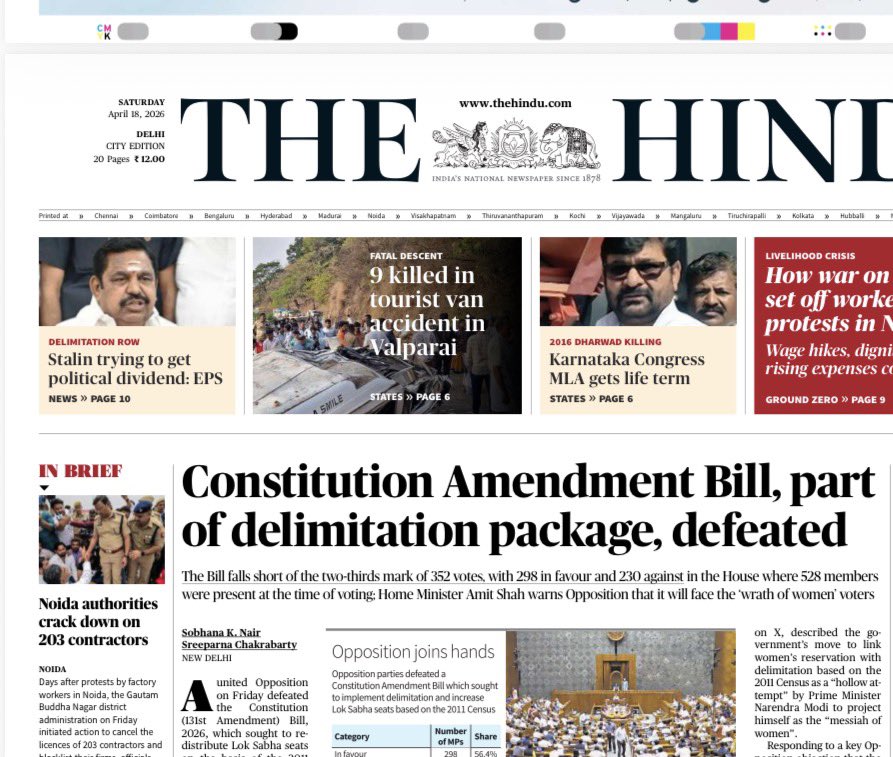
Proud of my old newspaper, @the_hindu, take a bow @nambath, the only paper to have the correct headline for what transpired in parliament yesterday. All other newspapers seem to have bought the government’s spin that the ‘opposition defeated women’s reservation’!
An 850-member Parliament will be even more ineffective than the current 543-member House. MPs are legislators, not administrative executives. Simply adding more of them does not—and cannot—improve constituency administration, because MPs are not the administrative heads of their constituencies.
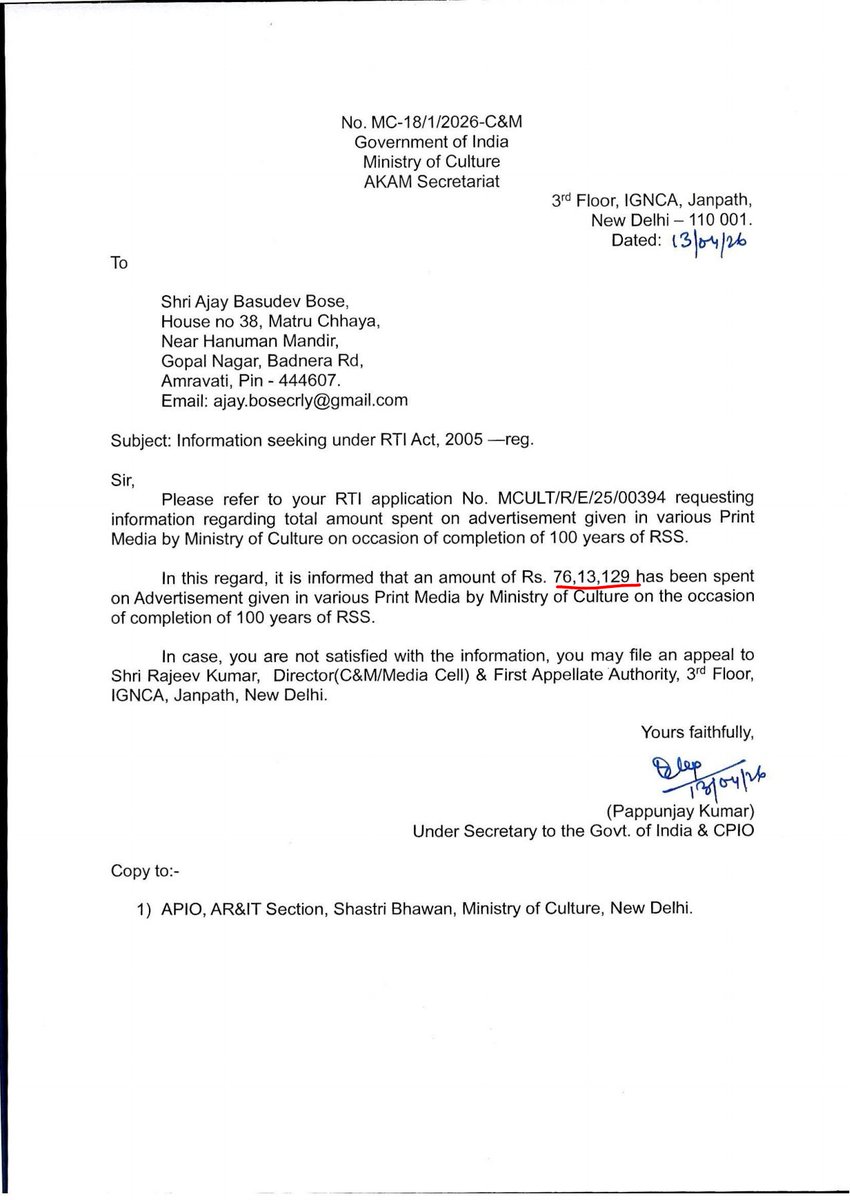
Senior RTI activist @AjayBos93388306 unearths that the Government of India (Ministry of Culture) spent INR 76.13 Lac rupees on print advertisements on the occasion of completion of 100 years of RSS.
Your GST, income tax & toll collection is being spent on Mohan Bhagwat's VVIP security & his PR.
The Hindu's editorial on delimitation lays bare the sinister agenda behind this plan. Ends with the line "The consequences of letting this amendment pass are too grave to contemplate."
"The government’s insistence on bundling women’s reservation with delimitation suggests that the former is being used as political cover for the latter: a sweeping reallocation of Lok Sabha seats that would reshape the federal composition of Parliament to the advantage of States where the Bharatiya Janata Party (BJP) enjoys electoral dominance, and at the expense of States where it has been historically weak."
"The Hindi-heartland States (Uttar Pradesh, Bihar, Madhya Pradesh, Rajasthan, Haryana, Chhattisgarh, Uttarakhand, and Delhi), which currently hold 207 of 543 seats, would secure 366 — a 77% increase, with their share rising from 38.1% to 43.1%. The southern States (Tamil Nadu, Karnataka, Andhra Pradesh, Telangana, Kerala, and Puducherry), with 132 seats now, would receive only 176, a 33% increase, while their share would drop from 24.3% to 20.7%. The eastern States would slip from 14.4% to 13.7%; the North-East from 4.4% to 3.8%."
"That this legislation is being rushed through, with barely any time for public debate, just days before voters in two crucial States go to the polls, makes the timing even more suspect. There is no reason why women’s reservation cannot be implemented within the existing 543-seat Lok Sabha by designating constituencies for women on a rotational basis,
"
https://t.co/eP3XTL9sYs
The answer can be found in Europe, where the principle of degressive proportionality is applied to the composition of the European Parliament — since they have the same problem of small and big states coexisting in one Union.
India also needs a compromise between strict democratic representation (one person, one vote) and the necessity of ensuring smaller political entities have a meaningful voice. It essentially means that while larger populations get more seats, the ratio of citizens to representatives increases as the population grows.
In the European Parliament, the allocation must follow these constraints:
*Minimum Threshold: No member state can have fewer than 6 seats.
*Maximum Ceiling: No member state can have more than 96 seats.
*Inverse Ratio: The "efficiency" of a vote must decrease as population increases. For example, a Member of the European Parliament (MEP) from Malta might represent roughly 80,000 citizens, while an MEP from Germany represents roughly 850,000 citizens.
The goal is to prevent the "Big Four" (Germany, France, Italy, and Spain) from holding a permanent absolute majority that could override the collective interests of the smaller nations, thereby maintaining the federalist spirit of the Union.
Applying this to India is what we need to debate, not women’s representation which no one objects to. We need to address the North-South divide that has arisen over delimitation. A strict population-based reallocation (proportional representation) would drastically increase seats for northern Hindi-belt states like Uttar Pradesh and Bihar, while states that successfully implemented population control (like Kerala and Tamil Nadu) would see their relative political influence diminish.
If India were to adopt a degressive model, the Parliament could be structured to balance population with federal equity. Similar to the EU, a "floor" could be set for smaller states (e.g., Goa, Sikkim, or the Northeast) to ensure they aren't reduced to insignificance. Instead of a fixed ratio of, say, 2 million citizens per MP, the ratio could scale. A state with 200 million people might have 2.5 million citizens per MP, while a state with 30 million might have 1 million per MP. This is to ensure no state feels disenfranchised. As @revanth_anumula suggests, another factor could be a state’s contribution to national GDP. It would be dangerous for our federalism if smaller states felt their prosperity & human development were being punished with relative disenfranchisement.
One could argue that the Rajya Sabha already exists for federal representation. However, degressive proportionality in the Lok Sabha would provide a "weighted" democratic mandate that acknowledges population without penalizing states for their developmental successes.
Finding a mathematical formula that satisfies both the high-growth and low-growth states, and both the large and small states, would require a level of bipartisan and interstate cooperation that it is in the interests of the central government to promote. I urge PM @narendramodi to initiate extensive consultations, with all parties and with all states, before rushing into a hasty delimitation process that leaves the core underlying issues unaddressed.
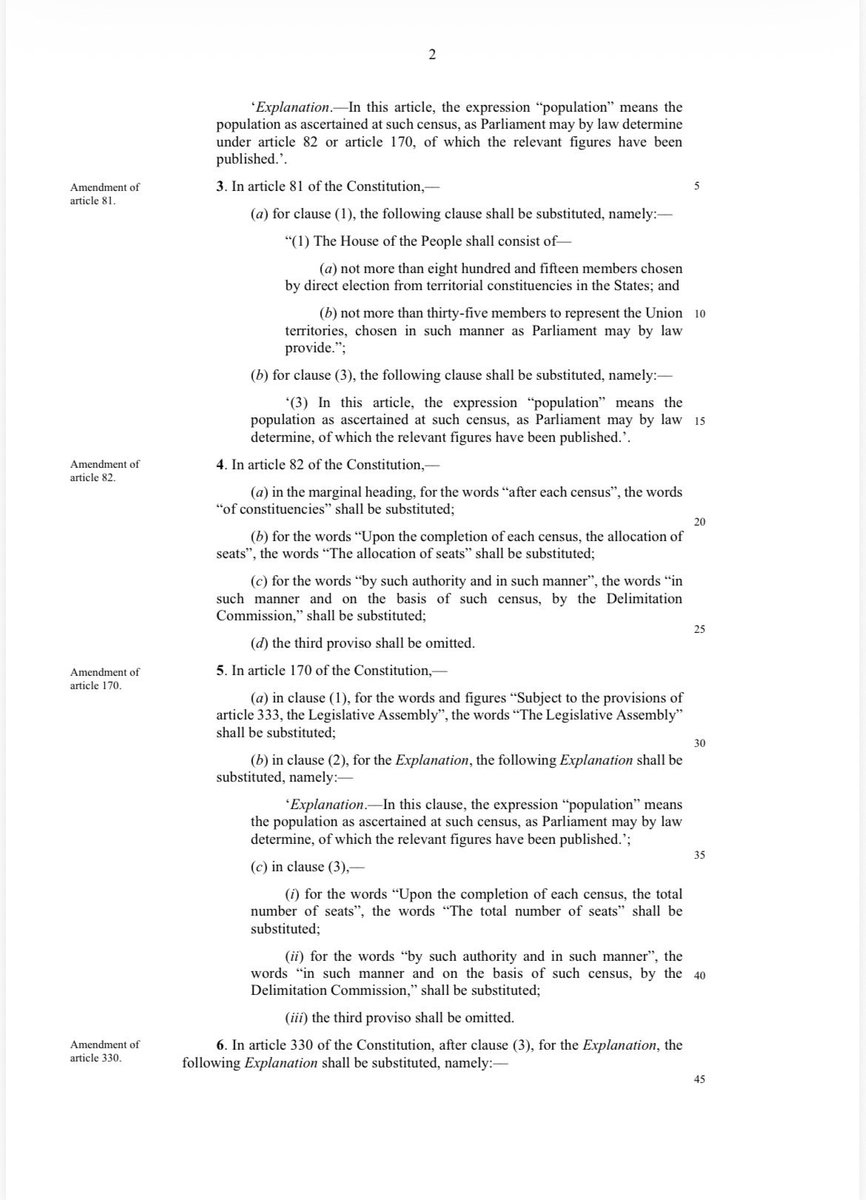
❗️Breaking: Just saw a copy👇🏽of the Constitution (131st Amendment) Bill, 2026, to be introduced in the parliament in the special session this week. It’s worse than what everyone feared - it opens the floodgates for complete reallocation of seats for states and for gerrymandering.
➡️ As expected, in the name of advancing women’s representation, it is basically a move to facilitate early delimitation and to expand the size of Lok Sabha to 815.
➡️ But, contrary to the assurance of the PM and ministers, there is nothing in this bill to ensure that the present proportion of seats for each state would be maintained. It lifts the existing freeze (based on 1971 census, extended to post 2026) completely without any safeguard the government was promising.
➡️ Worse, the decision about which Census would be the basis for reallocation is taken away from the constitution and placed in the domain of law (ie, simple parliamentary majority).
➡️ Actual reallocation and determination of boundaries would be done by the Delimitation Commission, on which the constitution is silent. And this cannot be challenged in a court of law.
Non-Bhutia,Lepcha Scheduled Tribes in Sikkim comprising around 15% of state's population dont have any reserved constituencies in the state. https://t.co/tXyBdUtm8o