In a six-hour window on July 22 and 23, three cross-chain protocols lost a combined $35.5 million.
AFX Trade. $24.15 million. Five of seven bridge validator keys compromised. The signatures cleared the quorum. The contract executed correctly.
B² Network. $3.86 million. Unauthorized access to the staking contract's upgrade authority. The address that drained it had held that role since 2025. It was revoked only after the funds were gone.
Verus. $7.54 million. The attacker walked through the same submitImports() contract path that drained $11.58 million from the same bridge in May. Same contract. Same entry point. Same bug class.
The Verus timeline is the part that should stop every protocol team cold. May attack: $11.58M stolen. Attacker returned most of the funds for a bounty. July 8: Verus redeposited the recovered money into the same bridge. July 23: the bridge was drained again. Two weeks between redeposit and second breach. The patch addressed the exploit path. It did not change the architecture that made the path exploitable in the first place.
Fixing a vulnerability and leaving the underlying design intact is a cycle, not a solution. Every bridge that patches its way forward stays exposed to the next permutation of the same structural weakness. The only exit from that loop is moving verification out of the custody layer entirely.
Source:
https://t.co/FxkyLgEh01
#DeepSafe #CRVA #AISecurity #BridgeSecurity #DeFi
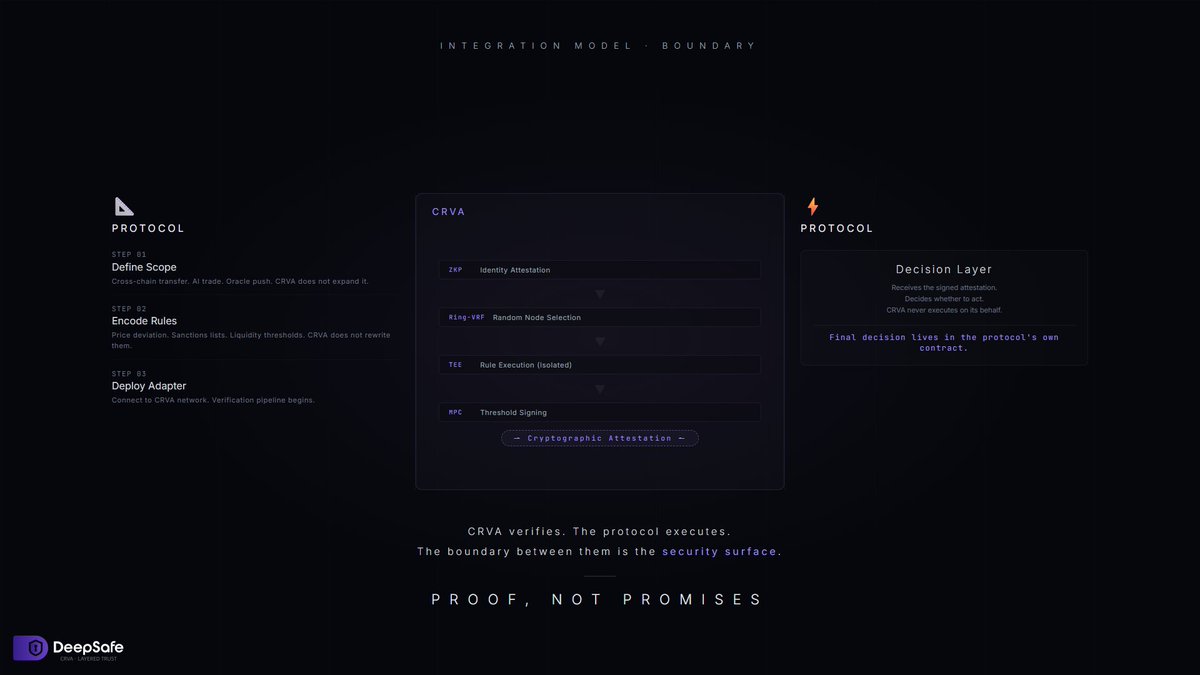
A protocol integrating with CRVA goes through three steps. Each one encodes a deliberate boundary around who makes decisions and who verifies them.
Step 1
Submit an integration request defining what needs verification. A cross-chain transfer. An AI agent's proposed trade. An oracle data push. The protocol specifies the verification scope. CRVA does not expand it.
Step 2
Encode the verification rules into an adapter contract. This is where the protocol defines exactly what conditions must be satisfied for CRVA to produce a valid signature. Price deviation within acceptable bounds. Counterparty addresses not on a sanctions list. Liquidity depth above a minimum threshold. The rules belong entirely to the integrating protocol. CRVA applies them. It does not rewrite them.
Step 3
Deploy the adapter and connect it to the CRVA network. From this point forward, every verification request from the protocol follows the same pipeline. ZKP identity attestation from the submitting agent. Ring-VRF random selection of verifier nodes. TEE execution of the verification rules. MPC threshold signing of the result.
What CRVA delivers is a signed attestation that the rules were checked and found to pass. That attestation is a cryptographic fact. The protocol receives it and decides whether to act. CRVA never executes a transaction on behalf of a protocol. The final decision always lives in the protocol's own contract, governed by its own logic.
This separation is not an implementation detail. It is the integration model. CRVA verifies. The protocol executes. The boundary between them is the security surface that keeps verification independent.
#DeepSafe #CRVA #AISecurity #DevEx #Web3Infra
🎉 Rewards for June Monthly Quest have been distributed!
Congratulations to the 15 randomly selected new users & our top referrers who earned SHM rewards.
And thank you to everyone who participated, referred friends, and welcomed new users on-chain.
More opportunities are ahead. 💙
📈 Top 5 Coins by Holders
See which coins have attracted the most holders on https://t.co/LxF2R1sx5z.
🔥 WRX
🔥 DOGESHM
🔥 SHIB
🔥 USDT
🔥 TRUMP
Explore them now 👇
https://t.co/nxvwE6Y3fM
Sikka x Shardeum AMA 🎙️
Got questions about Sikka Global Airdrop?
Join our Text AMA and learn everything about the Sikka Global Airdrop, including eligibility, rewards, verification, and how to claim up to 25,000 SHM.
🗓️ Today, 5:00 PM IST
📍 https://t.co/LI085P3fdr
Drop your questions below & win from 100,000
$SHM prize pool!