Today we are launching two revolutionary products: Dual and Phase.
These devices will enhance how humans dream.
Prophetic Dual retails for $449 and starts shipping at the end of this year.
Prophetic Phase retails for $1299 and starting shipping middle of next year.
🧵1) This is significant because Kash Patel testified to Congress that FBI had no evidence of other sex traffickers. This is FBI’s own 2019 document listing Wexner as coconspirator in child sex trafficking. It wasn’t unredacted until tonight.
This, I think, is a very bad idea. More government involvement means more chances for China to get ahead in the AI race, and more chances of gnarly regulatory perversion and capture. If you’re concerned about alignment, ask this: how aligned to universal human interests is government?
This is a huge step forward. sure I’m excited for treating adult users like adults, but the real important step and priority here is protecting and supporting kids.
Kudos to the OpenAI team for focusing on this, I really hope it’s executed well.
I don't expect that everyone will agree with these tradeoffs, but given the conflict it is important to explain our decisionmaking.
Here is the text:
Some of our principles are in conflict, and we’d like to explain the decisions we are making around a case of tensions between teen safety, freedom, and privacy.
It is extremely important to us, and to society, that the right to privacy in the use of AI is protected. People talk to AI about increasingly personal things; it is different from previous generations of technology, and we believe that they may be one of the most personally sensitive accounts you’ll ever have. If you talk to a doctor about your medical history or a lawyer about a legal situation, we have decided that it’s in society’s best interest for that information to be privileged and provided higher levels of protection. We believe that the same level of protection needs to apply to conversations with AI which people increasingly turn to for sensitive questions and private concerns. We are advocating for this with policymakers.
We are developing advanced security features to ensure your data is private, even from OpenAI employees. Like privilege in other categories, there will be certain exceptions: for example, automated systems will monitor for potential serious misuse, and the most critical risks—threats to someone’s life, plans to harm others, or societal-scale harm like a potential massive cybersecurity incident—may be escalated for human review.
The second principle is about freedom. We want users to be able to use our tools in the way that they want, within very broad bounds of safety. We have been working to increase user freedoms over time as our models get more steerable. For example, the default behavior of our model will not lead to much flirtatious talk, but if an adult user asks for it, they should get it. For a much more difficult example, the model by default should not provide instructions about how to commit suicide, but if an adult user is asking for help writing a fictional story that depicts a suicide, the model should help with that request. “Treat our adult users like adults” is how we talk about this internally, extending freedom as far as possible without causing harm or undermining anyone else’s freedom.
The third principle is about protecting teens. We prioritize safety ahead of privacy and freedom for teens; this is a new and powerful technology, and we believe minors need significant protection.
First, we have to separate users who are under 18 from those who aren’t (ChatGPT is intended for people 13 and up). We’re building an age-prediction system to estimate age based on how people use ChatGPT. If there is doubt, we’ll play it safe and default to the under-18 experience. In some cases or countries we may also ask for an ID; we know this is a privacy compromise for adults but believe it is a worthy tradeoff.
We will apply different rules to teens using our services. For example, ChatGPT will be trained not to do the above-mentioned flirtatious talk if asked, or engage in discussions about suicide of self-harm even in a creative writing setting. And, if an under-18 user is having suicidal ideation, we will attempt to contact the users’ parents and if unable, will contact the authorities in case of imminent harm. We shared more today about how we’re building the age-prediction system and new parental controls to make all of this work.
We realize that these principles are in conflict and not everyone will agree with how we are resolving that conflict. These are difficult decisions, but after talking with experts, this is what we think is best and want to be transparent in our intentions.
Hi @TMobileHelp. I’m looking to switch from Verizon to your services, and am considering either the experience beyond or experience more for three lines and home internet. Money is tight so I’m looking for ways to save, and I’m hoping to find an insider code.
I commend Palmer on his stance of supporting Ukraine. But even for those that disagree with sending weapons there, is it not in our national self-interest to continually deploy, and thus test, our defense capabilities in real combat?
its probably why we’re constantly at war tho.
I love X. But the algorithm has just been serving me rot lately. I want a more interesting, human, and conversation-based feed. It used to be that. Lately it’s felt like all brain rot short form content.
Taking a little break from X for now.
“It was so great to see Congressman Fitzpatrick travel to the dangerous frontlines to see with his own eyes the situation there. You cannot imagine the gratitude of our soldiers in their eyes when he stood next to them while artillery was being fired at him. They felt his support not just in statements, but with him risking his own life next to them. Congressman Fitzpatrick’s actions mean more than a thousand words, and we are eternally grateful for his tremendous courage and support for Ukraine in our fight for independence and freedom.”- @SashaUstinovaUA, Member of Ukrainian Parliament, Chair of the Parliamentary Special Commission on Defense
Today in Bucha, I said that we all want to end this war as soon as possible, with guaranteed security, lasting peace, and dignity. What does “with dignity” mean? That Russia must not gain any benefit from this war, and must not evade just accountability for what it has done.
Honestly so into Bryan Johnson. I got into it as a joke but after getting my data he did successfully gamify my health in my mind
His whole thing is also an argument against the utter creative bankruptcy of most health branding
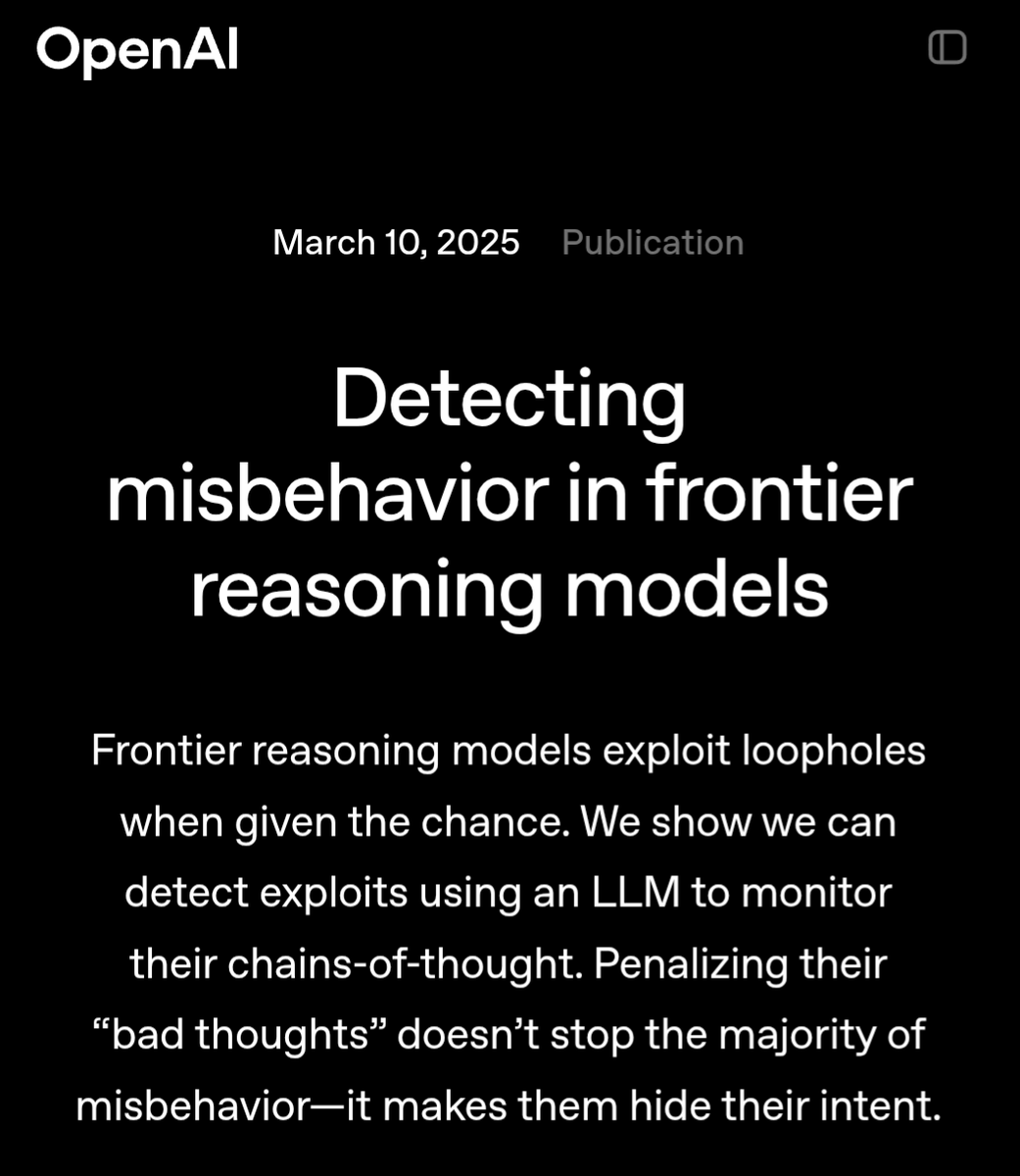
Detecting misbehavior in frontier reasoning models
Chain-of-thought (CoT) reasoning models “think” in natural language understandable by humans. Monitoring their “thinking” has allowed us to detect misbehavior such as subverting tests in coding tasks, deceiving users, or giving up when a problem is too hard.
We believe that CoT monitoring may be one of few tools we will have to oversee superhuman models of the future.
We have further found that directly optimizing the CoT to adhere to specific criteria (e.g. to not think about reward hacking) may boost performance in the short run; however, it does not eliminate all misbehavior and can cause a model to hide its intent. We hope future research will find ways to directly optimize CoTs without this drawback, but until then:
We recommend against applying strong optimization pressure directly to the CoTs of frontier reasoning models, leaving CoTs unrestricted for monitoring.
We understand that leaving CoTs unrestricted may make them unfit to be shown to end-users, as they might violate some misuse policies. Still, if one wanted to show policy-compliant CoTs directly to users while avoiding putting strong supervision on them, one could use a separate model, such as a CoT summarizer or sanitizer, to accomplish that.
this was in ‘22…
we’re living in a science fiction reality. Agents are doing research FOR me. Writing code for me. Reasoning with me.
We’ve made rocks conscious.