s a summary, high flux AVF (>1.5L/min):
-⬇️carotid, renal, gut, capillaries and aortic flows
-⬆️coronary, cardiac output and pulmonary artery pressure.
As a result, a high-flux AVF can be dangerous in moderate-severe heart failure patients
📢Article of the month📣 Interesting retrospective cohort study from Japan🤔! Showing that femoro-femoral arteriovenous fistulas can be a viable and durable option when traditional access points are no longer feasible!
https://t.co/cCE6OCQFc0
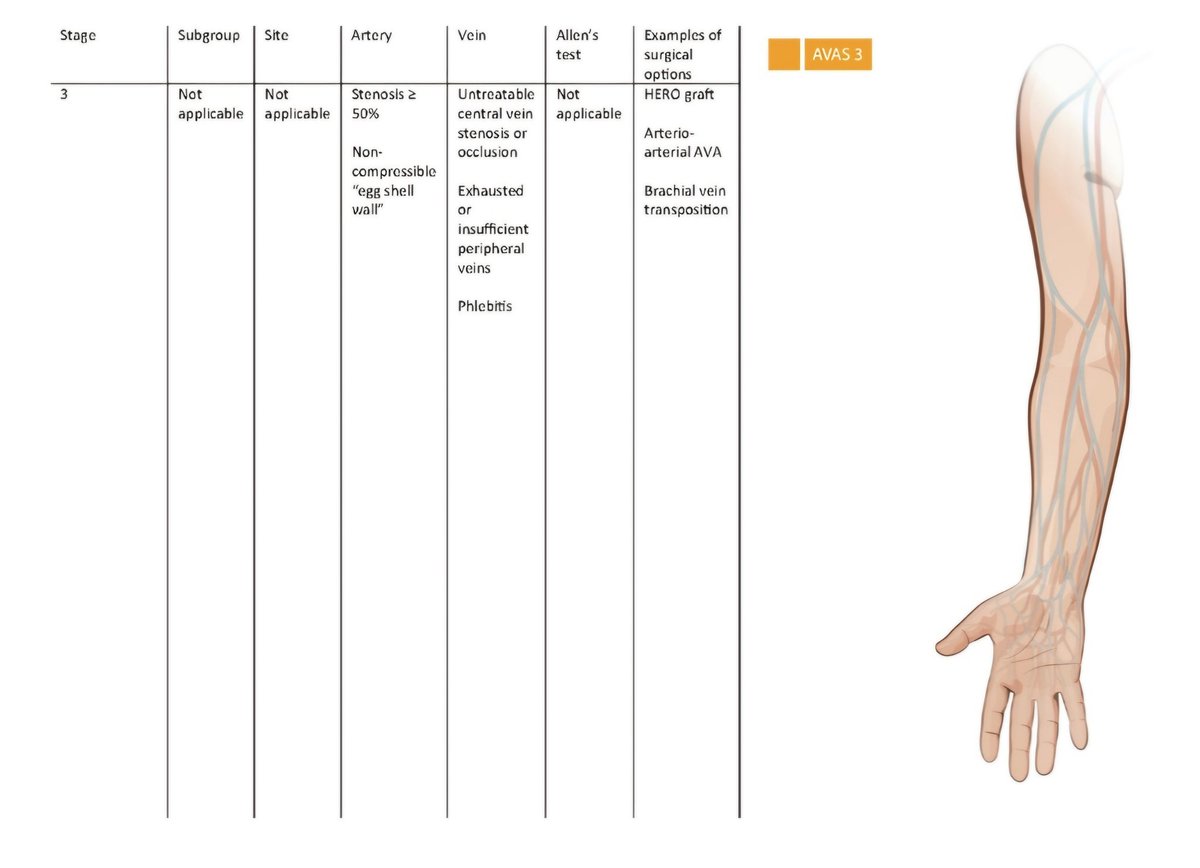
The AVAS classification is a simple and validated method of describing VA options. However, it doesn't consider non-vascular anatomy related contraindications for access creation,and is only one part of a patient centred approach to VA in the haemodialysis population
📣Article of the month 📢“The arteriovenous access stage (AVAS) classification” by Baláž et al. They report on a new classification system to describe a patient’s suitability and options for upper limb VA creation based on arterial and venous anatomy
https://t.co/qyzP7rNpC6
➡️AVAS 2 patients are suitable for AV grafts, but unsuitable for native AV access. It is divided into 2 subgroups (A, B) which also correspond to the anatomic location (A – forearm, B – upper arm).
➡️AVAS 3 patients are not suitable for typical native or graft options.
➡️Do not treat the venous stenosis as it could aggravate the distal ischaemia
➡️Cold hand without pain means the hand ischaemia is at grade I HAIDI
➡️Thus, conservative treatment and surveillance with no additional treatment if not aggravated during dialysis.
📣Case of the month📣
Patient presents with some complaints of a cold hand, without pain, after creation of radiocephalic fistula (grade I Haemodialysis access-induced distal ischaemia (HAIDI).
Ultrasound shows a central venous stenosis without venous hypertension (collapse of AVF with arm raising test) and a normal flow around 900 ml/min.
We also find an impaired dilatation of the distal arteries, narrowed and atheromatous.
What to treat????
📣Case of the month📢
Complex access cases where patients have exhausted traditional upper limb options or have central venous disease still have vascular access options beyond central venous catheters or lower limb access ⬇️⬇️⬇️
An ePTFE graft (white arrow, A) is anastomosed to the brachial artery, the outflow is connected to the venous outflow component (white arrow, B). The graft can be needled using standard needling techniques (C).
Limitations
▶️ Single center with smaller number of patients wever,
▶️ Assumed normal cognition and cancer-free patients
▶️ Did not consider any laboratory data
▶️ Would have been interesting if compared to the KDOQI Life Plan, as changes in the patient examination may vary
STRIKINGLY⚡️only 65% of AVFs were deemed mature prior to death versus 94% of AVGs p=0.03
🔔Suggesting AVG should be considered over AVF creation, if there is a short life expectancy 🔔