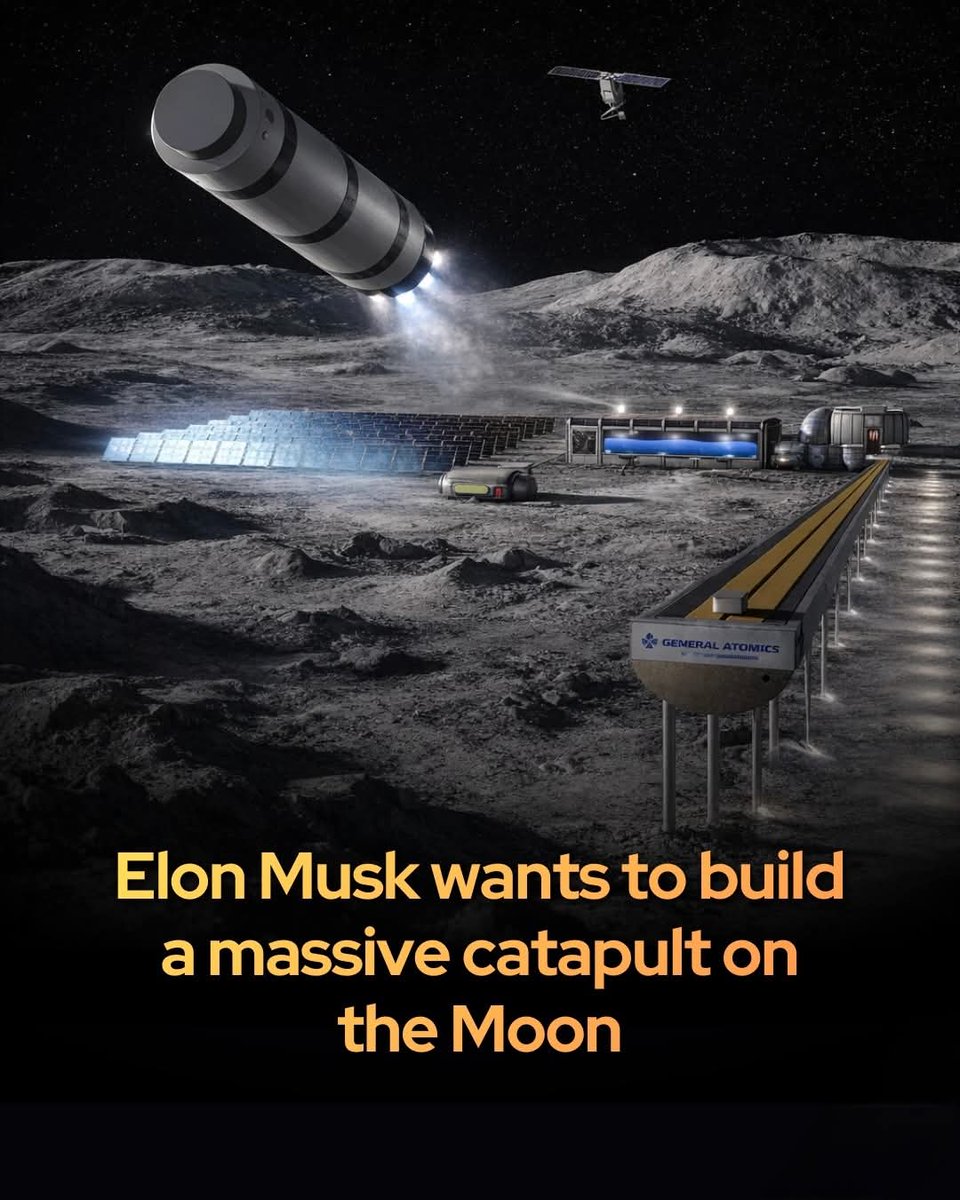
🚨 Elon Musk Wants to Turn the Moon Into a Giant Space Catapult — And It Could Change Everything
What if the Moon stopped being a quiet rock in the sky… and became humanity’s ultimate launchpad? Elon Musk is backing a bold idea that sounds like science fiction but is rooted in real physics: building a massive magnetic catapult on the lunar surface to fling satellites directly into deep space. No explosive rockets. No burning fuel. Just electromagnetic force accelerating payloads at extreme speed. Thanks to the Moon’s weak gravity and lack of atmosphere, launching from there needs far less energy than from Earth.
This idea isn’t new—it was first imagined in 1974 by physicist Gerard O’Neill at MIT—but modern technology may finally make it possible. The plan goes even further: mine the Moon itself. Extract metals, use frozen water for fuel, power everything with sunlight, and build satellites right there on the surface. No costly launches from Earth’s heavy gravity.
The challenges are extreme—deadly lunar dust, violent temperature swings, and the danger of creating space debris if precision fails. But if this works, rockets could become optional, and the Moon could become humanity’s first true space hub. Not just orbiting Earth anymore… but launching us toward the stars. 🌕🚀
A gravitational singularity is a point at the center of a black hole where spacetime curvature becomes infinite and the known laws of physics break down.
Gravity Isn’t a Force (Einstein) : ✍️
Gravity isn’t a force-it's the curvature of spacetime caused by mass and energy, as described by Einstein’s General Relativity. Massive objects like planets bend spacetime, and other objects follow these curves, creating what we perceive as gravitational attraction.
Voyager 2, launched by NASA in 1977, is the only spacecraft to have visited four planets: Jupiter (1979), Saturn (1981), Uranus (1986), and Neptune (1989)