Monteriggioni - the gate of the Middle Ages ...
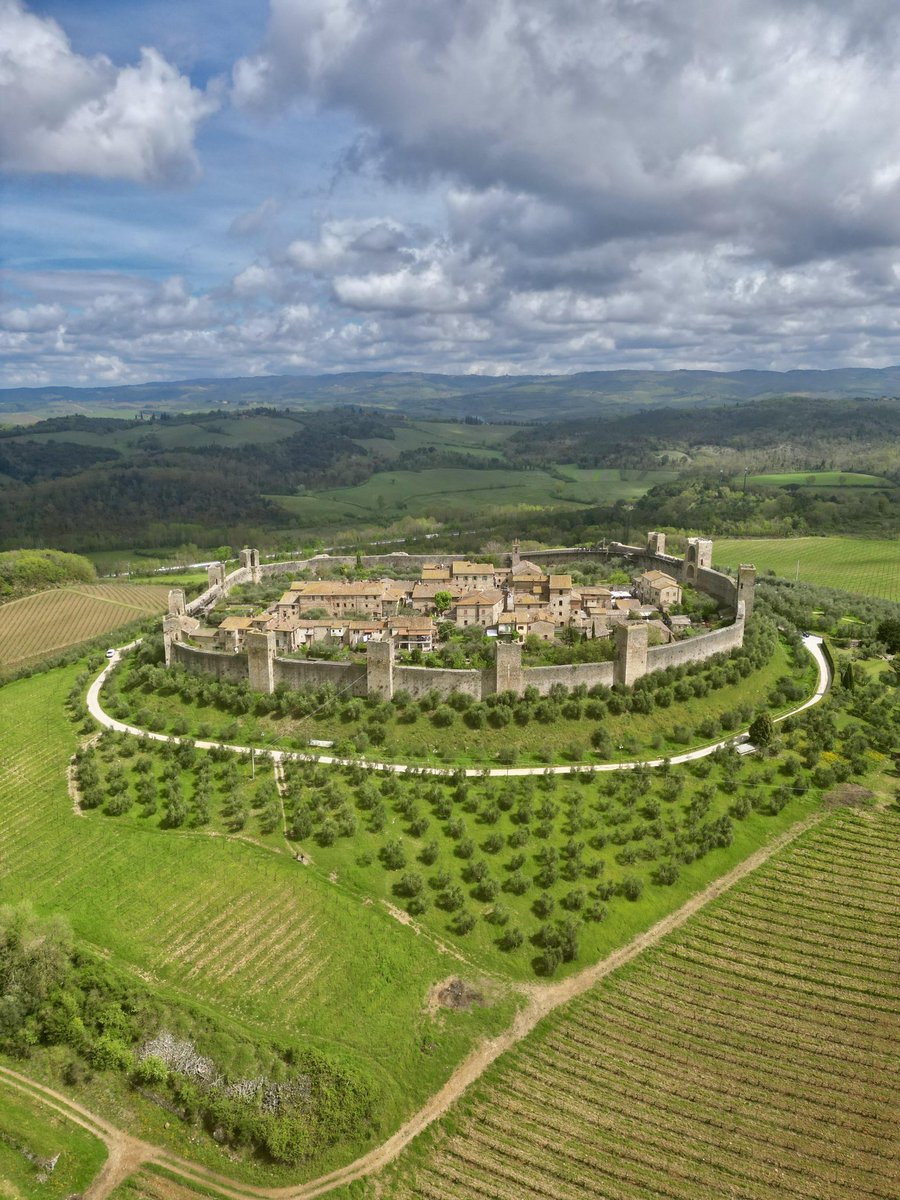
Monteriggioni represents one of most important medieval walled castles, nestled in south-western end of Chianti, province of Siena, at the the heart of Tuscany, Italy 🇮🇹. It has incredibly preserved an intact structure as a magical, fairy-tale place, capable of taking anyone back in time, to Middle Ages.
In Monteriggioni time seems to have stopped: the landscapes are those typical of a postcard, with a fairytale and dreamy air, with small houses and narrow streets that wind through the towers of the castle. Its perfect circular perimeter makes one suppose it to be an artficial construction while in actuality it was created by just following the curves in the natural ground.
The origins of the village dated between 1214-1219 CE, the Sienese built the Castle of Monteriggioni in order to defend the center and control the surrounding territory. The peculiarity of this building is the circular layout of its walls, which follows the natural course of the hill, thus giving it a particularly irregular shape and very similar, in small, to that of the Wall of China.
Castle of Monteriggioni is the symbol par excellence of the village: built by Sienese at behest of Guelfo da Porcari, Republic of Siena used it as a means of defense from enemy attacks. It is located, in fact, on Mount Ala, from which it offers a privileged view of the surrounding landscape and, above all, on Via Francigena.
In the beginning, castle was surrounded by ditches, useful in case of siege, because they could be filled with coal and set on fire to avoid the arrival of enemies. The structure has long been the subject of clashes between Sienese and Florentines; between 15th-16th Centuries CE, it became the headquarters of artillerymen, while today it is owned by the Griccioli family. Thanks to this system, Monteriggioni has long been an impregnable and unattainable village, so much so that its fall was possible only with a betrayal: the captain of the army, a Florentine escapee, in fact, decided to hand over the castle to the enemy Florence: without fighting. From that moment on, Monteriggioni passed into the hands of the Signoria of Florence, specifically to Cosimo I de’ Medici, and its inhabitants became subjects of Florence.
Even today, the walls of the castle look simply wonderful: this is due to the wise and important restoration work carried out between the twenties and thirties of the 20th Century CE, during which the previously demolished towers were also rebuilt.
The intact fortified wall presents 14 towers along which the guards used to walk and patrol the walls and 2 gates, one called Franca or Romea Gate which faces Rome and other known as Florentine Gate since it heads toward Florence.
The current structure of the village is essentially the original one, the only changes it went through date back to the 16th Century CE, when the towers were lowered and some earth accumulated at the base of the walls and another dating back to 1921 when 3 of the 14 towers were reduced to the level of the walls.
Monteriggioni, therefore, a fundamental place for all those who want to know the history of Tuscany and many battles that took place here during Middle Ages. Village has been included in route of Via Francigena, assuming a new importance, today tourist and no longer military as in 13th Century CE.
#archaeohistories
*druj ("lie") is a central concept in Zoroastrianism referring to metaphysical evil.
It is cognate with
Welsh *drwg ("bad, evil")
Gaelic *droch ("bad, evil")
German *trügen ("deceive")
And through a related Proto-Indo-European root to English "dream".
Thus, evil is that which is not true. It is the opposite of *Asha ("truth") cognate with vedic *Rta which has a root meaning of "that which is ordered" - thus cosmic order or "Logos".
In the photographs, the church in Rosslin
The church was built by the Knights Templar using primitive tools in the 15th century. The magnificent structure was constructed with swords and axes!
Before Picasso broke forms and Duchamp mocked art...
A group of painters built entire worlds of beauty, myth, and silence.
They weren’t rebels.
They were the last idealists.
And when the world changed, it left them behind.
Their story deserves to be remembered. 🧵👇
John William Godward
A disciple of Alma-Tadema.
He fled to Rome to escape modernism.
He painted silent, solitary women wrapped in togas, draped in color, resting in peace.
The world mocked him.
He destroyed all his work before dying by suicide in 1922.
Lawrence Alma-Tadema
He recreated ancient Rome with obsessive detail—temples, baths, and sunlit terraces.
His marble looked colder than real stone. His women, timeless.
At his peak, he was a celebrity.
By the 1920s? Virtually erased.
In a breathtaking revelation beneath the waves of the Aegean Sea, archaeologists have uncovered a 5,000-year-old town submerged off the coast of Kythnos, a Greek island in the Cyclades. Believed to date back to the Bronze Age, this lost settlement likely belonged to the early Cycladic civilization, known for its sophisticated art and maritime culture. Experts believe the town was consumed by the sea due to rising water levels or possibly a catastrophic earthquake—both common forces in this seismically active region. Its discovery offers a haunting yet illuminating window into life on the Greek islands thousands of years ago.
What makes this underwater town especially compelling is its exceptional state of preservation. Divers and researchers have found intact foundations of homes, streets, and even clay storage vessels—details that allow archaeologists to reconstruct elements of daily life in an era otherwise cloaked in mystery. The discovery adds vital pieces to the puzzle of early Aegean civilization, suggesting a complex society that had already begun to master both land-based and seafaring technologies. The find is being hailed as one of the most important underwater archaeological discoveries in recent memory.
As climate change continues to alter sea levels around the world, sites like this emphasize the urgency of underwater exploration. The submerged town off Kythnos may hold crucial information about trade, technology, and culture in the Cycladic Bronze Age, especially as researchers believe much of the site remains to be excavated. Each structure, artifact, and path preserved beneath the sea could tell stories of resilience, adaptation, and loss—reminding us how ancient civilizations, like our own, were deeply affected by the forces of nature.
#drthehistories
How in the world do you beat this formation?
Well, it was virtually unstoppable when it was first used in battle — it toppled an empire and became the default fighting formation of the ancient Greek world.
An introduction to the Macedonian phalanx…🧵
Great literature usually doesn’t come to mind when imagining the “dark ages.”
But some of the greatest tales that still shape our culture come from the medieval period.
Here are 10 of the best 🧵
Edmund Dulac's illustration for *The Princess and the Pea*, featured in *Stories from Hans Andersen* (published in 1911), is a beautiful example of early 20th Century fairy tale art. Dulac, known for his mastery of watercolor and intricate details, brings Hans Christian Andersen's tale to life with an ethereal quality that blends the whimsical with the elegant. The illustration captures the moment when the princess, who has been subjected to a test of sensitivity, lays upon a bed stacked high with mattresses. Dulac’s use of soft, flowing lines and muted colors creates a dreamlike atmosphere, imbuing the scene with a sense of delicacy and intrigue.
In Dulac's portrayal, the princess is depicted as serene and graceful, her figure almost floating among the pillows and blankets. His attention to detail is evident in the lavish textures of the bedding and the soft glow that surrounds the princess, enhancing the sense of both luxury and vulnerability. The pea itself, though central to the story, is subtly integrated into the scene, representing the small but mighty test that will reveal the princess’s true nature. Dulac’s composition elevates the simple narrative to something more atmospheric and emotionally resonant, allowing readers to connect not just with the plot but with the fairy tale world itself.
Dulac’s illustrations for *The Princess and the Pea* are often considered among his finest, capturing the magical quality of Andersen’s stories while showcasing his signature style of rich, atmospheric imagery. As part of the larger *Stories from Hans Andersen* collection, Dulac's work helped cement his reputation as one of the leading illustrators of his time. His enchanting depictions continue to draw admiration for their timeless beauty, offering a visual representation of the wonder and innocence that fairy tales encapsulate.
#archaeohistories
The Library of Ashurbanipal is a set of at least 30,000 cuneiform documents written in the Akkadian and Sumerian languages, which was found in the ruins of the Assyrian city of Nineveh, the ruins of which are called Tell Kouyunjik located in Mosul, present-day Iraq. The texts, which include both literary and administrative records, were collected, for the most part, by King Ashurbanipal (r. 668-627 BC) sixth Neo-Assyrian king to rule over both Assyria and Babylonia; but he was following the established practice of his father Esarhaddon (r. 680-668).
Earliest Assyrian documents in the library's collection are from the reigns of Sargon II (721-705 BC) and Sennacherib (704-681 BC) who made the Nineveh the Neo-Assyrian capital. The earliest Babylonian documents are from after Sargon II ascended the Babylonian throne, in 710 BC.
Ashurbanipal was the third eldest son of Esarhaddon, and as such he was not intended to be king. The eldest son was Sín-nãdin-apli, and he was named crown prince of Assyria, based at Nineveh; the second son Šamaš-šum-ukin was crowned at Babylonia, based at Babylon. Crown princes trained for years to take over the kingships, including training in warfare, administration, and the local language; and so when Sín-nãdin-apli died in 672, Esarhaddon gave the Assyrian capital to Ashurbanipal. That was politically dangerous--because although by then he was better trained to rule at Babylon, by rights Šamaš-šum-ukin should have gotten Nineveh (Assyria being the 'homeland' of the Assyrian kings). In 648, a brief civil war erupted. At the end of that, the victorious Ashurbanipal became king of both.
While he was the crown prince at Nineveh, Ashurbanipal learned to read and write cuneiform in both Sumerian and Akkadian and during his reign, it became a special fascination for him. Esarhaddon had collected documents before him, but Ashurbanipal focused his attention on the oldest tablets, sending out agents to look for them in Babylonia. A copy of one of his letters was found at Nineveh, written to the governor of Borsippa, asking for old texts, and specifying what the content should be--rituals, water control, spells to keep a person safe while in battle or walking in the country or entering the palace, and how to purify villages.
Ashurbanipal also wanted anything that was old and rare and not already in Assyria; he demanded the originals. Borsippa's governor replied that they would be sending wooden writing boards rather than clay tablets--it's possible the Nineveh's palace scribes copied the texts on wood into more permanent cuneiform tablets because those types of documents are present in the collection.
During Ashurbanipal's day, the library was located in the second story of two different buildings at Nineveh: the South-West Palace and the North Palace. Other cuneiform tablets were found in the Ishtar and Nabu temples, but they are not considered part of the library proper.
The library almost certainly included considerably more than 30,000 volumes, including fired clay cuneiform tablets, stone prisms, and cylinder seals, and waxed wooden writing boards called diptych. There was almost certainly parchment as well; murals on the walls of the southwest palace at Nineveh and the central palace at Nimrud both show scribes writing in Aramaic on animal or papyrus parchments. If they were included in the library, they were lost when Nineveh was sacked.
Nineveh was conquered in 612 and the libraries were looted, and the buildings destroyed. When the buildings collapsed, the library crashed through the ceilings, and when archaeologists got to Nineveh in early 20th Century, they found broken and entire tablets and waxed wooden writing boards as much as a foot deep on the floors of the palaces. The largest intact tablets were flat and measured (23x15cm), the smallest ones were slightly convex and not more than (2cm) long.
British Museum
#archaeohistories