Food for thought!
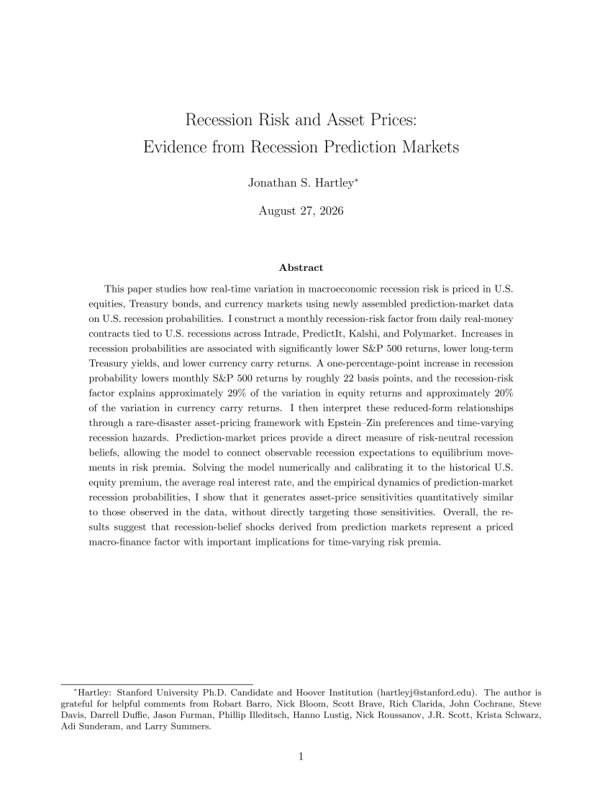
"Recession Risk and Asset Prices: Evidence From Recession Prediction Markets" by Jonathan Hartley.
"This paper studies how real-time variation in macroeconomic recession risk is priced in U.S. equities, Treasury bonds, and currency markets using newly assembled prediction-market data on U.S. recession probabilities....Overall, the results suggest that recession-belief shocks derived from prediction markets represent a priced macro-finance factor with important implications for time-varying risk premia."
https://t.co/zWDlUDrs5F
📊La especialización productiva es algo natural: permite a las economías explotar sus ventajas comparativas. España lo hace con el turismo. Otros países, con otras actividades: Noruega con el petróleo y gas, Alemania con la automoción o Países Bajos con la logística.
🏖️El problema, se dice, es que el turismo es una actividad poco productiva y de bajo valor. Pero los datos cuentan otra historia: el sector turístico explica más del 25% de las ganancias de productividad de la economía española en la última década. Y entre 2015 y 2024, la productividad por hora del turismo español aumentó cerca de un 13%, frente a apenas un 2% en el mismo sector en el resto de la Unión Europea.
💡Quizá el problema no sea nuestra especialización, sino el prejuicio con el que seguimos juzgándola. Sobre ello escribo hoy en @Act_Economica, con permiso de Jane Austen:
👉 Turismo y prejuicio
https://t.co/M1ZYgrDtQV
A young person asked me today for a few papers that would be great to read early on in one’s career. Here is a list I came up with (I posted a shorter list earlier in reply to a comment). There are many other great papers (and I apologize if I didn’t include yours), but my goal was to focus on papers that a 21-year-old undergrad would enjoy a lot. A paper on the asymptotic properties of the bootstrap or on some subtle point about New Keynesian models, as important as it might be, is not what I am looking for. Also, of course, the list reflects my deeply biased taste. So, feel free to add in the comment section other papers you love!
Philippe Aghion and Peter Howitt (1992), “A Model of Growth Through Creative Destruction,” Econometrica.
George A. Akerlof (1970), “The Market for ‘Lemons’: Quality Uncertainty and the Market Mechanism,” Quarterly Journal of Economics.
Armen A. Alchian (1950), “Uncertainty, Evolution, and Economic Theory,” Journal of Political Economy.
William J. Baumol (1967), “Macroeconomics of Unbalanced Growth: The Anatomy of Urban Crisis,” American Economic Review.
Gary S. Becker (1973), “A Theory of Marriage: Part I,” Journal of Political Economy.
Douglas W. Diamond and Philip H. Dybvig (1983), “Bank Runs, Deposit Insurance, and Liquidity,” Journal of Political Economy.
Xavier Gabaix (1999), “Zipf’s Law for Cities: An Explanation,” Quarterly Journal of Economics.
Xavier Gabaix and Augustin Landier (2008), “Why Has CEO Pay Increased So Much?,” Quarterly Journal of Economics.
Luis Garicano (2000), “Hierarchies and the Organization of Knowledge in Production,” Journal of Political Economy.
Edward L. Glaeser, Bruce Sacerdote and José A. Scheinkman (1996), “Crime and Social Interactions,” Quarterly Journal of Economics.
Sanford J. Grossman and Joseph E. Stiglitz (1980), “On the Impossibility of Informationally Efficient Markets,” American Economic Review.
Oliver Hart and John Moore (1990), “Property Rights and the Nature of the Firm,” Journal of Political Economy.
Friedrich A. Hayek (1945), “The Use of Knowledge in Society, American Economic Review.
Bengt Holmström (1979), “Moral Hazard and Observability,” Bell Journal of Economics.
Charles I. Jones (1995), “R&D-Based Models of Economic Growth,” Journal of Political Economy.
Charles I. Jones (2005), “The Shape of Production Functions and the Direction of Technical Change,” Quarterly Journal of Economics.
Michael Kremer (1993), “Population Growth and Technological Change: One Million B.C. to 1990,” Quarterly Journal of Economics.
Michael Kremer (1993), “The O-Ring Theory of Economic Development,” Quarterly Journal of Economics.
Paul Krugman (1991), “Increasing Returns and Economic Geography,” Journal of Political Economy.
Robert E. Lucas, Jr. (1978), “On the Size Distribution of Business Firms,” Bell Journal of Economics.
Kevin M. Murphy, Andrei Shleifer and Robert W. Vishny (1989), “Industrialization and the Big Push,” Journal of Political Economy.
Paul M. Romer (1990), “Endogenous Technological Change,” Journal of Political Economy.
Sherwin Rosen (1981), “The Economics of Superstars,” American Economic Review.
Alvin E. Roth (2007), “Repugnance as a Constraint on Markets,” Journal of Economic Perspectives.
Thomas C. Schelling (1971), “Dynamic Models of Segregation,” Journal of Mathematical Sociology.
Andrei Shleifer and Robert W. Vishny (1993), “Corruption,” Quarterly Journal of Economics.
Michael Spence (1973), “Job Market Signaling,” Quarterly Journal of Economics.
Robert M. Townsend (1979), “Optimal Contracts and Competitive Markets with Costly State Verification,” Journal of Economic Theory.
Martin L. Weitzman (1974), “Prices vs. Quantities,” Review of Economic Studies.
As @jburnmurdoch shows, functionally illiterate US workers earn about the same hourly wage as the average British worker, illustrating how higher US productivity elevates earnings across all skill levels.
Ultimately, education creates the workforce potential that a strong economy unleashes, while a thriving economic environment provides the returns and opportunities that give educational investment its true value.
https://t.co/8RsKzb1AF5 @ft
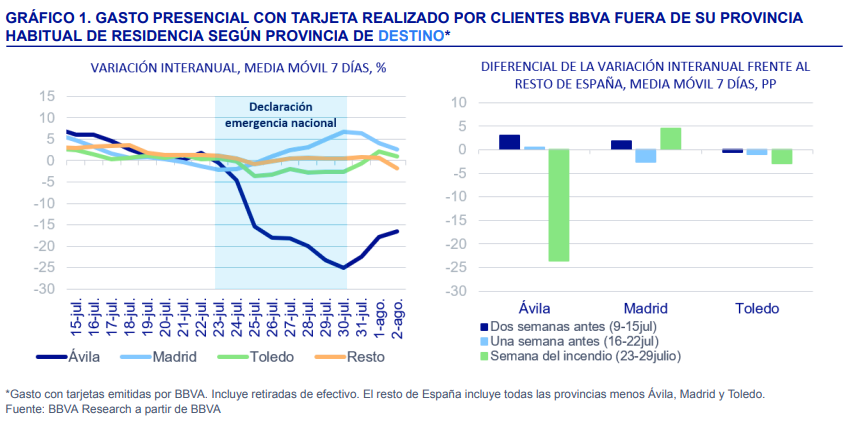
Los incendios tuvieron un impacto significativo en el gasto en la provincia de Ávila, y, con menor intensidad, en Madrid y Toledo. Análisis de @BBVAResearch con datos de gasto con tarjeta de clientes y no clientes de BBVA https://t.co/R6FbxbYcW4
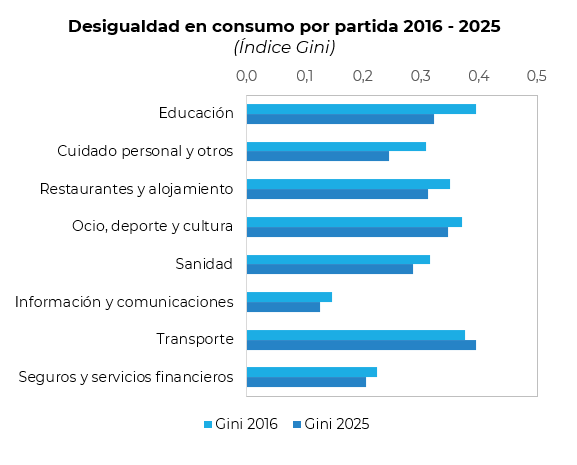
La única excepción es el transporte. Es el gran outlier de esta historia y merece un capítulo aparte. (5/5)
Os comparto aquí el link del artículo👇
https://t.co/3wiZVc6WCk
El domingo publiqué en @Act_Economica un artículo sobre cómo está cambiando las preferencias del consumo de los hogares españoles.
Hay un resultado paradójico: mientras el consumo de servicios se dispara, la desigualdad del consumo disminuye. ¿Cómo es posible? 🧵
Las preferencias de consumo de los hogares cambian silenciosamente. Comparto mi último artículo en @Act_Economica sobre las implicaciones de este cambio para la competitividad y el crecimiento de la economía española.
https://t.co/3wiZVc6WCk
La historia no se repite, pero a veces rima.
Las grandes potencias hacen sus apuestas. Algunas se renuevan. Otras permanecen.
Sobre ello escribo hoy en Actualidad Económica 👇
https://t.co/VBAQjLEMIi
Hoy publico en @Act_Economica un artículo sobre la evolución reciente de las cuentas públicas en España.
Más allá del buen dato de déficit, la clave también está en sus implicaciones económicas a largo plazo.
https://t.co/hCZ9a91K2G
En https://t.co/OoTC95cD0U mi visión sobre la actual situación económica en la zona euro y sus efectos en el proceso de convergencia con la economía norteamericana