@TMFScottP No, but it has the same essential characteristics as prohibition: make something difficult to access but don't properly police it allowing illegal markets to proliferate by attracting otherwise law abiding people.
Meanwhile, criminals get rich, Australians get sick, tax rev drops
@Glokkers@TMFScottP Lowering the excise will fix it. Tobacco consumption is up. Excise revenues are down 75%. Most people don't want to break the law but when you can buy an illegsl pack of cigarettes for 20% the price, then enough otherwise law abiding citizens choose to save their money.
@TMFScottP At this point they can't claim it's not deliberate. They've known for more than two years that tobacco consumption is up, that illegal sales are giving organised crime billions a year. Prohibition didn't work in the 20s. It doesn't work now. There's no excuse.
Racura Oncology CEO Dr Daniel Tillett (@Nucleics_Inc) was interviewed by Andrew Wilkinson, Senior Investment Analyst, Venn Brown (@VB_AndrewW) to discuss our clinical and corporate strategy in depth. Read the full report here: https://t.co/c369VPzldL #MYC#biotechresearch
Dear ABC,
If you're looking for opinions on the Census Data, here's mine.
I'm a former data analyst (crime), but I also designed a data matching algorithm still used today by Victoria Police because of its effectiveness, so I have some professional skin in the game.
I am unable to defend the 2026 prioritisation of Census questions.
How does "We urgently need nationally exhaustive information about whether someone identifies as straight, gay, bisexual or another sexual orientation"...
While we didn't obtain nationally exhaustive information about whether households can access a GP,
whether they have unmet childcare needs,
whether working people commute three days rather than five,
whether households are involuntarily overcrowded because they cannot find housing.
Or these types of questions, which would surely be hard to argue against from a prioritisation perspective of best value for data capture, and best opportunity for Australians to provide a holistic picture of their lives;
Citizenship / visa or residency status (because Country of birth doesn't tell government whether someone is a citizen, permanent resident, international student, temporary worker, etc. Those populations can impose quite different infrastructure/service demands).
Year a non-Australian-born person obtained permanent residency/citizenship (because there is much better longitudinal information about settlement and integration than birthplace alone)
Primary mode of transport normally used (Census asks about journey-to-work circumstances, but hybrid/WFH has made a single Census-day travel snapshot much less informative than it once was).
Housing capacity/occupancy pressure (Bedrooms alone is crude. Ask whether people are sharing bedrooms, using converted garages/studies, or accommodating people who would otherwise live elsewhere. That's enormously relevant during a housing shortage).
Reason adults remain in/shared household (Understanding drivers of Financial necessity, caring, cultural preference, disability, housing unavailability etc...would distinguish genuine housing stress from chosen multigenerational living & inform other pressure points th Government can focus on).
Internet quality/access (As infrastructure in its own right, particularly with WFH, telehealth and online government services).
Household energy characteristics (Solar, battery, EV charging, gas/electric heating etc... would be extraordinarily useful for electricity-grid infrastructure planning)
Many of these variables have extremely obvious relationships with hospitals, roads, rail, schools, housing, childcare, workforce participation and infrastructure investment.
The ABS also removed “number of children ever born” from the 2026 Census (it will return in 2031).... while introducing gender and sexual orientation.
From a strategic-planning perspective, fertility and family formation are among the most consequential long-term variables imaginable. They affect future school enrolments, workforce size, dependency ratios, healthcare demand and population ageing.
This missed opportunity to capture all those above mentioned data sets to inform in policy/planning areas isn't just a shame, it's borderline failure of professional judgement.
We removed access to data that could inform those things, and replaced it with gender questions.
Who managed to convince a ABS strategic review board
“We don't have enough justification to collect fertility information every Census, but sexual orientation warrants universal national collection every five years”??
I'd love to see the cost-benefit/consequences methodology behind that decision !
The reality is the Census can only ask so many questions, and we should prioritise the ones that provide the greatest benefit for planning Australia's future, not pander to the "feelings" of a tiny majority of people that got warm and fuzzy because a national census survey "affirmed" their gender.
Thank you, if you read this.
ok this might be the most aggressively american startup i’ve ever seen 🇺🇸
> they’re trying to build nuclear reactors 100x faster than the nuclear industry ever has
> the founder isaiah taylor grew up on food stamps + dropped out of high school at 16
> his great-grandfather literally worked on the manhattan project
> generations later isaiah built a working nuclear reactor before turning 28 and named it “ward” after him
> the pentagon used 3 military c-17s to airlift the reactor 700 miles from california to utah in a first-of-its-kind mission
> the company culture is hardcore americana
> they hold bible studies, offer raw milk, love fast cars + have a cigar lounge
> plus 4 gigantic patriotic paintings of columbus discovering america, the pilgrims arriving on the mayflower, the signing of the declaration + the constitutional convention
> they sued the nuclear regulatory commission for slowing them down
> valar's end goal is to build the same reactor thousands of times across nuclear “gigasites” to make energy 10x cheaper
> then they'll use that energy to pull carbon out of thin air and turn it into oil and gas for supreme energy abundance
> just raised $1b at a $6b valuation to scale it
> if valar pulls it off, isaiah’s family will have helped usher in both of america’s atomic ages
yeah this gets my vote for most badass startup of the year
@BenjaminJungson@TheJerzWay If the IP is all intellectual, simply close down the Australian business. It's a small business, so will the ATO chase you for selling the URL and business name below market value? Arguably, what IS the market value for a domain name and business name without a business?
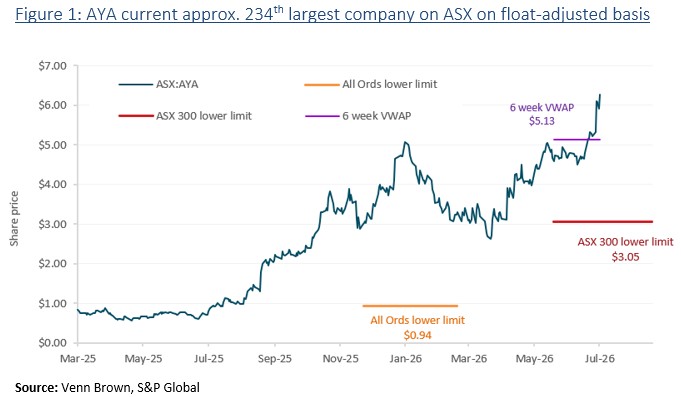
AYA is currently the ~234th largest stock on the ASX on a float adjusted basis. For ASX200 inclusion a company must be 179th on a float adjusted basis. At current levels AYA needs to trade at arount $11.58 per share. There is a path to this. Read the full report for details
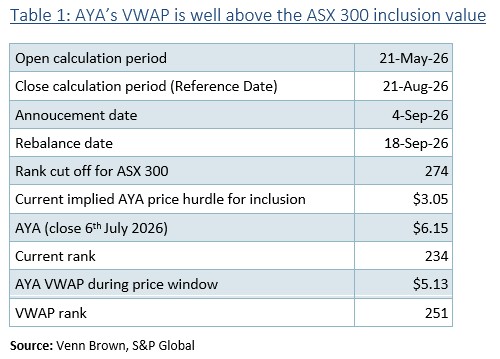
@Artrya1 is on track to join the ASX300 at it's rebalance September. At current levels, AYA needs to trade above $3.05 to be included, compared to yesterday's close of $6.18, and the pricing window VWAP of $5.13.
Window closes: 21-Aug
Announcement: 4-Sep
https://t.co/08bie5nLWR
The rebalance takes affect from 18-Sep.
To miss inclusions either the rest of the market needs to trade materially higher, or AYA drop to below $2 per share for the next 7 weeks.
@DavidMaywald Not that averages have the meaning most people apply, if we're going to have an entire government department dedicated to the random number generator that is the gender wage gap, we should at least acknowledge whee it currently sits.
@SpachusAus@matt_barrie The ceiling has not been reached. My rent has increased 30% in 3 years. If I add another 30% to the rent, there are literally only 3 listings within 1km of my place. If my landlord increases my rent by 10 or 20% my options are swallow it, or move +3km away.
@matt_barrie@RumblevsFrenzy Australia != US. The US has non-recourse loans. People could simply walk away from their mortage. The US economy was not nearly as leveraged to property as Australia. We couldn't survive a 20% decline in property values let alone 50%.
Gov't will do EVERYTHING to keep prices up.
@I_Menelaus @matt_barrie With a national vacancy rate of 1.2% (1.3% in Sydney, 1.5% in Melbourne, 0.8% in Brisbane) it's landlords who have the power. Rents will go up. Hopefully some will sell to lock in the lower CGT rate. Time will tell.
https://t.co/TpzWVpjKyf
Google is making $62 billion a quarter destroying the websites it NEEDS to survive.
This is literally a death spiral that ends with Google killing itself.
Let me explain what's going on...
Google added AI summaries to the top of every search result in 2024.
When you Google something now, the answer sits right there on Google's page. You never have to click anywhere. Google took the information from someone else's website, summarized it, and kept you inside Google's ecosystem.
The result: 60% of all Google searches now end without a single click to any website.
Small publishers lost 60% of their traffic in one year. Medium publishers lost 47%.
Even the biggest names in media, the New York Times, the Washington Post, Business Insider, all saw traffic fall between 22% and 55%.
The Axios CEO called it "a referral extinction event for the ad-supported web."
Google's response to all of this was to tell publishers they can "opt out" of having their content summarized. But opting out also REMOVES your description from normal search results.
So the choice Google gives you is let us steal your content for free, or become invisible on the internet.
That's extortion.
The Washington Post laid off another round of journalists this year because of it. Stereogum, one of the most respected music publications on the internet, had to BEG readers for donations.
Business Insider cut 21% of its staff. Dozens of smaller publishers have shut down entirely.
The people who actually CREATE the information Google summarizes are going bankrupt while Google posts record revenue.
But here's where this gets interesting and where everyone stops thinking:
Google's AI summaries are only as good as the content they summarize. If the publishers who write the original articles, run the original investigations, and create the original data go out of business, there is nothing left for Google to summarize.
The AI starts recycling old information, the answers get stale, the quality drops, and users start noticing that Google's summaries are increasingly wrong, outdated, or useless.
Google is essentially strip-mining the internet for short-term revenue. They are extracting all the value from content creators without paying for it, driving those creators out of business, and then wondering why the quality of their own product is declining.
This is exactly what Napster did to the music industry in the early 2000s:
Made content free, creators went broke, and quality collapsed. It took a decade to rebuild.
Google is doing the same thing to the entire internet at 100x the scale.
Rolling Stone, Variety, Deadline, The Hollywood Reporter, and Billboard are now suing Google for antitrust violations. Chegg, the education platform, lost 49% of its traffic and is suing too.
The UK's competition authority just ordered Google to let publishers opt out without being punished. The DOJ already ruled Google is an illegal monopoly.
And Google's defense in court is genuinely unbelievable.
They argue that publishers CHOOSE to let Google index their content and can leave anytime they want. That's like saying you choose to pay protection money to the mob because technically you could close your business and move to another city.
Google controls 90% of search. Leaving Google means leaving the internet.
Meanwhile Google is investing billions in custom AI chips to make these summaries cheaper at scale. Every quarter the problem gets worse.
The internet as we've known it for 25 years ran on a simple deal:
Publishers make content.
Google sends traffic.
Advertisers pay for the traffic. Everyone wins.
But Google just BROKE that deal and kept all the money.
@leighjasper It was already happening before this change, but it's going to accelerate. I've spoken with several young entrepreneurs & they're all planning to leave Australia for lower taxes countries. 100% online businesses, they can't afford property 5yrs overseas puts them 15yrs ahead.
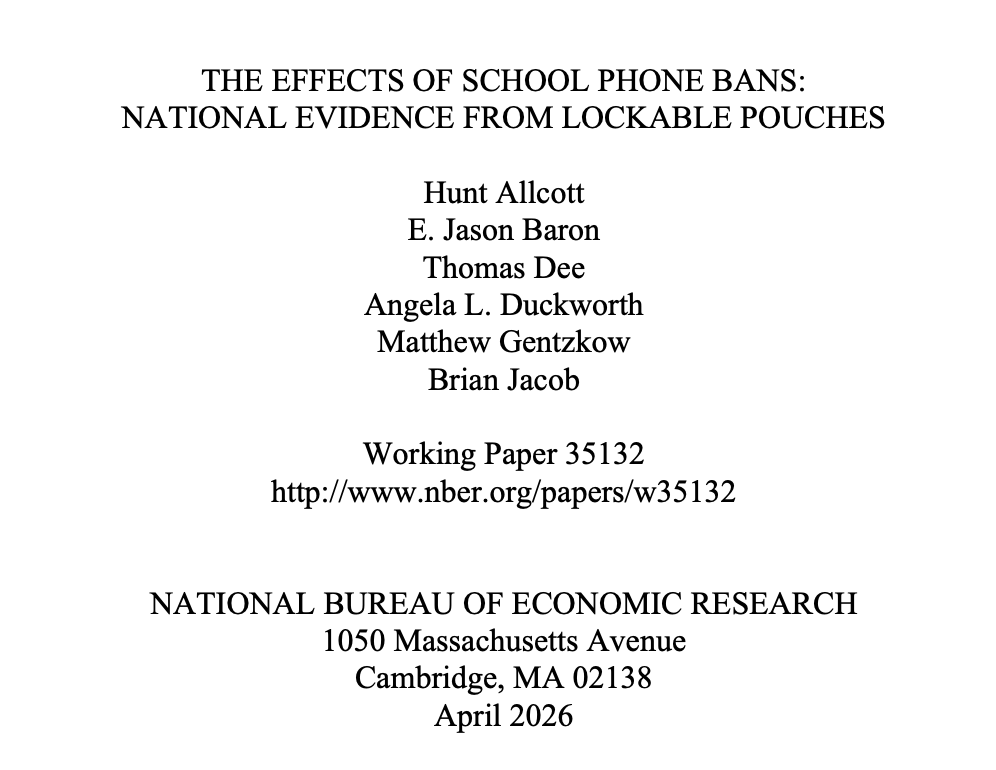
The Allcott et al. study on phone free schools is extraordinary in the way they combined data from various sources, including surveys, administrative data, and GPS measurements. And it was done by an interdisciplinary team of top researchers. Many have asked me for my take on it.
I first want to emphasize the tentative nature of the paper’s findings. This is still a working paper and has not yet been peer reviewed. I’m also currently in conversation with the authors about additional data that would help me better understand the results, so my own view remains provisional. We also think it will be important that the study be updated over the next few years, once more post implementation data is available. With those caveats in mind, here are my main thoughts:
First, it’s important to understand what the study actually assessed. It used administrative data from Yondr and it looked at changes over time in schools that adopted Yondr pouches, compared to changes over time in schools that used any other method or had any other policy. We do not yet know about the effects of other methods that separate kids from phones, such as schools that collect phones in the morning, or require them to be kept in student lockers, or in special phone lockers.
The headline finding was that adopting Yondr did not improve test scores overall, with high schoolers seeing a modest gain but middle schoolers seeing a small decline. But, it’s important to note that the study found several positive effects of Yondr pouches. Teachers really like phone free policies, they think they are helping, and in this study teachers reported higher satisfaction and less personal phone use in their classrooms in the Yondr schools than in the non-Yondr schools. Also, a set of survey questions about student well being declined in the first year, but “recovers, becoming positive” by the third year.
Second, it is important to note that the authors state the limitations of the paper clearly. One of the authors, Thomas Dee, spoke to the New York Times:
Overall, Professor Dee said, he considered the study an “encouraging” early report on strict cellphone bans. He warned against abandoning a broadly supported policy because test scores did not immediately go up, or because implementation presented disciplinary challenges.
The damage from distraction and fragmented attention has been compounding for years, and it may take years to turn it around -- especially if newly phone-free students can just turn to their school-issued Chromebooks and iPads for distraction during class. So a lot more work needs to be done to improve the climate for cognitive development in schools and to measure more variables about classroom ecology.
In the meantime, phone-free schools seem to be producing more social interaction in class, and a lot more noise and laughter in the hallways, and at lunch. Teachers like their jobs more, and some schools report big increases in library books taken out. All of these social benefits seem to kick in in the first few months. I hope other researchers will study these widely reported social and behavioral effects more systematically.
Here’s the working paper:
https://t.co/wopCsScpFP
How much do I need to pay the plumber who isn't yet automated away, how will I afford it, and for how long will he work until he decides a life on the beach is better than being arm deep in sewers.
I'm sure I'm not alone when I say that this is the exact end point I saw as the obvious and only path resulting from following the strategies taunted by AI proponents. In this world of abundance, who's paying and with what?
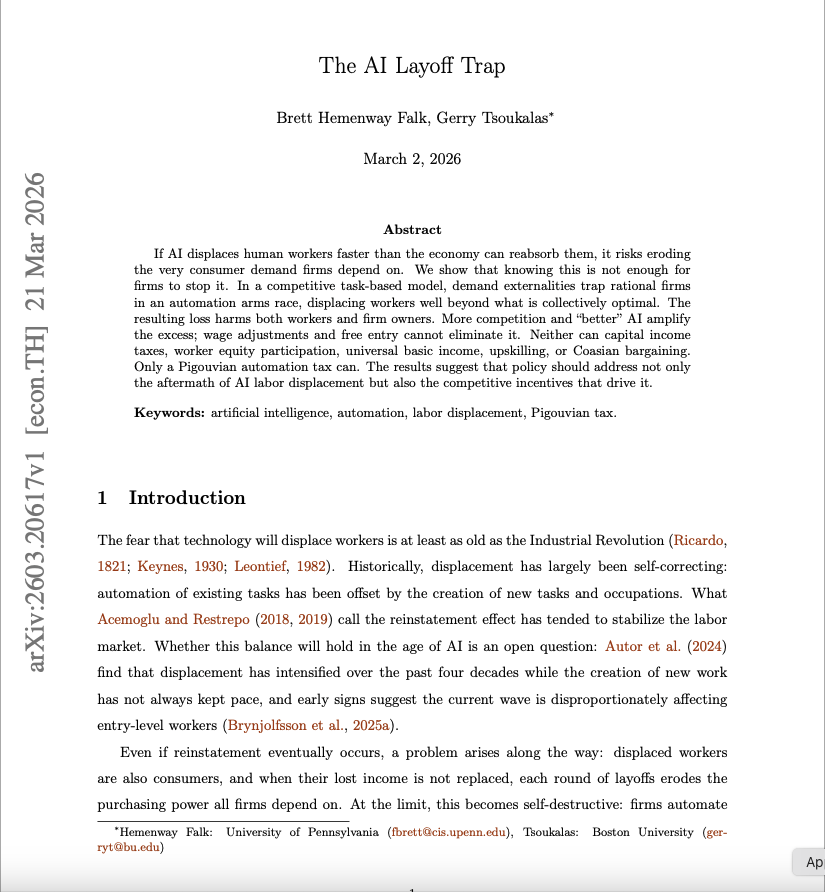
Two economists just published a mathematical proof that AI will destroy the economy.
Not might. Not could. Will — if nothing changes.
The paper is called "The AI Layoff Trap." Published March 2, 2026. Wharton School, University of Pennsylvania. Boston University. Peer reviewed. Mathematically modeled.
The conclusion is one sentence.
"At the limit, firms automate their way to boundless productivity and zero demand."
An economy that produces everything. And sells it to nobody.
Here is how you get there.
A company fires 500 workers and replaces them with AI. A competitor fires 700 to keep up. Another fires 1,000. Every company is behaving rationally. Every company is following the incentives correctly. And every company is building a trap for itself.
Because the workers who were fired were also customers.
When they lose their jobs faster than the economy can absorb them, they stop spending. Consumer demand falls. Companies respond by cutting costs — which means automating more workers — which means less spending — which means more falling demand — which means more automation.
The loop has no natural exit.
The researchers tested every proposed solution. Universal basic income. Capital income taxes. Worker equity participation. Upskilling programs. Corporate coordination agreements.
Every single one failed in the model.
The only intervention that worked: a Pigouvian automation tax — a per-task levy charged every time a company replaces a human with AI, forcing them to price in the demand they are destroying before they pull the trigger.
No government has implemented this. No major economy is seriously discussing it.
Meanwhile the numbers are already tracking the curve. 100,000 tech workers laid off in 2025. 92,000 more in the first months of 2026. Jack Dorsey fired half of Block's workforce and said publicly: "Within the next year, the majority of companies will reach the same conclusion."
Nobody is doing anything wrong. Companies are following their incentives perfectly. That is exactly the problem.
Rational behavior. At scale. Simultaneously. With no mechanism to stop it.
Two economists built the math. The math leads to one place.
Source: Falk & Tsoukalas · Wharton School + Boston University ·
https://t.co/4m8E9jQNYm
Equally important, how do we get through the uncanny valley where 10% of the work force is still needed, while the rest of us are supposedly luxuriating on the beach?