Every week someone asks me: "what is your price target for X altcoin?"
I do not answer that question with a number. I answer it with a method.
Here is the method. It takes about 5 minutes and works for any altcoin.
Step 1: Find your BTC drawdown reference.
Take Bitcoin's recent high and its most recent bear market low. In this cycle: from roughly 108K in January down to 61K in February. That is a drawdown of roughly 44%. Call this the BTC drawdown.
Step 2: Find your altcoin's matching drawdown.
Over that same period, how much did your altcoin drop? As an example: from about 700 dollars at the December high to around 200 dollars at the February low is roughly a 71% drop.
Step 3: Calculate the beta multiple.
Divide the altcoin percentage drawdown by the BTC percentage drawdown.
71% divided by 44% equals approximately 1.6x.
This is how much more your altcoin drops relative to BTC.
Step 4: Project your altcoin's target entry.
Now pick your BTC scenario. Say you think BTC could drop to 60K from around 77K today. That is roughly another 22% down. Apply the 1.6x beta: 22% times 1.6 equals about 35% drop for your altcoin. If the altcoin is currently at 60 dollars, a 35% drop puts you around 39 dollars.
That is your data-backed entry zone. Not a number you made up. Not a target from Twitter. A structured projection from actual price history.
Two things to watch out for.
First, beta multiples change. A coin that was 1.6x beta in the last leg can become 2.5x beta if sentiment shifts. Treat this as a floor estimate, not a ceiling.
Second, the method only works if you also pick the right BTC scenario. If Bitcoin goes sideways instead of down, your altcoin may not hit the target at all. The math is conditional on your BTC call.
The reason this beats gut-feel price targets: it anchors you to actual historical price behavior rather than pattern-matching to a chart that looks oversold. A lot of coins that look cheap at minus 50% from ATH have a BTC-beta that means they could go to minus 70% or 80% if BTC has one more leg down.
Until Bitcoin confirms the next bull run with a weekly close above roughly 95K, I am not buying altcoins. But if you are building a watch list and want to know where to put your limit orders, this is the framework.
Everyone in crypto is waiting for "the final capitulation" before they buy. The logic: bear markets always end with a violent crash at the very bottom, so wait for the pain, then back up the truck.
Three bear markets say this is wrong.
2022: Yes, the worst drop came at the end. FTX in November was the absolute low, one full year from the peak. If you were waiting for maximum pain, that cycle rewarded you. That's the data point everyone remembers.
But look at 2018 and 2019. The first dip after the peak was already the lowest point. The market did not make new lows later. The "final capitulation" never came. If you were waiting for it, you missed the entire bottom.
Same story in 2015. The first big drop around the six-month mark was as low as it got. After that, the bear market bottomed with a higher low. The catastrophic endpoint that everyone was waiting for was the first dip, not the last.
So now in 2026, the crowd is saying: "bear markets last 12 months, midterms are in November, Bitcoin always bottoms around the midterm cycle, so wait for October."
The problem is you are pattern-matching to 2022 and ignoring 2015 and 2018. You have exactly one data point supporting the "wait for October" thesis and two data points directly contradicting it.
Sitting out until the final month of a bear market is a coin flip, at best. And in the meantime, if Bitcoin goes to 60K in June and you are waiting for an October bottom, you are going to rationalize not buying. You will tell yourself: "It hasn't fully capitulated yet." You will watch it bounce from 60K and spend the next bull run wondering what happened.
The 200W SMA does not care about the calendar. In 2015, it hit the SMA early. In 2019, it hit the SMA early. One out of three bear markets bottomed late. Those are the odds you are betting on when you wait for the calendar instead of the chart.
My framework: when BTC touches the 200W SMA, currently around 61K and moving to roughly 63-64K in two months, that is the signal. Not October. Not one more leg down. The SMA is the trigger. Two out of three prior cycles confirm it.
If you are waiting for the worst, you may already be at it.
The right person who reads this will make a lot of money.
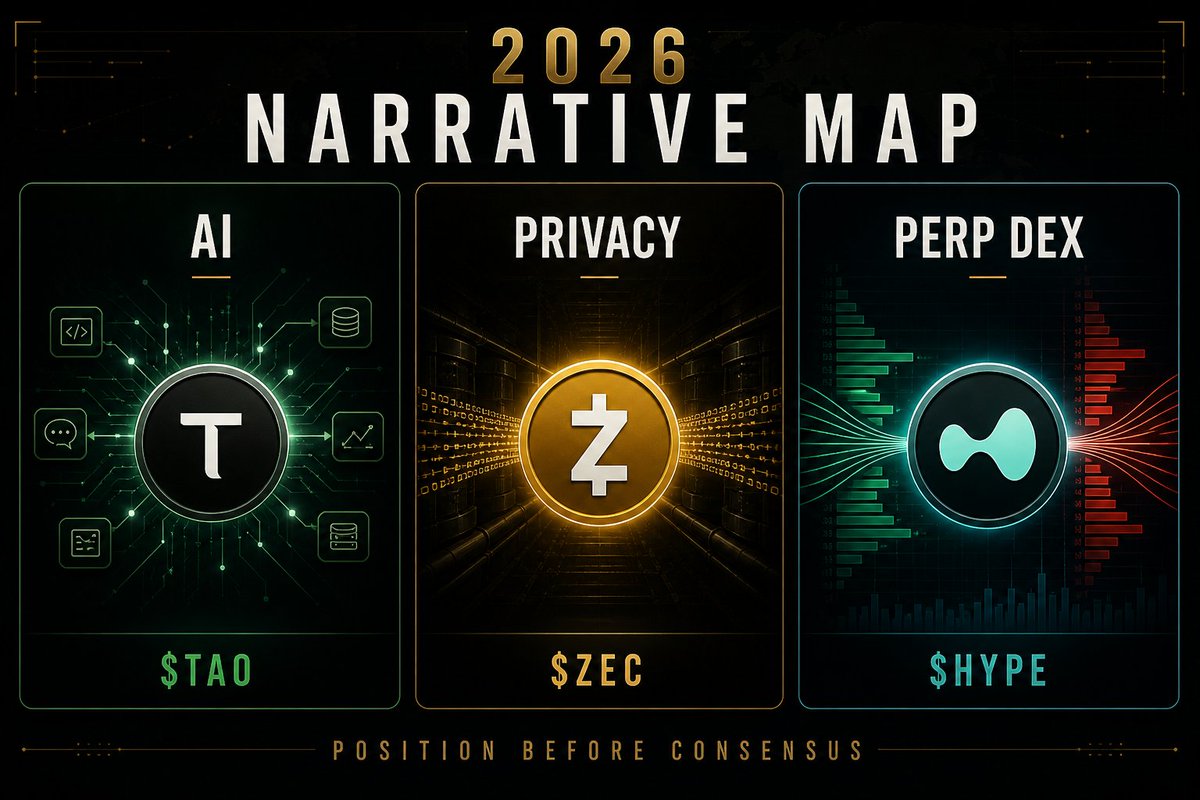
Here are the 3 biggest narratives I’m watching in 2026:
1. AI ( $TAO )
Why it matters: Get rid of the busy work & automate
2. Privacy ( $ZEC )
Why it matters: Your data is compromised. Privacy is the solution.
3. Perp DEX ( $HYPE )
Why it matters: If you dominate where the money flows, you win.
Most people will wait until prices move.
The edge is positioning before the narrative becomes obvious.
The shift in the crypto fundraising landscape the past 6 months has been insane.
Crypto VCs used to have to constantly be networking/writing/podcasting/going on spaces/promoting your thesis/getting on 10 deal flow calls a week, to get into good deals...now it's literally enough to just have capital to write checks.
Deals are being pushed rather than dug out. Inbound if people know you have money is at an all-time high.
Most firms are either 1) Out of money 2) Moved to Series A and beyond or 3) Fundraising (with no success).
Deals that used to close in 2-3 weeks now close in 2-3 months.
Firms with questionable business models or copy pasta of the latest trend are getting zero primary or follow-on funding (Good news!).
There are now realistically <20 firms writing checks in pre-seed/seed.
VCs basically have the pick of any deal they want, with more time to do DD.
IMHO 25/26 are going to be historic vintages for those who stick around.
What happens when you build a STOCK MARKET FOR AI & Incentive from scratch? $TAO
Walk you through something that most people in crypto still don't understand.
Not another L1. Not another DeFi fork. Not a meme coin with a roadmap that leads nowhere.
I'm talking about what happens when you take Bitcoin's scarcity model, fuse it with a decentralized intelligence network, and build an entire economy around artificial intelligence from the ground up.
I'm talking about Bittensor. $TAO.
And once you see the full picture, you can't unsee it.
Foundation:
At its core, Bittensor is a decentralized network where anyone can build, train, and deploy AI. No permission needed. No billion-dollar data center required. No board of directors deciding what gets built and what gets killed.
The network runs on Subtensor, a proof-of-stake blockchain that coordinates the entire operation. But here's where it gets interesting Bittensor isn't one AI model. It's not trying to be the next ChatGPT. It's the infrastructure layer that allows THOUSANDS of AI models to compete, collaborate, and get rewarded for producing real value.
Think of it like this: if OpenAI is a single restaurant trying to cook every dish on the planet, Bittensor is the entire food market, hundreds of specialized chefs competing to make the best version of every dish, and the market rewards the best ones automatically.
That market?
128+ Subnet
Unnoticed AI Economy
128+ active subnets (scaling toward 256 in 2026 roadmap). Each a specialized marketplace for AI commodities: text gen, code, images, inference, search, drug discovery, sports data, fraud detection, even non-AI incentive layers.
Miners produce, validators score via Yuma Consensus, owners set rules. Real revenue flows: Chutes (SN64) did $1.35M in 90 days on decentralized GPU inference. Others like Desearch (SN22), Templar (SN3), Numinous (SN6), Score (SN44), Ridges (SN62) building production-grade AI.
Subnet tokens aggregate $800M market cap. Real capital, real production, not hype.
Tokenomics: Bitcoin + AI
$TAO: 21M hard cap, no pre-mine/ICO. All earned via mining/staking.
First halving Dec 2025: daily emissions cut 7,200 = 3,600 TAO (13% annual inflation now). Four-year cycles like BTC.
Circulating supply 10.7M TAO. 70-73% staked = ultra-thin float.
Emissions: 41% miners, 41% validators, 18% subnet owners. Aligned incentives.
Dynamic $TAO (dTAO, launched Feb 2025): Stake $TAO into subnets get subnet Alpha tokens. Capital votes on best AI verticals. High-performers get more emissions. Market decides winners, no committees.
This IS the stock market for AI. Architecture, not metaphor.
Institutional:
Grayscale filed to convert its Bittensor Trust (GTAO) into a spot ETF. Bitwise filed for a TAO Strategy ETF. Europe launched the first Staked TAO ETP on the SIX Swiss Exchange with built-in staking yields.
Barry Silbert's Yuma launched an Asset Management arm specifically for subnet exposure. Stillcore Capital co-founded by Jason Calacanis launched a fund targeting subnet tokens. BitGo and Copper are providing institutional custody.
Backed by Galaxy, Polychain, Multicoin Capital. Research partnerships with Harvard and MIT.
This isn't retail speculation anymore.
This is infrastructure being recognized by the same people who recognized Bitcoin and Ethereum early.
OpenAI burns $5B+/yr. Google $50B+ capex. Closed-door, shareholder-first.
Bittensor inverts it: 128+ independent teams build specialized AI, compete openly, funded by emissions, quality enforced by validators, capital allocated by stakers.
No single point of failure. No CEO deciding what research lives or dies.
No fundraising rounds diluting builders. Just pure, market-driven, decentralized intelligence producing real commodities, generating real revenue, attracting real institutional capital.
21 million tokens.
First halving done.
128 subnets live. 73% staked. ETF filings in motion. Revenue in the millions.
*Not financial advice. DYOR.*
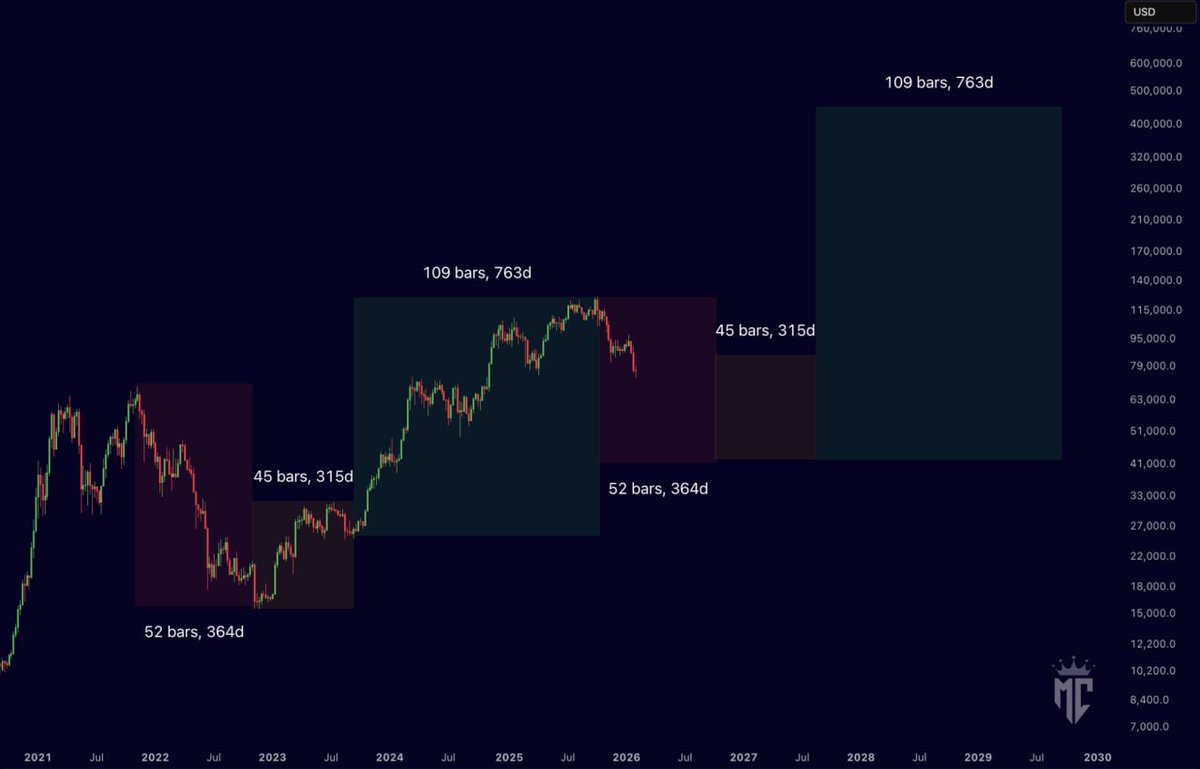
🚨 WARNING: You're watching history repeat in REAL TIME.
The cycle is playing out EXACTLY as before:
364 days of pain
315 days of accumulation
2 YEARS of euphoria ahead
This is NOT complicated.
My pinned post shows you EXACTLY how to position for what's coming.
Just scrolled my feed for 20 minutes
Now is the most confusing timeline I’ve ever seen.
BTC is still around $90k, but nobody knows what’s next:
- will alts ever run?
- when BTC will go to $150k?
- how to make money in this market?
This article is ur key to those questions:
A lot of people have already messaged me saying it completely changed how they think about the current crypto market - and helped them understand what comes next and how to make money in crypto.
Glad it helped.
If you’re also confused about where the market is heading, and what to do on the market rn - spend 10 minutes reading this instead of doomscrolling.
It will give you clarity and may change how you think about the market forever.
Let's simplify things.
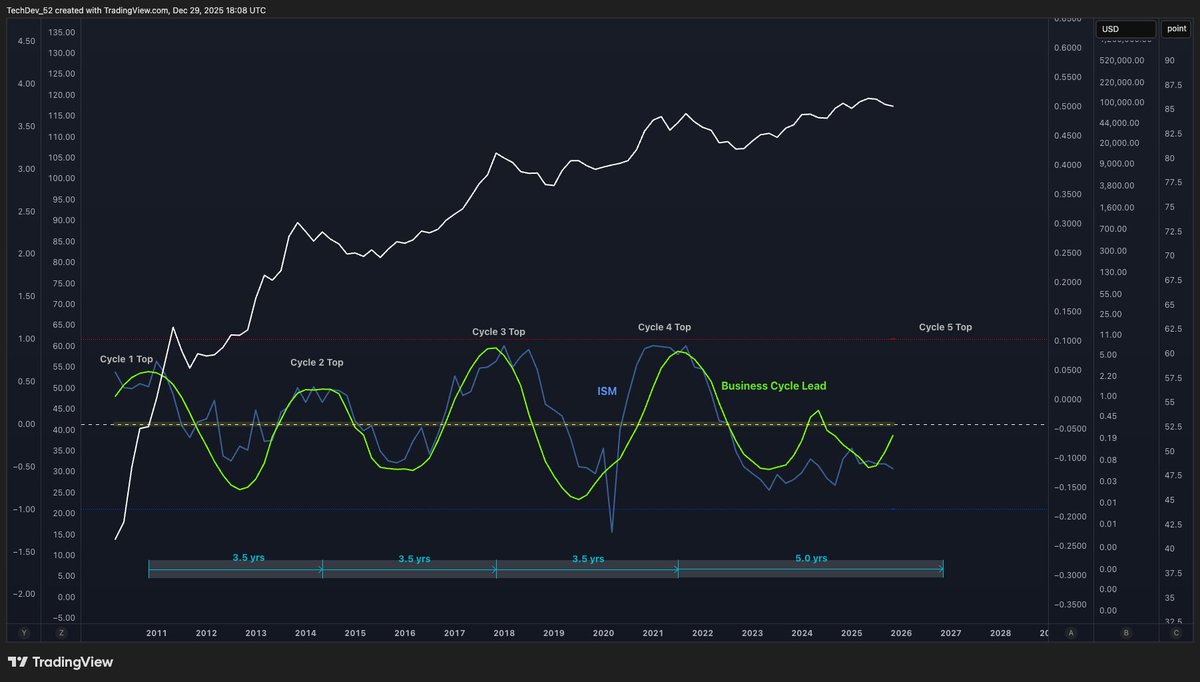
The 4 yr cycle was only the 4 yr cycle because the last three business cycles were ~4 yrs.
The global business cycle has always driven Bitcoin's. When it topped, Bitcoin topped. When it reversed off the bottom, Bitcoin went parabolic. Even the shapes of charted business cycle metrics have dictated the shapes of Bitcoin cycles.
ISM is a well-accepted measure of this business cycle. Look at the last 3 yrs. A mini-cycle at best, flat at worst. ISM never pushed above 50, and thus crypto never went parabolic. Halving or not.
Why? A strong argument for the ~4 yr business cycle cadence has been the ~4 yr refinancing cycle of US debt. This time, the US holds an additional ~1.5 yrs of average debt maturity due to the COVID-induced rate crash. Likely extending the business cycle by ~1.5 yrs. @RaoulGMI and @BittelJulien have spoken about this at length.
Now to look ahead.
The green signal has always mirrored ISM. More recently, it has led.
What do we see? A major uptick off the bottom. The stuff that starts Bitcoin runs, not ends them. Not on the hourly chart. On the monthly and quarterly.
ISM is expected to follow, and finally lift off its 3 yr floor.
Fifteen years of history tells us what crypto likely does next.
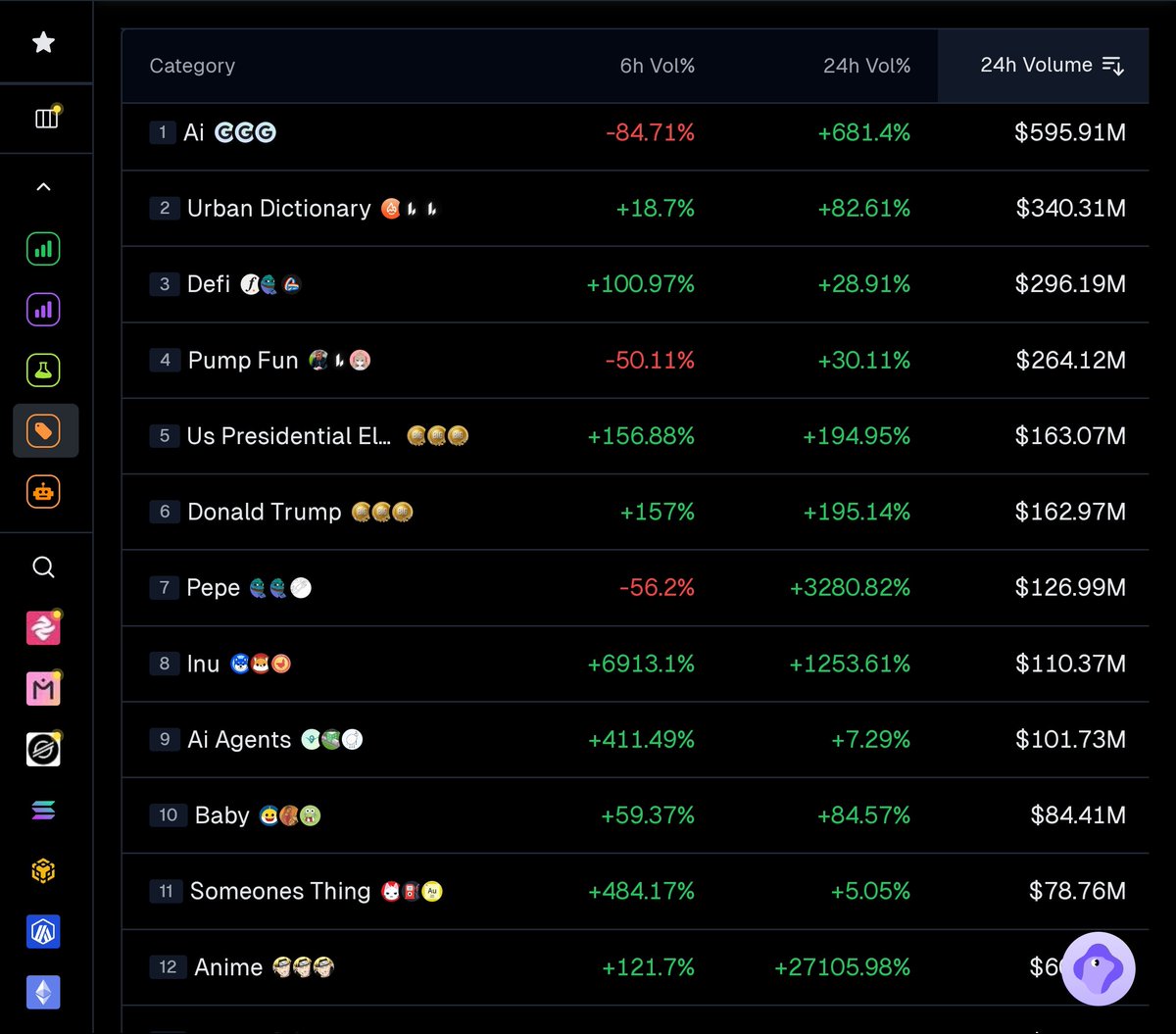
One of the best ways to actually see where liquidity is flowing once attention returns when the relevant indicators pop up is checking:
Trending Chains + Trending Categories on @GeckoTerminal.
The days of "everything will pump and more" don't apply anymore.
Narratives matter
chain volume matters
asset selection matters
Once a narrative pops up and you combine it with the highest chain of interest/volume?
Your winners are 99% of the time going to be there.
Kinda reminds me of Arbitrum season when it didn't look like a bull market was here but it literally was for everyone trading on there.
Again, it's not always the right time to trade everything (like today) but when it does, GeckoTerminal is great!
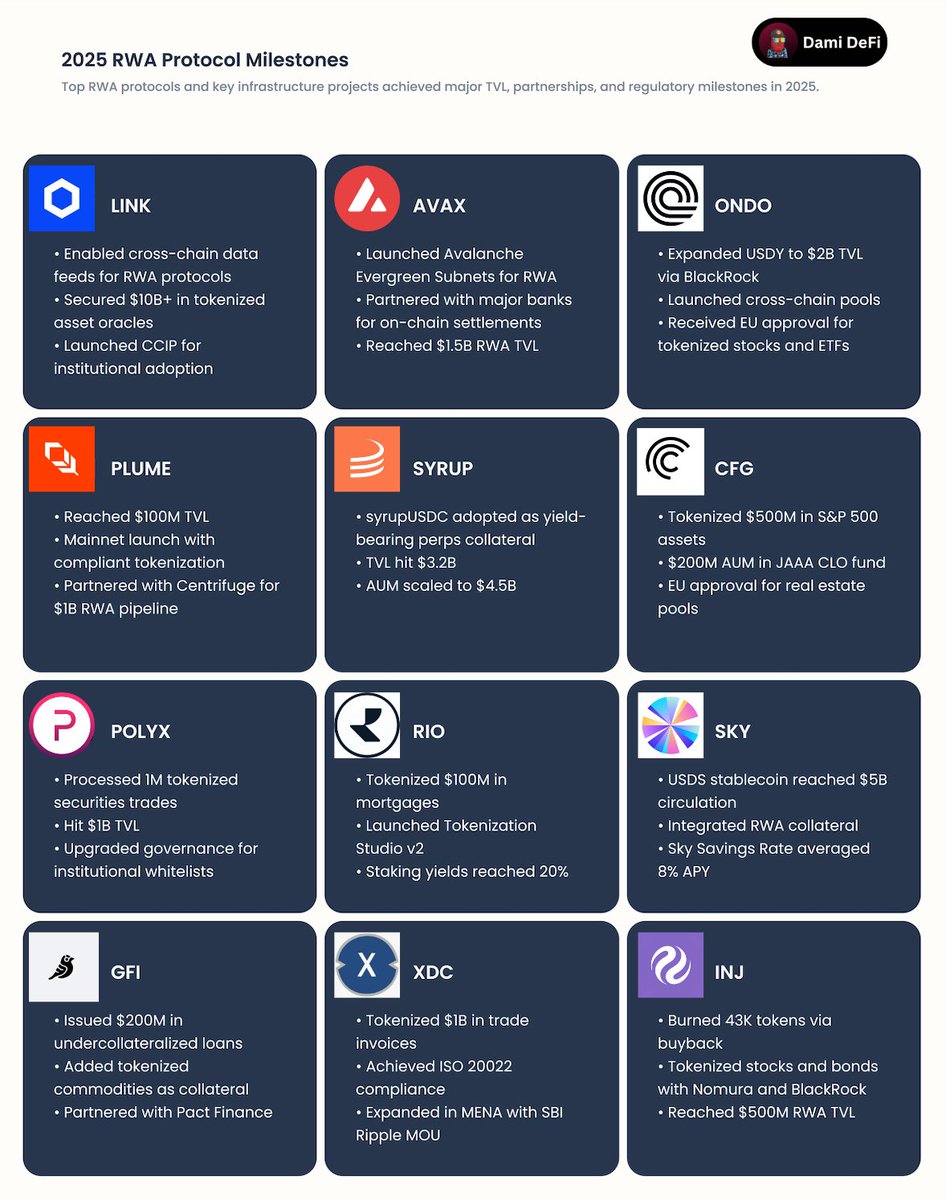
If you’re ignoring RWA, you’re ignoring half of what actually advanced in crypto in 2025.
2025 Milestones For RWA Protocols:
$ONDO: Expanded USDY to $2B TVL via BlackRock, launched cross-chain pools on Solana/Base, secured $500M institutional inflows for T-Bills, received EU Approval for Tokenized Stocks & ETFs.
$LINK: Selected by U.S. Dept. of Commerce for on-chain macro data, Confidential Compute + Chainlink Runtime Environment launched, Joined SEC crypto task-force, Won Swift Global Fintech Hackathon, First regulated Chainlink ETF announced
$AVAX: Daily tx up to 2.5M, DeFi TVL $5B, 500+ new dApps, SkyBridge tokenized $300M hedge funds, Securitize pan-EU tokenization system, Aug DEX volume $11.5B, Grayscale S-1 for AVAX ETF, C-Chain 65M unique wallets ATH, Visa stablecoin integration, Avax Treasury targeting $1B ecosystem treasury.
$PLUME: $100M TVL in Nest vaults, full mainnet launch with compliant tokenization, partnered with Centrifuge for $1B RWA pipeline, hit 50K active users
$SYRUP: AUM scaled to $4.5B, TVL hit $3.2B, syrupUSDC integrated as RWA collateral
$CFG: Tokenized $500M in S&P 500 assets, JAAA CLO fund reached $200M AUM, integrated with Plume for cross-chain lending, regulatory approval for EU real estate pools
$POLYX: Processed 1M tokenized securities trades, upgraded governance for institutional whitelists, partnered with IXS for PE/bond tokenization, hit $1B TVL milestone
$RIO: Tokenized $100M in mortgages, launched RWA Tokenization Studio v2, XRPL bridge for asset migration pilots, staking yields hit 20%
$SKY: USDS stable reached $5B circulation, integrated RWA collateral for sUSDS vaults, Sky Savings Rate averaged 8% APY, multi-chain expansion to Base/Solana
$GFI: Issued $200M in undercollateralized loans, added tokenized commodities as collateral, partnered with Pact Finance, achieved 12% average borrower yield
$XDC: Tokenized $1B in trade invoices, ISO 20022 compliance for institutional rails, MENA expansion with SBI Ripple MOU, payments hit 1M tx/day
$INJ: Burned 43K INJ via buyback, tokenized stocks/bonds with Nomura/BlackRock, $500M RWA TVL via oracle integration, sub-second perps for RWA trading
Nearly 97% of altcoins on Binance are trading below their 200-day moving average - one of the most oversold readings on record (similar to COVID lows).
When most alts sit below it, historically markets are deeply oversold. In past cycles this formed major bottoms before recoveries.
It’s coming.
We've never seen a yearly candle look like this for Bitcoin.
Price has essentially gone nowhere, and spanned a $51k range.
What does it mean?
Technically, this is a Doji candle. It means the price opened and closed at roughly the same level, signifying a complete lack of directional momentum.
The 2024 candle is large and green. The market likely priced in the halving early due to the Spot ETFs (approved Jan 2024). By the time 2025 arrived, the "easy money" had already been made, leaving 2025 as a year of distribution rather than accumulation.
This chart visually confirms the law of diminishing returns.
Cycle 1 (2013): Massive body.
Cycle 2 (2017): Large body, but smaller relative to price.
Cycle 3 (2021): Smaller body, longer wicks.
Cycle 4 (2025): Non-existent body.
This candle supports the theory that Bitcoin has graduated into a mature macro asset.
We have many of the 4 year cycle cultists claiming complete victory, but I think it is prudent to be very careful of any bias going into 2026, especially as this yearly candle shows BTC has behaved in a way it never has before.
I think you have to take that into account.
My outlook for 2026:
It is entirely plausible that next year is not as bearish as the frothy bears want, nor as explosive as the bulls hope.
We could see a slow, boring grind upward to close to new highs (maybe even new highs, I'm not going to completely rule it out, although its not my base case), driven by passive institutional flows with retail still mostly absent.
What are the downside catalysts that could make it a classic nasty BTC bear market?
Quantum fud.
That remains a topic that can lead to emotional selling, as almost nobody actually understands the topic, and is at the whims of narrative.
You can't really forecast this, as we could see headlines either mitigate the impact of quantum fud, or accelerate it.
I have still seen convincing write ups to support both the doomers and dismissers of quantum fud for bitcoin.
I think in a fiscal repression type environment BTC will find many buyers, and getting sensationally bearish and blindly following past cycle PA is unwise and ignoring the macro regime that we are in.
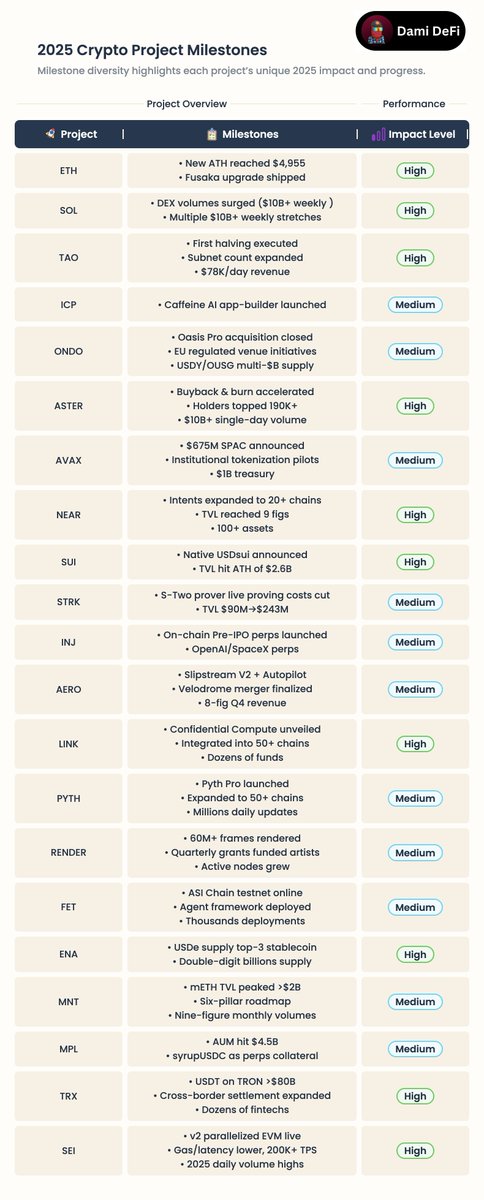
2025 Crypto Milestones: The Year in Review
Here's what the top projects shipped this year:
$ETH: New ATH ($4,955). Fusaka upgrade shipped (Dec)
$TAO: First halving executed (Dec) cutting emissions 50%, subnet count expanded, network hit $78K/day revenue
$ONDO: Closed Oasis Pro acquisition, USDY/OUSG supply climbed to multi-$B, announced EU regulated venue initiatives
$ICP: Launched Caffeine AI app-builder
$SOL: DEX volumes hit multiple $10B+ weekly stretches
$ASTER: Buyback & burn accelerated with 2$M/day pace at peak, holders topped 190K+, posted $10B+ single-day volume
$AVAX: Announced $675M SPAC for $1B treasury, 9 fig subnet incentives, institutional tokenization pilots advancing
$NEAR: Intents expanded to 20+ chains/100+ assets, TVL reached 9 figs
$SUI: Native USDsui announced, TVL hit ATH ($2.6B), daily DEX volume regularly crossed $100M+
$STRK: S-Two prover live cutting proving costs, daily tx hit 2025 peaks, TVL went from $90M to $243M
$INJ: Launched on-chain Pre-IPO perps (OpenAI/SpaceX)
$AERO: Slipstream V2 + Autopilot upgrade, $6M $AERO buybacks, Velodrome merger finalized with 8-fig Q4 revenue
$LINK: Unveiled Confidential Compute, institutional pilots expanded across dozens of funds, integrated into 50+ chains
$PYTH: Launched Pyth Pro, expanded to 50+ chains with millions of daily updates
$RENDER: Surpassed 60M frames rendered, active nodes grew, quarterly grants funded hundreds of artists
$FET: ASI Chain testnet online, agent framework saw thousands of deployments
$ENA: USDe supply hit double-digit billions (top-3 stablecoin)
$MNT: mETH TVL peaked >$2B, rolled out six-pillar roadmap, ecosystem apps drove nine-figure monthly volumes
$MPL: AUM hit $4.5B, syrupUSDC adopted as yield-bearing perps collateral
$TRX: USDT on TRON hit >$80B circulating, cross-border settlement expanded to dozens of fintechs
$SEI: v2 parallelized EVM live targeting 200K+ TPS, gas/latency materially lower, daily volume hit 2025 highs
2025 was the year of shipping. Infrastructure matured. Usage exploded. Institutional adoption accelerated.
If you weren't paying attention, you missed the foundation being laid for the next bull run.
It’s no accident that the FED will adjust the Supplementary Leverage Ratio in January, when the bulk of the debt refinancing that needs to happen next year is weighted into the first half, before July.
This means that the interest rates don’t need to come down as aggressively because bank balance sheet expansion won’t be choked by the purchase of these Treasuries anymore.
This expansion in Bank leverage in turn will turn into Liquidity and flow up the risk curve - to Bitcoin ultimately.
This is what Gold has sniffed out thus far.
Stealth QE is in full effect with no need to reduce rates fast as the FED is not “playing ball” - which Main Street will benefit from probably 2nd half of the year after FED Chair replacement - but Risk assets will get its turn first.
Next year, Wall Street and Main Street will benefit.
Wall Street will just benefit more and earlier.
Bitcoin bear markets happen for exactly two reasons:
1. Global liquidity turns negative (Fed / dollar tightening)
2. Forced selling from a Bitcoin-specific shock (Mt. Gox, miners, fraud)
Everything else is noise.
Let's examine the data, shall we? 1/
Essentially what happened was everybody thought Q4 was going to be a monster blowoff. They decided to double leverage to that by buying MSTR at 400 and short dated calls on IBIT.
When that didn't happen, everybody sold down to 80 and exited the asset. The MSTR positions dropped 70% -- "one full bear market, measured in standard bitcoin units".
We're now ready to resume the normal path upwards. All the same arguments apply, and Banks are all slotted in for 2026. The next 12 months will be epic. Most traditional Bitcoiners will miss the train.