your trades don't have to be content
there was a time when buying a token didn't come with a public profile, a pnl card and a bot copying you within the same block. that's the part we're bringing back
the zk proof for every veil trade gets made in your browser, on your machine
your keys and notes never leave it. the only thing that goes out is the proof, and all it says is that you're allowed to spend. no server in the middle that you have to trust with anything
why 65.537%
65.537% of veil's protocol fees go to buybacks and burns, not 50, not 70, exactly 65.537.
the number comes from cryptography. 65537 is the RSA public exponent, it's 2^16 + 1, which in binary is a 1, sixteen zeros, and a 1. only two bits set, so it's fast to compute with, and still large enough to be safe. it's been the default exponent in RSA keys for decades, and there's a good chance a key using it secured the page you're reading this on.
a privacy protocol borrowing its tokenomics from the most used number in public-key crypto felt right, so we did.
in practice, $1,000,000 traded means $5,000 in fees, and $3,276.85 of it bought back and burned.
e = 65537.
every trading app is turning into a social network. leaderboards, copy buttons, live trade feeds, pnl screenshots as a growth strategy.
great for the app, not so great for you. once people can see your trades they start trading against them.
we built the opposite on purpose. no feed, no followers, no copy button. your trade happens, settles onchain, and nobody gets a notification about it.
no watchers. no copytraders. no audience.
how veil works
1. deposit
you deposit tokens from your wallet into the shielded pool. that part is public, everyone can see a deposit happened. in return you get an encrypted note. it lives in your browser, it's backed up encrypted, and only you can spend it.
2. trade
you pick a pair and an amount. veil asks solvers for quotes. you pick the best one. then your browser builds a groth16 proof that says "i own a note worth at least this much and i'm allowed to spend it", without revealing which note or whose wallet it came from. the solver fills, the pool verifies the proof, the trade settles. your old note is spent, you get a new one.
3. withdraw
whenever you want out, you withdraw to your original wallet.
what stays public: deposits, withdrawals, the assets and amounts traded.
what doesn't: who made the trade.
no custodian, no account, no signup. a pool, a proof and a solver.
docs: https://t.co/BrxBE6pM61
if you submit txs through centralized infra, your txs aren't private. with how I designed veil and solvers that anyone can run (sample solver and SDK coming soon), that relay over Nostr so it's truly decentralized and private. nobody knows your wallet, not even the solver
paste any wallet into an explorer and you'll know everything about it in like ten seconds. what it holds, what it bought, when it sold. there are whole products built on doing exactly that, copytrade bots, wallet trackers, all the smart money dashboards
on veil your trade still settles onchain and the tokens and amounts are public, but nothing links it back to your wallet. there's no address in the calldata for anyone to follow
also someone tried to grab our dexscreener page today and put their own links on it. it's fixed now, but just so it's clear, the only real links are https://t.co/1BZj2xLXL9 and @veilproto
veil is live.
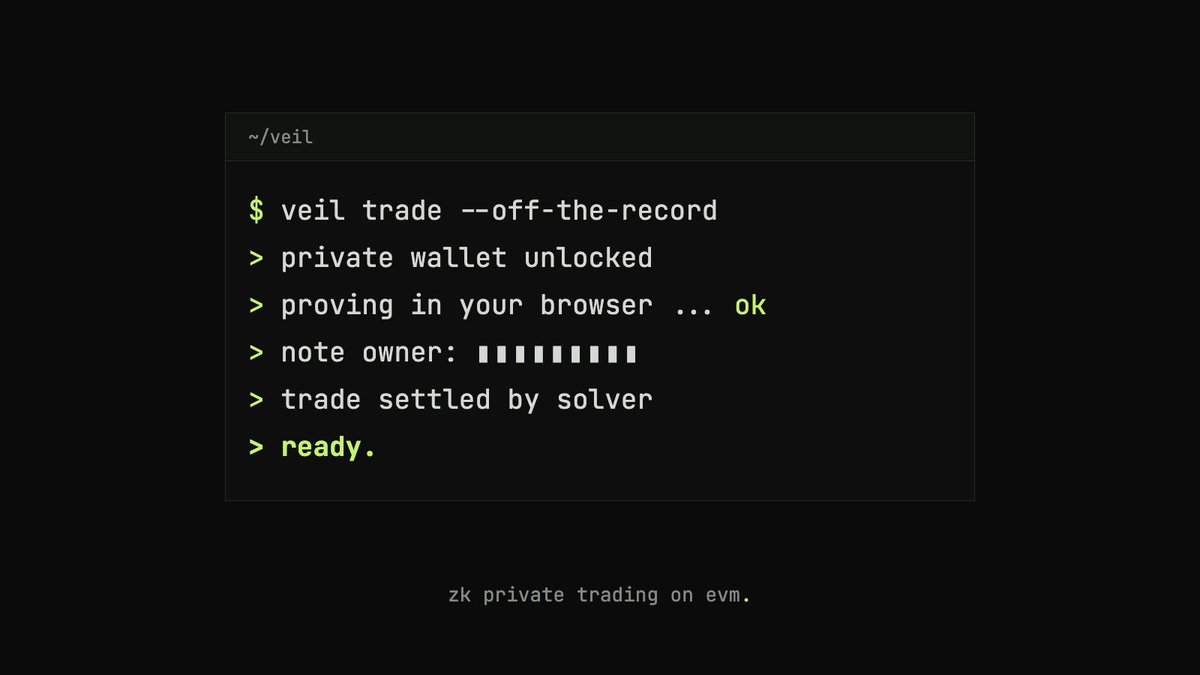
private trading on evm. zk-shielded pool, proofs built in your browser, solvers settle the trade.
the chain sees the swap. it doesn't see you.
onchain. off the record.
https://t.co/93xonmXZvI
0x951FE06f8059F2A9073Fa5d22c775787FdA3eD5D