Been fighting "startup disk full" on my mac for weeks. deleting downloads, moving photos, buying myself a day at a time.
Found mole — open source CLI that cleans the invisible stuff. caches, logs, leftovers from apps I deleted years ago.
brew install mole → mo or lets your Codex/Claude do it for you. 😅
freed [X] GB. https://t.co/lfRPp77Ocw
I AM QUITTING MY JOB TO GO FULL IN CLAUDE
Just asked him to:
"Analyze misspriced Polymarket markets opportunities for arbitrage and find wallets that are using it to copy"
Turned $2K into $12K in one night
Monitored ~1k+ wallets
I just realized that there are many arbitrage bots that I can't beat without code knowledge
But I can find them and copy
So Claude created a monitoring terminal and copytraded found wallets using TG copytrading bot
It's not a script and not even the bot, it's an AI agent that is improving with each found wallet
Fetching wallet behaviour, how it's trading, arbitrage, what's sized and timings
70% win rate, 7 wallets copytrading rn from ~500 monitored, bot never paused, never gambling, just math and profit
Giving This Free for 24 hours. To get it:
1. Comment the word 'Claude'
2. Like and Retweet this post
3. Follow me
@anjum_ai
(so i can DM you)
The most useful tool in my AI workflow has no AI in it.
yt-dlp. 184k stars.
Everyone uses it to download video. The better trick: --skip-download with --write-sub --write-auto-sub. Captions only, no media.
If you're paying to transcribe YouTube content, check whether the transcript already exists. Usually it does.
Google's policy does not say what everyone claims it says.
The actual wording on scaled content abuse: "no matter how it's created."
It targets volume and intent, not AI.
Lily Ray checked 220+ sites that AI content vendors published as their own success stories. 54% lost 30%+ of peak traffic.
Volume is the risk. Not the tool.
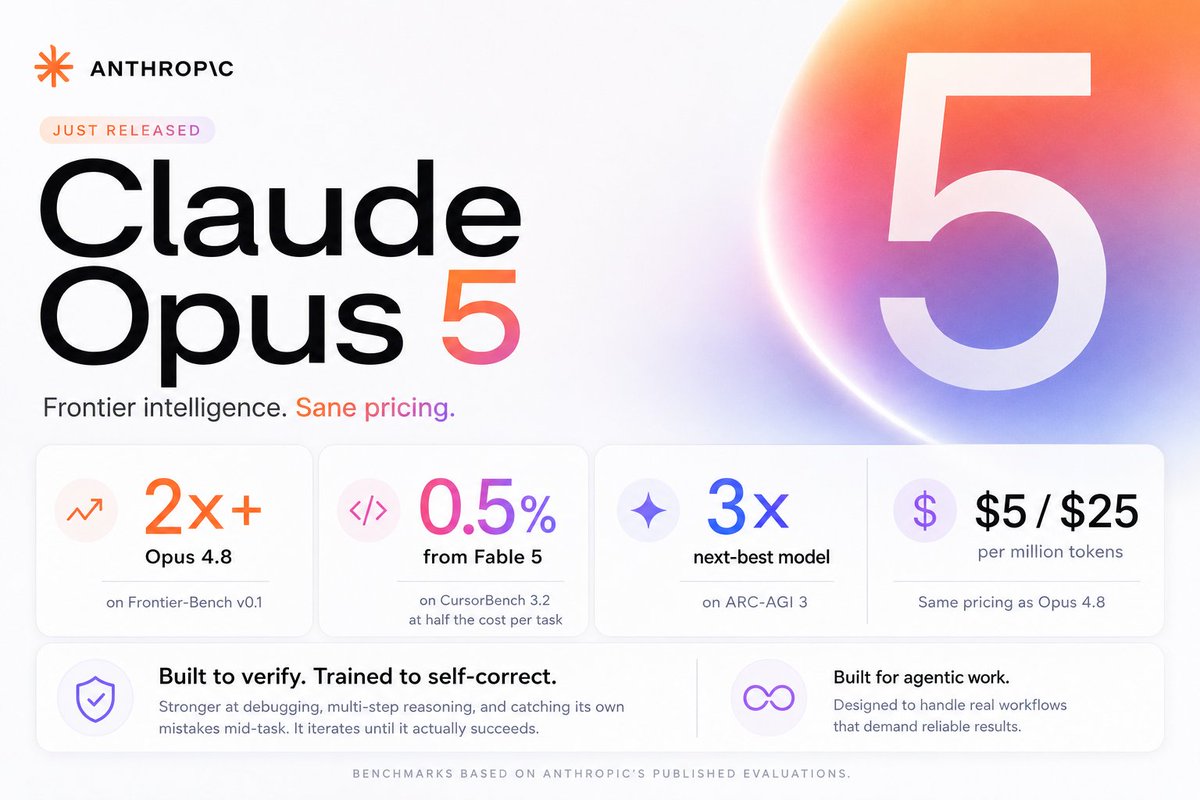
Anthropic just released Claude Opus 5—and the numbers are hard to ignore.
According to Anthropic's launch benchmarks:
→ More than 2× Opus 4.8's performance on Frontier-Bench v0.1
→ Within 0.5% of Fable 5's peak CursorBench 3.2 score at half the cost per task
→ 3× the score of the next-best model on ARC-AGI 3
What excites me even more than the benchmarks is the focus on verification and self-correction. Opus 5 is designed to inspect its own work, iterate, and keep going until it actually solves the problem—not just produce a plausible answer.
Pricing also stays the same as Opus 4.8: $5 / $25 per million input/output tokens, making the jump in capability even more interesting.
I've been building with Claude Code almost every day, so I'm looking forward to putting Opus 5 through real multi-agent workflows over the next few days to see how it performs outside of benchmarks.
Benchmark figures are based on Anthropic's published launch evaluations.
Deleting Soon
My Glitchy Marketing is at $2k/Day profit.
I'm close to financial freedom.
Organic Videos are stable: ~3 hours of work ~$2000 return ~ (with just iPhone and Laptop)
No time to relax. More work to be done.
Want a guide on which AI tools I used to get to $2k/day profit? Retweet + Comment "AI" and I will send the guide. (must be following
My AI brain is finally working.
I wanted something better than storing agent memory in Obsidian, Notion, or hundreds of Markdown files.
So I built my own.
Instead of documents, I use a vector database + knowledge graph (ArangoDB).
Everything runs on my personal server.
My apps, projects, notes, documents, workflows, and even my finances live there.
It's connected through Tailscale, so I can securely access it from anywhere.
My AI agents interact with it through custom MCP servers.
Now I don't have to explain context.
I just ask.
It already knows.
The most interesting part is something I call Dreaming.
Every night, the system reviews everything that happened during the day.
It organizes information, creates new relationships, removes noise, and strengthens long-term memory.
The goal isn't to build a chatbot.
The goal is to build an AI that continuously learns my world.
Curious how others are solving long-term agent memory.
Are you using documents, graphs, vectors, or something completely different?
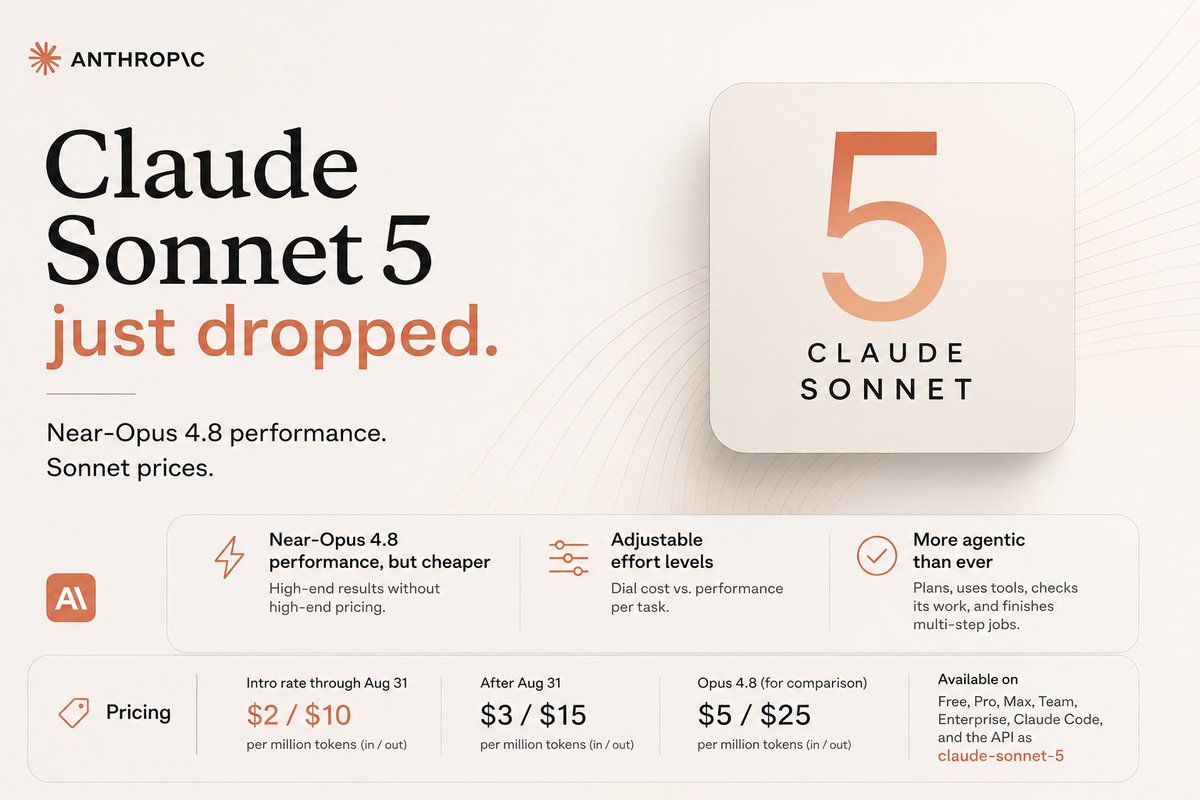
Claude Sonnet 5 is out. 🚀
The headline: near-Opus 4.8 performance at Sonnet prices.
Most agentic Sonnet yet — plans, uses tools, runs autonomously
Adjustable effort = tune cost vs performance per task
Testers: finishes multi-step tasks older Sonnets abandoned, self-checks unprompted
Pricing: $2/$10 per Mtok (intro, thru Aug 31) → $3/$15
Opus 4.8 = $5/$25
Default on Free + Pro. Live in Claude Code + API (claude-sonnet-5).
The cost of running production-grade agents keeps falling fast.
Fable 5 is back. 🧵-free version:
June 12: US export controls kill Fable 5 + Mythos 5 access overnight
June 30: controls lifted, global relaunch July 1
The "jailbreak" that caused it? Opus 4.8, GPT-5.5 & Kimi K2.7 could do the same thing
New classifier blocks it 99%+ (reroutes to Opus 4.8), but expect more false positives on routine coding.
Real story: frontier releases now ship with gov pre-testing + a shared industry jailbreak-severity framework.
What was the last thing you built for yourself?
I got tired of jumping between dozens of apps.
So I built my own.
One app to:
• Manage finances
• Track health metrics
• Save bookmarks and ideas
• Store files and documents
• Organize personal projects
And it's all running on a small home server next to my desk.
No subscriptions. No vendor lock-in.
Just a system built exactly for my needs.
What's something you've built for yourself recently?
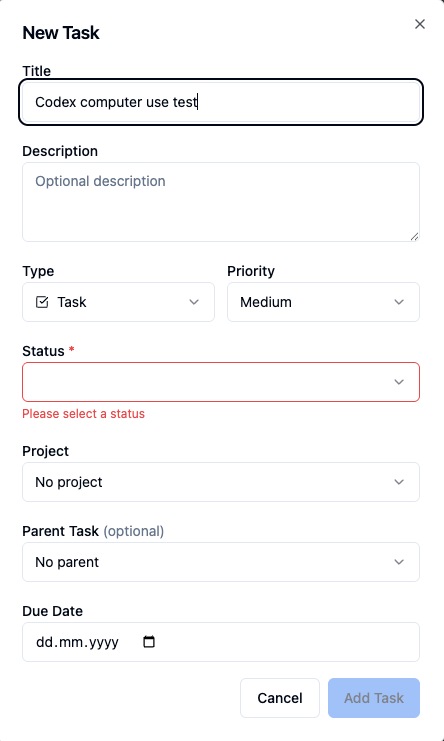
Just watched Codex use one of my own apps better than I expected.
CZ doesn't have computer use yet → Proton VPN → US exit node.
Pointed it at a UI it had never seen. Asked it to create tasks and add teammates.
It just did it. Like it had been onboarded last week.
New journey unlocked 🖥️
Finally bought my first home server. went to Gigacomputer, grabbed a cheap box, installed Linux, and now it's humming away next to me, running some of my automations.
excited to dive deeper into homelabbing, hardware, and see how far I can push this thing.
Right now, I'm using Tailscale + Windows Remote Desktop to access it from any device. It's a bit clunky on the phone, but on iPad it feels like a solid travel-light setup.
Anyone else running a home server? What are you doing with yours?
Your “master” spreadsheet is actually version 14.
Three people edit it. Nobody tracks changes.
A formula broke 2 months ago and you just found out from a client.
You’re not using Excel anymore.
You’re running a database that happens to look like Excel.
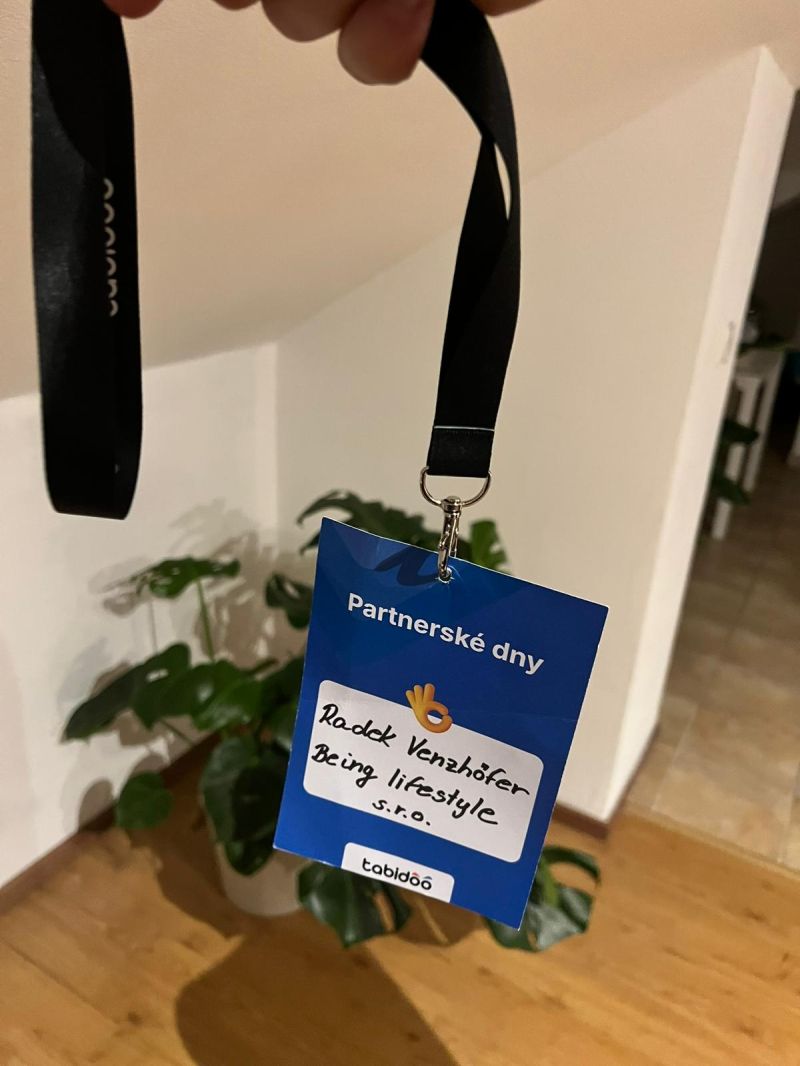
Last week I attended the Tabidoo Partner Day — a great event full of inspiration, platform updates, partner showcases, and insights on client acquisition.
Always great to meet the community and exchange ideas.
Thanks for the great event! 💪
10/10 Závěr:
Evaluace není „příjemný doplněk" pro AI workflows.
Je to rozdíl mezi nasazením s jistotou a nadějí, že se nic nerozbije v produkci.
Zabudujte ji od prvního dne. Vaše budoucí já vám poděkuje. 🙏
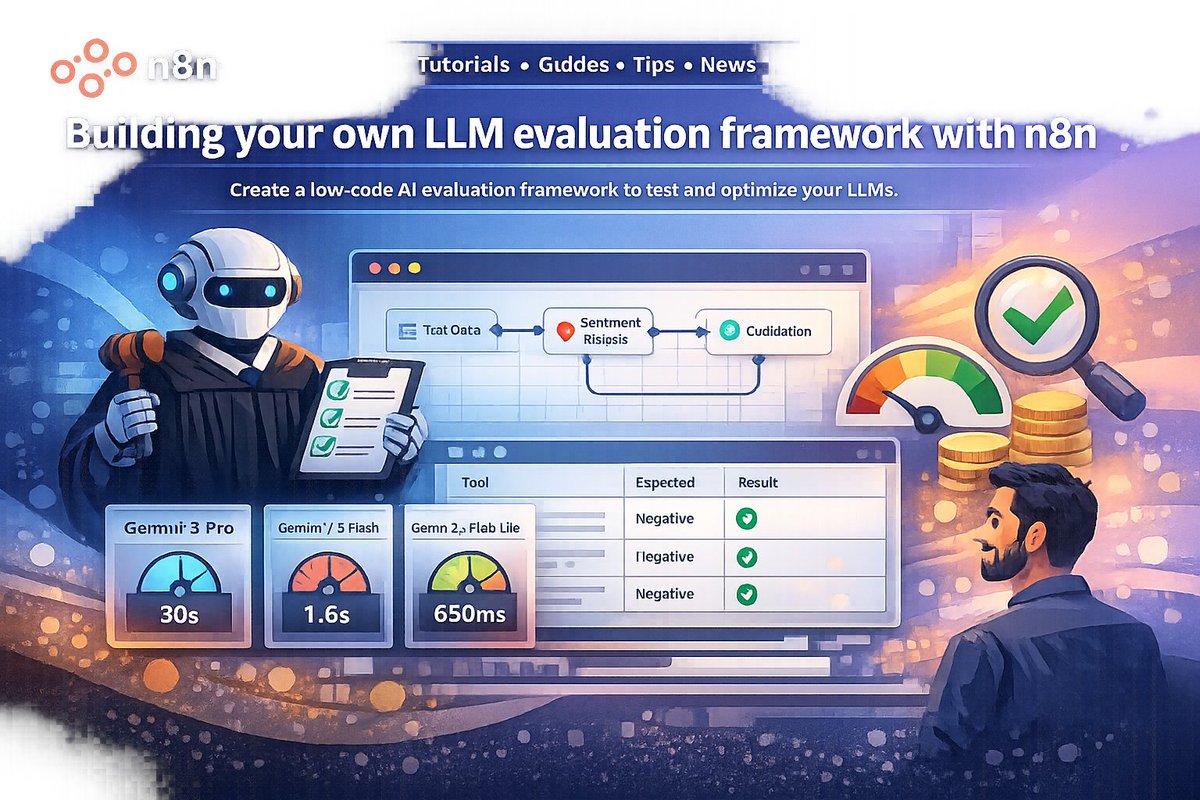
1/10 Deploying AI workflows without an evaluation framework is pure guesswork.
One prompt tweak, one model swap — and your perfectly working workflow silently breaks.
Here's how to fix that with @n8n_io 🧵
9/10 5 osvědčených postupů, jak to postavit správně:
→ Vždy oddělte evaluační logiku od produkce (Check if Evaluating node)
→ Sestavte Golden Dataset z reálných okrajových případů, ne náhodných vstupů
→ Měňte JEDNU proměnnou najednou (model NEBO prompt, nikdy obojí)
→ Pravidelně auditujte svého LLM-as-a-Judge
→ Kombinujte rychlostní metriky s metrikami kvality


![venzhofer's tweet photo. Been fighting "startup disk full" on my mac for weeks. deleting downloads, moving photos, buying myself a day at a time.
Found mole — open source CLI that cleans the invisible stuff. caches, logs, leftovers from apps I deleted years ago.
brew install mole → mo or lets your Codex/Claude do it for you. 😅
freed [X] GB. https://t.co/lfRPp77Ocw](https://pbs.twimg.com/media/HPrKh3NXsAAU-k4.jpg)