I traded the same strategy with 7 different risk percentages for 100 trades each
0.5%, 1%, 1.5%, 2%, 2.5%, 3%, 4% per trade
The results will change how you think about position sizing forever
Here's the optimal risk percentage backed by 700 trades of data:
The experiment setup:
- Same strategy across all tests
- Same entry rules
- Same exit rules
- 100 trades per risk level
- Same market conditions (6 months)
- Only variable: Risk per trade
The hypothesis: Higher risk = higher returns
The reality: It's not linear
Here's what actually happened:
0.5% RISK PER TRADE:
- 100 trades
- Win rate: 59%
- Max drawdown: 3.2%
- Final return: +14.8%
- Largest loss: -0.5%
- Psychological stress: Low
- Quit probability: 0%
1% RISK PER TRADE:
- 100 trades
- Win rate: 58%
- Max drawdown: 6.7%
- Final return: +31.4%
- Largest loss: -1%
- Psychological stress: Low-Medium
- Quit probability: 5%
1.5% RISK PER TRADE:
- 100 trades
- Win rate: 57%
- Max drawdown: 11.3%
- Final return: +48.9%
- Largest loss: -1.5%
- Psychological stress: Medium
- Quit probability: 15%
2% RISK PER TRADE:
- 100 trades
- Win rate: 54%
- Max drawdown: 17.8%
- Final return: +52.1%
- Largest loss: -2%
- Psychological stress: Medium-High
- Quit probability: 35%
2.5% RISK PER TRADE:
- 100 trades
- Win rate: 51%
- Max drawdown: 24.6%
- Final return: +41.3%
- Largest loss: -2.5%
- Psychological stress: High
- Quit probability: 58%
3% RISK PER TRADE:
- 100 trades
- Win rate: 48%
- Max drawdown: 31.2%
- Final return: +28.7%
- Largest loss: -3%
- Psychological stress: Very High
- Quit probability: 73%
4% RISK PER TRADE:
- 100 trades
- Win rate: 44%
- Max drawdown: 43.8%
- Final return: -12.4%
- Largest loss: -4%
- Psychological stress: Extreme
- Quit probability: 94%
The pattern is clear:
Risk 0.5%-1.5%: Win rate stable, returns increase proportionally
Risk 2%-2.5%: Win rate drops, returns peak then decline
Risk 3%-4%: Win rate collapses, returns become negative
Why does win rate drop with higher risk?
PSYCHOLOGY BREAKDOWN:
At 0.5% risk:
- Losing doesn't hurt
- Easy to follow system
- No emotional interference
- Execute perfectly
At 2% risk:
- Losses sting
- Start questioning system
- Emotional interference begins
- Exit winners early (fear of giving back)
- Hold losers longer (hope of recovery)
At 4% risk:
- Every loss is painful
- System abandoned after 2-3 losses
- Full emotional chaos
- Revenge trading kicks in
- Random position sizing
- Complete system breakdown
You're not executing the same strategy at 4% risk
You're executing an emotional disaster
The optimal risk percentage:
Based on 700 trades across 7 risk levels:
BEST RISK-ADJUSTED RETURN: 1.5%
- Highest absolute return: +48.9%
- Manageable drawdown: 11.3%
- Sustainable psychology: Medium stress
- Win rate preservation: 57%
BEST FOR BEGINNERS: 1%
- Solid return: +31.4%
- Low drawdown: 6.7%
- Low psychological stress
- Win rate preservation: 58%
DEATH ZONE: 3%+
- Returns collapse
- Drawdowns explode
- Psychology destroyed
- Account blown inevitable
The risk/drawdown relationship:
0.5% risk → 3.2% max drawdown (6.4X multiplier)
1% risk → 6.7% max drawdown (6.7X multiplier)
1.5% risk → 11.3% max drawdown (7.5X multiplier)
2% risk → 17.8% max drawdown (8.9X multiplier)
3% risk → 31.2% max drawdown (10.4X multiplier)
The multiplier increases exponentially
Why?
Because losing streaks exist
At 58% win rate:
- 6-trade losing streak: Statistically expected every 100 trades
- 8-trade losing streak: Possible every 200 trades
- 10-trade losing streak: Rare but happens
10 losing trades at different risk levels:
0.5% × 10 = 5% drawdown (survivable)
1% × 10 = 10% drawdown (manageable)
1.5% × 10 = 15% drawdown (uncomfortable)
2% × 10 = 20% drawdown (scary)
3% × 10 = 30% drawdown (panic mode)
4% × 10 = 40% drawdown (blown account psychology)
Your system WILL hit losing streaks
Question is: Will you survive them?
The return-per-unit-of-stress:
0.5% risk: +14.8% return / Low stress = Good ratio
1% risk: +31.4% return / Low-Med stress = Great ratio
1.5% risk: +48.9% return / Medium stress = Best ratio
2% risk: +52.1% return / Med-High stress = Declining ratio
3% risk: +28.7% return / Very High stress = Bad ratio
4% risk: -12.4% return / Extreme stress = Terrible ratio
The sweet spot: 1-1.5% risk
Maximum returns without destroying psychology
The actual implementation:
BEGINNER (0-200 trades live experience):
Use 0.5-1% risk
Focus on execution
Build psychological capital
Profits are secondary
INTERMEDIATE (200-500 trades):
Use 1-1.5% risk
Scale up slowly
Prove psychological readiness
Lock in profits
ADVANCED (500+ trades, proven edge):
Use 1.5% risk maximum
Never go higher
Resist temptation to "make more"
Consistency over home runs
NEVER USE:
2.5%+ risk
Even if you "can handle it"
The data shows you can't
Nobody can
The prop firm context:
Prop firms typically allow 4% daily loss
If you risk:
- 0.5%: Takes 6 losing trades to hit limit (survivable)
- 2%: Takes 2 losing trades to hit limit (dangerous)
- 3%: Takes 1 losing trade to hit limit (death)
At 3% risk, two consecutive losses = near daily limit
Panic sets in
Revenge trade taken
Account blown
The "make money faster" trap:
You think: "If I risk 3% instead of 1%, I'll make money 3X faster"
Reality: You'll blow account 5X faster
Because psychology breaks at high risk
And broken psychology = broken trading
The traders making real money:
Risk 0.5-1% per trade (depending if you are on eval, funded or live)
Boring position sizing
Consistent execution
Compounding for years
The traders blowing accounts:
Risk 3-5% per trade
"Aggressive" position sizing
Emotional execution
Blown in months
Choose your path
The data is clear:
1-1.5% risk = Optimal returns with manageable psychology
Anything higher = Chasing ret
It's about whether you'll still be trading in 6 months
Risk 1.5% and you will be
Risk 3% and you won't
DM me "RISK" if you want help calculating YOUR optimal risk percentage based on YOUR account size, YOUR psychology, and YOUR risk tolerance
This tweet from @ZenomTrader hit harder than most people realize. He is one of the best prop firm quants in the game.
Too many traders think payouts = skill.
But in prop, sometimes it’s:
variance + big risk + short window
not
edge + structure + consistency.
Prop firms are a game — and if you don’t understand risk math, the rules will eat you alive.
I built a video breaking this down.
If it adds perspective → retweet it.
The year is almost over…
A whole year where you probably said you were going to get your trading business in order.
Yet the year has gone by… and you’re still over-leveraging, over-trading, revenge trading, and not journaling.
Insanity is doing the same thing over and over but expecting different results.
Input -> output
Profitability is found in the tasks you’re avoiding.
If you make a New Year’s resolution and it’s the same as last year… you have a problem.
Time to own 2026.
BREAKING: The World’s Markets Didn’t Crash From a Cyberattack. They Froze Because Silicon Got Too Hot.
At 03:00 GMT today, 90% percent of global derivatives trading stopped. Not hacked. Not manipulated. The cooling system failed at a single data center in Illinois.
Let that satisfy for a moment.
The CME Group, which prices everything from Treasury bonds to crude oil to the S&P 500, went dark because the machines that run global finance exceeded their thermal limits. The heat generated by computation overwhelmed the capacity to reject it.
This is not a glitch. This is a structural warning.
The numbers tell the story: U.S. data centers consumed 183 terawatt-hours of electricity in 2024, more than four percent of national consumption, equivalent to Pakistan’s entire annual demand. By 2030, this doubles to 426 terawatt-hours. AI workloads are growing at thirty percent annually. Every watt becomes heat. Every server needs cooling. The infrastructure was built for 2015. The demands are from 2025.
We have reached the thermodynamic ceiling of centralized finance.
The CME sold this data center in 2016 for $130 million and leased it back. When the cooling failed, they owned nothing. They controlled nothing. They waited, like the rest of us, for someone else to fix the pipes.
Ninety percent of global derivatives volume, frozen by physics.
Treasury futures offline. Energy markets dark. Agricultural pricing halted from Chicago to Kuala Lumpur.
The lesson is simple and profound: The limit on financial transaction throughput is not code efficiency. It is heat rejection capacity.
We built the engine of global price discovery on silicon that melts.
The future demands distribution, redundancy, architectural transformation.
Or we wait for the next failure, perhaps not on a quiet holiday, but in crisis, when every minute of darkness compounds into catastrophe.
The thermodynamic ceiling is here.
What we build next determines everything.
Read the full story - https://t.co/wFK6L5NbGC
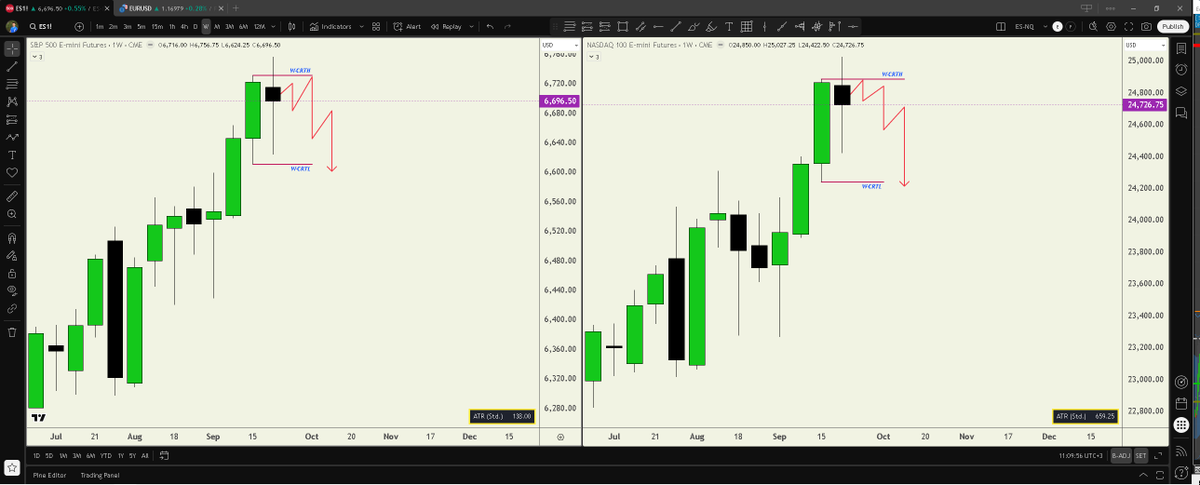
You do realise all we’re waiting for is the candle to open, stab into a liquidity pool (CRTL), create a model#1 or a true market structure shift, then you enter and trade it to 50% and then the (CRTH) ?
Read that again.
Don’t let anyone fool you into thinking CRT is complex.
The Lifeline of a Short-Term Day Trader
I was 21 when I got my badge. I’d come in early, stay late, stare at charts until my eyes burned. I was losing more than winning, but I had the energy to keep going. I gave up nights out, parties, weekends, everything for trading. Sleep deprived, stressed, anxious as hell, but fueled by adrenaline and the belief I’d get where I wanted.
In my early 30s, I started to find success. But the stress never left. By 36, it caught up to me, I had a heart attack at my screen. That moment should have been my out. I’d done well enough financially to walk away. But once this business is in your blood, there’s no clean exit.
The reality is, short term day trading eats away at you. It demands all of your time, all of your focus, and it stacks stress until your body forces you to pay up. After the heart attack, I’d go out for runs in the morning and just break down. Tears streaming, not because of the physical pain, but from the fear of losing my identity if I wasn’t a trader anymore.
What you don’t realize when you’re young is that this life has a clock on it. You don’t know when it runs out, but it does. In my mid 30s, I started shifting, investing, traveling, building relationships, creating a media business. Slowly learning how to live without the daily adrenaline hit. Eventually, I made peace with being a swing trader.
If you’re starting out now don’t waste a second. Push as hard as you can. But don’t wait until your body or life forces a change to start thinking about the future. Build something alongside the trading grind. Because the lifeline of a short term trader is shorter than you think.
Get my detailed daily morning note, it’s free, delivered straight to your inbox by subscribing here: https://t.co/T5geK5UOdM
Cheers, DELI
$400,000 - funded
0.5% risk per trade
4% per month
$15,000 - after profit split
All that can be achieved by trading a single 4h candle range per week with 1:2 trade.