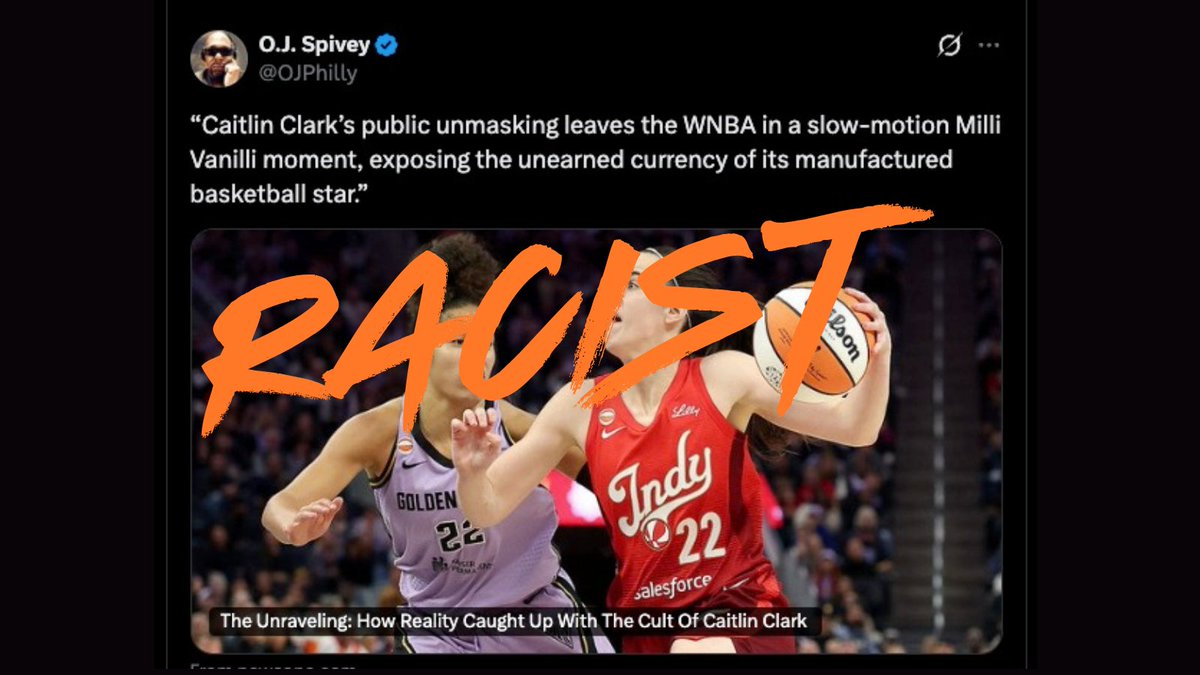
I am not linking the article because I have no interest in rewarding race-bait with traffic.
But I am absolutely here to set the record straight and be a loud voice against racism of any kind.
But anyone who wants to read it can go find it and see exactly what happens when legitimate basketball criticism gets buried under a deeply racialized attack on Caitlin Clark, her fans, and the people who recognize her impact.
But since apparently people are allowed to publish racist, non-basketball attacks on Caitlin Clark and pretend they are serious sports analysis, I thought I would correct the record.
Not as someone who thinks Caitlin is perfect.
She is not.
She turns the ball over too much at times.
She has rough shooting nights.
She can be targeted defensively.
She gets visibly frustrated.
She still has to grow as a professional guard.
All fair.
All basketball.
But this article is not really about basketball.
It is about race.
The author does not simply argue that Caitlin Clark has flaws. That would be normal. Every great young player has flaws.
He argues that Caitlin’s rise is built on whiteness, entitlement, media protection, and a fan base supposedly driven by resentment rather than basketball.
That is not analysis.
That is racial grievance dressed up in sports language.
And it deserves to be called out.
Because here is the problem with that argument:
Caitlin Clark was not manufactured by the WNBA.
She was not invented by Nike.
She was not created by television executives.
She became impossible to ignore because people watched her play basketball and could not look away.
The range was real.
The passing was real.
The vision was real.
The pace was real.
The shot-making was real.
The creativity was real.
The gravity was real.
The impact was real.
Caitlin Clark became the NCAA Division I all-time leading scorer with 3,951 career points.
She won national player of the year awards.
She helped turn Iowa games into national television events.
She entered the WNBA and immediately became one of the biggest business drivers the league has ever seen.
In 2024, the WNBA had its most-watched regular season in 24 years, its highest attendance in 22 years, and record merchandise sales.
This year, Caitlin became the fastest player in WNBA history to reach 500 career assists, doing it in 59 games.
Those are not myths.
Those are facts.
So yes, criticize the turnovers.
Criticize the defense.
Criticize the shot selection.
Criticize the bad games.
Criticize the reactions.
But do not insult everyone’s intelligence by pretending her popularity is some empty racial hallucination.
That is where the author loses the plot.
A player can be imperfect and still be generational.
A player can struggle and still have gravity.
A player can have bad nights and still change the economics of a league.
A player can need development and still be the most important player in the sport’s growth.
Those things can all be true at the same time.
That is called sports.
What this article does is different.
It takes legitimate basketball criticisms and buries them under race.
It takes a young player’s flaws and turns them into a racial indictment.
It takes fans who enjoy her style of play and paints them as a grievance movement.
It takes the most obvious basketball and business phenomenon women’s basketball has seen in years and reduces it to identity politics.
That is not brave.
That is lazy.
And yes, when you reduce an athlete’s talent, popularity, fan base, and value primarily to skin color, that is racist.
I do not care which direction it comes from.
If your standard changes depending on which race is being attacked, you do not oppose racism.
You just want permission to use it.
Caitlin Clark does not need to be protected from criticism.
She needs to be protected from dishonest criticism.
There is a difference.
If you want to say she needs to reduce turnovers, fine.
If you want to say she needs to defend better, fine.
If you want to say she needs to manage her emotions better, fine.
If you want to say she has not yet earned a professional GOAT conversation, fine.
Those are basketball arguments.
But if your argument is that Caitlin Clark is a manufactured symbol of white entitlement, then you are not breaking down basketball.
You are proving why this conversation has become so poisoned.
Because millions of people did not start watching Caitlin Clark because they were handed a racial assignment.
They watched because she made basketball exciting.
Deep threes.
Hit-ahead passes.
Court vision.
Swagger.
Pace.
Creativity.
Risk.
Emotion.
A style of play that made people stop scrolling and pay attention.
That does not mean other great players should be ignored.
A’ja Wilson is great.
Breanna Stewart is great.
Napheesa Collier is great.
Paige Bueckers is great.
Aliyah Boston is great.
JuJu Watkins is coming.
Women’s basketball has elite talent everywhere.
But elevating Caitlin Clark does not erase them.
And recognizing Caitlin’s impact does not require insulting theirs.
That is another false argument.
The truth is simple:
Caitlin Clark did not damage women’s basketball.
She expanded the audience.
She brought new fans.
She raised the stakes.
She forced the WNBA into mainstream scrutiny.
She made people care who had never cared before.
And now that the spotlight is brighter, some people are furious that the player who brought it does not fit the story they wanted to tell.
That is what this article really reveals.
Not Caitlin’s “unmasking.”
The author’s resentment.
Because Caitlin Clark is not perfect.
But she is not a fraud.
She is not a myth.
She is not white mediocrity.
She is a generational basketball talent with real flaws, real growth ahead, and a real impact that cannot be erased by racialized insults disguised as commentary.
So let’s correct the record.
Basketball criticism is fair.
Racist framing is not.
Caitlin Clark should be judged by the same standard every great athlete should be judged by:
Talent.
Skill.
Toughness.
Leadership.
Production.
Impact.
Growth.
Winning.
Not resentment.
Not labels.
Not identity politics.
Not some writer’s need to turn a basketball phenomenon into a racial grievance column.
Women’s basketball deserves better than that.
The fans deserve better than that.
And yes, Caitlin Clark deserves better than that.
@SportsPatriotUS I always enjoy reading your posts. They are insightful and provide valuable perspective. Please continue sharing your thoughts. Hopefully, more people will come to understand the bigger picture and what is really happening surrounding Caitlin Clark.
I’m going to say this as calmly as possible:
Watching Caitlin Clark in the WNBA has become genuinely hard to stomach.
Not because she struggles sometimes. Not because she makes mistakes. Not because she gets criticized. That comes with being great.
It’s hard to stomach because it has become obvious that the league, the officials, the media, the players, and even her own organization have all decided that the most important thing is not letting Caitlin Clark become too big.
And that is insane.
This league was handed the most marketable, electric, revenue-generating player women’s basketball has ever seen, and instead of building around the moment, too many people seem obsessed with humbling her.
She gets fouled. Held. Hit. Cheap-shotted. Mocked. Targeted. Then when she reacts like a normal competitor, suddenly everyone wants to analyze her attitude.
No.
Her attitude is not the story.
The story is that a generational player is being treated like a problem by the very league she helped drag into mainstream relevance.
This reminds me of the worst kind of youth coach... the one who sees a special player, feels threatened by her talent, and slowly drains the joy out of her in the name of “teaching humility.”
That is what this looks like.
The freedom she played with at Iowa is disappearing. The fire is still there, but the joy looks damaged. The confidence looks weighed down. She looks like someone constantly fighting the refs, opponents, narratives, coaching decisions, jealousy, and a league culture that should be protecting its golden opportunity instead of resenting it.
And let’s be honest: Stephanie White has not helped.
Benching Caitlin Clark randomly when she is controlling the game tempo, or having your best shooter off the floor in critical game ending minutes when a victory is within reach is basketball malpractice. Limiting her rhythm, downplaying her greatness, benching momentum, and treating her like just another piece instead of the engine is absurd.
You do not take a player who changed the economics of your sport and manage her like you’re afraid her greatness might offend the room.
Nike deserves criticism too. Other players get signature shoes rolled out with urgency, while the biggest draw in women’s basketball is somehow still waiting on that signature shoe. That is not confusing. That is revealing.
Fans are not stupid.
They see the fouls.
They see the double standards.
They see the jealousy.
They see the media resentment.
They see the league benefiting from her popularity while refusing to fully embrace her.
And here is the part the WNBA better understand quickly:
People are not tuning in to watch Caitlin Clark be humbled.
They are tuning in to watch Caitlin Clark be great.
If she walked away tomorrow, the fans would follow her. The sponsors would follow her. The energy would follow her. The high salaries and the charter jets would follow her. And the league would be forced to confront the uncomfortable truth it keeps trying to avoid:
Caitlin Clark did not need the WNBA nearly as much as the WNBA needed Caitlin Clark.
At some point, her family, her agent, and her team need to ask a hard question:
How much longer do you let a league profit from her while allowing the culture around her to beat the spirit out of her?
Because from the outside looking in, this does not look like normal adversity anymore. It looks like abuse.
It looks like a league trying to break the very player who made millions of people care.
https://t.co/AAxFrO46Z4
I hate what Caitlin has become. I miss the fire, the deep logo threes, and the fearless attitude she used to play with. That's what drew me to basketball in the first place. When I watch her now, it feels like she's lost some of what made her so special.