Request for Startups -- Teleoperation:
Almost nobody takes teleoperation seriously. It's treated as a waiting room for autonomy.
We think teleoperation IS the path to autonomy.
We just published our full thesis. Link below. If you're building this: [email protected] .
1/6 🧵
@stefanobernardi (BTW TFR will be hard to measure when people will have infinite lifespan and can produce offspring at any age. But we'll cross that bridge when we get there -- will be good for my side of the bet anyway.)
@stefanobernardi (I wish I could make the bet 1 BTC: would be a better story. But I'm pretty bullish on BTC and am also under-exposed to it. So I can't be totally sure I'll have enough collateral; last thing I want is to go bankrupt in 2076 because of a bet I made when bitcoin was sub-billion :)
@stefanobernardi IN SIZE -- meaning?
I'm not confident about my timelines here. But for example I would bet 50-50% that in 50 years, TFR among meat-humans is higher than 3. And I expect to win this bet with probability 70%)
(bet has to get nullified if neither of us survives because doom :( )
@stefanobernardi (All of this is of course only discussing the drivers we discussed in this thread. In reality my p(doom) is quite high and I believe there's a decent chance meat-humans will indeed go extinct. But that'd have nothing to do with fertility rate, but rather with man-made dangers.)
SpaceX may have actual needs for space-native compute, and for low-latency compute in space. And for the compute needs of satellites, sure, having the data centers in space makes sense. But for terrestrial compute needs? the economic sense of this is decades away.
The hype around space data centers baffles me.
Like, sure, one day we'll have vast data centers in space. It might even be in 20 years. But the timelines are so long, it makes very little economic sense to actually launch these today.
(Caveat: might make sense for SpaceX: >>)
“We’ve done the analysis, reusable rockets aren’t economic.”
SpaceX makes reusable rockets economic.
“We’ve done the analysis satellite internet isn’t economic. The antenna alone is tens of thousands of dollars. The cost to manage a constellation that size, the radiation, the space hardened solar cost…”
Satellite internet appears to be a very good business with antennas in the $100 range.
“We’ve done the analysis, orbital data centers aren’t economic. The radiators, launch costs, the radiation, the solar…”
You are here.
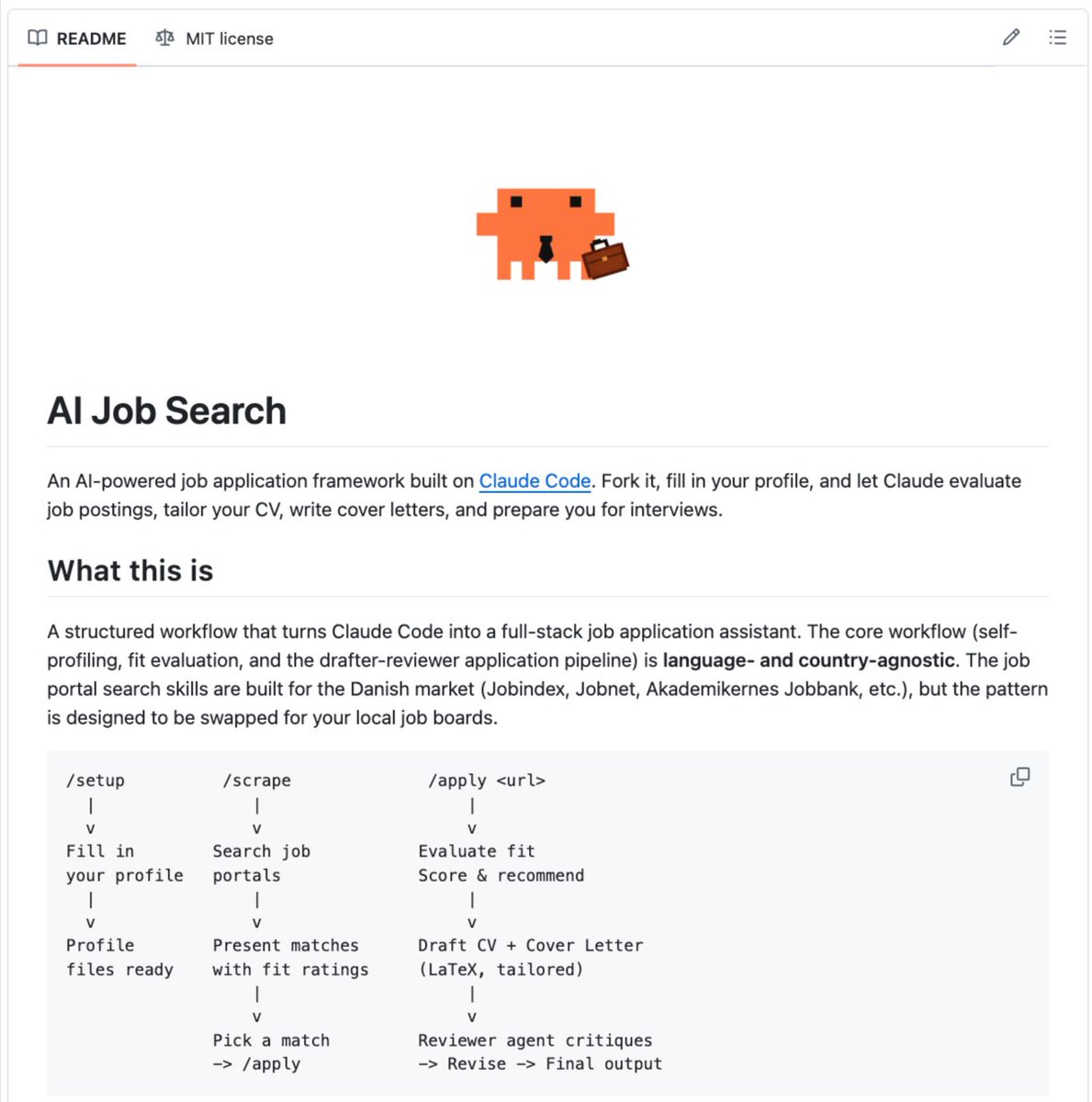
A scientist in Denmark figured out how to make Claude prepare his job applications. He open-sourced the whole thing.
His name is Mads Lorentzen. He is a PhD geophysicist. He built it on top of Claude Code and released it under MIT license.
Here is what it does. You fork the repo, fill in your background once, and it runs a five-step pipeline for every job you want to apply to.
Step 1. It reads the job posting and scores how well you fit.
Step 2. It drafts a tailored CV in LaTeX, picking only the experience that matches.
Step 3. It writes a cover letter framed around what you would bring to the role.
Step 4. A second AI agent reviews the first agent's work, points out weaknesses, and the first agent revises.
Step 5. It compiles both into clean PDFs you can send.
The whole thing is a folder of markdown files. The candidate profile, the writing style rules, the CV templates, the interview prep notes. Every step is plain text you can read and change.
The job portal search is built for Danish boards. The application workflow itself works for any country.
489 stars. 270 forks. A fork-to-star ratio that high means people are using it, not only bookmarking.
Mads is not a startup founder. He built this because he needed it for himself, then shared it.
This is the future of job hunting. Not a service you pay for. A workflow you own.
(Link in the comments)
@stefanobernardi Here is the underlying thesis, which from the article I thought you do agree with: I think AI, controlling robots, will be able to autonomously do all blue-collar work in 20 years or less. (And for most blue-collar work, more like 10 years.)
@stefanobernardi I'm much more worried about how the synthetic humans will treat us, and how do meat-humans even survive the "teenage years" in the rise of the synthetic humans. I'm far from optimistic. But IMO population decline is not in the top 10 of our worries.