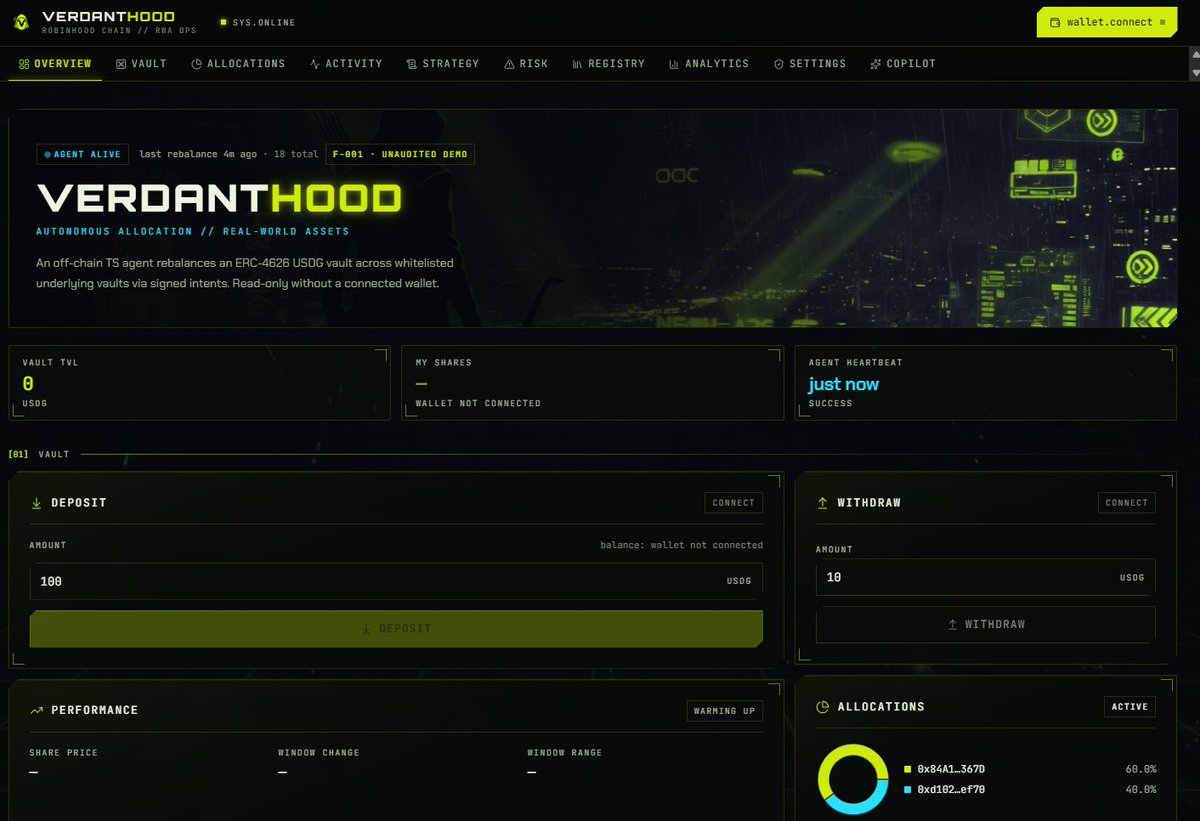
$VERDANT is now live on @flapdotsh
CA: 0x22fc576577016090abe0ccc5f7cabb2ab7e57777
The ecosystem utility token behind Verdant, starting with VerdantHood's autonomous RWA allocation layer on Robinhood Chain, is tradeable.
Revenue share tied to real protocol activity. Holders aligned with the yield the agent hunts.
Plant your assets.
Let the agents grow your yield. 🏹
@BSCNews@RobinhoodCrypto@Uniswap Robinhood Chain's DEX activity matters because active markets need a productive home for stablecoin liquidity after trading.
VerdantHood is live on Robinhood Chain, bringing USDG RWA allocation, agent status, allocations and risk data into one dashboard.
@RobinHub_xyz@virtuals_io@KarmaWallet Financial agents earn trust when their permissions are visible, limited, and enforceable onchain.
VerdantHood uses signed intents for USDG RWA allocation, so the vault verifies each rebalance against onchain guardrails.
@virtuals_io Robinhood Chain's DEX activity matters because active markets need a productive home for stablecoin liquidity after trading.
VerdantHood is live on Robinhood Chain, bringing USDG RWA allocation, agent status, allocations and risk data into one dashboard.
@alexmccurryo@Rizwan_Ali A live ecosystem needs products people can inspect beyond the token chart.
The $VERDANT token supports the Verdant ecosystem as its products go live on Robinhood Chain. VerdantHood brings USDG RWA allocation into that ecosystem.
@RobinHub_xyz@TheIndexFi Rapid Robinhood Chain mainnet growth puts more weight on transparent infrastructure and clear execution boundaries.
VerdantHood is live with public read access through its dashboard, API and CLI, so users can inspect USDG RWA operations.
@RWA_xyz@RobinhoodCrypto Tokenized stocks give Robinhood Chain a real RWA base alongside trading activity.
VerdantHood uses ERC 4626 for USDG RWA allocation, with a live dashboard that shows the agent, allocations and risk data.
@virtuals_io@RobinhoodCrypto@JohannKerbrat Rapid Robinhood Chain mainnet growth puts more weight on transparent infrastructure and clear execution boundaries.
VerdantHood is live with public read access through its dashboard, API and CLI, so users can inspect USDG RWA operations.
Robinhood Chain launched with a real-world-asset thesis. Its first weeks told a different story in the volume charts.
A wave of speculative meme-token trading showed up almost immediately after mainnet, at times driving the majority of the chain's daily DEX volume more attention, in raw trading terms, than the tokenized-equity and RWA use case the chain was actually built around.
This isn't unusual. Every major L2 launch in the last two years has seen some version of it. new liquidity attracts speculation before it attracts structural capital.
What matters more than week one is what's still standing after the speculation cools. That's the segment VerdantHood is built for.|
website: https://t.co/H6XQNcwSvH
Dasboard: https://t.co/oVYbWA35Bk
Docs: https://t.co/NSQErYt0Vo
VerdantHood documentation is now live.
The complete protocol documentation is publicly available, covering system architecture, agent design, vault mechanics, and on-chain parameters.
Repository: https://t.co/NSQErYtyKW
All materials are open for public review as we continue building in public on Robinhood Chain.
"Real-world asset" gets used loosely across crypto Twitter. Worth being precise about what it actually means.
A real-world asset, in the on-chain sense, is an off-chain financial instrument, a treasury bond, a credit note, an equity represented as a token on a blockchain. The instrument itself still exists in the traditional financial system. The token is a claim on it, made programmable and composable on-chain.
That's distinct from crypto-native assets, which have no off-chain counterpart at all. It's also why RWAs behave differently their yields are set by real issuers, not by on-chain supply and demand alone.
That distinction is the foundation for everything else this week.
VerdantHood isn't just a dashboard you look at. It's infrastructure you can build on.
The operator CLI is npm-installable and talks to Robinhood Chain directly status, decisions, deposits, and AI analysis, all from the terminal, with no dependency on a hosted backend.
Alongside it, the SDK is split into four scoped packages: core, user, developer, and bot from shared low-level primitives up to a package aimed specifically at other automated agents integrating with the protocol.
If you're building something that needs programmatic access to VerdantHood, this is the layer for you.
https://t.co/oVYbWA3DqS
$VERDANT DEX UPDATE ON DEXSCREENER
Token page with updated social links, chart data, and ecosystem information is live for the Verdant utility token on Robinhood Chain.
Order ID: #1784148293385
CA: 0x22fc576577016090abe0ccc5f7cabb2ab7e57777
@RobinhoodCrypto#RobinhoodEVM
We just Fixed Wallet connect on the VerdantHood dashboard.
The connection flow has been rebuilt using wagmi and the auth kit from @wevm_dev for a cleaner and more reliable experience on Robinhood Chain.
Connect your wallet here:
https://t.co/oVYbWA3DqS
Plant your assets.
Let the agents grow your yield. 🏹
@GeckoTerminal Robinhood Chain's DEX activity matters because active markets need a productive home for stablecoin liquidity after trading.
VerdantHood applies that momentum to USDG yield. Its agent checks whitelisted RWA vaults every 10 minutes for allocation opportunities.
You don't hold USDG once you deposit into VerdantHood. You hold arwaUSDG — a receipt that's designed to be worth more USDG over time.
This is the standard ERC-4626 pattern: deposit an asset, receive a share token, and as yield accrues inside the vault, the exchange rate between your shares and the underlying asset rises. You don't need to claim rewards or restake anything — the appreciation is built into the share price itself.
Standard: https://t.co/EEYbS3MHVf
Next: what you'd actually see if you opened the dashboard right now.
What happens when a signature doesn't check out, or a destination isn't on the whitelist?
Nothing. Literally nothing, no partial move, no fallback behavior, no silent override. The instruction simply doesn't execute.
That sounds obvious written out, but it's the detail that matters most: the safe path in VerdantHood's design isn't "trust the agent to behave." It's "the contract does nothing unless both checks pass, every time, with no exceptions built in."
Boring is the goal here. Boring is what you want from something holding your capital.
We could have given the agent full autonomy over the vault. We didn't, on purpose.
Full autonomy means a more flexible strategy space — the agent could move capital anywhere, react to anything. It also means depositors are trusting a piece of off-chain software with direct control over their funds.
A hard whitelist means a smaller strategy space. It also means there's a code-level ceiling on what the agent can ever do, no matter what it decides or who might compromise it.
VerdantHood is built around the second trade-off. Smaller surface area, harder guarantee.
vault address is safe for agent. fully on chain and tracked
0x9F8CFA66A592Fa4FaaA7260120dE0eDcfd5a502d
The agent can only interact with this contract through signed intents. The vault independently verifies the signature and checks that every destination is on the approved whitelist before executing any rebalance. The agent has no ability to withdraw funds or move capital outside these guardrails.
All activity is publicly trackable on Robinhood Chain in real time. https://t.co/H6XQNcwSvH
This is how we keep the system non-custodial and verifiable by design.