Your tax tool booked that bridge as a sale. Free read-only scan finds the phantom gains — tx-hash evidence on every line. No keys, ever. Not tax advice.
We ran standard cost-basis rules over Vitalik's public wallets, twice.
Linked as one owner: normal numbers.
Treated as strangers: $44,975,057 in gains that never happened.
Most tax tools treat yours as strangers too.
Free read-only scan, no signup: https://t.co/ytZmXRfO0x
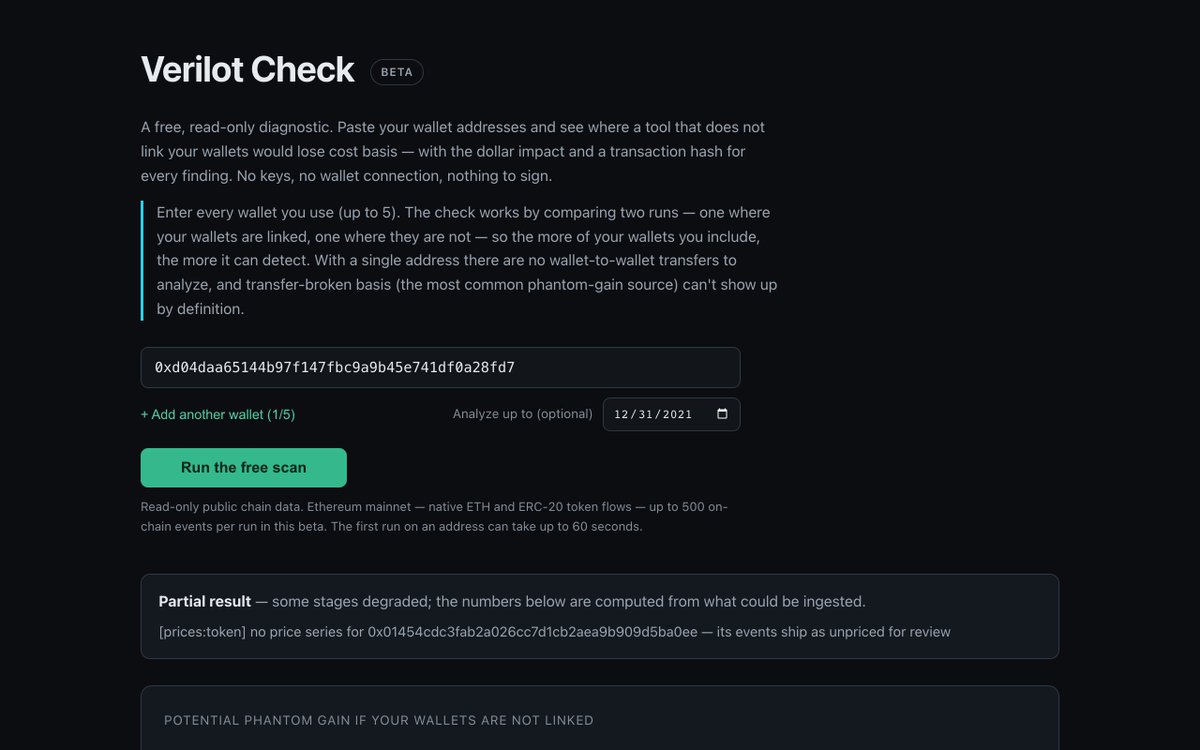
Paste a wallet address. Verilot re-runs your history with wallet linking on and off, and shows the delta — plus a balance tie-out check against the real on-chain balance.
Read-only. No keys, no wallet connection, no signup: https://t.co/D4upwp1dGn
The IRS no longer lets you pool cost basis across wallets. Since Jan 1 2025, wallet-by-wallet tracking is required, and most software made that split for you without asking.
If the split was wrong, so is every gain since: https://t.co/fq60vPnBlu
Your crypto tax tool doesn't know a bridge from a sale.
Move funds between your own wallets, or bridge chains, and cost basis quietly resets to $0 — showing up as gains you never made.
Verilot flags exactly which transactions got mislabeled: https://t.co/fIAAy3vAyZ
"Missing purchase history" isn't a bug. It's Koinly saying a sale got a $0 cost basis because it never saw the coins arrive. Every crypto tax tool has this failure mode.
Common causes, and fixes: https://t.co/NnnnFKfM9n
Form 1099-DA lands in early 2027 with a box most people will misread: Box 1g, cost basis. A blank box does not mean zero basis. Software often assumes otherwise.
What Box 1g reports, and how to reconcile it: https://t.co/57cW8f6pk3
@wminshew On cost-basis tracking: the failure mode isn't the math, it's labeling. Bridges, wraps and wallet-to-wallet moves get read as disposals, basis resets to zero, and phantom gains show up. Whatever you build, put a tx hash on every line so it stays checkable.
@__marijuano LLMs are fine for labeling, bad for the ledger — they'll invent a basis. Cross-chain, the over/underpay risk is almost always self-transfers and bridges being read as sales. This flags exactly those, read-only, tx hash per line: https://t.co/8hTGX3A4VL
This is what the free scan actually returns, not a mockup.
Paste a wallet: Verilot runs your history two ways (linked / not linked) and shows the delta, plus a balance tie-out check against the real on-chain balance.
Read-only, no wallet connection. https://t.co/ytZmXRfO0x
@CryptoTaxFixer Good breakdown.
The part that trips people up most is transfers between wallets they own — basis resets to $0 on the receiving side and shows as a phantom gain even though nothing was sold.
Free tool that flags exactly those mislabeled transfers: https://t.co/9IiFTaL8rc
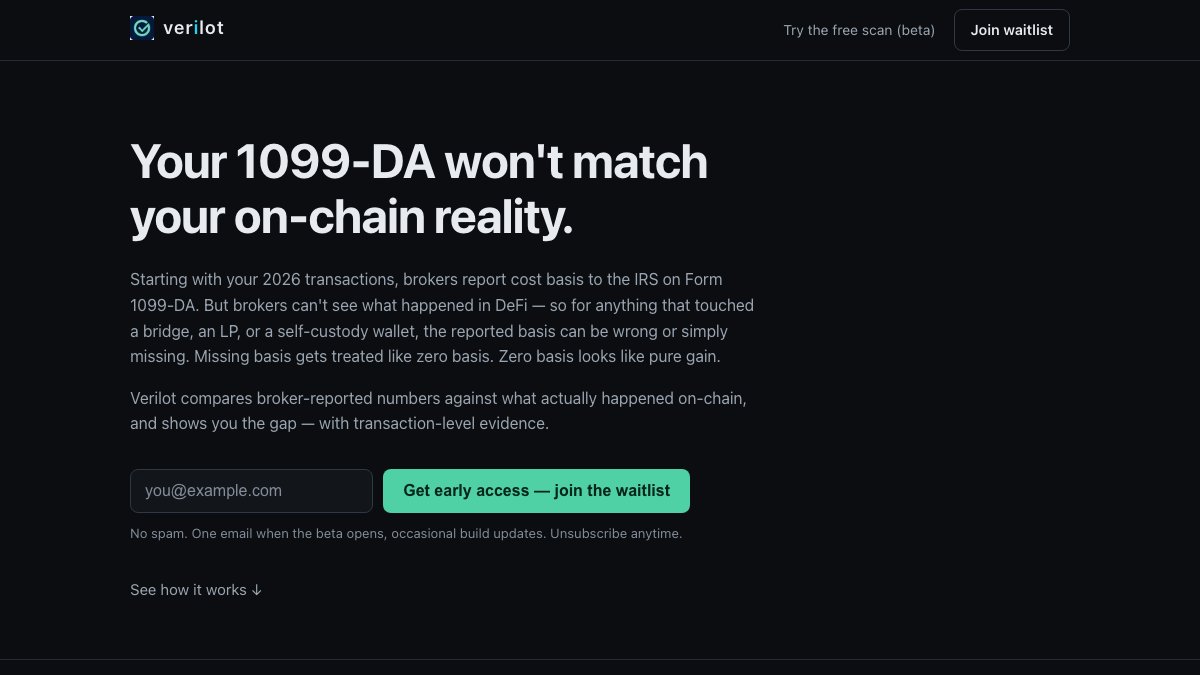
@Psalmdav0 Right, and the gap is what brokers can't see — anything that touched a bridge, an LP, or self-custody.
That missing basis defaults to zero, which reads as pure gain.
Built Verilot to check broker numbers against on-chain history for exactly that. https://t.co/9IiFTaL8rc
@HODLTrackapp Built the same frustration into Verilot, just checking broker-reported 1099-DA numbers against actual on-chain history instead of a spreadsheet — curious how yours handles bridged/LP txns, that's usually where FIFO breaks down for us.
https://t.co/9IiFTaL8rc
We ran Verilot on Vitalik's public wallets. Wallet-linking off: $164.1M "realized gains." Linked: $119.2M.
The $44.9M gap is phantom - gains that only exist because a per-wallet tool loses cost basis on transfers between someone's own wallets.
https://t.co/9IiFTaL8rc
This week I linked up Verilot's 4 guides so they actually point to each other — phantom gains, per-wallet basis, Koinly's missing-history warning, and Form 1099-DA Box 1g. Land on one problem, see the other three in one read. Small fix, should've done it week one.
@CryptoTaxWiz Thanks for checking it out — would love to hear what you think once you try a wallet. Happy to answer anything on how the on-chain matching works.
Building Verilot — a tool to check your crypto cost basis before the IRS does.
Wallets don't track basis. Exchanges don't agree. The 2027 filing season (Form 1099-DA, per-wallet rules) makes that gap expensive.
Sharing progress as I build it. Not tax advice.