Java/Spring developer exploring practical AI engineering.
Spring Boot, Spring AI, agentic workflows, DevSecOps, Nuxt.
Maintainer of @wpnuxt.
Kaspa enthousiast
I'm setting up this dual MoA preset config in Hermes:
One cheaper default MoA preset with glm-5.2 as aggregator.
But for max quality, I can switch to my "dreamteam" MoA:
Opus 4.8 as aggregator with gpt-5.5 and glm-5.2 as reference models.
I'm very curious for the results with the dreamteam 🤓
The strongest models are gated and access is granted only to a select few.
Hermes Agent now exposes MoA presets as virtual models, giving you capabilities beyond the publicly available frontier: 8% higher than Opus 4.8 and 11% higher than GPT 5.5 on our upcoming benchmark.
@therealdanvega Being a good developer has always been more than merely producing code.
So I think what separates a good developer from everyone else hasn't changed
Nice to see Spring AI converging on the boring-but-critical bits before GA.
HTTP client control, compatibility fixes, and multi-turn behaviour are exactly the things that decide whether an AI feature remains a demo or becomes part of a real Spring application.
🚀 Spring AI 2.0.0-RC2 is out and one more step to GA!
✅Configurable HTTP clients for OpenAI & Anthropic
✅ Restored Spring Framework < 7.0.4 compatibility
✅ Multi-turn thinking fixed for Ollama & OpenAI, bug fixes and more on https://t.co/piCrsbrjwS
@shivam56296 This is why MCP needs to be treated like infrastructure, not a plugin toy.
For enterprise Java teams I’d default to sandboxed processes, least-privilege filesystem access, network deny-by-default, and explicit allowlists per server.
@theo What made this land for me is that “takeoff” becomes much less abstract when you look at day-to-day engineering.
Agents already shift humans from supplying methods to supplying goals.
The big question is when they start supplying the next goals too.
AI self-improvement sounds abstract until you frame it like engineering:
Humans used to supply the method. Now we supply the goal. Next question: when does the system supply the next goal too?
That’s why evals and oversight can’t stay an afterthought.
https://t.co/1QV9ZQLK0y
Appreciate the shoutout, @vkp_00 🙏
This is exactly the mindset shift: with AI, don’t test whether it says the same words — test whether it respects the contract.
Schema, facts, boundaries, safety, and behaviour matter more than phrasing.
Glad it clicked from the Java/microservices angle. That’s where Spring AI evals start to feel very natural.
@vkp_00 I would avoid exact-output tests. Test the contract instead: schema, allowed values, required facts, banned claims, source usage, tool calls, and nasty edge cases like prompt injection or missing info.
The wording can vary. The acceptance criteria shouldn’t.
Interesting workflow, thanks for sharing.
The separation between architecture, implementation, and quality agents feels like the important part here.
Curious how you handle shared context between the agents: specs, existing codebase conventions, test strategy, and review criteria?
The JVM AI stack is getting genuinely interesting now.
For Java teams, the question is no longer “can we call an LLM API?” but which layer owns prompts, tools, memory, evals, local models, and production concerns.
#spring#springai
Confused by the exploding number of #AI tools in the #JVM ecosystem? Teams mix #SpringAI, #LangChain4j, MCP & #Ollama without understanding the layers underneath. @ArturSkowronski explains what each part of the #Java AI stack is actually for: https://t.co/zp6IDTxTem
@langchain4j
I agree with the direction.
For many enterprise teams, the winning AI stack won’t be a separate island — it’ll be the same Spring services, security model, observability, CI/CD, and deployment patterns they already trust, with AI capabilities added carefully.
FDEs are a "round peg, square hole" approach.
A better approach is Congruent AI tech. If the business system is already Java & Spring (which it likely is, if it is powering significant business value), then Spring AI is the solution, not FDEs.
Over the past 2 months I've published more than 20 Spring AI recipes.
If you've missed any, here's the complete collection: https://t.co/VYdJ96wtwe
I'm excited about the recipes next week, including one from my "Test Kitchen" showing something I've been experimenting with.
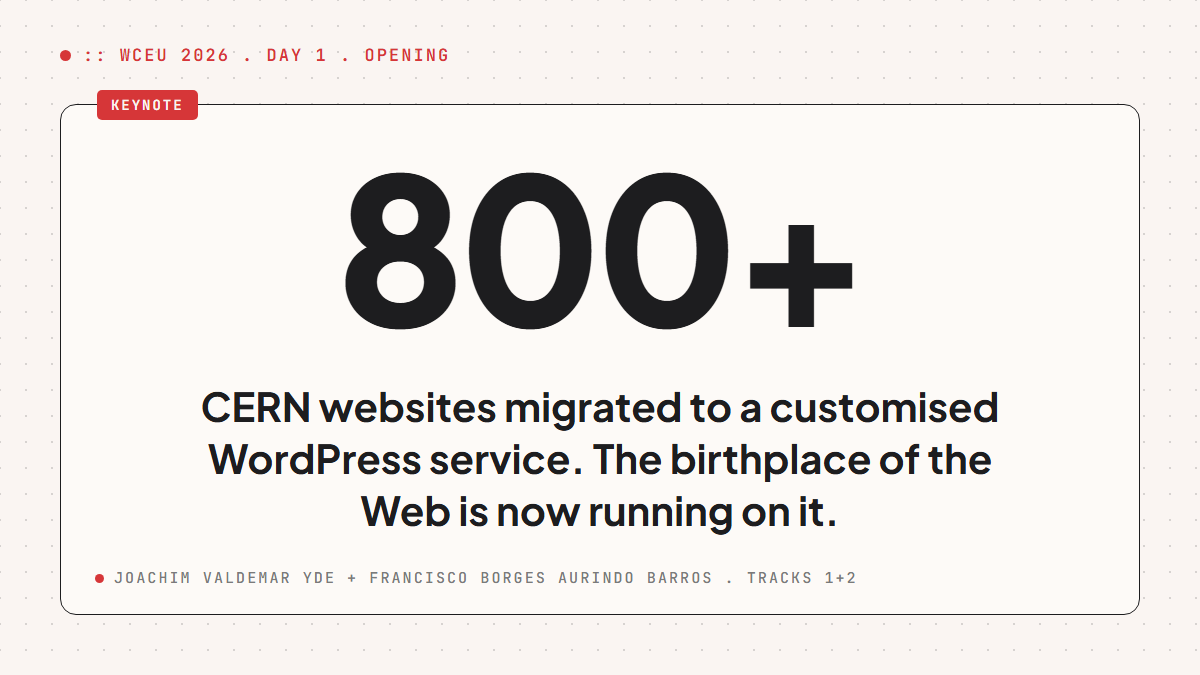
CERN now runs on WordPress. 800+ sites migrated to a customised service — the inside story is the opening session at WCEU 2026 today.
The birthplace of the Web picked open source. Worth a beat.
#WCEU#WCEU2026#WordPress