Squirrels plant more new trees than every reforestation program on Earth combined.
Each fall, a single gray squirrel buries somewhere between 3,000 and 10,000 acorns, nuts, and seeds.
They do this by memory, sort of. They remember the general area but not the specific spots. The forgotten ones germinate.
Researchers studying scatter-hoarding species have found that squirrels recover only about 25% of what they bury. The other 75% becomes next year's saplings.
Oaks especially depend on this. Acorns are too heavy to travel by wind and too big for most birds. The tree's main reproductive strategy is convincing a rodent to forget where lunch is.
The forest you walk through is partly squirrel mistakes. The shade you sit under was something a squirrel meant to eat in 1982.
Worth thinking about next time one of them barks at you from a fence post.
Meet Bumpy!
This enchanting little chap was rescued over the weekend. His mother likely died defending him in a territorial fight and when the Kenya Wildlife Service found him, he was huddled beside her body. They rescued him and placed him in our care.
This was Bumpy's first night with us, snuggled next to Keeper Simon. Simon put his mattress on the ground and the tiny hippo nestled by his side, swaddled in his cherry blanket. After his fraught ordeal, he finally felt at peace and slept soundly in the crook of Simon's arm.
Now, you can become part of Bumpy’s journey — read his full rescue story and support him through an adoption: https://t.co/sR6w4FUvNN
The song of this little bird has a frequency of 432 Hz.
This sound helps release happy hormones like serotonin, and naturally regulates blood pressure and heart rate.
Don't harm opossums! They’re harmless and actually really useful. They keep pests in check (eating ticks, roaches, rats, and scorpions), clean up dead animals, and help spread seeds. Basically, they’re nature’s cleanup crew
Katharine Hepburn, in her own words:
"Once, when I was a teenager, my father and I were standing in line to buy tickets for the circus. Finally, there was only one family between us and the ticket counter. That family made a lasting impression on me.
There were eight children, all under the age of 12. From the way they were dressed, you could tell they didn’t have much money, but their clothes were clean, very clean. The children were well-behaved, standing in pairs behind their parents, holding hands.
They were so excited about the clowns, the animals, and all the acts they would see that night. From their excitement, you could tell they had never been to a circus before. It was going to be a highlight of their lives.
The father and mother stood proudly at the front of their little group. The mother was holding her husband’s hand, looking at him as if to say, 'You’re my knight in shining armor.' He was smiling, enjoying seeing his family happy.
The ticket lady asked how many tickets he wanted, and he proudly responded, 'I want eight children’s tickets and two adult tickets.' Then she announced the price.
The wife let go of her husband’s hand, her head dropped, and the man’s lip began to quiver. He leaned in closer and asked, 'How much did you say?'
The ticket lady repeated the price.
He didn’t have enough money. How was he supposed to turn around and tell his eight kids that he couldn’t afford to take them to the circus?
Seeing what was happening, my dad reached into his pocket, pulled out a $20 bill, and dropped it on the ground. We weren’t rich by any means. My father bent down, picked up the $20 bill, tapped the man on the shoulder, and said, 'Excuse me, sir, this fell out of your pocket.'
The man understood what was happening. He wasn’t being handed charity, but he gratefully accepted the help in his desperate, heartbreaking, and embarrassing situation. He looked straight into my father’s eyes, took my dad’s hand in both of his, squeezed the bill tightly, and with trembling lips and a tear streaming down his cheek, he replied, 'Thank you, sir. This really means so much to me and my family.'
My father and I went back to our car and drove home. The $20 my dad gave away was what we had planned to use for our own tickets.
Although we didn’t see the circus that night, we felt a joy inside us that was far greater than seeing the circus.
That day, I learned the true value of giving. The Giver is greater than the Receiver.
If you want to be great, greater than life itself, learn to give. Love has nothing to do with what you expect to get, only with what you expect to give—everything.
The importance of giving and blessing others cannot be overstated because there is always joy in giving. Learn to make someone happy through acts of giving."
~Katharine Hepburn
Braving the storm: Jackie, one half of the famous bald eagles of Big Bear Valley, protects their new eaglets from strong winds, freezing rain, and snow over the weekend 🌨️🦅
I will never tire of watching this beautiful video ❤️.
There is always one child that can’t behave!
Happiness is remembering when a baby Elephant tickled reporter Alvin Maunda with his trunk during a piece to camera for a report from Elephant ophanage @SheldrickTrust for a local news channel.
🎦 Credit: KBC News.
That cute rock stack by the creek just killed a bunch of mosquito killers.
Dragonflies spend most of their lives underwater, sometimes up to five years, clinging to rocks while they grow.
A single dragonfly larva eats hundreds of mosquito larvae before it ever flies.
But dragonflies are just one species. The rocks in a healthy stream are also covering caddisfly larvae, mayflies, stoneflies, water beetles, salamander egg clutches, and the freshwater snails that fish depend on.
Eastern Hellbenders, an endangered giant salamander species, lay their eggs specifically under flat stream rocks. Moving the rock kills the clutch.
When you pull a wet rock out of the water and stack it on the bank, everything clinging to that rock dies. They desiccate within minutes in the sun.
A single rock pile is dozens of small lives lost. Most stream cairns are stacks of fifteen to twenty rocks.
If you see stacked rocks at a creek, knock them over. The stream rebuilds itself faster when rocks are scattered the way water put them.
Leave no trace isn't an aesthetic preference. It's real habitat protection.
Jessica fell over an 180-foot waterfall, and when rescuers arrived, her border collie was nowhere to be seen. 😰 But strangers wouldn’t just forget about her and made every effort to find her. 🐕 📸 Precision Helicopters / Jessica Johnston precisionhelicoptersltd
Almost 2,000 years in age, the Roman aqueduct located in Zaghouan, Tunisia, is an example of ancient engineering.
Spanning 132 kilometers (82 miles), this aqueduct historically supplied water to Carthage.
Did you know?
Sunflowers are used to assist in cleaning up after a nuclear disaster.
They are hyperaccumulators, capable of absorbing toxic heavy metals from the ground and have been planted at both Chernobyl and Fukushima.
[🎞️ thebrainmaze]
Brandon Alderson, from Sunderland, UK, was travelling to work when he noticed a man in distress in a layby.
He pulled over and saw that the man was suffocating. Brandon performed the Heimlich manoeuvre six times and saved the man's life.
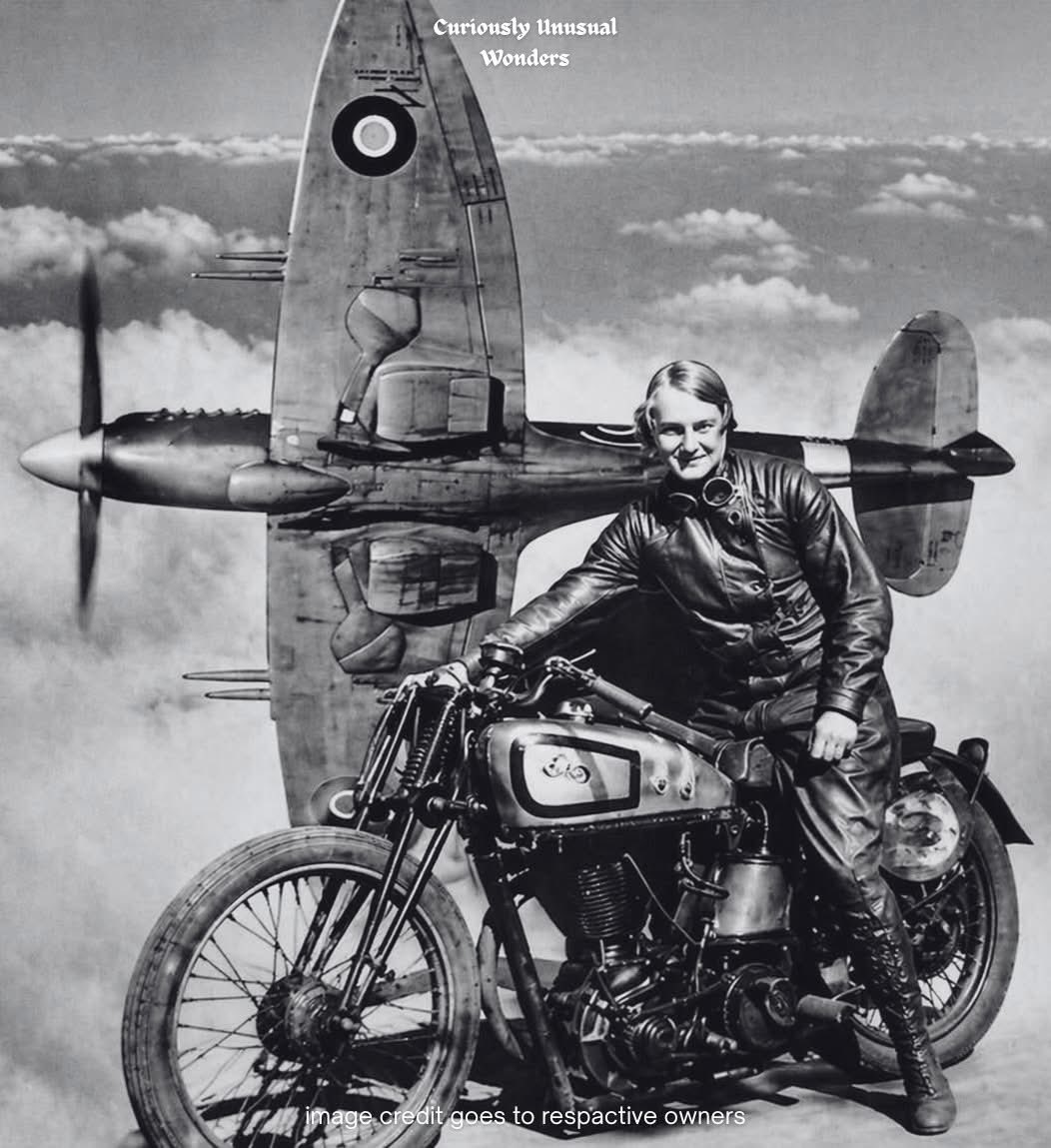
The restrictor remained in use until 1943, when the full pressure carburetor finally arrived. It had kept British pilots alive for two years in the middle of the war they couldn't afford to lose.
After the war she worked on the Blue Streak missile. She studied what wet runways do to braking distances. She helped design a bobsled for the RAF Olympic team. In 1967 she solved overheating problems on an Eagle Mk1 Formula 1 car.
She never received a top promotion at the RAE. Such positions, she was told, were for men.
She received an OBE in 1949. The citation said "services to aviation." It did not mention the washer.
She retired from the RAE in 1969. She kept racing motorcycles and sports cars. She modified and tuned both in her home workshop until she couldn't anymore.
She died on November 18, 1990. She was 81.
The Battle of Britain is one of the most documented events in British military history. Hundreds of books. Dozens of films. Memoirs by the pilots who flew in it. Almost none of them mention the carburetor problem. Almost none of them mention her.
The pilots who benefited most never knew her name. They just knew that when they pushed the nose down, the engine kept running.
Every time a German Messerschmitt pilot wanted to escape a Spitfire on his tail, he did the same thing.
He pushed the nose down.
In a dive, the German engine kept running — it used fuel injection. The British Spitfire's engine cut out. For one and a half seconds the Merlin went dead, the aircraft shuddered, and by the time it caught again the German was gone. Worse: if a German was behind a British pilot and the British pilot dove to escape, the German could follow and keep shooting while the British engine was silent.
Pilots were dying because of a carburetor.
The engineers at Farnborough knew about the problem. They were working on a long-term solution — a redesigned carburetor that would take years to perfect and manufacture.
A woman named Beatrice Shilling fixed it with a washer.
She was born in Hampshire in 1909 and was the kind of child who spent her pocket money on Meccano sets and tools. At fourteen she bought her first motorbike. Her mother, with the inspired instinct of someone who understood what her daughter actually was, found the Women's Engineering Society and arranged an apprenticeship at an electrical firm.
She went to Manchester University — one of the first two women ever to study engineering there — graduated with a degree in electrical engineering, stayed another year for a master's in mechanical engineering, and in 1936 joined the Royal Aircraft Establishment at Farnborough as a scientific officer.
By the late 1930s she was one of the best carburetor engineers in Britain. She was also one of only three women to hold the British Motorcycle Racing Club's Gold Star — awarded for lapping the Brooklands racing circuit at over 100 miles per hour on a motorcycle.
She had reportedly told her future husband, an engineer named George Naylor, that she wouldn't marry him until he earned his own Brooklands Gold Star first.
He earned it. They married in 1938.
The problem with the Merlin was specific and lethal. The SU carburetor used a float chamber to regulate fuel flow. Under negative g-forces — the forces experienced in a sudden dive — the fuel flooded to the top of the float chamber and starved the engine for 1.5 seconds. Just enough time for a German pilot to turn the tables entirely.
The RAF had known about this since the Battle of France. The formal solution — a redesigned pressure carburetor — was in development but wouldn't be ready for years.
Shilling was thirty-one years old, working in carburetor research, and she designed a fix in weeks.
A brass thimble with a precisely calibrated hole in the center — later simplified to a flat washer — fitted inline in the fuel line just before the carburetor. It restricted maximum fuel flow to just enough to prevent flooding without cutting off power. The key breakthrough: it could be fitted without taking the aircraft out of service. No downtime. No factory return.
The old guard at the RAE looked at it and called it a plumbing fix. They called her a plumber. The first batch of 5,000 units was made by a Birmingham firm that normally manufactured plumbing fixtures, which they found embarrassing.
The RAF pilots who flew Spitfires with Messerschmitts on their tails called it something else.
They called it Miss Shilling's Orifice. With deep affection.
By March 1941 she had organized a small team and was personally touring RAF fighter stations across England — traveling between bases on her old racing motorcycle — fitting the device to every Merlin engine they could reach. Squadron leaders all over the country were demanding installations. The word spread faster than the official channels could keep up with.
The Germans noticed. They couldn't explain why British fighter pilots had suddenly started following them into dives. They were baffled by the new aggression. They didn't know about the washer.
(More story replies)