Sainte Chapelle, built on Ile de la Cité in heart of Paris, France 🇫🇷 Sainte-Chapelle de Paris (Sainte-Chapelle du Palais) was specially built to house Christian artefacts like Crown of Thorns and piece of True Cross as well as other relics related to crucifixion of Christ.
At beginning of 13th Century CE, Emperor Baudouin II de Courtenay, last Emperor of Constantinople urgently needs money and in order to get it, he offers to sell his most precious religious artefact: Crown of Thorns, placed on Jesus’ head before crucifixion. In 1237, Emperor leaves for a European voyage hoping to find a buyer and an ally to join him in his latest crusade. He meets with French king Louis IX. While king is not interested in joining Emperor’s crusade, he is interested in Crown of Thorns and other relics for sale in Venice. For 135000 pounds, Crown of Thorns is brought to France, arriving in Paris in 1239.
Day after arrival of Crown in Paris, a great ceremony is organized, during which relic is placed in Chapel of Saint-Nicolas de la Cité. Three years later, two new artefacts sold by Emperor arrive in Paris: Relics of Passion of Christ and part of the True Cross (on which Jesus was crucified). These were considered to be direct proof of story of Jesus and his crucifixion. These three relics, now owned by king, are particularly important to Christians. Louis IX decides to place these precious items in a more prestigious location than little Saint-Nicolas Chapel. Thus, king calls for construction of a new chapel within old Palais Royal de l’Ile de la Cité, specially designed to house these sacred items.
While name of original architect of Sainte-Chapelle de Paris remains unconfirmed to this day, some texts have mentioned the name Pierre de Montreuil. At start of project in 1240 CE, architect of Sainte-Chapelle must already have been a man of a certain age, who possessed quite a bit of favour with king. Thus in 1242, construction work begins. Project is completed in 1248, an impressive accomplishment considering complex gothic architecture of chapel. It's a architectural masterpiece combining fine workmanship and precision.
Entirely dedicated to Virgin Mary, lower chapel of Sainte-Chapelle was once reserved for members of court. Lower chapel is notable for lack of lighting, lending it an almost mystical quality. Lack of light is due to its unusually small windows and lower ceilings. Located above lower chapel, upper chapel is dedicated to relics of Crucifixion and is directly connected to first floor of Palais Royal by a small door. Thus, access to upper chapel was, at time, exclusively reserved for members of royal family. A massive rosette dominates entryway and bathes chapel’s floors, walls and sculptures in light. Atmosphere, lofty architecture, massive stained glass windows and warmly coloured light of this room are in stark contrast to darkness of lower chapel.
A true symbol of monarchy, Sainte-Chapelle was one of first targets of French Revolutionaries in 1789. While two-thirds of its stained glass windows are original, different restorations throughout chapel’s history have removed some of its panels. Similarly, among 12 statues of apostles located at base of ogive arches, only those that adorn stage in front of apse are genuine. Other statues are replicas of originals, which were badly damaged during French Revolution and now stored at Cluny Museum. Furniture, stalls, rood screen and all regalia were also destroyed during Revolution. At this time, reliquaries and boxes were sent to mint to be melted down. Only Crown of Thorns was saved from destruction. In order to accommodate shelving, 2m of stained glass was removed from upper chapel and it was temporarily converted into archival storage. Removed stained glass windows were, for most part sold to England.
Between 1840-1868, Chapel finally underwent works to restore it to its authentic original appearance and preserve its historical value for future generations.
#archaeohistories
Strawberry plant from
"A Curious Herbal Antique Botanical Illustration", 1737 by Scottish botanical illustrator/author and engraver Elizabeth Blackwell #WomensArt
This is one of the oldest wooden doors in Britain
Carved with a Viking longship, figures of Adam and Eve, and dragon-headed iron hinges, the "Viking Door" has hung in St Helen's Church in Yorkshire for nearly 900 years.
#BirminghamLibrary The Birmingham War Poetry Collection was donated to the library in 1921 by William Cross of Rubery: https://t.co/J2JSLOudI4 Ref: L 53.31 @LibraryofBham
#BirminghamHistory the Birmingham Cinderella Club formed in 1893 took poor children on outings and provided entertainment. In 1898 over 600 children were taken to Sutton Park. Ref: WK/B11/441 @LibraryofBham
Women of 'The Immortals', a group of friends formed at the Glasgow School of Art during the 1890s, including artists Margaret and Frances Macdonald, Katherine Cameron, Janet Aitken, Agnes Raeburn and Jessie Keppie #womensart
The “magic sphere” of Helios
Found in the Theater of Dionysus in 1866, this mystical object, dating back to the ~2nd-3rd century AD, is made of marble, shaped like a sphere, and depicts Helios, Greek Solar God.
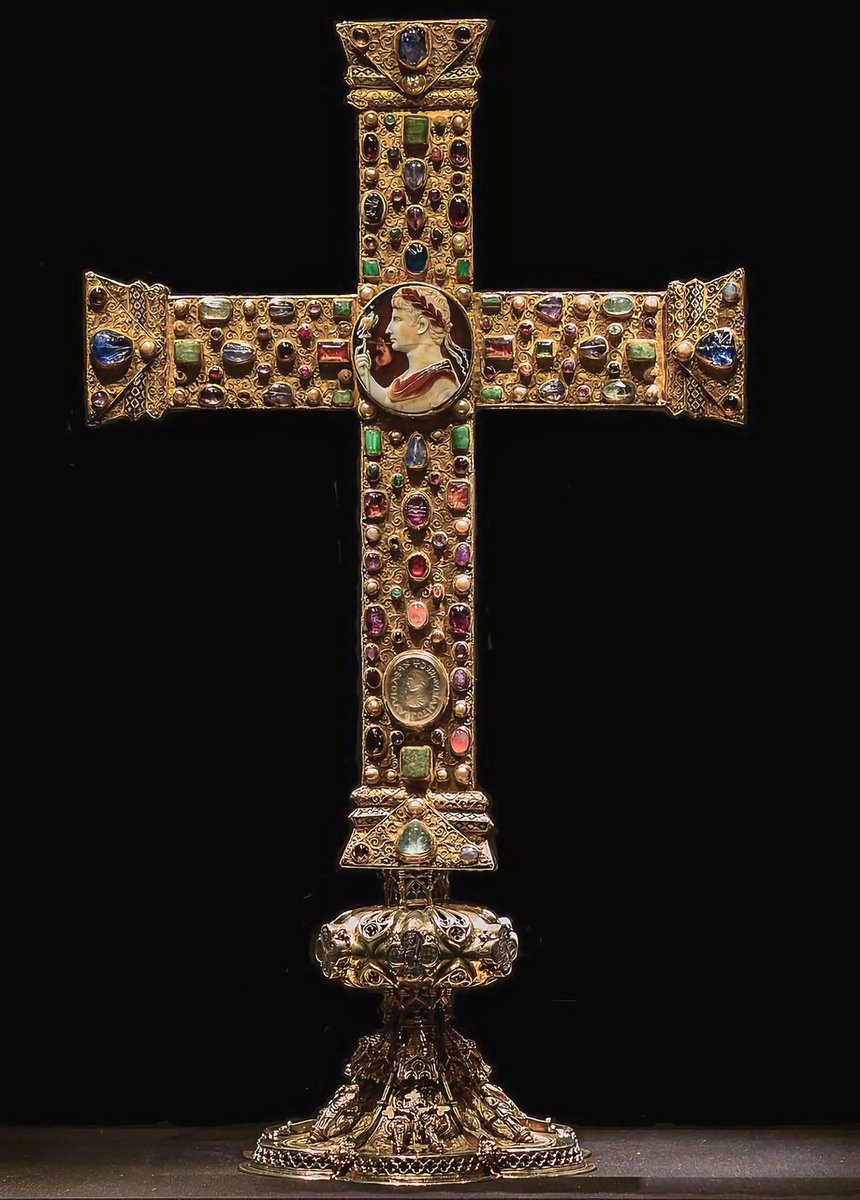
A masterpiece of medieval goldsmithing is the Lothair Cross (Lotharkreuz). It is an extraordinary crux gemmata (processional cross covered with precious stones) created around 1000 AD, likely in Cologne, Germany 🇩🇪
Today, the work is housed in the famous Treasury of Aachen Cathedral (AachenerDomschatz), one of the most important sacred art complexes in Europe. It has an oak core entirely covered in gold and silver-gilt leaf. It is decorated with 102 gems and 35 pearls, arranged in exquisite filigree. The decorated Gothic base on which it rests is a later addition, dating back to the 14th century.
The cross is a key monument of Ottonian imperial ideology (it was likely commissioned or donated by Emperor Otto III). It combines Christian religious symbols with the prestige of the Roman and Carolingian past according to the practice of reuse (spolia);
The Cameo of Augustus: At the exact center of the cross stands a Roman cameo from 1st century AD depicting the profile of the Roman Emperor Augustus wearing a laurel wreath. This central placement served to legitimize the power of the emperors of the Holy Roman Empire, positioning them as direct successors of Rome.
The Seal of Lothair: Set into the lower part of the vertical arm is a rock crystal seal that belonged to the Carolingian king LothairII (9th century). The seal bears his portrait and the inscription "
+XPE ADIVVA HLOTARIVM REG"
("O Christ, help King Lothair").
The Back: Contrasting with the opulence of the front, the back of the cross is a flat silver plate engraved with a delicate and dramatic Crucifixion of Jesus. The hand of God the Father falls upon it, holding a laurel wreath for the Son.
#archaeohistories
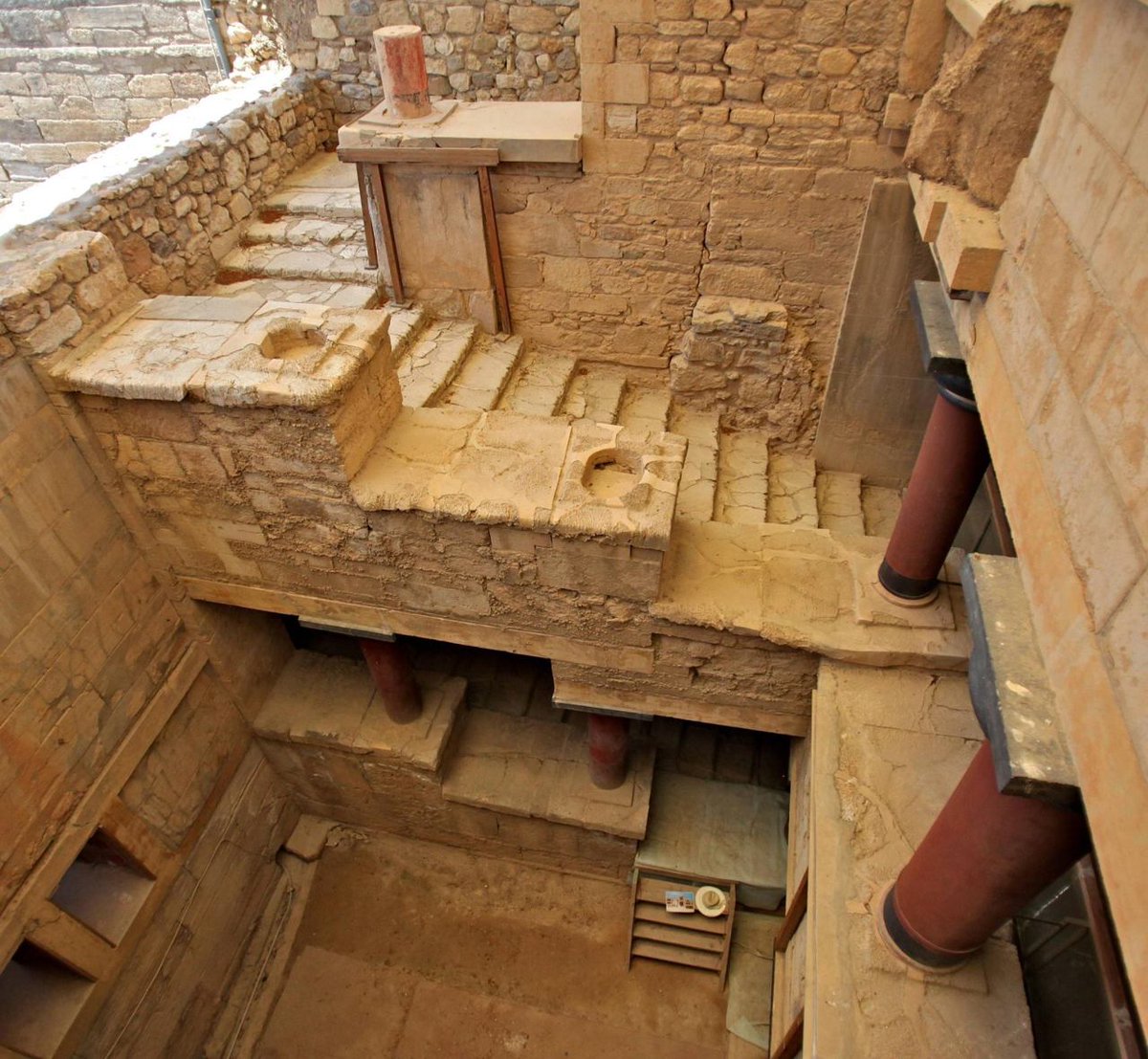
The grand stairs of the Palace of Knossos in Crete, one of the oldest palace complexes in Europe.
It was built around 1900 BC on a site that had been inhabited since roughly 7000 BC.
During a recent excavation near Enderby, England, archaeologists discovered an Iron Age shield made of bark—the only such shield ever found in Europe. Wood-based shields could be lightweight yet durable, but very few have survived to the present.
https://t.co/ioaZcnNgEV
1909 embroidered English suffrage banner designed by artist Mary Lowndes. Bearing the name of Caroline Herschel (1750-1848) the first female profession astronomer, it was one of a number of banners created to celebrate women from history #Womensart
#SundayShowcase is A History of the World in 47 Borders by Jonn Elledge. Those inconsequential lines can mask years of conflict, political identity, hubris & foolishness. This book explains why our world looks the way it does. Ref: 526.09 HRA Map Area @LibraryofBham@jonnelledge
Eliot Hodgkin, 'June', from 'The Months', 1950. That gorgeous poppy, what I suspect is rosa 'Mermaid', scented pinks and philadelphus, and the first summer fruits and vegetables. Many things noticeably later than today, especially as Hodgkin gardened in central London.