@Ewphoriac@yFactr Some portions of it do have surprisingly high ridership, the B and D lines have some of the highest per mile ridership in the country outside New York.
People from LA tend to exaggerate how bad their public transit is and make no effort to try it in the first place.
@LittleMikeyMcD@SukritGanesh@kamikazecash Of course you wouldn't. Did you know that despite being some of the highest demand places to live in the country, Manhattan, Boston, and Washington DC all have lower population and housing capacity than they did in 1950 when their populations were much more working class?
@LittleMikeyMcD@SukritGanesh@kamikazecash That's the effect, the cause is housing shortage.
The most gentrified cities are the ones that build the least amount of new housing relative to economic growth, that's a fact. Cities are supposed to grow with job growth, that's how they became major cities in the first place.
@LittleMikeyMcD@SukritGanesh@kamikazecash I'm sorry that reality disagrees with you. Median home price in a city that has barely increased in population since 1950:
@LittleMikeyMcD@SukritGanesh@kamikazecash Gentrification is when local housing supply doesn't keep up with demand, it's what happens when you don't build new housing.
San Francisco is the most gentrified major city in the US, while also having the oldest median building age and some of the slowest housing growth.
@handsomocity@TPCarney >"No zoning sounds great but it's not."
Zoning didn't exist in American cities until the 1920s or later. All the classic great American cities were mostly built with little to no zoning.
@SkiersRight@TPCarney@scottlincicome What you're doing is pointing to a random anecdotal example of a building burning down, not any larger statistical reality. Zoning codes aren't relevant to construction standards, and nobody is advocating for the abolition of building codes in the first place.
@smo841603557184@DrCameronMurray@TPCarney American cities didn't have zoning codes until the 1920s, all the classic great American cities were built before they existed.
@SkiersRight@TPCarney@scottlincicome Why would it be acceptable to have a higher level of a per capita fire death in one building type than another? If multi-units require higher engineering standards to achieve the same safety standard then fine, but it doesn't make sense for them to need a higher safety standard.
@SkiersRight@TPCarney@scottlincicome Well for one, fire safety and engineering standards aren't a part of zoning in the first place, those are a part of building codes. Different sets of regulations. Abolishing zoning regulations doesn't change engineering standards.
@handsomocity@TPCarney I don't think there are many who would argue against industrial zoning, but commercial zoning is a different topic. Most commercial uses you wouldn't want in residential neighborhoods, like bars or clubs, can be effectively filtered out by just requiring them to close by 10pm.
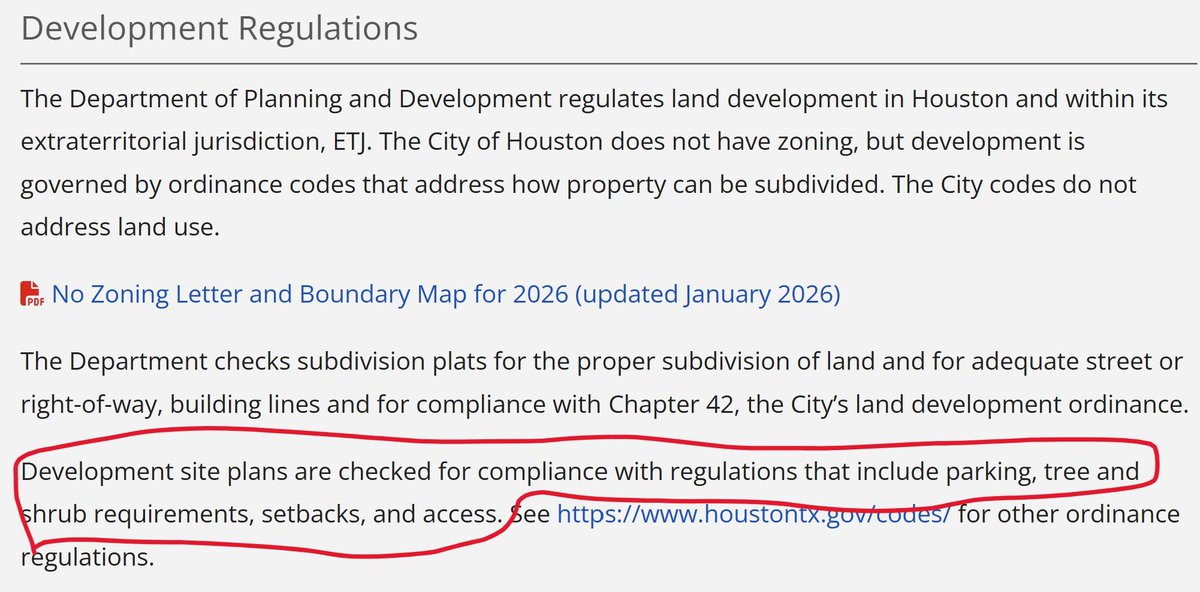
@handsomocity@TPCarney Houston has no separation of uses, but they have most other types of zoning regulations like parking minimums, unit limits, minimum lot sizes. They basically zone through deed restrictions and enforce them as if they're mini legal codes.
@Biotransgurl@leodaube Well for one, buying a single family home is almost never going to be cheaper than renting an apartment in the same neighborhood.
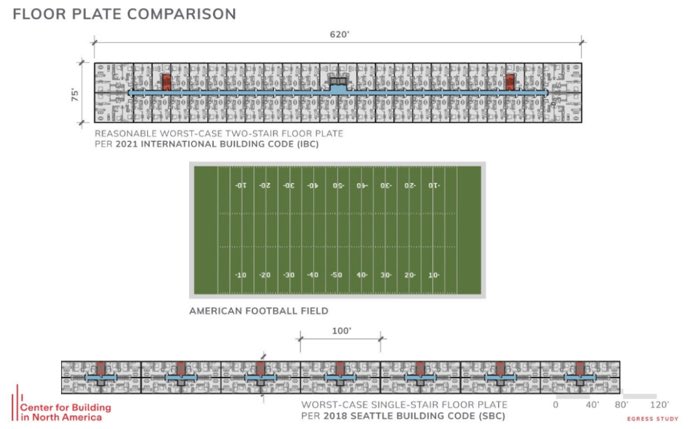
@Rascal112Social@leodaube Because point-access mid-rises aren't actually a compromise on safety in the first place. They have fewer staircases per building, but more staircases per unit. These things balance each other out in terms of fire safety to the point of being statistically equal to each other.
@leodaube For the love of God, please stop calling it "single stair", it's called point-access. "Single stair" is terrible advertising and doesn't convey that it's a fundamentally different internal structure than a double-loaded corridor building.
@SkiersRight@TPCarney@scottlincicome Didn't miss your point, that five over one construction style is the standard for mid-rise multi-unit buildings nowadays and they have a much better fire safety record than single family homes, which are also mostly wood frame.
@PeterGa57410783@TPCarney@scottlincicome Despite what Houston's city government claims, Houston actually has most types of zoning regulation except for separation of uses. They just zone on a subdivision level instead of having a centralized code and refer to them as "development regulations" instead.