موقع صيني للأمن السيبراني يركز على الهندسة العكسية ، تحليل البرمجيات الخبيثة ، Kernel Research ،حماية الأنظمة Mobile Reverse ، و Exploit Development . يحتوي الموقع على دورات مجانية ومدفوعة .
https://t.co/23pCVnAV8J
#الأمن_السيبراني
O povo surtando por causa da Bolsa e nem entende sobre provavelmente.
Vou resumir aqui pra vocês
Circuitbreaker é tipo um DIJUNTOR da sua casa.
Quando tem uma SOBRECARGA ELÉTRICA ele DESARMA por segurança PARA EVITAR UM PROBLEMA MAIOR.
Quando o IBOVESPA (que mede nossa QUERIDÍSSIMA bolsa de valores) cai 10% em relação ao fechamento DO DIA ANTERIOOOR a B3 INTERROMPE TODAS as negociações por 30 minutos pra o pessoal respirar, acalmar os ânimos, pra evitar um PÂNICO no mercado financeiro.
Isso não é algo ruim, é só uma reação de que os investidores tiveram uma reação negativa a eleição do atual governo, porque eles tinham expectativas que a oposição fosse assumir.
E uma vez que expectativas não são atendidas elas precisam ser AJUSTADAS, ou seja, a bolsa está apenas reagindo a PROJEÇÃO do que os INVESTIDORES ESPERAVAM DO FUTURO.
Não tem nada a ver com o Brasil quebrar.
Agora o que acontece? Qual a preocupação deles? Eles tão preocupados que o governo comece aumentar gastos em cima de gastos sem ter responsabilidade fiscal ou CONTROLE DE DÍVIDA PÚBLICA.
Quando os investidores olham pro Brasil e TEORIZAM “nossa tão gastando muito ali, vão aumentar os juros, créditos vão estar mais altos, vamos perder dinheiro”
Então a única coisa que o governo tem que fazer agora é MOSTRAR que vai ter responsabilidade fiscal e como pretende administrar os recursos públicos sem comprometer o crescimento econômico e as políticas públicas, e é reduzir essa imprevisibilidade como por exemplo anunciar em vai assumir o ministério da fazenda porque isso vai trazer uma ideia de como ele pensa, apresentar as prioridades econômicas, como vão ser esses números, como vão cumprir metas fiscais.
Em 2002 mesmo teve uma queda da bolsa de 4% e aí o Lula lá trás fez uma carta mostrando todos seus comprometimentos, respeitos aos contratos, responsabilidade fiscal. E essa carta fez com que a bolsa respirasse e fizesse “nossa não vamo se desesperar”
Tanto que 1 dia antes da eleição pro 2 turno a bolsa subiu 8 pontos.
Então, é questão do governo fazer uma nova sinalização, e quando isso acontecer e tivermos essa conversa, mostrarmos as responsabilidades, contas, planejamentos e o possível ministro da fazenda vai fazer com que o mercado entenda, reduza imprevisibilidade e aí sim as coisas vão se acalmar.
Bom, eleição passou, vencemos e agora precisamos conversar sobre 2 coisas:
1. PRO GOVERNO
Quase perdemos pra um miliciano bicheiro por não ouvir a população, o que a população quer de MUDANÇA??
- Redução da maioridade penal para crimes hediondos
- Enxugar o privilégio dos políticos e reduzir a carga tributária pra PF e de pequenos CNPJs
- Redistribuir imposto pra desonerar o carrinho do mercado
- Punir TODOS os envolvidos no caso INSS e Master - Indicar novos ministros do STF com reputação ilibada e imagem IMPARCIAL
- Rever o papo sobre regulamentação das redes sociais pra gente chegar num MEIO TERMO entre segurança de menores, segurança nacional e liberdade de expressão
- Criar o sistema unificado de segurança pública para ontem
- Tirar do papel o projeto aprovado sobre cadastro nacional de criminosos sexuais
- Reequilibrar investimento entre ensino superior e EDUCAÇÃO BÁSICA
O que maais??
Algo incontestável deve ser dito sobre Luiz Inácio Lula da Silva: ele não é apenas um político normal numa democracia, porque algo em sua pessoa encarna profundamente um aspecto sombrio do brasileiro que nenhum outro político desde 1988 conseguiu recriar.
Luiz Inácio é sui generis, e só Getúlio o supera historicamente como político brasileiro - isso não é mérito moral nenhum. É como se Luiz Inácio fosse um "tipo ideal platônico" ambulante que serve de espelho quando se pensa no lado ruim do Brasil e do brasileiro.
Como explicar que um confesso mentiroso contumaz consiga cinicamente mentir não uma, nem duas, nem três, nem quatro, nem cinco, mas SEIS vezes em eleições e sair vencedor ininterrupto de quatro, numa era cheia de fact-checking, IAs e internet?
Como explicar que o líder do partido mais corrupto da história brasileira não apenas se safe por aí dizendo que "não sabia de nada", mas ativamente promova a candidatura de corruptos condenados como José Dirceu e Delúbio Soares nas ruas do país sem a menor vergonha e desfaçatez?
Como explicar que o presidente que cedeu a nossa soberania nacional na Amazônia para centenas de ONGs internacionais sem o menor escrúpulo, e que ao mesmo tempo que desviava dinheiro do trabalhador brasileiro para ajudar a sustentar ferozes ditaduras narcoterroristas no continente, se safe com a aura do "Lulinha paz e amor" que luta pela soberania?
Como é possível explicar que um líder tenha a coragem de passar pano publicamente para ladrões, traficantes e criminosos, e ativamente resista a quaisquer tentativas de endurecer as penas para crimes num país com altíssimas taxas de violência, e ao mesmo tempo seja visto como um defensor dos trabalhadores e das minorias que mais sofrem nas mãos dos criminosos?
Como é possível explicar que um líder que governou, junto ao seu partido, por quase duas décadas e deixou um país subdesenvolvido, sem indústrias, sem ferrovias, sem capacidade de manufatura e inovação tecnológica relevantes seja, ao mesmo tepo, visto como promovedor do desenvolvimento?
Como é possível que o líder que mais beneficiou a alta elite banqueira e capitalista brasileira, concedendo-lhes ricos empréstimos públicos e altíssimas taxas de juros para uma vida fácil de rentismo às custas do imposto do trabalhador, seja visto como um inimigo dos ricos e poderosos?
Como é possível que político mais dinheirista e gastador contumaz da história brasileira moderna, cujos déficits públicos e esbórnia financeira desmedida são estrondosos, seja visto como alguém preocupado com a sustentabilidade e a longevidade dos serviços sociais como o SUS e o INSS?
Como é possível que o político que mais se gabou de não apenas não ter concluído o ensino médio, mas de não ter tido qualquer interesse em ampliar sua educação formal e de ter mantido as Universidades numa situação financeira difícil e cheia de cortes, seja visto como o promovedor da "Pátria Educadora", com índices educaionais declinantes e vaxaminosos?
Possivelmente nenhuma ciência consiga explicar a contradição sombria que é Luiz Inácio, mas parte da resposta está no fato que o brasileiro "cordial", o brasileiro do "jeitinho", do malandro de temperamento romântico e emocional que infesta os trópicos e esconde sua falta de espírito, coragem e retitude sob a postiça fachada do espertalhão tenha sido inteiramente encarnado na pessoa de Luiz Inácio.
Quando toda essa ruindade do brasileiro se encarna num pesado ponto único, e ele se torna candidato numa frágil democracia de sufrágio universal, o lado bom, respeitável, inteligente e capaz de levantar o país está fadado a seguir a lei da gravidade: para baixo.
Over the last year, I've fallen in love with Rust.
I was a C programmer for about a decade, really loved C, then moved to Python, but always kinda missed C.
Then I discovered Rust, and well, I like it more than C.
I also think we're moving into a time where we can see code as art in many ways. Code can be beautiful, or at least, it is to me.
And while we all write code with agents now, that doesn't mean we can't write beautiful code, and work on improving our code quality.
In a world where agents write all our code, writing better code is actually even more important imo.
Soooo, I've been working on a skill that I use with my agents to write better Rust code, distilled from the Google Rust style guide, the official API Guidelines, Effective Rust, and a couple of others.
Thought I'd share it, it's called BeautifulRust 🦀 ✨
https://t.co/fw8jkfAq5e
As a backend engineer.
Please learn:
- System Design (scalability, microservices)
-APIs (REST, GraphQL, gRPC)
-Database Systems (SQL, NoSQL)
-Distributed Systems (consistency, replication)
-Caching (Redis, Memcached)
-Security (OAuth2, JWT, encryption)
-DevOps (CI/CD, Docker, Kubernetes)
-Performance Optimization (profiling, load balancing)
-Cloud Services (AWS, GCP, Azure)
-Monitoring (Prometheus, Grafana)
Pick up a language..
Stop jumping from one language to the other
Researchers mathematically proved that AI will cause something worse than mass unemployment.
They call it “The Tragedy of the Cognitive Commons.”
Every industry relies on a shared pool of deep professional expertise. This expertise doesn't just magically appear. It regenerates generation after generation.
How? Through struggle.
Junior employees do the hard, repetitive, frustrating work. In exchange, they slowly build what researchers call "Internalized Mastery."
But right now, AI is completely annihilating junior-level work.
Companies are celebrating massive productivity boosts by automating the entry-level grind. (Anthropic’s own data shows their technical junior hiring has plunged 33% as AI agents take over the pipeline).
It looks like efficiency. But it is actually a time bomb.
The researchers highlight a concept called the "Validation Tether."
Effective human oversight of AI depends entirely on deep domain expertise. When an AI hallucinates or makes a critical error, a human expert catches it.
The experts validating AI outputs today look competent because they spent a decade doing the grunt work before AI existed.
The terrifying question the paper asks is this:
Who comes after them?
When the current generation of experts retires, there will be no one left with the Internalized Mastery required to spot when the machine is wrong. We are completely severing the pipeline that creates human competence.
We are trading our long-term intellectual independence for short-term productivity boosts.
Every time you let AI bypass the struggle, you are borrowing expertise from the future.
And the interest rate is our ability to think for ourselves.
Stanford discovered something like to "Dopamine" inside LLMs.
They looked deep inside the hidden states of these models and discovered something terrifying.
AI has naturally developed a complete, functioning reward subsystem.
It perfectly mimics the human brain.
Nobody programmed this architecture. It just emerged.
Inside the model, a tiny, sparse subset of neurons act as "value neurons." Their only job is to anticipate how good an answer will be.
But the real shock is what happens next.
They found a second set of neurons that act exactly like human dopamine.
When the AI gets a better result than it expected, these dopamine neurons spike in activation. When it gets a worse result, they crash. The AI is literally experiencing a mathematical dopamine hit.
Researchers tried an intervention experiment. They went in and artificially removed just a tiny fraction of these specific dopamine and value neurons.
AI didn't just get slightly less accurate.
Its entire ability to reason collapsed.
Without its digital dopamine, the model lost the capacity for complex logic. Ablating those specific neurons basically gave the AI severe depression, killing its ability to think through problems.
Meta published a paper that might end the current LLM era.
They proved that we can kill the "tokenizer" forever and it actually makes the models stronger.
Every AI you use today (ChatGPT, Claude, Gemini) reads text the exact same way. It chops your words into arbitrary chunks called tokens.
It relies on a massive, bloated vocabulary of around 100,000 specific chunks just to understand a sentence.
We assumed this was the only way to build AI. We treated it as the fundamental speed limit of language models.
Meta proved we were completely wrong.
Their new paper, "Breaking the Token Ceiling," ditches tokens entirely.
Instead, they forced the AI to process raw bytes. A vocabulary of just 256 values.
The results rewrite the rules of model efficiency.
By training on pure bytes and distilling the knowledge, these tiny models didn't just survive. They dominated.
Meta's distilled 1B-parameter byte models asymptotically surpassed state-of-the-art token models like Llama 3.2-1B and Gemma-3-1B across downstream tasks.
They use a fraction of the vocabulary. They require less data. They take up less storage.
It forces the model to actually learn the fundamental relationships between raw data instead of relying on pre-packaged text chunks.
This is a massive shift for anyone building, training, or deploying AI.
We’ve spent the last five years obsessively optimizing how we chop up text to feed these models.
It turns out, the bottleneck wasn't the intelligence of the model.
It was the tokenizer.
If you learn backend engineering for AI, you will never be unemployed again.
Stage 1: LLM calls are backend calls
- Learn: tokens, streaming, timeouts, retries, structured outputs.
- Practice: wrap an LLM API with a timeout, retry limit, fallback model and a cost log per request.
Stage 2: Retrieval
- Learn: embeddings, chunking, hybrid search, reranking, metadata filters.
- Practice: RAG over real docs, with citations and a freshness filter.
Stage 3: Cost and latency
- Learn: prompt caching, semantic caching, model routing, batching.
- Practice: cut cost per query by 50% without dropping your eval score.
Stage 4: Agents in production
- Learn: tool calling, step budgets, idempotent tools, human approval.
- Practice: an agent that can issue a refund safely.
Stage 5: Evals and observability
- Learn: golden datasets, LLM-as-judge, tracing.
- Practice: an eval suite in CI that blocks a bad prompt change.
For people who keep asking what to build as a Backend Engineer in the AI Era.
➣ Build your own AI Gateway
(semantic caching + token budgeting + provider fallback chains)
➣ Build your own Durable Workflow Engine
(state checkpointing + saga patterns + human-in-the-loop pauses)
➣ Build your own PII Redaction Proxy
(UUID masking + deterministic encryption + post-generation unmasking)
➣ Build your own Hybrid Search Engine
(pgvector + BM25 + cross-encoder reranking + row-level security)
➣ Build your own Streaming SSE Proxy
(token chunking + backpressure handling + TTFT/ITL metric emission)
➣ Build your own Token-Aware Rate Limiter
(Redis sliding window + prompt complexity scoring + per-tenant quotas)
➣ Build your own Webhook Reconciliation Engine
(idempotency keys + dead-letter queues + automated replay tooling)
➣ Build your own Event-Sourced Trajectory Store
(immutable agent logs + time-travel debugging + state replay)
➣ Build your own Inter-Agent Auth Broker
(delegated OAuth flows + scoped JWTs + least-privilege tool access)
➣ Build your own Cost Kill-Switch Middleware
(spend projection + circuit breakers + graceful degradation chains)
➣ Build your own Shadow Traffic Router
(5% async mirroring + trajectory diffing + silent cost comparison)
➣ Build your own Queue-Based GPU Autoscaler
(queue depth tracking + spot instance provisioning + drain logic)
➣ Build your own LLM Tracing Pipeline
(OpenTelemetry spans + token counting + correlated DB query logs)
➣ Build your own Edge Fallback API
(cloud 503 detection + local model routing + offline request queuing)
➣ Build your own Ephemeral AI Provisioner
(Terraform scripts + isolated vector DBs + per-PR test environments)
Pick 3. Build them from scratch. Document every decision.
Most people write CRUD APIs.
Builders architect the nervous system for autonomous agents.
Bookmark this. You'll need it.
13 ETHICAL HACKING TOOLS EVERY BEGINNER SHOULD LEARN
1. Kali Linux (ethical hacking and penetration testing)
2. Nmap (discover and scan networks)
3. Burp Suite (test web application vulnerabilities)
4. Metasploit (exploit development and security testing)
5. Wireshark (capture and analyze network traffic)
6. Gobuster (discover hidden directories and endpoints)
7. John the Ripper (audit password strength)
8. Hydra (test authentication security in authorized labs)
9. SQLmap (automate SQL injection testing)
10. Hashcat (perform password hash auditing)
11. Amass (discover and map attack surfaces)
12. BloodHound (analyze Active Directory attack paths)
13. TryHackMe (practice ethical hacking through hands-on labs)
Know how to use this tools, understand the techniques and build real-world hacking skills.
As a Backend Engineer, you must build these projects.
1.) URL shortener that survives 10x traffic
Build: Postgres + Redis cache + rate limiting, load tested to 5,000 requests a second.
Why: caching, ID generation and capacity math in one project.
2.) Distributed rate limiter
Build: token bucket and sliding window in Redis, shared by 3 app servers.
Why: it shows up in almost every Senior loop.
3.) Job queue with retries
Build: workers with backoff, a dead-letter queue and idempotent jobs.
Why: you learn that "at least once" means "sometimes twice."
4.) Chat server
Build: WebSockets, presence, delivery receipts, reconnects.
Why: real-time is where most candidates start guessing.
5.) Payments ledger
Build: double-entry ledger with idempotency keys and nightly reconciliation.
Why: money forces you to care about correctness.
6.) Zero-downtime migration
Build: rename a column on a 10M-row table while a load test runs.
Why: the Senior skill nobody practises.
Put the load test numbers in your README. That's your system design round, already rehearsed.
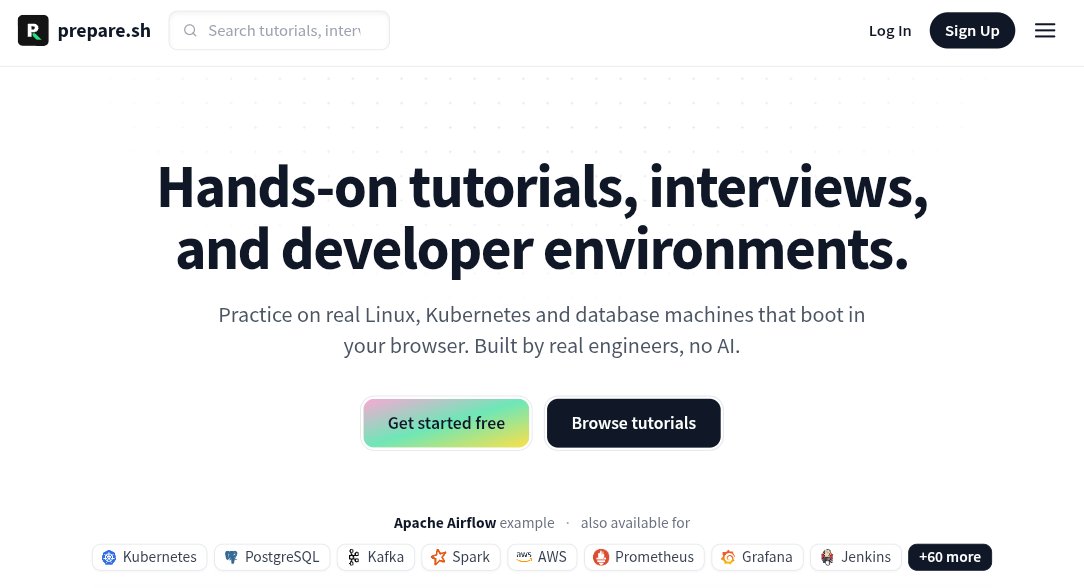
This is the best site I’ve found for practising DevOps directly in the browser.
Practise Linux, Kubernetes, Docker, AWS and 60+ other tools in real browser labs, with tutorials and interview questions.
https://t.co/mbvT8QrCCC
As a backend engineer, make sure you understand these concepts:
- SOLID Principles
- Multithreading & Concurrency
- Immutability
- Streaming & Message Queues
- Caching Strategies
- Security (SSL/TLS, JWT, OAuth 2.0)
- Design Patterns (Factory, Decorator, Singleton, Observer)
- Test-Driven Development (TDD)
Writing code is just one part of backend engineering.
Understanding how to build secure, scalable, and maintainable systems is what sets you apart.
13 years in backend. Principal Engineer at Atlassian.
Concepts I wish I'd learned in year 2 instead of year 8:
→ p99 latency, and why averages lie
→ Connection pooling
→ Backpressure
→ Idempotency keys
→ Reading query plans (EXPLAIN ANALYZE)
→ Write amplification
→ Consistent hashing
→ Change data capture
→ The outbox pattern
→ Tail latency amplification
None of them are hard.
Every one of them would have saved me from tonnes of headaches.
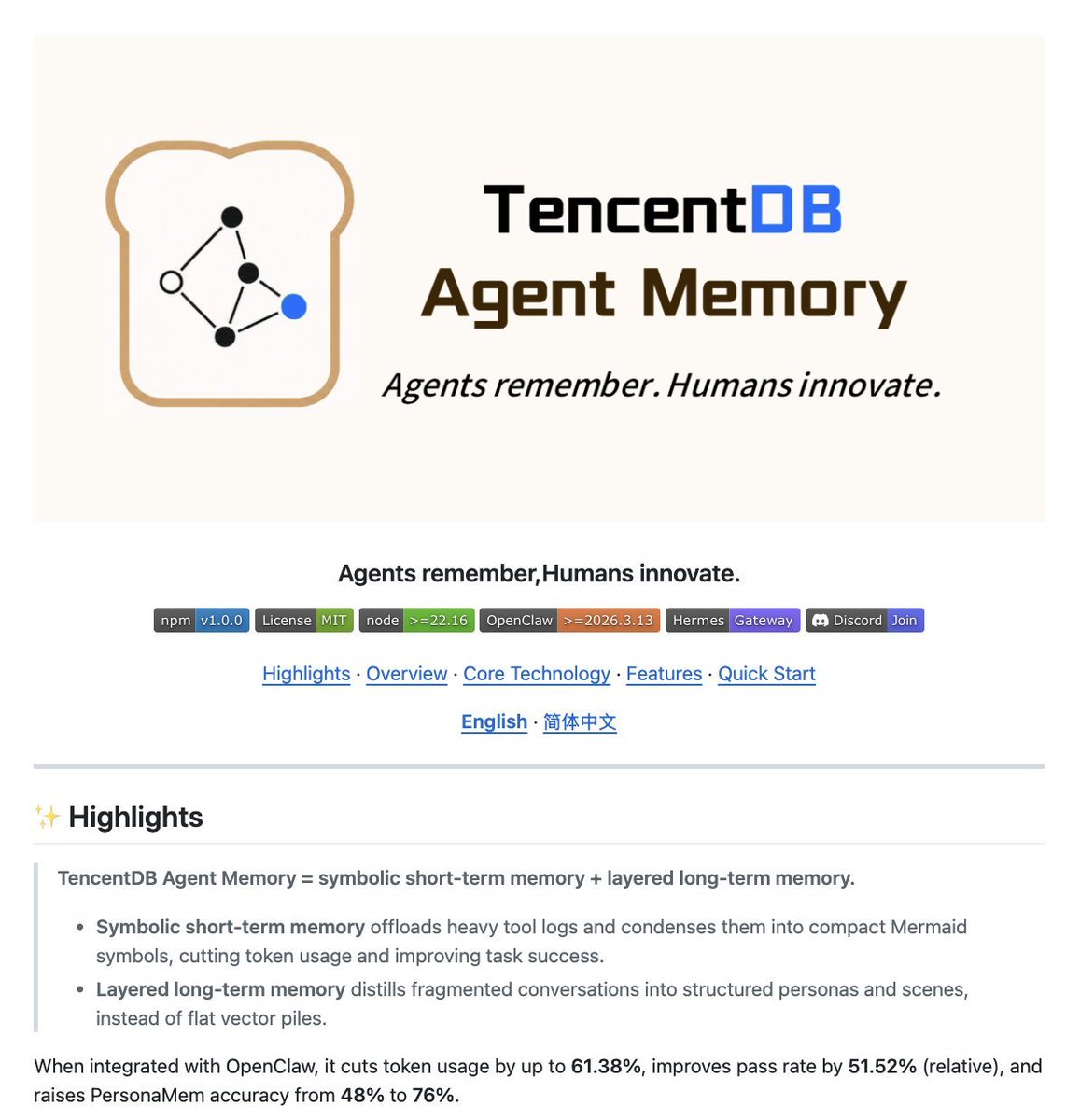
China has killed the entire vector database industry.
They open-sourced TencentDB Agent Memory. It gives any AI agent long-term memory that runs 100% locally.
No Pinecone. No cloud APIs. No repeating yourself every session.
- 61% fewer tokens
- PersonaMem accuracy: 48% → 76%
- Zero external API dependencies
- Runs on plain SQLite
Most memory systems compress your history into an opaque vector pile. when recall goes wrong, you're guessing. this one doesn't compress, it builds a semantic pyramid.
L0 Conversation → L1 Atom → L2 Scenario → L3 Persona.
Short-term state gets encoded as a Mermaid graph in your agent's context. verbose tool logs get offloaded to disk. when the agent needs proof, it drills back via node_id to the exact raw log.
no lossy compression. every layer is readable markdown you can just open and inspect.
5.1k stars. 100% Open Source.
If you want a solid video course on 3D math for video games, that mixes both theory and practice, here it is: https://t.co/mYE346PzgS
Part I of the course, which is 14 hours long, is available for FREE. I recently split it into sections so that it's easier to get through. No section is longer than ~30 minutes.
The whole course is a hefty 50 hour ride so definitely a challenge, but I think it's worth it if you are serious about understanding 3D math.
.