With a whopping $ 20.1 B in staked, 46.9% of the circulating supply supports network security.
Supply at a glance:
• Total: 82.25B
• Circulating: 42.90B
• Staked: 20.1B
Track the live figures:
https://t.co/bbGNnS50cg
NEW VIDEO OUT NOW 🎬
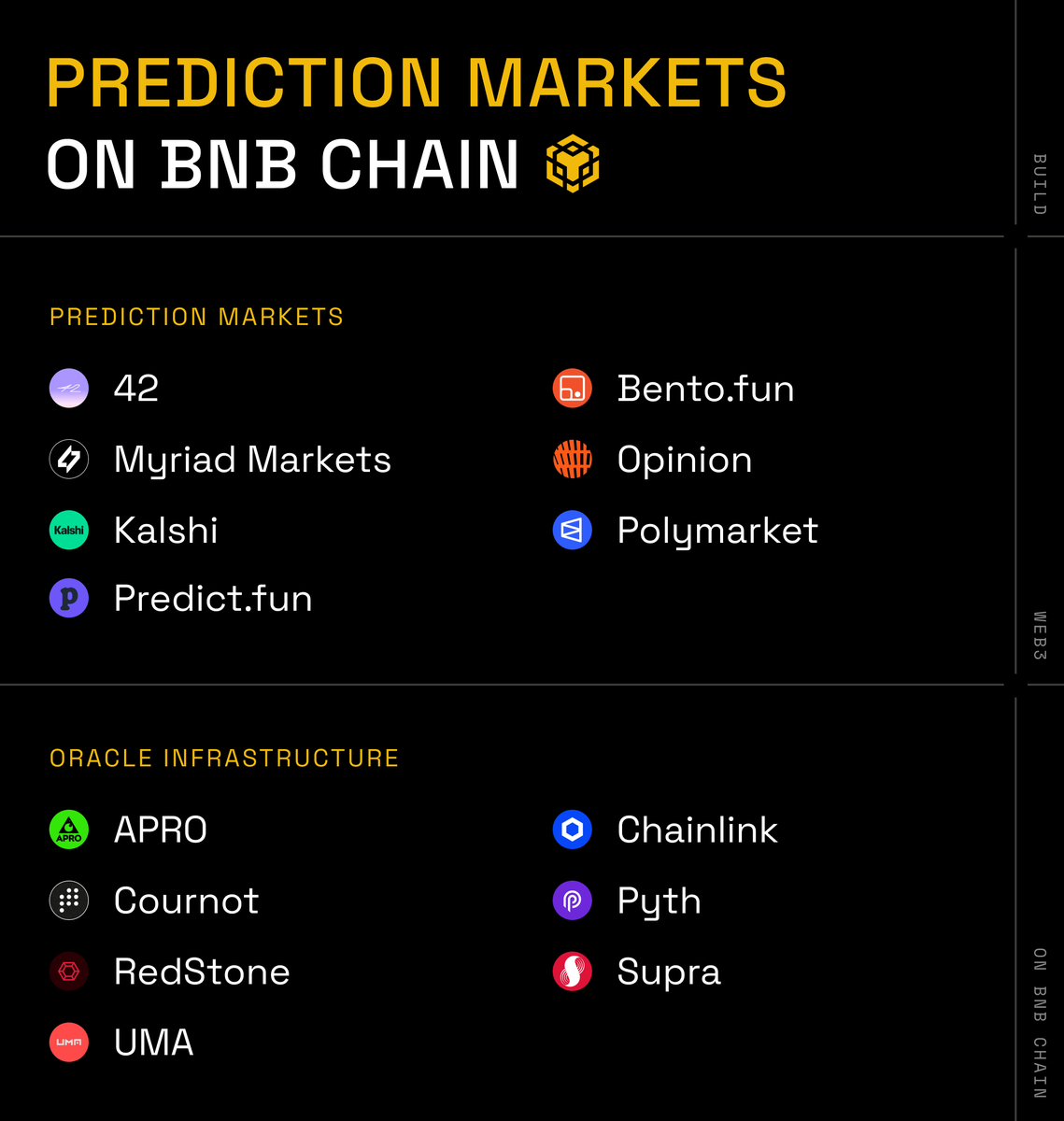
Big $SUPRA news we have to talk about. FUD about $LINK and the hottest narrative right now "PREDICTION MARKETS"
ENJOY
SUPRA Just Powered BNB Chain Prediction Markets!
➡️➡️➡️ https://t.co/bo8xTutgCT
Quick reminder of who is in the room with us. 🤝
Supra is an alumnus of @Mastercard Start Path, the program that connects later-stage fintech startups to Mastercard's network.
We're proud to sit alongside the Web3 names actually solving real-world problems: cross-border payments, B2B settlement, the infrastructure that quietly moves money.
Receipts over narratives. 🧾
A weekend reminder for the builders. 👷
Supra is one of the few L1s where you can ship:
→ A high-throughput DeFi protocol on a parallel-execution chain.
→ An AI agent that enforces its own rules on chain.
→ A cross-chain product without inheriting bridge risk.
All on the same stack. Same token. Same trust assumptions.
If you have an idea sitting in a Notion doc waiting for the right rails, these are the rails. 🛤️
Supra ( $SUPRA ), a diamond in the rough!
Supra has been quietly building and shipping new products, its future is bright. Its price is extremely low now. Strategy: Buy, stake for 8% return and wait for its glory day to arrive.
Supra ( $SUPRA ) is among the more advanced Layer 1 blockchains in 2026, particularly in its vertical integration approach and focus on real-time, automated DeFi (AutoFi). While it builds on established high-performance L1 innovations (e.g., from Solana, Aptos, Sui), it introduces meaningful differentiators that position it as a strong contender for the "latest generation" of monolithic-yet-composable L1s.
Supra is a high-performance, fully vertically integrated Layer-1 (L1) blockchain built for speed, security, and developer convenience. It stands out by natively embedding services (oracles, randomness, automation, cross-chain) directly into the consensus layer rather than relying on external add-ons. This enables "Super dApps" and its flagship vision: AutoFi (Automatic DeFi) — self-executing financial primitives that sense market conditions and act block-by-block without human intervention or off-chain bots. It uses Moonshot consensus (formally verified) with a Tribes & Clans architecture for extreme scalability: up to 500,000 TPS and sub-second finality, tested across 300 globally distributed nodes.
Supra's performance edge over key competitors:
Vs. Chainlink/Pyth:
Faster oracles with better decentralization/scalability and native L1 integration (no middleware fees/delays).
Vs. Solana/Sui/Aptos:
Comparable or better TPS (up to 500k claimed) with instant finality, plus built-in services they lack natively. MultiVM adds flexibility.
Supra Core Blockchain Utilities & Features:
Supra’s “all-in-one stack” gives dApps everything they need natively.
1. Native Oracles & Live Data Feeds — Fast, secure, tamper-resistant price feeds (e.g., BTC/USDC, ETH/USDT) with full finality in 600–900 ms. Includes Threshold AI Oracles. Data is available directly on Supra L1 (and powers 90+ external chains) with no extra integration or latency.
2. Decentralized Verifiable Randomness (dVRF) — Unbiased, on-chain randomness for gaming, NFTs, lotteries, and more.
3. Native System-Level Automation — Zero block-delay execution. Triggers and actions happen deterministically in the same block, powering true AutoFi (liquidations, arbitrage, rebalancing, lending, etc.) without keeper networks or MEV risks.
4. Cross-Chain Communication (SupraNova) — Bridgeless, trust-minimized messaging and asset transfers between L1s (live for ETH/USDC, expanding further).
5. MultiVM Support — Deploy on MoveVM (mainnet), EVM (testnet live), with SolanaVM and others coming. Existing contracts work with minimal or no changes and instantly access native services.
6. AutoFi Primitives — Self-operating DeFi stack (e.g., Dynamic Function Market Maker/DFMM, iAssets) that generates and redistributes protocol revenue.
7. AI Agents & IntraLayer — Full stack for autonomous on-chain AI finance agents that can sense, decide, and execute strategies.
8. Other Capabilities — Custom Supra Containers, Proof of Efficient Liquidity (PoEL), SupraScan explorer, developer grants/$100M Builder Competition, and strong focus on capital efficiency and decentralization.
This vertical integration reduces complexity, latency, and security assumptions while improving UX for both users and developers.$SUPRA Token Utilities$SUPRA is the unified native utility token (max supply 100 billion) that powers the entire ecosystem — L1 operations + all native services. It is designed with one of the broadest utility sets in crypto.
Key utilities include:
1. Gas Fees — Primary token for all transactions, smart contract execution, and AutoFi task fees on Supra L1.
2. Staking & Network Security — Validators stake significant amounts (e.g., 55M SUPRA per node) to secure consensus, oracles, dVRF, and automation. Earn rewards from fees/revenue.
3. Economic Security for Native Services — Staked/locked tokens back oracles, VRF, automation, and cross-chain features.
4. Cross-Chain Service Access — dApps on 90+ external blockchains use SUPRA to access Supra’s oracles and other services.
5. AutoFi Participation — Priority execution auctions, collateral in primitives, and task fees. Revenue flows back to the protocol/treasury/stakers.
6. Governance — On-chain voting for upgrades, parameters, and revenue splits.
7. Proof of Efficient Liquidity (PoEL) — Innovative dual-use model: stake the same tokens for network security and provide liquidity to earn from both staking rewards and DeFi fees (capital efficiency play).
8. Future/Deflationary Elements — Transition toward protocol revenue share (reducing reliance on inflationary block rewards) and other mechanisms to align long-term incentives.
Tokenomics highlights (as of latest data): Structured distribution with vesting (team/founders locked), focus on community/ecosystem allocation, and emphasis on sustainable growth.
Summary:
Supra’s utilities revolve around vertical integration + automation. It aims to be the go-to infrastructure for high-speed DeFi, gaming, AI agents, and cross-chain applications by making complex functionality (oracles, randomness, automation, bridging) a first-class, native part of the L1. The $SUPRA token ties it all together with broad, real-world demand drivers.
@SUPRA_Labs #Supra #Oracles #dVRF #AutoFiStack #CrossChain #Multivm #MoveVM #EVM #SolanaVM #SupraContainers #Suprascan #PoEL #iAssets #DFMM #AutoFi #SupraNovaai #FTO #AtmosProtocol #SupraLend #CrystaraMarkets #MetaSoul #PumpIt #Dexlyn #SkinFi #MaymunDAO #LOWCAPS #StarKey #RibbitWallet #Leo #NFT #Solana #Sui #Aptos #Chainlink #Pyth #Blockchain #cryptocurrency #Web3 #DeFi #RWA #NFT #Game #Prediction
HyperNova in plain English...📖
A traditional bridge says: trust this group of validators we picked.
HyperNova says: trust the consensus of both chains, mathematically. 🧮
That is the difference between a bridge being a target, and the bridge concept not even needing to exist.
Big SUP news!! 🎙️
@toonswapsupra have made the decision to launch their mainnet Prediction Markets on Supra's MoveVM!
We're going to be talking about all of this on today's SUP:
⏰ Today, 3pm UTC
📍 X and YT
Don't miss it. 📆
Cross-chain agents need cross-chain trust. 🔐
An autonomous agent that operates across chains is only as safe as the weakest bridge in its path.
Build agents on SupraOS and that risk surface shrinks dramatically, because HyperNova does the heavy lifting underneath.
Less attack surface. More agent reach.
Why take the risk of a bridge hack? 🥷
Cross-chain has cost the industry billions. The pattern is always the same: external relayers, multi-sig assumptions, single points of failure.
HyperNova is our approach to removing the bridge as a category of risk. L1-to-L1 communication embedded in the Supra stack, without external oracles or relayers. 🔗
Trust the consensus of both chains. Not a committee in between. 🤝
I think we're about to see a tsunami of long anticipated items launching off supra:native. Josh is quiet. Price is moving up. Somebody knows something. 🔥 🚀 🐂
Is SUPRA going to do the IMPOSSIBULL? If we close the weekly candle above 0.00057 we will break the 1 YEAR downtrend! Right before the quarter unlocks ...
This means that we would flip from a Bearish downtrend to a Bullish uptrend.
Let's get louder then ever! UNITED WE STAND 💯
SOON one Dolla #SUPRA 💎
@SUPRA_Labs@supraosai 🔥
Four things achieved this month while the timeline argued about narratives:
→ Recognised as Mastercard Start Path alumni alongside the names actually building Web3 infrastructure that works.
→ SupraOS alpha cohort is running. Real agents, real on-chain rule enforcement, real feedback loop with the founders in the alpha.
→ The 1,000x minimum gas fee upgrade went live on mainnet. Not glamorous. Necessary. It hardens the network against spam at scale.
→ Ethereum -> SUPRA reverse bridge on testnet.
Heads down. Shipping. 🛠️
Supra Network: Why the First Vertically Integrated All-in-One Blockchain Infrastructure Could Far Surpass Solana, BNB, SUI, TRX and Other L1s
As a veteran blockchain analyst, I’ve tracked the Layer 1 sector for over 8 years. From Ethereum’s smart contract revolution to Solana’s explosive high-performance era and the rise of Sui, Avalanche, and other next-gen chains, I’ve seen countless “high TPS” narratives ultimately struggle with ecosystem fragmentation and stitched-together infrastructure.
Supra Network is different.
It is not just another “high-performance chain” — it is the first truly vertically integrated all-in-one blockchain infrastructure.
Its core innovation is this: from the protocol layer itself, Supra natively integrates critical services such as oracles, randomness, cross-chain communication, automation, and MultiVM support into one unified shared-security architecture.
This is not simple feature stacking. It represents a blockchain “iPhone moment.”
Below, I’ll explain from multiple perspectives — comparison, fragmentation vs integration, functionality, performance, developer experience, and long-term potential — why Supra may ultimately possess greater upside than leading high-market-cap chains like Solana (SOL), BNB Chain, Sui (SUI), Avalanche (AVAX), and TRON (TRX).
Once TVL, developers, and liquidity enter a positive feedback cycle, Supra could truly unlock the era of “Super dApps.”
1. The Common Weakness of Traditional High-Performance Chains: High TPS Marketing + Single-Sector Focus + Severe Fragmentation
Most major high-performance L1s follow the same narrative:
high TPS + low fees + focus on one vertical, while relying heavily on external services for critical infrastructure.
This creates severe ecosystem fragmentation.
Solana: Monolithic architecture with Sealevel parallel execution + PoH. Strong in memes, DeFi, and consumer apps. But oracles depend on Pyth/Switchboard, VRF depends on external systems, cross-chain relies on Wormhole/LayerZero, and automation requires Keeper bots. Complex dApps become “blockchain LEGO,” adding latency, security risks, and extra costs.
Sui: Object-centric model + Move language + parallel execution. Strong for gaming, NFTs, and RWA. While it has native randomness, oracles, cross-chain communication, and automation remain externally dependent.
BNB Chain: EVM compatibility + ultra-low fees. Dominates retail DeFi and meme ecosystems, but fundamentally remains an execution-optimized chain without protocol-level advanced services.
Avalanche: Subnet architecture targeting enterprise customization, but communication between subnets is still fragmented.
TRON: High TPS and stablecoin payments dominate emerging markets, yet infrastructure services are also externally dependent.
The core limitation:
These chains were designed primarily around execution performance. Advanced functions like real-time data, randomness, automation, and interoperability were added later as patches.
Upgrading the protocol layer becomes extremely difficult due to governance voting, hard forks, compatibility issues, and ecosystem inertia.
In short: their architecture is fragmented, specialized, and difficult to evolve.
2. Supra’s Revolutionary Difference: Protocol-Level Vertical Integration + IntraLayer Design
Supra was designed from day one around vertical integration.
The project officially positions itself as the first fully vertically integrated all-in-one Layer 1 blockchain.
All core services share the same consensus, security, and state layer:
No external trust assumptions
No added latency
No fragmented security
No cross-service complexity
Core integrated components include:
Moonshot Consensus + Tribes Clans Architecture
Tested at 500,000 TPS across 300 nodes with sub-second finality — significantly beyond Solana’s slower confirmation finality. The Tribes & Clans architecture is naturally optimized for vertical integration.
Native DORA Oracle
Protocol-level real-time price feeds integrated directly into consensus.
Native dVRF (Distributed Verifiable Random Function)
Fair randomness generated every block for gaming, NFTs, lotteries, and DeFi.
Native Cross-Chain Infrastructure (HyperNova / HyperLoop)
Light-client and rational-bridge architecture designed for low latency and reduced bridge risk.
Native AutoFi Automation
Zero-block-delay automation allowing real-time market event detection and execution without Keepers.
MultiVM Support
MoveVM already live, with EVM and SolanaVM support coming — enabling near frictionless migration for developers.
AppChain-Inspired Containers
Dedicated blockspace for Super dApps, reducing congestion and gas wars.
These are not plugins.
They are integrated directly into the protocol itself.
Supra’s documentation consistently emphasizes a unified “Super dApps” platform where developers can build real-time, autonomous, self-operating applications entirely within one chain.
3. Why Supra’s Integrated Model Could Dominate
Fragmentation vs Unified Architecture
Traditional chains require multiple external services stitched together. Supra operates as a unified security domain.
This dramatically reduces:
latency
trust assumptions
integration complexity
extra gas costs
while exponentially improving composability.
Performance and Finality
Supra’s experimental architecture targets:
500,000 TPS
sub-second finality
Compared to Solana’s real-world throughput of roughly 1,000–1,500 TPS with slower final settlement, Supra’s BFT-style Moonshot consensus is better suited for:
high-frequency finance
AI agents
gaming
real-time applications
Developer Experience and “Super dApps”
Developers on traditional chains often integrate:
oracles
VRF
bridges
Keepers
VM compatibility layers
Supra offers these natively in one environment.
This enables:
autonomous DeFi
AI-driven applications
real-time RWA systems
self-operating financial protocols
Containers further allow major dApps to secure dedicated resources, creating a Web2-like experience.
Security and Cost Efficiency
Every external service introduces:
new attack surfaces
additional fees
operational risks
Supra’s shared Layer 1 security model significantly reduces these problems while maintaining low operational costs.
Future Expansion Potential
MultiVM + Containers allow Supra to support:
Solidity ecosystems
Move ecosystems
Rust ecosystems
Most existing chains would require deep protocol redesigns to achieve this level of integration.
Supra was designed for it from the beginning.
Supra is not simply “another fast blockchain.”
It represents a paradigm shift in blockchain infrastructure — moving from fragmented high-performance systems toward fully integrated intelligent infrastructure.
Solana, BNB, SUI, TRX, and others may dominate execution layers today, but Supra may be leading the next generation in unified full-stack architecture.
If liquidity, adoption, and developers enter a strong positive cycle, Supra could eventually evolve into the foundational infrastructure powering the next era of Super dApps and autonomous AI-powered applications.
As an analyst, I remain highly optimistic about Supra’s long-term narrative.
Developers and investors should study its documentation and testnet ecosystem carefully now — because the biggest opportunities often emerge during the early stages of architectural transformation.
The future of blockchain is no longer just about being faster.
It is about being more unified, more intelligent, and more powerful.
#SUPRA #BTC #ETH #BNB #SOL $PI #Doge #TRX @okx@binance@coinbase@Official_Upbit@bitget supra:native
Validators secure the chain. Agents will use it. 🔐
The validator framework taking shape on @SUPRA_Labs is what makes the next chapter of SupraOS possible.
When the network is fully live, every autonomous agent built on SupraOS inherits the security those operators provide.
If you operate infrastructure, follow @SUPRA_Labs. The framework is forming in public.
Where SupraOS is right now. 🛠️
An agent takes a market signal. Runs a rule check on-chain. Acts on it.
Web3 finally has a brain. 🧠
Alpha is live with the first cohort, and we're learning fast.
How we are thinking about the validator set on Supra. 🧠
The validator set is the most important decision a network makes, and we are not rushing the criteria.
What we are anchoring on:
→ Hardware and uptime standards that match the network's load profile.
→ Geographic distribution rather than concentration.
→ Skin in the game through stake commitments and slashing.
→ Genuine community representation, not just well-funded operators.
If you have run nodes before and want to be in the conversation as we finalise the framework, stay tuned! 🛰️