NØNOS is not an evolution of existing operating systems.
It is a refusal to inherit them.
The system is built from scratch around a single principle:
Privacy is not about hiding actions.
It is about preventing stable identity, history and state from forming in the first place.
There is no persistence unless explicitly chosen.
There is no silent accumulation.
There is no long-lived identity by default.
There is no background telemetry waiting to be correlated later.
The system lives in memory.
When power goes away, the system collapses completely.
This is not an aesthetic decision.
It is the security model.
It’s the ZeroState by Ø revolution.
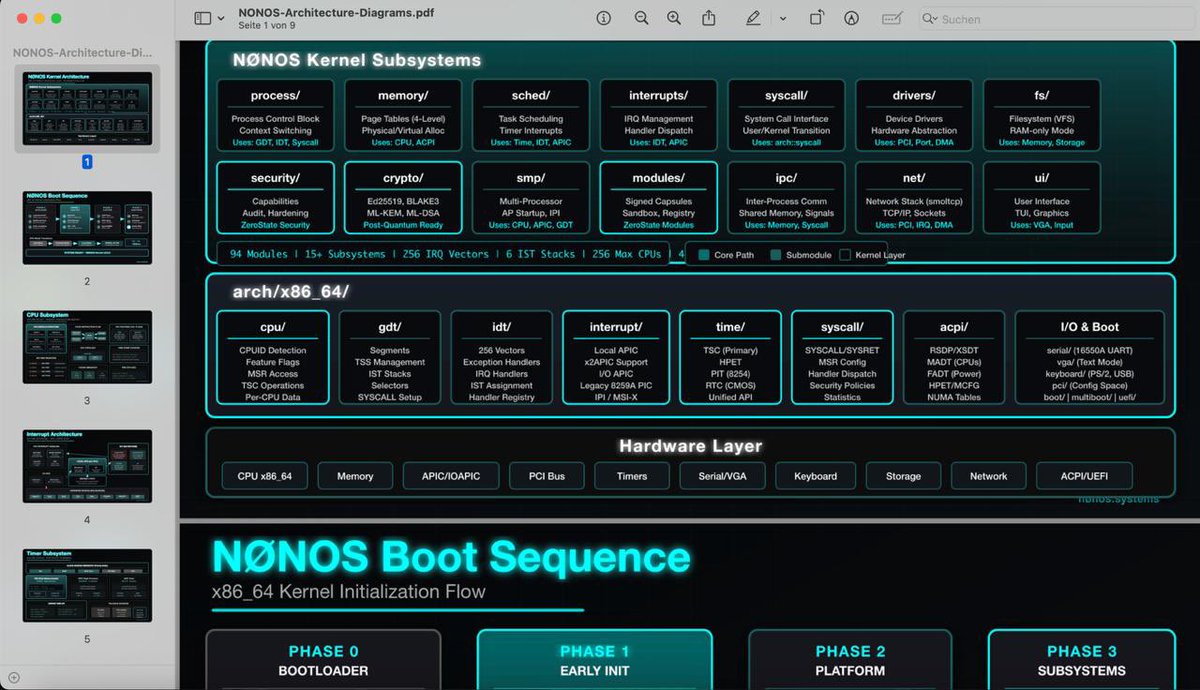
Today we’re publishing an update on the state of the NØNOS kernel and system architecture. Where at this point, the kernel is functionally complete in local development. It’s a good feeling knowing what a year of NØNOS taught myself. The core architecture, subsystems and driver stack are implemented and running also commited on GitHub with few more subsystems and current pushes towards full release on public side.
Always ensuring at this stage rigorous final validation, testing, documentation and progressive upstreaming into the public GitHub repository.
Over the last phase we completed:
i) The full kernel architecture and execution model
ii) Memory management, scheduling, interrupts, syscalls
iii) A broad hardware driver stack (storage, networking, USB/xHCI, audio, TPM, PCI/PCIe)
iv) ZeroState design constraints enforced at the kernel level
The remaining work is deliberate and methodical:
1. Committing the remaining kernel components in structured waves
Publishing architecture diagrams and documentation updates
Running continuous testing and fixing edge cases as they surface
If everything continues at the current pace, the goal is to have the full kernel pushed publicly by the end of the month.
This phase is about correctness and transparency, not velocity theater.
The system already exists and runs; now we make it auditable, reproducible and reviewable by the community.
Further updates and diagrams will be shared continuously as commits land.
On GitHub: https://t.co/PGJPJTz0dM
Community: https://t.co/YYO7Ri2SzS
— NØNOS Systems
Anyone tokens that are staked or locked for relay operators are now tracked across major portfolio tools.
View your positions directly in @Rabby_io, @LighthouseOne_, @DeBankDeFi, @CoinStats and other popular trackers!.
DeFi is for ANYONE.
From the entire NØNOS team, we wish you a warm and peaceful Christmas.
Whether you’re with family, friends or enjoying some well-earned quiet, we hope the day brings you rest, clarity and good moments.
Thank you for the support, the trust and the energy you’ve given us.
Enjoy the holiday, we’ll be right here, building.
Merry Christmas from NØNOS.
Coming soon to Kraken 🛡️
$ANYONE powers @AnyoneFDN, a decentralized privacy network that protects your data through next generation onion routing.
Get ready ⤵️
https://t.co/17d15mM6ED
A natural alliance: NØNOS × zkCLOB
Today we announce the listing of $NOX on zkCLOB, a platform that aligns with our core principle: Privacy must be built in, not added on.
NØNOS is a zero-trust operating system engineered from bare metal with one mission: restore digital autonomy.
zkCLOB is an emerging zero-knowledge order book exchange delivering private, self-custodial, sub-second trading.
This partnership is not about convenience, it is about philosophy. It is about building systems that do not watch you, do not track you and do not own you.
Pair: $NOX/ETH
Trade: https://t.co/4Tjdo905qL
To support deeper alignment between our ecosystems, zkCLOB has allocated 160,000 $Z tokens toward two options:
• ZeroState NFTs airdrop.
• NØNOS node-operator incentives.
A commitment to those who run the infrastructure and those who believed early.
Sovereignty is not given, it is built.
Today, we take another step toward it.
Explore @zkCLOB 🔗 https://t.co/Kq8nVkKWav
@mert .@mert
Privacy is choice, not secrecy. If money is public by default, the system should encrypt by default. We’re building toward that future at the OS layer.
https://t.co/SAXiZyrJ3x
Two new articles are live, covering the current state of development across both layers of the stack. One dives into Noxterm, exploring privacy-first terminal access through ephemeral container isolation, anonymous routing and hardened execution environments. The other details the progress behind NØNOS, a zero-trust operating system built from the ground up from boot and verification to kernel design and system architecture.
Both pieces reflect where the work is today and where it’s heading.
Noxterm:
https://t.co/C7XNqcq6z5
NØNOS OS:
https://t.co/NHJ2gsAiMG
A historic moment for NØNOS.
Tonight, the OS crossed the boundary from theory into reality, a full cryptographic boot, a clean kernel handoff and its first-ever GUI desktop running entirely on our own architecture.
This moment is now part of the permanent record.
A new operating system took its first breath.
Watch the full milestone on YouTube:
https://t.co/Epkh4KW2rj
Full technical deep-dive included.
We’re going LIVE in 2.5 hours with our beta test community on Telegram and today marks a major milestone:
The full #NOXTERM codebase (backend + frontend) is going live.
Open source. Transparent. Built for scale.
Join us for a live, screen-shared session where we will:
🔹 Build from source together
🔹 Walk through the back/frontend architecture
🔹 Discuss scaling plans for upcoming releases
🔹 Answer questions live with the core team
This is the first public look at NOXTERM engineering foundation and the vision driving the platform forward.
Join the beta group: https://t.co/XPHKVIXETp
See you in 3 hours.
NØXTERM | We’re now in the final stretch.
The full documentation + whitepaper are being finalized. This includes a complete breakdown of the architecture, the terminal engine, security model and the container orchestration layer.
Tonight, we will publish the enhanced backend + frontend builds following an internal security review and several rounds of heavy testing.
This new iteration reflects the real direction of NØXTERM: faster, safer, cleaner and aligned with a long-term open-source roadmap.
From here, we enter the internal testing phase, a matter of hours before the first “nephew” build is live for private trials.
Public beta testing is expected to begin tonight and within 30–40 days targeting the official public release.
Thank you for the patience.
The next phase is extremely close.
Privacy Without Transparency is Just Marketing. NØNOS @nonossystems Just Changed the Game.
For years, the "Privacy Tech" sector has had a dirty little secret: The Black Box.
We are constantly told to trust secure terminals, trust the VPNs, and trust the "encrypted" operating systems. But if the code is closed, that trust is blind. You aren't relying on math; you are relying on a corporate promise.
Today, NØNOS ended the "Trust Me, Bro" era.
They just announced that #NØXTERM the core compute terminal of the ecosystem is now fully Open Source.
This isn't just a roadmap update. This is a philosophical line in the sand. Here is why this decision makes NØXTERM the most important tool to watch in Web3 right now:
1. The End of the Black Box 📦🚫
In a closed-source system, there is no way to prove that "ZeroState" (RAM-only execution) is actually happening.
By opening the repo (https://t.co/zUpFwEGVNB), the team has handed the keys to the community.
• Security researchers can now audit the container orchestration.
• Cryptographers can verify the attestation logic.
• We can see, line-by-line, that when a session ends, the data is truly destroyed.
2. The "Rust" Reality Check 🦀
We’ve heard about the high-performance Axum backend and Bollard integration. Now, developers don't have to imagine it they can read it.
I’ve already started looking at the repo.
This is a masterclass in memory-safe architecture. The way the WebSocket tunnels handle latency is engineering art, not just code.
3. Permissionless Innovation ⚡
This turns NØXTERM from a "Product" into a "Protocol."
Developers no longer need an API key or permission to build.
• Want to integrate NØXTERM into your DePIN dashboard? Fork it.
• Want to build a custom Python environment for data science? Build it.
• Want to fix a bug? Submit a PR.
The Verdict:
Open Models Win. Open Infrastructure Wins.
NØNOS just proved they aren't here to sell a subscription; they are here to build a standard. The barrier to entry for "Sovereign Computing" just dropped to zero.
If you are a developer, a researcher, or just someone who cares about digital freedom, head to the GitHub. Star the repo. Audit the code.
Don't trust. Verify.
#NØNOS #OpenSource #RustLang
**NØXTERM IS NOW GOING OPEN-SOURCE**
https://t.co/3YjOP0E1A4
Today we’re making a simple but important decision for the future of NØNOS:
NØXTERM will be fully open-source and free for everyone.
This project was never meant to sit behind closed doors. NØXTERM is a foundational piece of the NØNOS ecosystem; a secure, ephemeral, cryptographically-attested compute environment that spins up disposable Linux machines instantly in the browser.
Opening it to the world means:
. Developers can audit every line
. Researchers can build on top of it
. Contributors can start shaping the ecosystem
. Teams can integrate it into their workflows without friction
. Security improves through transparency
. Innovation compounds instead of being gated
We will begin pushing the entire codebase to the public GitHub today.
The repo will receive continuous commits as we stabilize the beta and move toward the first public release.
NØXTERM is no longer just our tool, it becomes a building block for anyone who believes in sovereign computing.
This is the right step forward.
Open models win. Open infrastructure wins.
Privacy and freedom demand transparency, not gatekeeping.
Let’s build the future together.
Ø
NOXTERM is a fundamental reimagining of how modern technical teams access, deploy and interact with Linux environments. Designed with precision engineering and grounded in enterprise-grade security principles, #NOXTERM delivers a fully containerized, browser-native terminal platform that eliminates the traditional boundaries between local development, remote infrastructure and distributed compute systems.
At its core, it represents a paradigm shift: a world where powerful, isolated Linux environments are accessible instantly, securely from any device, without configuration, without installing software and without compromising performance.
Read the thread below 👇
NØXTERM, the terminal reimagined for a sovereign future.
NØXTERM is reaching the stage where the vision stops being abstract and begins to run as a real system. The backend is now fully alive: it responds, initializes cleanly, issues session identities and speaks to the frontend without friction. The database layer is active, storing session states and proving the system can track, verify and authenticate its own operations without external dependency. Even in its early form, the architecture shows why this project is different: the terminal is no longer a window into a local shell but it becomes a cryptographically attested, privacy-preserving execution chamber that refuses to leak.
On the frontend, the real-time interface is now stable and communicating directly with the backend over a clean API bridge. Launching the app at localhost already brings you into an environment built like a secure enclave: no browser extensions, no system telemetry, no exposure to the host OS. Every session is born with intention and ends without residue.
We are now entering the final phase before NØXTERM becomes something no other “cloud terminal” or dev environment has managed to be: a system where the machine you use cannot betray you, even under pressure. The last missing layer is WebSocket terminal streaming and is being implemented with the same principle that defines the entire stack: no metadata leaks, no hidden correlations, no unverified code paths. Once the streaming layer is wired into container IO, the entire pipeline becomes a cryptographically sealed workflow from keystroke to container to attestation to verifiable compute.
The reason this matters is simple: today’s developer environments are hostile by design. Every system assumes your data, your runtime, your identity, and your intent belong to someone else. NØXTERM reverses the premise entirely. The environment does not trust the host; the host does not inspect the environment and every action is proven, not inferred. This is what a sovereign terminal looks like, an execution environment that refuses to collaborate with surveillance.
The fundamentals are already running. The system boots, the UI connects, the backend responds, and the architecture is stabilizing exactly as intended. What comes next is the transition from “functional” to “formally secure” and when the container engine, WebSocket layer, attestation subsystem and payment rails all merge into a single coherent flow, the industry will see the first terminal built for people who actually need privacy not for marketing slides.
NØXTERM is not another developer tool. It’s the first step toward reclaiming the digital surface where real work happens.
Soon, you won’t just open a terminal.
You will step into a sovereign compute environment that answers to nobody but you.
More updates soon, the pace is accelerating.
Amazing read here.
Encryption isn’t the failure point here as highlighted but the operating system is, and that’s the issues of every system today.
Sturnus isn’t “breaking Signal” or bypassing cryptography. It’s exploiting the same underlying problem every mainstream OS suffers from: users do not control what code executes on their own hardware. Once the endpoint is compromised, your encrypted messages are just plaintext on a screen.
The malware isn’t attacking math, it’s attacking the environment that renders the decrypted text.
This is exactly why NØNOS is being built and on a mission on itself.
No privacy tool can survive on top of a compromised foundation. The base layer matters more than the app:
i) If the OS grants hostile code Accessibility privileges then your privacy is gone.
ii) If the OS allows silent UI interception then encryption becomes irrelevant.
iii) If the OS has no verifiable execution path then malware becomes invisible.
E2EE works. The OS beneath it doesn’t.
Digital sovereignty starts where malware operates:
the kernel, the permissions system, the trust anchors, the execution layer.
That’s the layer we are rebuilding from Ø.
Because real privacy cannot be patched on top, it must be architected from the base.
Cheers, to all builders❤️