@wicknellchivayo@wicknellchivayo “A hand that gives generously shall never lack; for the hand that gives shall receive even more.” God shall reward you with more business opportunities.
The survey revealed that 96.4% of households now own a mobile phone and 75.5% have internet at home. 80.0% have a radio and 30.3% have a TV. Just 11.2% of households own a computer (laptops most common, 84.4%) and 92.2% of home internet users connect via mobile handset broadband.
So, a lot of people ask me, “How much is a Boer goat?” That is like asking, “How much is a car?” or “How much is an aeroplane?” There are brand-new cars that cost US$20,000, others that cost US$100,000, and some that cost more than US$1 million. It all depends on the type, quality, and specifications.
The same principle applies to Boer goats. Not all Boer goats are the same, and therefore they do not all cost the same. Their prices depend on their genetics, conformation, bloodlines, and grading.
When I started this business 12 years ago, I spent a lot of time learning and reading about Boer goats, and I want to share some of that information with you.
Boer goats are graded from Grade 2 to Grade 9:
Grade 9 – Outstanding: Show quality and export grade. These are the top animals and are highly sought after by serious breeders.
Grade 8 – Very Good: High-quality stud animals and export grade.
Grade 7 – Good: Stud quality and export grade.
Grade 6 – Above Average: Good conformation and suitable for commercial and export purposes.
Grade 5 – Average: Commercial and export grade.
Grade 4 – Under Average: Second selection animals.
Grade 3 – Poor: Abnormal type but without cull defects.
Grade 2 – Cull: Mainly for meat production and generally not suitable for breeding.
As you can see, when someone asks me, “How much is a Boer goat?” I cannot give a simple answer because a Grade 2 goat and a Grade 9 show-quality stud animal are worlds apart in value.
One is bought mainly for meat, while the other may be purchased to improve an entire breeding programme and can cost many times more.
That is why, before asking the price of a Boer goat, the first question should be, What grade of Boer goat are you looking for? And what is your budget, in South Africa you can get a Boer goat for R10,000 or for R500,000. It all depends with what you want.
When you buy goats from South Africa and import them into Zimbabwe, you do not pay customs duty. Not a single cent of customs duty is charged. Goats enter Zimbabwe duty-free.
But, and this is a big but, you must always get a receipt or commercial invoice from the person you bought the goats from. It is part of the customs clearance process. The receipt is not required because customs will charge you duty; it is required because it forms part of the documentation that must accompany the animals during transportation.
Your driver should always have this documentation with them. If you are using a clearing agent and the goats have been cleared before the truck reaches Beitbridge Border Post, or whichever border post you are using, the agent must also have these documents.
Never transport goats without the proper paperwork. Even when no duty is payable, the authorities still require the documentation to prove ownership, value and the legal movement of the animals across the border.
This invoice is from 2015. It was for 12 Boer goats, and I paid R62,500 for them. At the time, that was the equivalent of approximately US$4,400, based on an exchange rate of about US$1 to R14.41.
Many people ask me what documents are needed from the South African side importing Boer goats from South Africa into Zimbabwe.
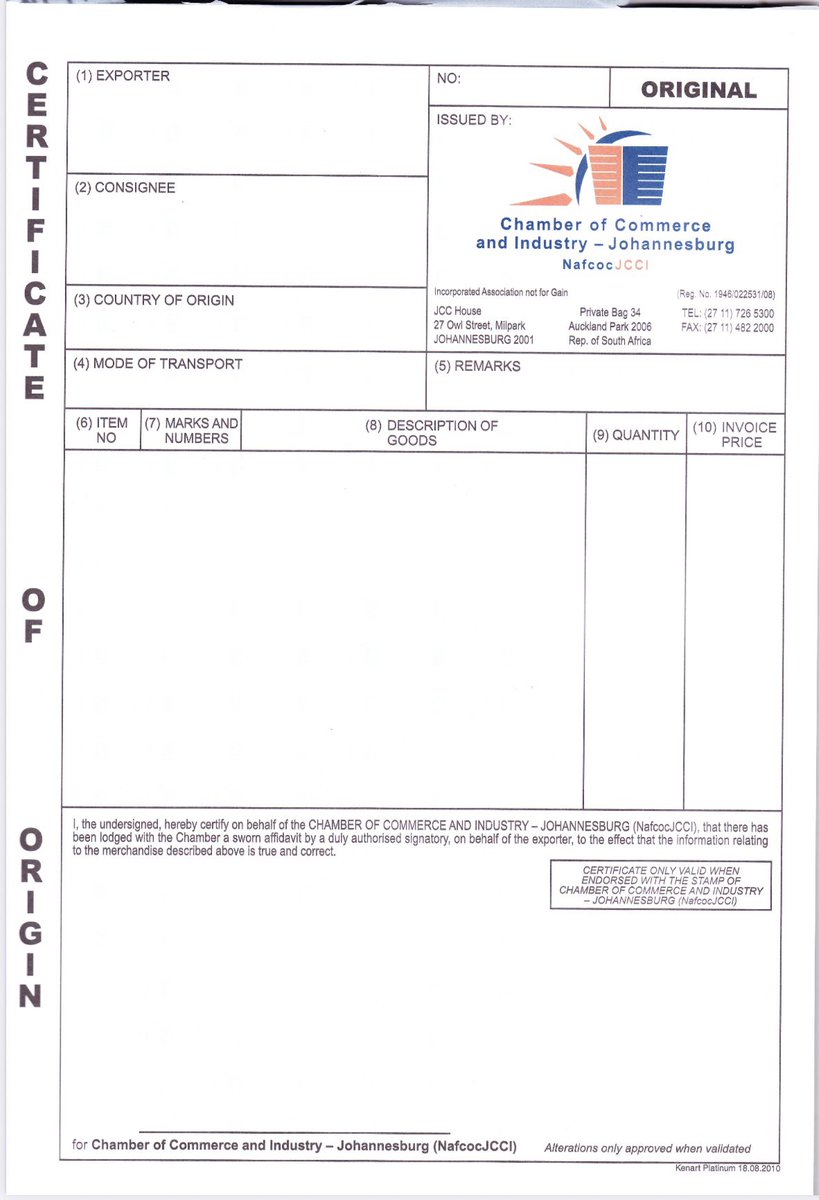
The first document is a Certificate of Origin, issued by the Johannesburg Chamber of Commerce. It confirms that the goats being exported originated in South Africa and forms part of the paperwork required for export and import.
The second document is a veterinary declaration letter from the farmer’s veterinarian. In this letter, the vet confirms that the herd from which the goats come is visually free of notifiable diseases. This document is also required by the Zimbabwean authorities as part of the import process.
The farmer usually arranges this veterinary letter together with the other export documentation. As the buyer, you need to make sure that all these documents are in order before transporting the animals to Zimbabwe.
When importing livestock, paperwork is just as important as the animals themselves. Without the correct documents, including veterinary permits, quarantine papers and certificates such as these, your goats can be delayed at the border or even refused entry.
When you import Boer goats from South Africa into Zimbabwe, you must understand that they will ordinarily spend 30 days in a quarantine station in South Africa before they can be exported.
Most of the goats that I bring into Zimbabwe are bought in Gauteng, and there are a number of quarantine stations in the province. The farmer usually organises the quarantine process. In my case, the farmers I buy from simply tell me the quarantine fee, which I pay directly to them, and then I wait for the 30-day quarantine period to be completed.
You should also remember that when you are buying male Boer goats (bucks), their semen must be tested. When I first imported goats from South Africa, the farmer I had bought from had not done the semen testing, and it delayed the importation process.
Therefore, make sure that when you buy male Boer goats, the semen test has been done. It is a requirement before they leave South Africa, to ensure that the animals do not have any diseases, reproductive defects, or other conditions that could affect breeding and the health of your herd.
The key to a smooth import process is to make sure that all veterinary requirements, testing and quarantine procedures are completed before the goats are transported to Zimbabwe.
Every goat is identified by a unique number. The females have their own identification numbers, and the males also have their own identification numbers. Below is one of the quarantine sheets from one of the many consignments of Boer goats that I imported into Zimbabwe.
Once you buy the goats, the farmer takes them to the quarantine station, where they spend 30 days, or the agreed number of days, in quarantine. When it is time to collect them, you do not go to the farm. You collect the goats directly from the quarantine station and then transport them to Zimbabwe.
So, if you want to import goats from South Africa into Zimbabwe, the first thing you need to know is that goats do not attract customs duty. The only costs involved are the fees for the import certificates and a small fee payable at the border, which I believe is around US$25 to US$50.
Here is what you need:
1. Veterinary Services Import Permit – You apply for this at the Department of Veterinary Services headquarters on Borrowdale Road, just after State House in Harare.
2. Ministry of Agriculture Certificate – The Ministry of Agriculture offices are located next to the Veterinary Services offices on Borrowdale Road, and this certificate is also required.
3. Agricultural Marketing Authority (AMA) Certificate – You also need an import certificate from the Agricultural Marketing Authority, which is based in Harare.
These are the three certificates you need to import goats into Zimbabwe.
I can only speak specifically about goats because I do not import any other livestock. My focus is entirely on goats, and this is the process that I follow when bringing them into Zimbabwe.
It may also be advisable to contact the Department of Veterinary Services before purchasing the animals, as import requirements and fees can change from time to time.
Make sure the goats come from a province that Zimbabwe currently allows imports from. Zimbabwe has, at different times, restricted imports from certain South African provinces because of outbreaks of diseases such as Foot-and-Mouth Disease. Before buying any animals, confirm with the Department of Veterinary Services that imports from that province are still permitted.
The goats must have a Veterinary Health Certificate from South Africa. This certificate is issued by a South African state veterinarian and confirms that the animals are healthy and free from specified diseases.
Goats need to undergo quarantine and testing. Depending on the prevailing veterinary requirements, the animals may have to spend time in an approved quarantine facility and undergo blood tests before export.
Apply for your permits before buying the animals. It is always advisable to secure your Zimbabwean import permits first so that you do not buy goats that you later discover cannot be imported because of disease restrictions or paperwork issues.
You will also need a clearing agent at the border. The clearing agent helps process the paperwork and ensures the permits and animal movement documents are properly handled when the truck reaches the border. It costs less than US$100 or just US$100.
South Africans are now crying and begging foreigners to come back. Some are even asking those still in the country to reopen their shops because prices have gone up badly.
Things that were once easy to buy, even on credit, are no longer readily available.
You guys have not seen anything.