Reminds me of a book I recently finished.
"The Angel of Bethesda" by Cotton Mather, an essay upon the common maladies of mankind, the draft completed in 1724. This book is a compilation of the state-of-art in medicine during the early 1700's.
Cotton Mather was a Puritan Minister in Boston who enjoyed scientific and medical experimentation as a hobby, including being a member and regular contributor of the British Royal Society.
Cotton Mather was one of the early adopters of "microorganism" theory of Small-Pox.
"It begins now to be Vehemently Suspected That the Small-Pox may be more of an Animalculated Business, than we have been generally aware of. The Millions of ---- which the Microscopes discover in the Pustules, have Confirmed the Suspicion. ... And so, we are insensibly drawn into New Sentiments, about the Way of its Conveyance, and the Cause why tis convey'd but once ..." [page 94]
Animalculated, or "little animals", was the common term around the 1720's for the moving things in pus or blood that were not clearly cells and were only seen in people with Small-Pox.
Mather was an active advocate for the "Inoculation" process being used in Africa, Constantinopolitans, and Georgians. He then describes (page 113) the "Way of Proceeding, in the Practice" of the Inoculation.
Anyway, based on this book, challenges for a LLM to harvest pre-1900's "medical" literature include:
(1) Languages - Latin, Greek, English, German, Arabic, and more. Mather knew five languages. This book contains Latin and Greek phrases naturally.
(2) Spelling - There was no standard spelling. Even Mather used many different spellings for words in this single book.
(3) Terminology drift - Animalculated vs Bacteria. Many early terms were proposed then changed as research progressed.
It is a social and philanthropic club that uses a 300+ year old initiation ritual as an unifying feature.
* Many men in my family heritage were/are members, so my information is first-hand.
* The initiation ritual and terminology are 300+ years old and based on the membership rite of medieval masonry guilds. For example, "Worshipful" means "Respectful" or "Honorable", a term of high position is the local society.
* Members are required to attest a belief in the God of the Bible. It was always assumed the candidate was a Christian or Jewish.
* While the initiation ritual does sound strange to modern ears, to the authors in the 1600's, it was understood to stress the importance of keeping the initiation details secret so outsiders could not sneak in.
* Other than an opening prayer by the chaplain (who is often an ordained minister of a local church), there is nothing religious about the monthly meeting. They discuss budgets, activities, events, fundraisers, philanthropic activities, recognition, and closing with a meal. In the past, drinking was included at the meal, but today nearly all lodges are dry.
* In the past, especially from 1700's to 1960's, the Masonic Lodges were popular among the community leaders as a means of socializing. This aspect is decaying. Then again, the Masonic Lodges are dying off since they cannot attract new younger members.
* Masonic Lodges, and the related Shriners (you have to be a Mason in order to become a Shriner), support many philanthropic causes such as hospitals, orphanages, and more.
* There is a lot of false information floating around because people don't like a "secret society" or don't understand a 300+ year old initiation ritual.
https://t.co/tMo8ctDlBm
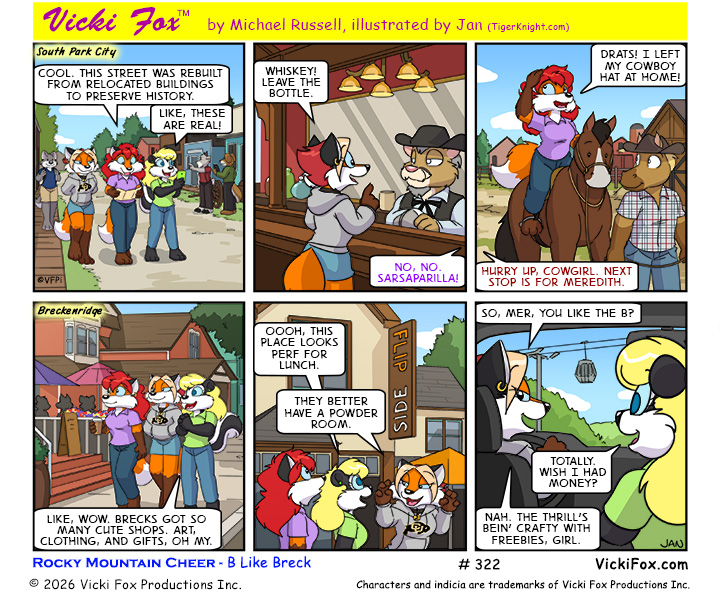
A fellow webcomic artist reminded me that the Vicki Fox comic strip turns 25 years old this year. Wow.
Check out his comic, too. Features cartoon skunks.