@truthseeker_stl@awkwardgoogle My husband’s older car has a less advanced feature which if he starts veering it sounds an alarm. Several times on longer drives this has happened when he’d start to doze. We were in separate cars. Now we stop overnight on these drives.
Whether you're heading to the mountains, the beach, or somewhere in between this summer, drive safely on I-40 through the Pigeon River Gorge.
This section remains one lane in each direction with a 35 mph speed limit as recovery work continues following Hurricane Helene.
It's a baby bear brawl! Thanks to Paul Willis in Asheville for sharing this adorable video for Wildlife Wednesday this week. 🐻
Got bear footage? Share it with us here: https://t.co/mYPT9c8yYN
@ryanmouquegolf@drip_flood Seeing this post yesterday changed my game around from a years worth of frustration. Picked up two points from this that I thought I should focus on and tried it today at a tournament. A miracle! Thanks so much!
I saw @drip_flood was having a tough time during his practice session so here are my thoughts on what you might need to work on mate
If you are someone who comes over the top or steepens the club in transition, this backswing structure could help 👊
If you enjoyed this analysis, DM me for coaching options
@ryanmouquegolf Ah, you have a YT channel? Ok, I’ll start there. Had a decent game for years but it’s taken a nosedive the last year. I’ll check out your lessons, too.
@ryanmouquegolf Do you favor a one plane or two plane swing? I think my instructions over the last 2 yrs were for a one plane when I was taught 2 plane over the yrs and think this has led to my nosedive of my golf swing. No one ever said one plane or two.
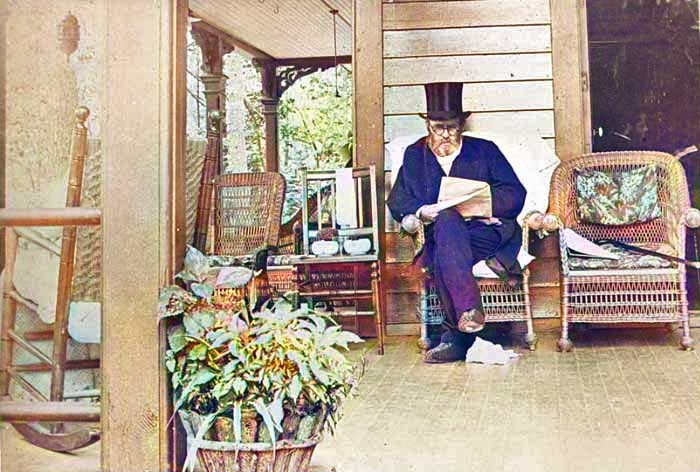
In 1884, Ulysses S. Grant was dying of throat cancer and was dead broke.
His money was wiped out by a swindler who stole his fortune.
Desperate to leave something for his wife, he agreed to write his Civil War memoirs and was close to signing a contract for a meager 10% royalty.
Mark Twain stepped in, called the deal robbery and offered Grant 70% of the profits through his own publishing company.
Grant raced death to finish the book, completing it just days before he died in July 1885.
It became one of the greatest memoirs ever written.
The royalties left his widow nearly half a million dollars, about $16 million today, and the book has never gone out of print.
@seizuresalad A friend fell on stone steps in the rain months ago and suffered a severe concussion. Your explanation helps to understand what she’s still experiencing.
Those steps scare me without any railing. I always lightly hold on while climbing stairs.
Archaeologists have found one of the oldest settlements in North America.
A remarkable archaeological discovery near Sturgeon Lake First Nation in Saskatchewan, Canada, has revealed an approximately 11,000-year-old pre-contact Indigenous settlement—one of the oldest known on the continent—that challenges conventional views of early North American history.
Located along the North Saskatchewan River, roughly 5 kilometers (3 miles) north of Prince Albert, the site known as Âsowanânihk ("A Place to Cross" in Cree) provides evidence of a long-term village rather than a transient camp. Excavations have uncovered fire pits, stone tools, lithic materials, charcoal layers indicating fire management practices, and remains of large bison, including the extinct Bison antiquus (which could exceed 4,400 pounds or 2,000 kilograms in weight). These findings suggest sophisticated hunting techniques, environmental stewardship, and sustained occupation shortly after glacial retreat made the area habitable.
The discovery aligns with Cree oral histories describing the region as a longstanding cultural and trade hub, offering physical corroboration of Indigenous presence and complexity far earlier than many archaeological models had assumed. It also prompts reconsideration of migration theories, such as the Bering Strait hypothesis, by affirming the deep, continuous roots affirmed in Indigenous traditions.
Researchers from the University of Saskatchewan (including Dr. Glenn Stuart) and the University of Calgary are collaborating with the community-led Âsowanânihk Council—a group comprising Elders, Knowledge Keepers, youth, educators, and archaeologists—to study and safeguard the site.
"This discovery challenges the outdated idea that early Indigenous peoples were solely nomadic," noted Dr. Glenn Stuart. "The evidence of long-term settlement and land stewardship suggests a deep-rooted presence."
Chief Christine Longjohn of Sturgeon Lake First Nation emphasized its broader significance: "This isn’t just archaeology. This is truth, memory, and proof. Our ancestors were here—building, thriving, and shaping this land long before history books began to notice."
Future plans include developing a cultural interpretive center and land-based education programs for youth. However, the site remains vulnerable to erosion and nearby industrial development, prompting urgent calls for protection from local, provincial, and federal authorities.
["11,000-year-old Indigenous village uncovered near Sturgeon Lake." University of Saskatchewan, 2024]




![Rainmaker1973's tweet photo. Archaeologists have found one of the oldest settlements in North America.
A remarkable archaeological discovery near Sturgeon Lake First Nation in Saskatchewan, Canada, has revealed an approximately 11,000-year-old pre-contact Indigenous settlement—one of the oldest known on the continent—that challenges conventional views of early North American history.
Located along the North Saskatchewan River, roughly 5 kilometers (3 miles) north of Prince Albert, the site known as Âsowanânihk ("A Place to Cross" in Cree) provides evidence of a long-term village rather than a transient camp. Excavations have uncovered fire pits, stone tools, lithic materials, charcoal layers indicating fire management practices, and remains of large bison, including the extinct Bison antiquus (which could exceed 4,400 pounds or 2,000 kilograms in weight). These findings suggest sophisticated hunting techniques, environmental stewardship, and sustained occupation shortly after glacial retreat made the area habitable.
The discovery aligns with Cree oral histories describing the region as a longstanding cultural and trade hub, offering physical corroboration of Indigenous presence and complexity far earlier than many archaeological models had assumed. It also prompts reconsideration of migration theories, such as the Bering Strait hypothesis, by affirming the deep, continuous roots affirmed in Indigenous traditions.
Researchers from the University of Saskatchewan (including Dr. Glenn Stuart) and the University of Calgary are collaborating with the community-led Âsowanânihk Council—a group comprising Elders, Knowledge Keepers, youth, educators, and archaeologists—to study and safeguard the site.
"This discovery challenges the outdated idea that early Indigenous peoples were solely nomadic," noted Dr. Glenn Stuart. "The evidence of long-term settlement and land stewardship suggests a deep-rooted presence."
Chief Christine Longjohn of Sturgeon Lake First Nation emphasized its broader significance: "This isn’t just archaeology. This is truth, memory, and proof. Our ancestors were here—building, thriving, and shaping this land long before history books began to notice."
Future plans include developing a cultural interpretive center and land-based education programs for youth. However, the site remains vulnerable to erosion and nearby industrial development, prompting urgent calls for protection from local, provincial, and federal authorities.
["11,000-year-old Indigenous village uncovered near Sturgeon Lake." University of Saskatchewan, 2024]](https://pbs.twimg.com/media/HLKNf9tXIAApGcr.jpg)


