There’s a lot riding on the meeting between Xi Jinping, Vladimir Putin and Donald Trump here in Shenzhen.
Whatever you think of these three men, the decisions they make affect all of us. Trade, energy prices, technology, security — these things reach into our everyday lives, often much more than we realise.
Each brings different priorities to the table. Xi leads a China whose manufacturing, infrastructure and growing technological capabilities give it enormous influence. Trump can shift America’s relationships with the world through tariffs, sanctions and security commitments. Putin’s decisions, particularly over the war in Ukraine, carry consequences far beyond Russia’s borders.
They don’t control everything. Other countries have their own interests and deserve a say in decisions that affect them. But relations between China, Russia and America can either create room for cooperation or make solving almost any international problem more difficult.
For me, the significance of this meeting is the opportunity to talk directly. You don’t need to agree with someone to recognise the value of sitting down with them. In fact, when the disagreements are this serious, that’s when talking matters most.
And Shenzhen is quite a setting for it. Living here, I’ve seen how much this city has to show the world. Hosting these talks puts it at the centre of a conversation with consequences well beyond China.
I’m not expecting one meeting to suddenly resolve years of mistrust. The real test will be what follows: whether commitments are kept, tensions ease, and ordinary people see some benefit.
Because behind all the speeches and photographs are people who simply want a decent living, a secure future for their children and a world where disagreements don’t keep turning into conflict.
That’s what I’ll be looking for. What would you most like to see come out of these talks?
CHINA'S ROBOT REVOLUTION IS ALREADY HERE!
While much of the world is still talking about the future of robotics, here in China, robots are already getting on with the job!
I recently visited PUDU Robotics in Shenzhen, and what I saw was seriously impressive.
We're talking about robots delivering food in restaurants, providing room service in hotels, cleaning shopping centres, transporting heavy loads in factories, and even making your morning coffee!
And these aren't just fancy prototypes designed to impress people at exhibitions. These are practical machines already being deployed in businesses around the world.
What impressed me most was how PUDU is developing different types of robots for different jobs, rather than assuming every robot needs to look like a human.
This is where China really excels — turning advanced technology into affordable, practical solutions for everyday problems.
OH, THE IRONY! America spent years accusing China of stealing its technology. Now a former CIA deputy director wants America to spy on Chinese companies to get ahead!
You really couldn't make this stuff up!
For decades, we've heard the same accusations coming out of Washington. Chinese companies copy American designs, steal American technology, and only succeed because they supposedly can't innovate for themselves.
Well, how the tables have turned!
David Cohen, a former Deputy Director of the CIA who served under both Obama and Biden, has now openly called for the United States to abandon its longstanding ban on economic espionage and start spying on foreign companies to help American businesses compete.
And guess who's firmly in the crosshairs? China, of course!
We're talking about some of the most important technologies of the future, including artificial intelligence, semiconductors, 6G and quantum computing.
For years, Washington has portrayed China as a country that simply copies Western innovation. Yet now we're hearing arguments that America needs to steal technological secrets from its competitors because its own companies risk falling behind.
What happened to all that talk about American technological superiority?
I've been saying for years that people seriously underestimate China's ability to innovate. I've visited countless Chinese factories, technology exhibitions and research facilities, and I've seen firsthand just how quickly Chinese companies are developing new technologies.
China isn't simply catching up anymore. In many areas, it's pushing the boundaries of what's possible.
And perhaps that's what really worries Washington.
Of course, Cohen's proposal isn't official US government policy, but the fact that a former senior CIA official is openly advocating economic espionage to benefit American companies tells you something about how the technological competition is changing.
Imagine the reaction in Washington if a senior Chinese intelligence official publicly suggested doing exactly the same thing to American companies!
The headlines would be absolutely deafening.
When China is accused of doing it, it's called intellectual property theft. When America considers doing it, suddenly it's a matter of national security and economic competitiveness.
You really have to admire the double standards.
The irony is extraordinary. After spending decades telling the world that China couldn't innovate without stealing Western technology, some in Washington are now suggesting America should steal its competitors' technology to stay ahead.
Oh, how the tables have turned!
And I'll say it again: DO NOT UNDERESTIMATE CHINA.
Solar generators used to be camping gear. In 2026, they're starting to look like home preparedness.
Why the shift? A few things seem to be happening at once:
1. Governments in at least 17 countries now ask households to be ready for 3–7 days on their own.
2. Winter and storm outages are a recurring reality across much of the US.
3. NERC, the grid's reliability watchdog, has warned that demand is growing faster than new supply.
4. US home electricity prices are expected to rise about 5% this year.
The category is moving too. Jackery, EcoFlow, Bluetti and Anker SOLIX have all been pushing beyond camping and into home backup.
Is demand following? One data point: Jackery, the world's No.1 solar generator brand, sold out its hero product line within 3 days of opening Black Friday preorders. Preorders are available now, and thousands of people are already on the waitlist.
No single cause explains that. But "personal energy" is starting to sound less like a niche and more like common sense.
What would you want to keep running if the power went out for 3 days?
This is an absolute Joke. The British Economy is not good, many people living month to month, but the politicians can find 10 Billion Pounds to give to the corrupt dictator Zelensky. We are told it's "Loans", but everyone knows it will never be paid back. I would like to bet that a majority of the British public would not agree with this decision.
Hong Kong is playing a much bigger role in China's space programme than you might think! I travelled from Shenzhen to Hong Kong's InnoCarnival 2026 to discover some incredible space technology, from lunar robots and reusable rockets to immersive virtual reality experiences. I also discovered how Hong Kong's universities and engineers are helping shape China's future in space. And perhaps most importantly, how the next generation of scientists and engineers are being inspired to dream big. #HKSTPCreator #25toNext
If DeepSeek can already compete with America's AI giants on a fraction of their budgets, just imagine what they could achieve with another $15 BILLION behind them!
According to Bloomberg, China's DeepSeek has reportedly raised around 100 billion yuan ($15 billion) in one of the largest funding rounds in Chinese history, with Tencent and CATL among the major investors.
DeepSeek has already demonstrated that you don't necessarily need the enormous budgets of OpenAI, Anthropic or Google to develop genuinely impressive AI models. They've challenged the industry with their efficiency, performance and approach to open-source AI.
Now imagine what they could achieve with this level of investment.
More computing power, more research, better models and potentially even greater competition with the American AI giants.
What's also interesting is that DeepSeek's annualised revenue has reportedly surpassed $1 billion, more than doubling in just a few months. So this isn't simply about attracting investment; there's clearly growing commercial demand for what they're producing.
For years, we've been told that US restrictions on advanced chips would hold back China's AI development. Yet DeepSeek has already shown just how much can be achieved by doing things differently.
And if they've achieved this much with relatively limited resources, I suspect we're only scratching the surface of what's coming next.
The global AI race is getting a lot more interesting, and competition is exactly what this industry needs.
Discover 2,200 industry professional exhibitors at the 40th edition of China's leading International Electric Power & Energy Exhibition — covering the full power supply chain under one roof:
EP Shanghai 2026 Date : 03–05 December 2026 Venue : Shanghai New International Expo Center, PR China (Hall N1- N5 & W4 &W5)
How Huawei is beating western sanctions and innovating in semiconductor technology. The Tau Scaling Law.
I've said this many times. Do not underestimate China.
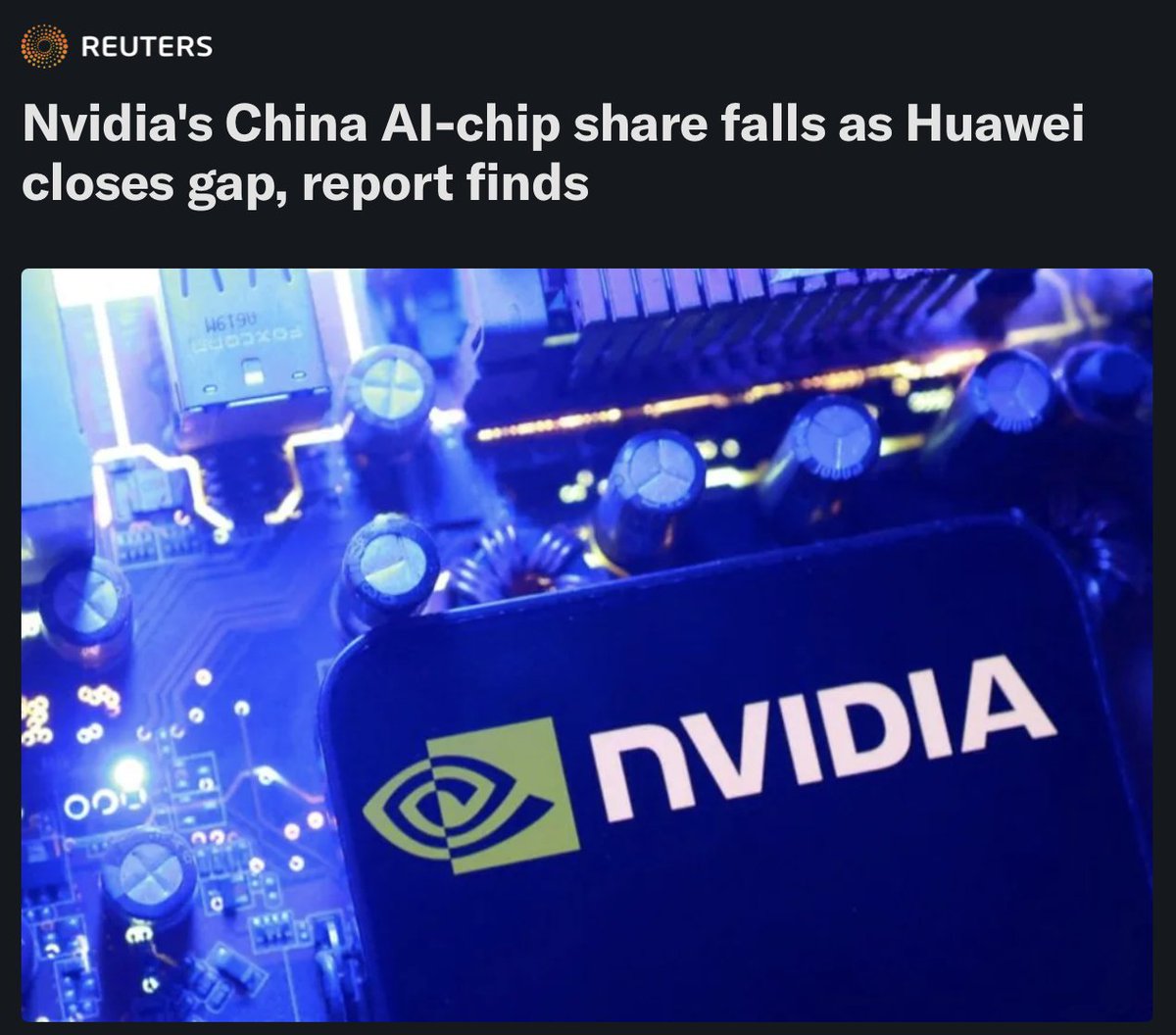
Washington wanted to cripple China's AI industry by cutting off access to advanced American chips. Instead, it may have just handed Huawei one of the biggest opportunities in its history. And Nvidia is paying the price!
According to a new IDC report seen by Reuters, Nvidia's share of China's data-centre AI chip market has fallen to just 34% in the first half of 2026, with shipments plunging 44% year-on-year. Meanwhile, Huawei has surged ahead, shipping 572,000 AI accelerators and capturing 28% of the market. That's just six percentage points behind Nvidia.
The United States has spent years tightening restrictions on China's access to advanced semiconductors, supposedly to slow down its technological development. Yet those very restrictions have created an enormous opportunity for Chinese companies to develop, manufacture and deploy their own alternatives.
And it's not just Huawei. Alibaba's T-Head, Cambricon, Baidu's Kunlunxin and Hygon are all gaining ground. In fact, nine of the eleven Chinese chipmakers tracked by IDC increased their shipments compared with last year.
Perhaps the most interesting finding is that China is increasingly moving beyond traditional GPUs. Shipments of other AI accelerators jumped nearly 80%, overtaking GPUs in volume for the first time. Chinese companies are also focusing on complete computing systems, rather than simply trying to match Nvidia chip for chip.
Even Nvidia CEO Jensen Huang has repeatedly warned that Washington's restrictions are effectively handing China's enormous AI chip market to Huawei.
I've said this many times before: when you try to contain China's technological development, you don't necessarily stop it. You give Chinese companies a very powerful incentive to find their own solutions.
And once those domestic alternatives become competitive, why would China want to return to depending on American technology that Washington can restrict whenever it chooses?
Nvidia still leads in China, but the gap is narrowing rapidly. The bigger question now is whether US policymakers have inadvertently accelerated the very technological independence they were trying to prevent.
Washington wanted to slow China down. Instead, it may have helped create Nvidia's biggest future competitor.
Many say that China cannot innovate, only steals technology from the West. Check out this video explaining how Huawei and Qualcomm just signed a huge patent licensing deal, and as part of that deal purchased patents from Huawei.
America can't compete with China, so now it wants to stop Chinese laboratories from testing electronics destined for the US market. Seriously, where does this end?
The US Federal Communications Commission (FCC) is preparing to vote on October 29 on a proposal to ban ALL Chinese laboratories from testing electronic products such as smartphones, computers and cameras for the American market.
According to the FCC itself, 82% of electronic products were tested in China in 2025, compared with less than 4% in the United States.
China has spent decades building one of the world's most advanced electronics manufacturing ecosystems, including testing facilities, suppliers and engineering expertise. American companies have benefited enormously from this, keeping costs down and bringing products to market faster.
But rather than investing in its own capabilities, Washington seems more interested in disrupting the very supply chains American businesses rely on.
Of course, we're hearing the usual arguments about "national security" and "fair competition". But seriously, where is the national security threat in having a smartphone tested in a Chinese laboratory?
The ban wouldn't take effect until December 2028. If this really is such a serious security concern, why wait over two years?
I've spent years visiting factories and technology companies across China, and one thing I've learned is that China's manufacturing strength isn't something you can simply switch off with sanctions and restrictions.
You don't make American industry more competitive by making it more expensive to do business.
At some point, Washington needs to realise that competing with China means investing in innovation and manufacturing, not putting up more barriers.
Meanwhile, China will continue doing what it does best: building, innovating and moving forward.
Human vs Robot! What happens when you challenge a humanoid robot to a game of tennis? At the China Open in Beijing, I went head-to-head with Galbot’s AI-powered humanoid robot. Join me as I put China’s latest robotics technology to the test and experience the future of embodied AI firsthand!
I've been seeing posts about test rides in the XPENG L03 in Paris, as someone who follows XPENG quite closely I looked into what’s happening at the show.
Turns out more than 60 automakers are at the Paris Motor Show, and only two are giving the public intelligent driving rides on real roads. XPENG is one of them, alongside Tesla.
Inside the show’s official Autonomous Lab, visitors are experiencing XPENG FSD in the new L03 SUV coupe. It’s XPENG’s first large-scale NGP test ride experience in Europe.
The leadership extends beyond the show floor. XPENG now serves as OICA Secretary of a newly established UNECE task force on automated driving, which brings together regulators, technical experts and industry from around the world to share real-world experience.
XPENG and Tesla, two names leading the way, setting the pace for global intelligent driving.
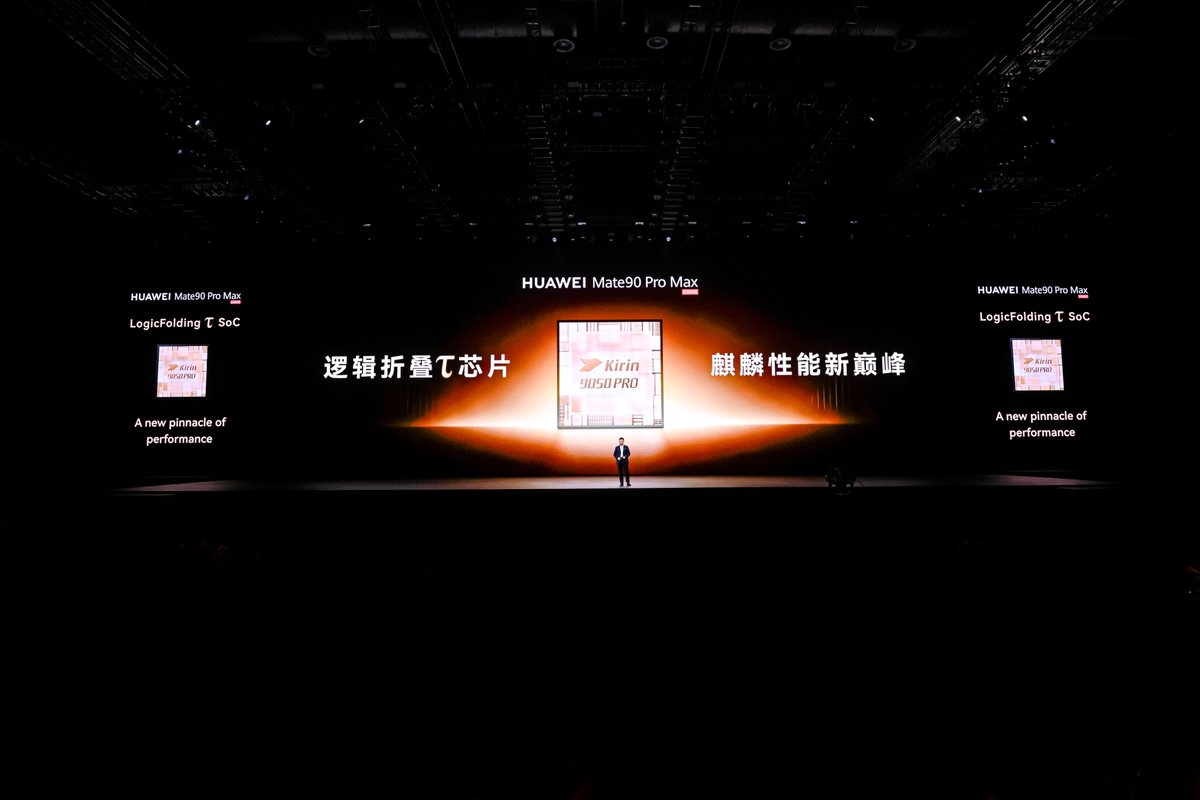
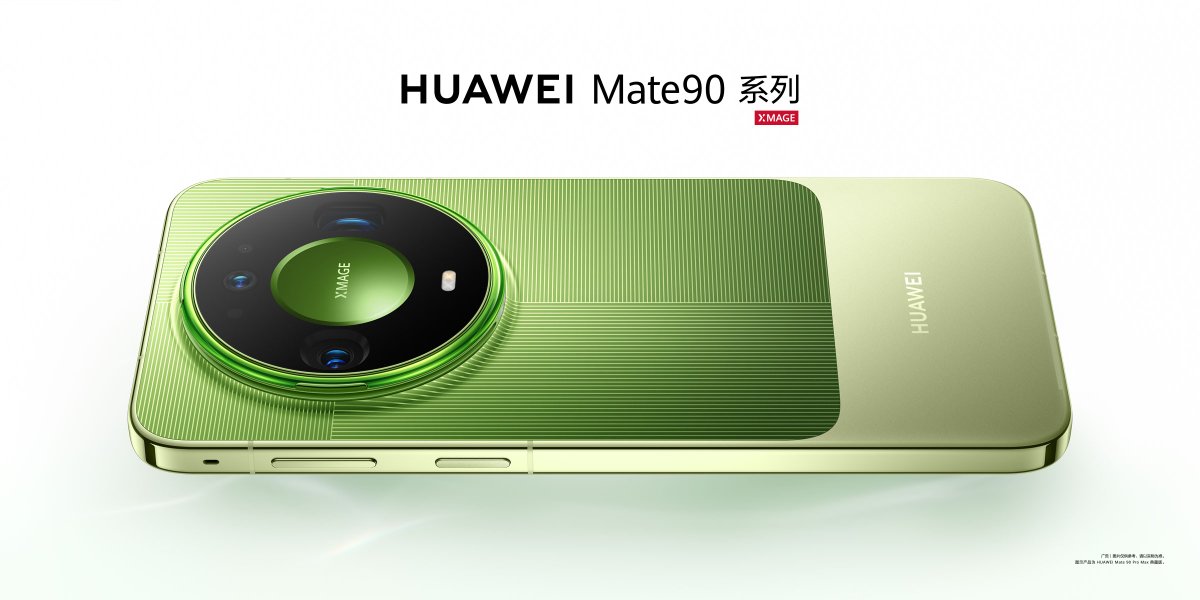
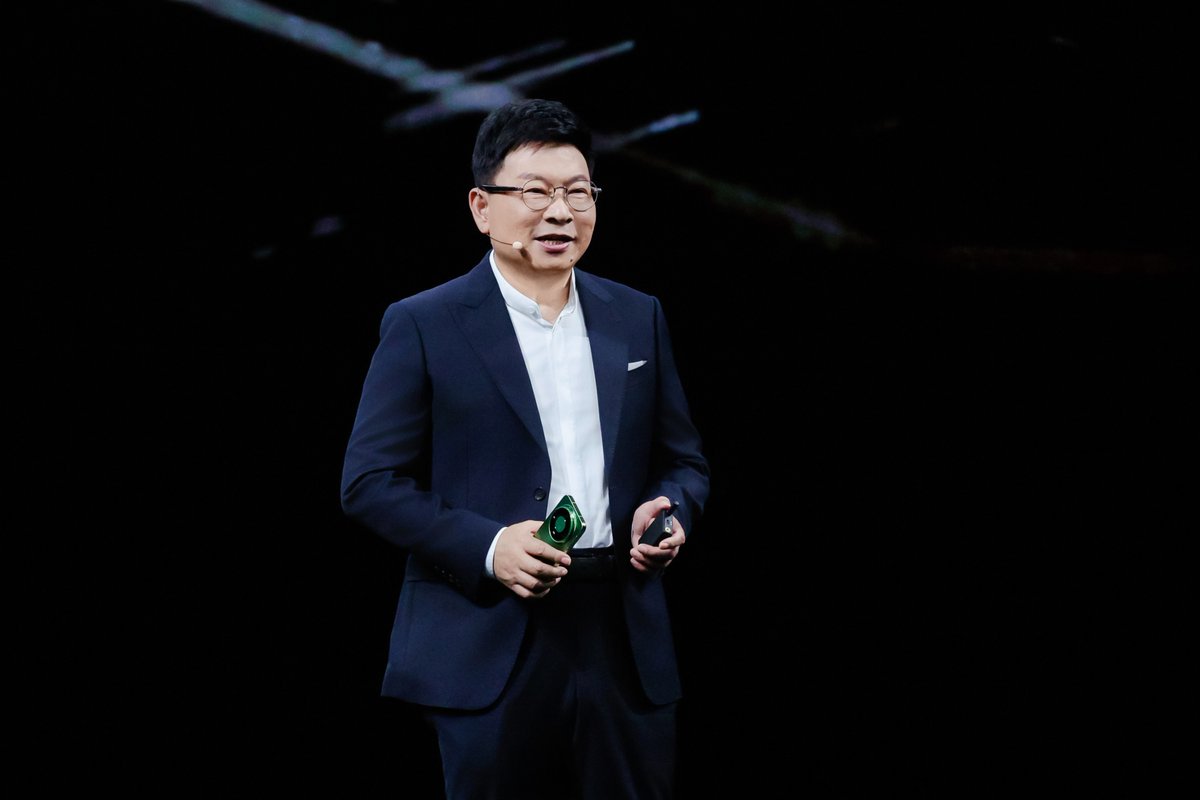
Huawei's new Mate 90 series launched today, and I'll be honest, it's the chip story that's caught my attention more than anything else.
"The HUAWEI Mate 90 Series is equipped with the flagship Tau chipset across the entire series." — Richard Yu
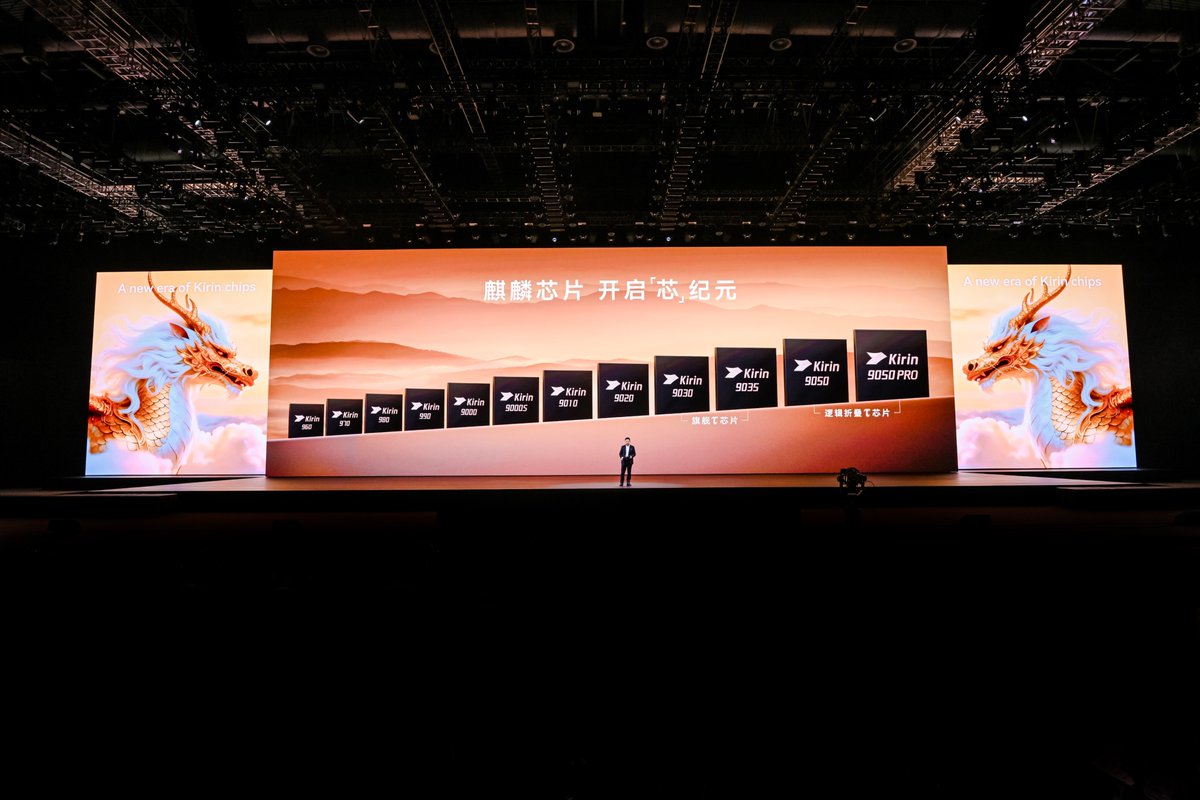
For as long as I've followed phones, performance upgrades have mostly come down to one thing: who can shrink their transistors the most. It's the same race every year. So it's refreshing to see Huawei take a different route with LogicFolding, rethinking how the chip itself is built rather than just chasing a smaller process. Huawei describes it as moving away from the idea that "process determines everything." Whatever you think of that, it's a bold thing to put your flagship behind.
The Kirin 9050 Pro sits at the top of the range, and on paper it's a proper step up. What I'm most interested in isn't the benchmark numbers, though, it's how that feels day to day. Do apps open instantly? Does it stay cool after an hour of gaming? Does on-device AI actually feel quicker when nothing has to go to the cloud? Those are the things that matter once the launch buzz settles.
It's not all about the chip, either. The camera side looks seriously exciting, especially the XMAGE Z10 modular camera with its 1-inch sensor. Clipping a proper camera onto your phone is the kind of idea that sounds like a gimmick until you see what it can do, and I really want to try it. The new Linglong display, built to stay clear even in bright sunlight, is another one I'm keen to see in person.
Launches like this are a good reminder that there's still room for genuinely different thinking in smartphones. I'm looking forward to spending some real time with it.
#HUAWEIMate90 #Kirin9050Pro #LogicFolding