This is a post about animal excrement and the English language.
bull$#!% = nonsense/lies
chicken$#!% = petty or cowardly
horse$#!% = nonsense/lies
dog$#!%= low quality
ape$#!% = wild
bat$#!%= crazy
Ordered above from oldest to newest: bull$#!% (1914), bat$#!% (1971).
On Dec. 2, 1919, Toronto's Ambrose Small deposited $1.7 million into his bank account and met with his lawyer.
Then...he vanished without a trace. The money remained untouched by Small and he was never seen again.
This is the story of a very interesting mystery.
🧵 1/10
Here's when we'll see full moons in 2026! 🌕
There will be 13 full moons in 2026, which includes two in May. The second is known as a blue moon. 2026 will also have three supermoons, the first one is happening this weekend. https://t.co/euOpiK5Ypv
‘Twas the night before Xmas,
And all through the Mall,
Not a retail employee was stirring,
A shout out to all!
Me, all punned out &
Santa icing his lap
Settling down to
A Cinnabon snack
Back to the North Pole
It’s ok, I’m alright 🥹
Merry Creepymas to all
To all a good night.🎄
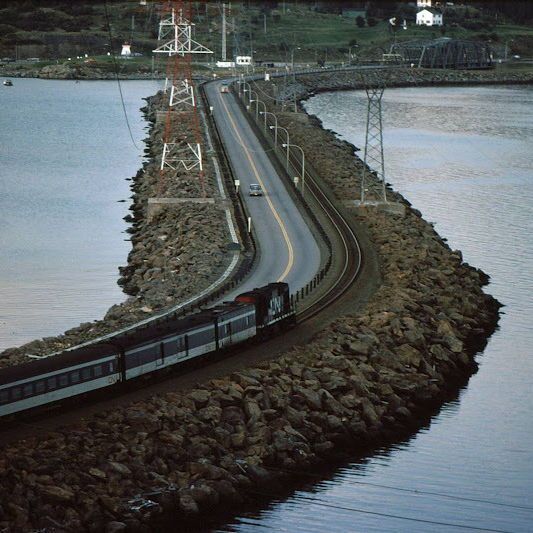
The Canso Causeway was built as part of the Trans-Canada Highway construction in Nova Scotia. This 1.5 kilometre long rock-filled causeway cost $23 million and connected the Nova Scotia Peninsula with Cape Breton Island.
This is its story.
Long before the Canso Causeway was built, ferries were used to transport people and things across the strait.
As early as the 1890s, there were talks of building a bridge across the strait. One proposal was for a 1.3 km steel cantilever bridge.
After the Second World War, renewed proposals for a bridge were put forward but it was decided that due to the amount of ice in the winter and the strong currents, constructing a bridge was not feasible.
A causeway was chosen as a better option instead.
When Nova Scotia signed the agreement to build a portion of the Trans-Canada Highway in the province, part of that agreement included federal financial assistance for building the causeway.
Estimates on the work were put at $22.75 million to complete the project.
The Canso Causeway Project began on Sept. 16, 1952 in a grand ceremony.
As soon as construction began, the communities of Mulgrave, Point Tupper and Port Hawkesbury began to boom with so many workers coming into the area for the project.
On Dec. 10, 1954, the Strait of Canso was permanently blocked by the construction.
Occasionally, since maps still showed a strait, some ships ran aground on the causeway. On Nov. 28, 1954, a 2,200-ton Norwegian freighter ran aground. It took a day to refloat the ship.
On April 13, 1955, the Causeway was officially finished. Five days later, a CNR work train drove across the causeway. On May 14, 1955, regular train service began on the causeway.
Six days later, the roadway was opened to traffic.
The roadway was 2.1 km long, 24 metres wide at the top and 198 metres wide at the bottom. A sidewalk was also built along the roadway.
On Aug. 13, 1955, 35,000 people came out for the grand opening. It included 100 bagpipers walking across the causeway.
The final cost of the causeway came to $19,490,000. Of that, the federal government paid $14,780,000.
Part of the cost was paid off through the use of tolls from 1955 to the early-1990s.
The government also had to pay out a lot of money in a lawsuit.
Alistair Fraser, the Lt. Governor of Nova Scotia, launched a $5 million lawsuit against the federal government due to gravel and earth being removed from his property for the project. Over 10 million tons was removed, for which the government offered $5,000.
Fraser, a decorated First World War soldier who served at Vimy Ridge, kept at his lawsuit for years. In 1963, the Supreme Court ruled he be awarded $560,000.
Learn more about the Causeway in my book 👇
https://t.co/Yq48uHYqcf
I hope you enjoyed that look at the construction of the Canso Causeway!
If you enjoy my Canadian history content, you can support my work with a donation at 👇
https://t.co/1bARpMfNGq
Sources:
Parks Canada: https://t.co/sqW8ImGW2x
Historic Nova Scotia: https://t.co/sts7nNuKtI
Canadian Encyclopedia: https://t.co/35GXtlTCnB
Canada's Main Street - Craig Baird
Drone video captured the incredible moment a rare albino humpback whale breached the water off the east coast of Australia. Scientists estimate that only 1 in 40,000 humpbacks are albino.
Woody The Talking Tree has awakened from his slumber to usher in another Christmas season.
While he may seem slightly unsettling, all Woody asks for is Cinnabon sacrifices.
But where did he come from?
This is the story of Woody The Talking Tree.
While the main source states Woody debuted at the Mic Mac Mall in Dartmouth, NS in 1983, many remember seeing him earlier, just a different version.
Woody stood 17 metres tall and answered questions from people. He remained a fixture of the mall for a quarter century.
There was no Woody in 2007, as he was officially retired due to safety concerns and repairs needed to his frame. The mall stated Woody went to the North Pole to help Santa and the elves sustain the magical forest at the North Pole.
In 2021, Halifax developer Joe Ramia bought the mall, and one of the first things he did was bring back Woody. On Nov. 18, 2021, Woody returned after an absence of a decade and a half. This time, he had received a facelift to make him, somewhat less terrifying.
Lee Rodgers, a local radio host, is the main voice for the tree. Woody has become famous enough that he was featured on The Tonight Show Starring Jimmy Fallon on Nov. 23, 2021, as well as news outlets like CNN.
I hope you enjoyed that look at Woody The Talking Christmas Tree.
If you enjoy my Canadian history content, you can support my work with a donation at 👇
https://t.co/1bARpMfNGq