Understanding VAN's epidemiology, risk factors, mechanisms, clinical presentation, management, and prevention is critical to optimize vancomycin use and minimize nephrotoxicity risk. This has been a first @KIReports tweetorial by @vidhyag26@ISNkidneycare
Thank you for reading!
Discontinuation of vancomycin and piperacillin-tazobactam often leads to a rapid decline in serum creatinine levels, supporting the pseudo-toxicity theory. In addition, Cystatin C levels remain unchanged during pseudo-toxicity, indicating no loss of glomerular filtration.
Combination therapy of vancomycin (inhibits the proximal tubular secretion of creatinine) and piperacillin-tazobactam (competitively decreases tubular secretion of creatinine), may cause a “pseudo-toxicity” without kidney damage.
https://t.co/kT7XOZNt0I
Discontinuation of vancomycin & use of alternative antibiotics may be necessary. Linezolid & daptomycin are potential replacements. A meta-analysis in 2021 showed no significant difference in nephrotoxicity between linezolid & vancomycin.
https://t.co/nNZQMYPuM3
Regular monitoring of kidney function is crucial in managing VAN. Serum creatinine and urine output should be measured to detect early kidney damage. Dosage adjustment based on renal function changes and trough/AUC calculations reduces the risk of VAN.
Immune-mediated damage, such as interstitial nephritis & glomerulonephritis, involving drug-specific T cells that activate inflammatory pathways. Hemodynamic effects of vancomycin, including vasoconstriction & altered renal autoregulation, may contribute to ischemic injury.
Vancomycin-associated tubular casts (VATCs) have been associated with a higher risk of nephrotoxicity. Monitoring VATCs through biopsy could help identify patients at risk for VAN and guide medication dosing.
https://t.co/dFukLOAtcN
Mechanisms of VAN include direct tubular toxicity, potentially through mitochondrial dysfunction & oxidative stress. Intracellular accumulation of vancomycin in lysosomes can disrupt organelle function, leading to apoptosis and cell death.
Inconsistent study definitions contribute to the uncertain incidence of VAN. Criteria include changes in Creatinine, urine output, or the need for renal replacement. Furthermore, risk factors for VAN do not necessarily preclude vancomycin use; individual assessment is crucial.
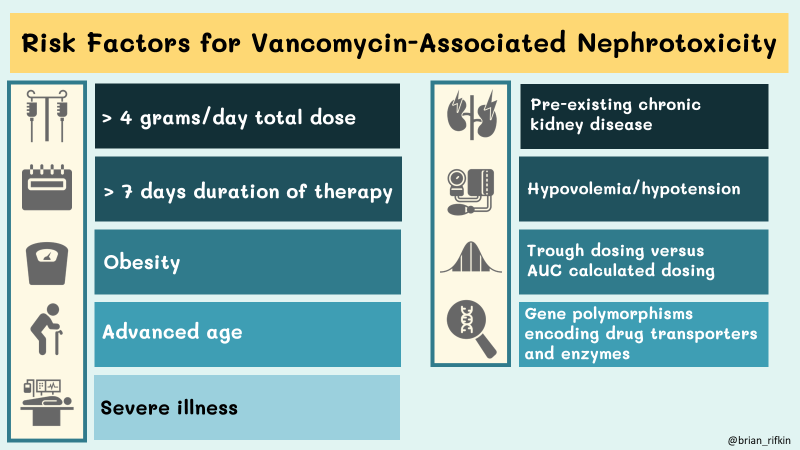
Clinical factors like advanced age, pre-existing CKD, hypotension, severe illness, and obesity (due to improper dose calculations) increase the risk of nephrotoxicity. Genetic polymorphisms can also influence vancomycin metabolism.
Incidence of VAN varies widely, influenced by factors such as therapy durations ≥7 days. Trough dosing may contribute to higher AKI rates, while AUC-guided dosing (which is more difficult) has shown lower nephrotoxicity incidence.
https://t.co/RYuxCnWnBp
VAN can lead to prolonged hospitalization, ⬆️ hospital readmissions & ⬆️ mortality. Repeat exposure to vancomycin may also contribute to the development of CKD. Frequent monitoring of serum creatinine is crucial to early detection.
📢📢📢 Tweetorial Alert
Vancomycin is a powerful antibiotic used to vanquish bacterial infections. Unfortunately, it can also be associated with kidney damage. Symptoms and timing of nephrotoxicity can vary widely. #Vancomycin#NephTwitter
https://t.co/jQDxZdq4j9
Hey #NephTwitter#MedTwitter here is a first blog/tweetorial combo from PGY-2 IM budding nephrologist @vidhyag26 ! Let’s see if we can get 💯❤️💯🔁.
PS did you know the name Vancomycin was derived from “vanquish”? ⚔️