I built Stamp, a Gmail-style inbox, to explore the new 𝚗𝚊𝚟𝚒𝚐𝚊𝚝𝚒𝚘𝚗() API in Next.js 16.4.
Sometimes you want to cache content for return visits without prefetching it before someone opens the page.
In this mailbox, visible links prefetch each thread's header. The message bodies still use '𝚞𝚜𝚎 𝚌𝚊𝚌𝚑𝚎', but 𝚊𝚠𝚊𝚒𝚝 𝚗𝚊𝚟𝚒𝚐𝚊𝚝𝚒𝚘𝚗() keeps them out of the prefetch. They load after the click but will still be reused when you return.
Live demo, source code, and docs below ↓
Something I have been thinking about: in the past, the best engineers I knew spent a lot of time automating their work in various ways. Better vim/emacs automations, writing lint rules to catch repeat code issues, building up a suite of e2e tests so they don't need to smoke test the app manually. These kinds of things were the highest leverage activities an engineer could do, because it multiplied their own output, which in turn meant they could build more things.
I think many of these automations have become even more important now. This is true for a number of reasons.
First, infra and DevX automation speeds you up. And if you are running an army of agents, each of those agents will be sped up also. More automation == more output per unit of time.
Second, moving things to code improves efficiency. Your agent could fix an issue every time it sees that issue happen, but that uses tokens and might miss cases. If Claude instead writes a lint rule, CI step, or routine, that class of issue can be fully automated forever. This is really what people are talking about when they talk about loops -- it's about automating entire types of busywork rather than solving them one off. This isn't a new idea at all. Engineers have been doing this for a long time!
Third and most importantly, automation makes it possible for others to contribute to the codebase more easily. Increasingly what I am seeing is engineers are contributing to codebases on day one because Claude can navigate the codebase for them, and that non-engineers are able to contribute to a codebase as effectively as engineers can. What gets in the way of both of these is domain knowledge that lives in peoples' heads rather than in automation -- the stuff you used to have to learn when ramping up. What has changed thanks to agents is the domain knowledge that can be encoded as infrastructure is no longer limited to what is expressible in lint rules and types and tests; it can now capture nearly all domain knowledge, encoded as code comments and skills and CLAUDE.md rules and memories. If I put up a PR for an iOS codebase I don't know and a code reviewer rejects it because it doesn't use the right framework, or if a designer builds a new feature and it gets rejected because it doesn't follow the right architectural patterns, these are failures of automation.
Every team should be writing the CLAUDE.md's, REVIEW.md's, skills, and docs that enable agents to productively work in their codebase with zero additional context from the prompter. This sounds crazy, and at the same time is a natural extension of the stuff engineers have always done: automate, and encode domain knowledge as infrastructure. As the model gets smarter and as the harness matures, this task becomes easier. In the meantime, it is on every team to look for ways to convert their domain knowledge to infra so that Claude can write code better, so that code review catches issues automatically, and so the next person working on your codebase can contribute more easily.
fate 1.0: The first full Async React Metaframework
New in 1.0:
* Zero-Config Live Views via SSE
* Drizzle Support
* "Native" HTTP support (no tRPC)
* Void Router
* Vite plugin
* Clientside Garbage Collection
* Performance & scalability improvements
https://t.co/enF2EdbBaQ
Today, we’re open-sourcing the draft specification for DESIGN.md, so it can be used across any tool or platform. We’re also adding new capabilities.
DESIGN.md lets you easily export and import your design rules from project to project. Instead of guessing intent, agents know exactly what a color is for and can even validate their choices against WCAG accessibility rules.
Watch David East break down this shared visual language in action👇. New capabilities and links in 🧵
@stitchbygoogle CLAUDE.md for behavior, DESIGN.md for visual intent, Karpathy's wiki .md for accumulated knowledge. we're converging on a spec-file layer that agents read before doing anything. the interesting question is what happens when these files contradict each other.
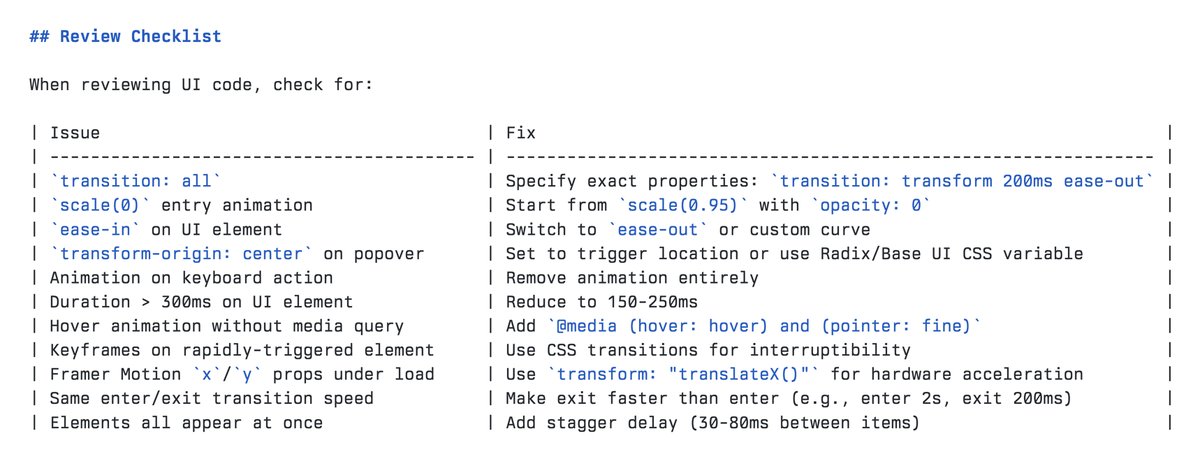
Turned my blog articles into one big design engineering skill that you can use with coding agents like Claude Code or Codex.
It covers animations, component design, principles from my open source projects like Sonner, and more.
https://t.co/WKXPGQuvQd
Not knowing how to code giving you an advantage is absolute nonsense.
The more you understand, the better your prompts, the better the feedback you give, the better product you ship.
What will change is that the intricacies of syntax, compilers, module systems, the finer details of type systems, won’t matter as much to everyone.
But you should absolutely understand how the pieces fit together. From syscall to pixels. Learn how data flows, because you’ll be able to secure your systems. Learn about performance, because you’ll be able to push your agent further. Learn about APIs, because they determine how to integrate systems. Learn about how systems fail, because you’ll be able to make reliable programs.
Rules, commands, MCP servers, subagents, modes, hooks, skills...
There's a lot of stuff! And tbh it's a little confusing.
Here's what you need to know (and how we got here).
people who hate @nextjs first learn fundamentals. if you wanna go deep , rsc, isr, edge, hydration i made a dedicated repo:
https://t.co/jLBAU3VRiJ
devs cry about next.js all day. hydration bug, isr loop, streaming broken, lcp slow. 99% it’s their own lack of understanding toward the web lol
they don’t get what is runtime, break file-based routing, misuse rsc hooks, fail edge constraints, double-fetch waterfalls, hydration mismatches, slow lcp, suspense deadlocks or whatever this repo shows how it really works . understand fundamentals → master runtime → app router → rsc → isr → edge → hydration
this may feel some what harder . but dm me we can change it fast fast the way it would really great im curious to see all opinion cus im not only the smart next js ever lol
@nuqs47ng I would like to use nuqs a second shot. But doesn’t find the pattern and solution that work seamlessly with native URLSearchParams and startTransition with