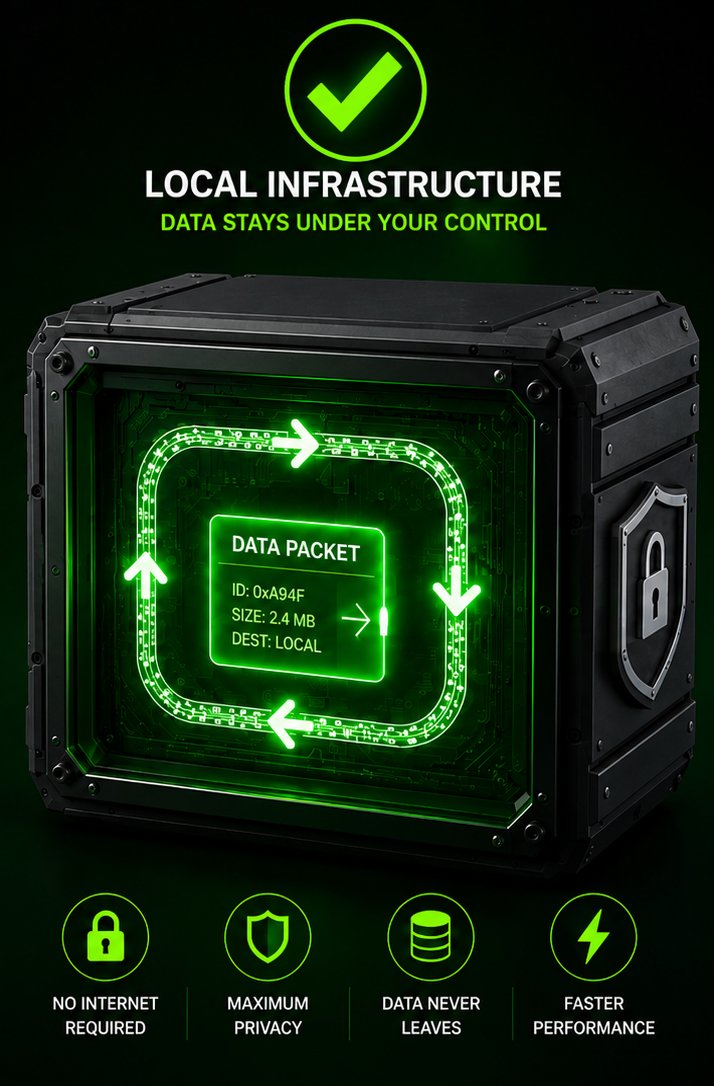
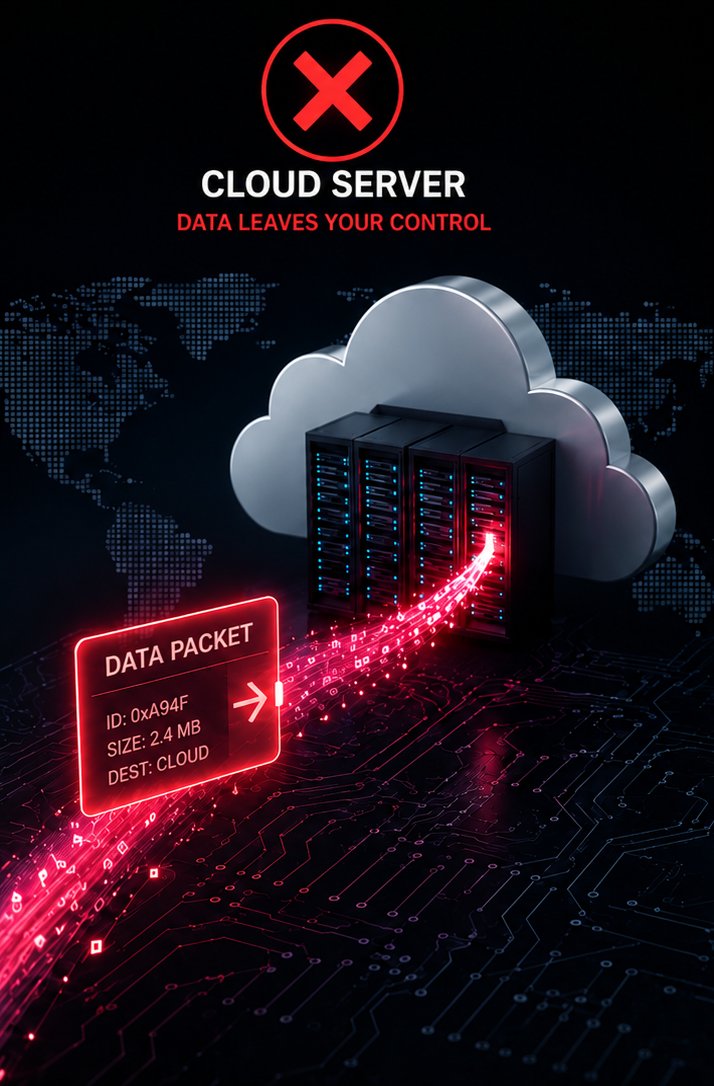
Microsoft has officially entered the race for local AI, announcing a new runtime designed to bring open-source Large Language Models (LLMs) directly onto your hardware. At first glance, it looks like a victory for the user: the power of AI without the latency or privacy concerns of the cloud, but if you look past the marketing you'll find something far more concerning...
When a trillion-dollar corporation offers you a "private" solution that lives within their own proprietary ecosystem, you have to ask, "who is actually in control?"
In software architecture, the runtime is the environment that executes the code. If Microsoft provides the runtime and integrates it deeply into the Windows OS, they control the gateway through which every piece of data flows. While they may claim the AI is "local," a corporate-controlled runtime creates an invisible tether.
When your AI is integrated into a proprietary OS, "security" becomes a matter of trust, not verification. History has shown that corporate "telemetry" and "system updates" can easily be used as channel for data harvesting. In a world where data is the new oil, it is naive to believe that a company whose business model relies on data aggregation will provide you with a truly transparent stack.
When you rely on a corporate local AI solution, your infrastructure is at the mercy of the update cycle. A single Windows Update could fundamentally change how your AI processes information, introduce new tracking mechanisms, or deprecate a feature your business relies on. You are essentially renting it on a "local" basis, subject to the whims and policy changes of a third party boardroom.
True local AI should be completely private, stable, and under your absolute command. It should not share information or alter functionality unless you make these changes.
This is why our V-Core package offers local AI with auditable code, open models, and strict firewall rules are still the purest form of secure on-premises local AI.
Our stack is designed for those who understand that "Local" is not a feature, but a requirement.
The entrance of big tech into the local AI space is an attempt to commoditize privacy. They want to give you just enough "local" capability to make you feel safe, while keeping the control firmly in their hands.
For a business, "almost private" is the same as "not private."
If your data is the backbone of your competitive advantage, you cannot afford to house it within a corporate runtime. You need an infrastructure that is transparent, verifiable, and entirely disconnected from the corporate grid.
Looking to integrate true local AI into your business? Contact us today and we can perform an infrastructure audit to see if you can save even more money by using existing hardware.
Scalability defines modern production efficiency.
This segment isolates operational workflows to demonstrate how streamlined processes reduce overhead and optimize resource allocation.
Strategic video documentation provides the visual evidence required to support vendor evaluations and logistical planning.
Use content to showcase operational efficiency, streamline stakeholder approvals, and demonstrate cost-effectiveness.
Stop renting your intelligence ✋
Most professionals treat their ChatGPT Plus subscription like a utility (e.g. electricity or water), but there’s a massive difference: the "water" in your AI pipe changes flavor, temperature, and quality without warning.
If you’ve noticed your prompts aren't working as well as they did three months ago, you aren't imagining it.
The Cloud AI Trap consists of two major risks:
1️⃣ The Consistency Gap
The industry is obsessed with benchmark scores, yet a higher score means little if a model’s behavior shifts overnight. When providers update their models, the workflows you’ve spent months perfecting can break, turning marginal theoretical gains into real setbacks. In tooling, what matters isn’t a record-topping benchmark but predictable reliability.
2️⃣ The Privacy Liability
Every piece of proprietary data, strategic plan, or client secret you feed into the cloud is a risk. Between client contracts and "model improvement" training, the line between your private data and public knowledge is dangerously thin.
The Solution? Self-hosted AI 🖥️
We are seeing a massive shift toward on-premise, local AI deployments. Why? Because owning the stack changes the game:
➡️ 100% Privacy
Your data never leaves your hardware. Period.
➡️ Absolute Consistency
You choose the model. You lock the version. It works exactly the same way today as it will in the future.
➡️ Customization
Instead of one "general" chatbot, you can run multiple specialized models: one for speed, one for creative nuance, and one for deep technical knowledge.
The era of blindly trusting the cloud with your company's intellectual property is ending. The future belongs to those who own their infrastructure.
What's your biggest concern with cloud AI? Are you still relying on a subscription for your core workflows, or have you started looking into local solutions?
Let’s discuss in the comments. 👇
#AIStrategy #DataPrivacy #LocalLLM #OnPremise #Viewbility
I had the great privilege of filming most of the New York based principal photography (fancy film term for filming) for the late great Jazz legend Roy Hargrove.
I remember getting to the studio and seeing this amazing crest like wall fixture and I knew I had to incorporate it somehow.
Living in New York you really have to be conscious about what and how much gear to pack and after doing my 10,000 hours I feel confident filming in just about any scenario with just 3 lights: a hard source (@nanlite_official) and 2 light weight panels (@aladdinlights).
Camera-wise, when filming indoors without windows it really doesn’t matter to me which to use since just about any camera nowadays can film at least 10 stops of dynamic range which is 4-5 stops over the rec709 standard, which is what most videos are delivered in.
To stay sharp, I like to challenge myself on-set to keep things interesting, so I decided to light these interview sequences with just one light source... and that’s exactly what I did 💪
The result, hopefully something moody and visually interesting ;) 📹💡🎬
Also, I don't remember whose glasses those were? 🤷♂️
Talent //
Frank Lacy - Trombonist
Antonio Hart - Alto Saxophonist
#jazzmusic #royhargrove #jazzlegend #musicdocumentary #cinematography #lightingsetup #nanlite #aladdinlights #newyorkcity
If you cannot track your data, do you truly own it?
Many cloud AI agreements contain fine print that could allow providers to learn from the information you upload. That creates a real risk for teams handling unique methods or client materials. When you send your work to a distant server, you are trusting their security measures instead of keeping control yourself.
Keeping your data safe is about how you set up your system. At Viewbility, our V-Core local setup keeps every file and prompt inside your own machines. There is no background tracking or hidden data transfer. Your information stays behind your firewall, where you decide what happens to it.
DM us to see how we can save you money on your AI spend.
Have you ever stopped to think about the hands that wrote our Constitution?
Jacob Shallus, the penman behind this historic document, spent roughly 40 hours creating it by hand. That is serious craftsmanship! Some people say he might have used an entire hour just for the ornate "We the People" at the top.
Think about how much care went into every letter. It wasn't just typed or printed. It was poured onto parchment with intention.
Here is another fun fact:
George Washington signed this document first. But remember, he was not President of the United States yet. He served as the President of the Convention.
The signatures follow a specific order too. They start at the northernmost state (New Hampshire) and work their way down to the southernmost state (Georgia). It creates a beautiful map of the founders across the page.
It really puts into perspective how much time, patience, and precision built our foundation. Next time you look at a document, remember the human effort behind it.
What historical details do you love learning about? Let me know in the comments! 👇
#History #Constitution #HumanStories #America250 #4thofJuly
Stop feeding your proprietary data into public cloud servers.
At Viewbility, we believe your IP is yours.
Today, we’re launching the V-Core Creative Accelerator.
This isn’t software as a service. It’s infrastructure as an asset. Designed for brands that refuse to compromise on security for productivity.
Why V-Core?
1. Data Ownership: Your IP never leaves your machine. No cloud latency, no data scraping risks.
2. Margin Protection: Stop paying per token. One upfront cost, unlimited access.
3. Secure, Private, and Offline Architecture: Zero cloud exposure. Fully on-premise and network-isolated so your proprietary data stays under your control.
We've already integrated this into our standard studio builds to protect client IP while scaling creative output without the API tax.
Ready to secure your stack? Reach out to Viewbility to learn more.
#Viewbility #LocalAI #DataSovereignty #StudioBuilds #AISecurity #ContentOperations
One pretty unusual winter afternoon in Brooklyn, I got a call from the legendary vocal coach, Cheryl Porter, to create a promo for her Vocal Method courses.
Next thing I knew, we were sending out casting calls, finding locations, and filming the whole script just two days later.
Product integration in documentary-style content works best when it demonstrates practical value.
Clear, benefit-driven framing supports partnership development while maintaining an editorial tone that aligns with platform expectations for native content.
Stakes transform information into narrative.
Without them, content reads as a lecture, but with them, it becomes a story.
By showcasing a problem/solution framework you create a complete narrative arc.
When filming established products, it's about the nuance that makes a classic iconic.
When content aligns with the product's soul, the aesthetic speaks for itself.
Please note: Any sales, pricing, or promotions mentioned in the video may no longer be active.
Editorial timing shapes content momentum.
This segment is structured to mirror the moment of public awareness, aligning narrative beats with current cultural curiosity.
When producers synchronize pacing with audience search intent, engagement naturally compounds.
In event documentation, safety standards serve as a key trust indicator.
By centering the participant and spectator experience, the edit positions safety compliance as a brand differentiator.
Strategic content translates operational standards into audience confidence.
Conflict sustains attention, even in educational content.
I pulled this clip from our main video to show that even at the highest levels of government, operations don't always run seamlessly.
True content strategy isn't just about showcasing a product; it's about revealing the lifestyle value it unlocks.
We aren't just displaying eyewear, we're demonstrating how design can solve friction in the daily routine.
When cutting down long-form video into standalone assets, structure dictates retention.
Here is a quick look at how we transitioned the narrative from grievance to agency before pivoting to solution-oriented messaging.
Translating cellular biology into on-screen moments requires deliberate sequencing.
I pulled this clip from our main video to stand on its own because it isolates the biological mechanism before revealing its developmental impact.
Showing a close-up of the physical document and holding on the handprint long enough for the viewer to personally inspect the document shifts the clip from a standard history lesson to a memorable moment.
This clip was pulled from our longer version of the video.