THE RECEIPT NOBODY PRINTS
──────────────────
I built product at a bank. I know the difference between a fee that's a mistake and a fee that's the business model. Every post here is me finding the second kind - and proving it with the regulator's own paperwork, not a hot take.
──────────────────
This week alone: a funeral home that won't itemize its one non-optional fee, a landlord charging you to pay the rent he requires you to pay online, an Amazon "free returns" membership that isn't free the moment a third-party seller ships your order.
No screenshots without a source. No "this feels illegal" without the actual rule it breaks - or the rule that was written just loose enough to let it through legally.
If you've got a fee like this - the kind that only survives because nobody reads the document it's hiding in - reply with it. I'll run the math.
The bug everyone's blaming on kids and moochers isn't a bug. It's the checkout button working exactly as designed.
Cancel Netflix and it walks you through a maze pick a reason, sit through a retention screen, confirm you really mean it.
Restart it and there's one screen: pick a plan. No card re-entry, because Netflix never actually deletes your card on file when you cancel a top comment on today's viral post (15k+ upvotes, "canceled last night, got an email that I continued it") confirms you can't even remove it while subscribed. A kid pressing the remote button, a moocher signing back in, anyone with the login hits one button and you're rebilled before you notice.
Every subscription company could build the same one-click resubscribe. Almost none makes cancellation one click back. That gap isn't an accident it's the whole business model wearing a UX decision as a costume.
A public school just built two ways to pay for your kid's lunch, and both take a cut before your kid gets a tray.
Pay per transaction and there's a "Program Fee" stacked on top of the meal price. Skip that and pay a monthly subscription instead. One parent in the thread says the per-load fee runs $2.50 every time - and some districts cap each load at $120, so a family topping up twice a month eats that fee twice, per kid.
The reason isn't hidden. A food-service admin in the same thread said federal rules bar schools from raising meal prices to cover card-processing costs. So instead of absorbing it, the district hands the fee straight to parents under its own line item.
Cash and checks still clear with zero fee attached. Same payment, same lunch, routed differently - free.
Whatever gets labeled a "convenience fee" is never for the person paying it.
THE $9M SETTLEMENT DIDN'T MAKE THE FEE GO AWAY
──────────────────
Six months after Tennessee got a company to pay $8.75M for exactly this fee, a driver posted the same math on Reddit this morning.
──────────────────
- Jan 2026: Metropolis Technologies settles with the Tennessee AG for $8.75M over "notice fees" - the state's investigation found some running 13x higher than the actual unpaid parking charge
- The AG's complaint came from 100+ consumers describing the identical pattern: a $5 fare turning into a $70 fine, notices formatted to look like government citations, refunds the office called "nearly impossible" to get
- Restitution claims opened June 11, 2026. Checks aren't going out until early 2027 - over a year after the state announced the company had to stop
- This morning, a Reddit post: a plate-tracking garage charged $36.50 to "notify" a driver they owed $3, gate open the whole time. Commenters flagged it as the same operator within hours
- A second thread from the same week: $54.50 in fees stacked on a $9.35 fare - fought down to $15, but only after a phone call
──────────────────
The state already put a number on how much this exact fee costs to run. The fee's still running. The refund isn't due until next year.
THE SETTLEMENT FOR AN 8-YEAR FEE: TWO $5 COUPONS
──────────────────
Deadline to file is in two days. The payout is two vouchers you can't even use together.
──────────────────
> Fanatics advertised "free shipping" while charging a separate handling fee at checkout - the exact drip-pricing pattern regulators have been targeting nationwide
> Class period: May 6, 2018 to March 30, 2026 - almost 8 years of the fee running before anyone got a dime back
> The payout per person: two $5 digital vouchers, usable only on https://t.co/xMNbBoQoJL, that can't be combined on one order - you need two separate purchases to collect the full $10
> Vouchers don't even get issued until after the Sept 16 final approval hearing clears, and appeals can push that past a year
> Claim deadline: August 27, 2026. Miss it and the fee you already paid stays paid, permanently
──────────────────
Eight years of a fee running on every order. The settlement made you place two more orders just to collect what it owed you.
THE $37 REFUND FOR A FEE THAT RAN SINCE 2019
──────────────────
The FTC caught this in December 2024. The money actually landed this month.
──────────────────
> 2019: Grubhub restructures its checkout - advertises a lower delivery fee, then folds a chunk of it into a separate "service fee" that only appears at the very end of the order
> The FTC's own complaint: that service fee could more than double the delivery cost a diner agreed to when the order started
> Dec 2024: FTC + Illinois AG settle for $25M over the fee, plus deceiving drivers about pay and listing restaurants without consent
> Aug 2026: the FTC actually disburses the money - $23.8M split across 640,038 people, averaging out to about $37 a head
──────────────────
Twenty months between the settlement and the check landing in your account. Twenty months where the same checkout screen kept running for everyone whose order wasn't part of this specific case.
THE THREE DAYS STUBHUB DIDN'T WANT TO COMPLY
──────────────────
A rule doesn't need three extra days to follow - unless those three days are worth more than the fine that comes later.
> The FTC's Junk Fees Rule took full effect May 12, 2025 - all mandatory fees disclosed upfront, no exceptions, no fine print
> StubHub kept showing the old broken-out price through May 14 - three more days of the number you saw not being the number you paid
> May 14, 2025 was the day the NFL posted its full season schedule - the single biggest ticket-buying rush StubHub sees all year
> The FTC's own complaint says it plainly: StubHub timed its compliance delay to capture that exact traffic window
$10M settlement. April 2026. The fine landed a year later.
The three days of old pricing landed exactly when they were worth the most.
THE ADD-ON THAT SHOWED UP ON 90% OF THE CARS ANYWAY
──────────────────
A "certified pre-owned" fee for a certification the FTC says sometimes never happened - and an add-on the dealer called mandatory that showed up on nine out of ten sales anyway.
──────────────────
> FTC + Connecticut AG, Aug 20: Chase Nissan LLC (Manchester City Nissan) settles for $4M over deceptive fee practices
> Charged $100s-$1,000s in "inspection" fees on certified pre-owned vehicles advertised at a set price, on the promise certification was included - the FTC alleges some certifications were never actually performed, voiding the warranty buyers thought they had
> "Total loss protection" - an add-on product - appeared on roughly 90% of all Manchester City sales, per the FTC's own count
> Buyers were told GAP insurance, service contracts, and maintenance plans were required by the dealership or the finance company. They weren't
> Government fees on closing paperwork were overstated above what the dealer actually owed
> Settlement requires the dealer to post the real maximum price up front and get explicit written consent before adding a single charge to financing - the two things it wasn't doing
──────────────────
A 90% attach rate on an "optional" product isn't a popular add-on. It's the default nobody was told they could decline.
THE FEE HOPPER TESTED UNTIL HIDING IT WORKED THREE TIMES BETTER
──────────────────
The FTC didn't just catch Hopper hiding a fee. It got the company's own A/B test showing exactly how much hiding it was worth.
──────────────────
FTC's July 2 complaint: Hopper pre-selected "optional" Tip and VIP Support charges, hidden below the main booking screen until the customer scrolled down
Hopper's own internal testing, quoted in the complaint: 15% of users paid the fee when it was disclosed and unselected. 25% when disclosed and pre-selected. 75% when hidden and pre-selected - same fee, three screens, a 5x jump
Employees called the pattern "tricking users" and "deceptive UX" in their own internal messages - the FTC quotes both phrases directly from the company's records
Tip and VIP Support fees pulled roughly $85.6M combined between 2021 and 2023, per the complaint - $67.6M of it from VIP Support, a service the FTC alleges often delivered an automated message or no response at all
A separate feature, Price Freeze, told buyers their deposit was refundable when the terms said otherwise - the FTC's own consumer testing found 45% believed it was refundable anyway, and 62% didn't know there was a cap on how far the fare could climb before the freeze stopped covering it
Hopper settled for $35M on July 2 - about 40 cents on every dollar the FTC says the fees brought in - and says the practices ended in 2023, before the agency came looking
──────────────────
Hopper didn't stumble into a 75% pay rate. It ran three versions of the same checkout screen, measured which one made people pay the most, and shipped that one.
THE REBATE PROMISE THE CONTRACT QUIETLY VOIDS
──────────────────
A city government was sold "100% of all rebates." The document it actually signed says the opposite, in writing.
──────────────────
Dallas's pharmacy benefits contract with Blue Cross/Prime, awarded June 2025 and reviewed publicly this week - the sales pitch promised "100% of all rebates" passed through to the city
The operating exhibit the city signed says the reverse: Dallas has "no right to, or legal interest in, any portion of the rebates" - replaced with a fixed monthly credit instead. The contract's own rules say the exhibit wins over the pitch
Rebates grow every year as drug list prices rise. The city's fixed credit doesn't - the gap, plus fees redefined out of "rebates" entirely, stays on the vendor side. Estimated at $2-6M a year, growing
Generic drug prices come off a list the vendor itself "maintains and updates from time to time" - no city approval, no cap. Estimated $1-3M/year versus a city-controlled list
To audit its own rebate money, the city must travel to the vendor's partner office out of state, use only a vendor-approved auditor, sign an NDA, and pay a $15,000 fee - once a year, maximum
Leave the contract early and the price guarantees and monthly credits are voided immediately
──────────────────
On a plan covering roughly 30,000 people and $40-55M a year in drugs, the estimated gap runs $3-9M a year versus an honest structure.
The pitch promised the city everything. The exhibit that actually governs the deal gave it a credit, a vendor-written price list, and a $15,000 toll just to check the math.
THE DISCOUNT THAT WAS NEVER A DISCOUNT
──────────────────
Your hospital bill said you saved $3,100. Almost nobody was ever going to pay the number it saved you from.
──────────────────
The sticker price - the "chargemaster" - is largely fictional. Health economist Uwe Reinhardt called it chaos behind a veil of secrecy before he died in 2017
Insurers negotiate that number down. Self-pay and uninsured patients get billed closest to it - because nobody's negotiating on their side
Steven Brill's 2013 Time investigation found a real hospital bill charging $1.50 for a single generic Tylenol tablet
The high number isn't incidental - Tversky and Kahneman's 1974 anchoring research is why a $4,000 bill negotiated to $900 reads as a $3,100 win instead of a $900 charge
The No Surprises Act became federal law Jan 1, 2022 specifically over the version where this turns into a separate out-of-network bill you never chose
A companion 2021 rule requires hospitals to post real negotiated prices online - a 2024 HHS Inspector General report found 46% of hospitals still aren't fully compliant
──────────────────
The high number was never the price. It was the thing that makes the real price feel like a gift.
THEY DIDN'T TOW THE CAR. THEY CHARGED $990 TO PUT IT BACK DOWN.
──────────────────
A family parks in an empty lot for 15 minutes. They come back and their SUV is already up on dollies - it never moved an inch.
──────────────────
The offer on the spot: $600 cash, no receipt, no tax - or $990 + HST if you want it "legal"
Wait too long and it becomes $1,495+ at an impound lot in Mississauga, plus after-hours fees
The invoice says "Request by: Property Management" - the building's own manager says nobody called about this car that night
People who've worked the industry call the $600 cash option a "drop fee" - money paid just to get the hook released, no actual tow involved
──────────────────
Nothing in this story says the car did anything wrong. It says the truck was already parked and running before anyone did.
THE PRICE YOU SEE ISN'T THE PRICE YOU PAY
──────────────────
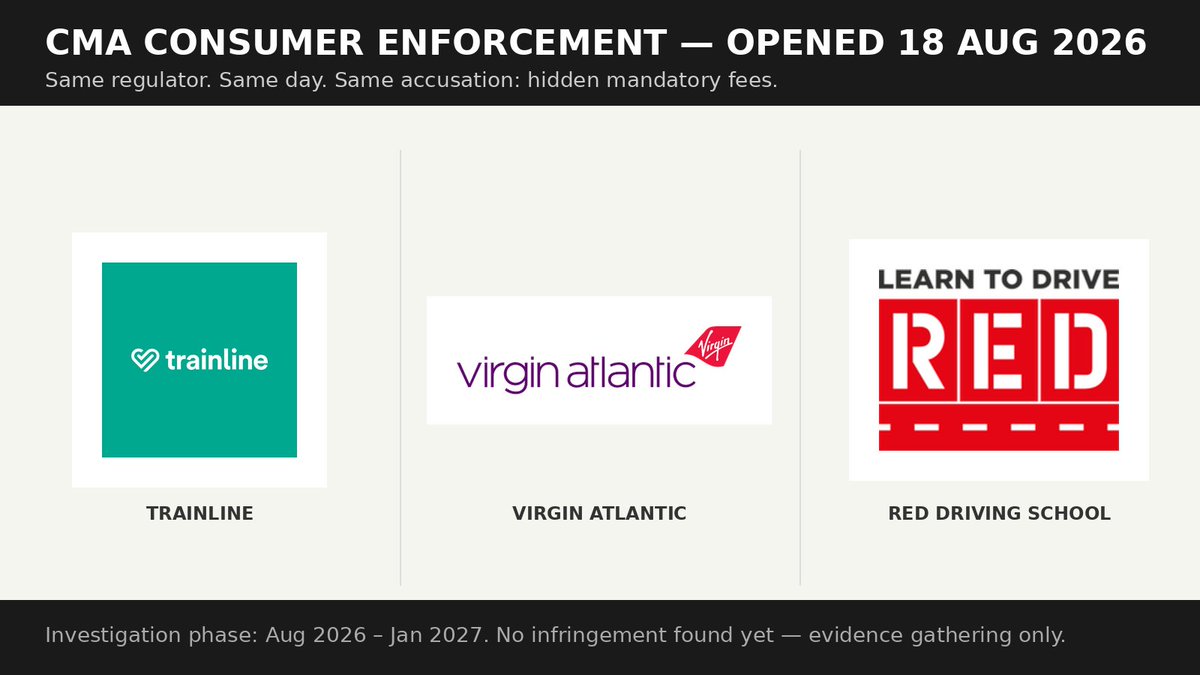
Three UK companies. Same regulator. Same day. Same exact accusation.
──────────────────
> Aug 18: the CMA opens formal investigations into Trainline, Virgin Atlantic, and Red Driving School - a ticket platform, an airline, and a driving school, three unrelated sectors, opened the same date
> The question is identical for all three: whether the mandatory fees you actually pay were included in the price shown to you at the start of checkout, or added on after
> The CMA's own language: it's checking whether the price you see "at the beginning of the process" is the price that ends up on your card
> None of the three has been found to have broken the law yet - this is the evidence-gathering phase, running through January 2027
──────────────────
Three companies, three industries, zero coordination between them - and all three landed on the identical move: show the small number first, let the real one show up at checkout.
That's not a coincidence. That's just what the default setting looks like once regulators finally check.
THE $7M - A - DAY BILL PARAMOUNT WANTS SOMEONE ELSE TO PAY
──────────────────
The company being sued over its own merger just told the people suing it to cover the cost of the delay their lawsuit caused.
──────────────────
> Paramount's $110B takeover of Warner Bros. - HBO Max, CNN, the studio - carries a "ticking fee": $7M every single day owed to Warner Bros. shareholders if the deal doesn't close by October 1
> 12 states plus the Writers Guild are suing to block it over Hollywood job losses - that lawsuit is the delay
> Paramount's own filing: those states should personally cover the $1.9B in costs piling up because they chose to sue
> California AG Rob Bonta's response to this exact pressure campaign, on the record: "blackmail"
──────────────────
The US federal government already cleared this deal. So did the EU. So did the UK. The one bill Paramount can't get anyone else to sign off on is the one for suing them - so now it's trying to send that bill to the states instead.
A hearing this week decides who actually pays.
THE $179 MEMBERSHIP THAT STOPS AT YOUR FRONT DOOR
You pay for free shipping and free returns once a year. Neither one is guaranteed the moment a third-party seller is the one actually shipping your order.
> Viral this week: a Prime member paid $28 for dental rinse - the seller had an Instacart runner buy the same product at a local Sam's Club for $11 and hand-deliver it, receipt included in the box
> Returning it wasn't free either: no free return option was offered, and the buyer got charged $8.50 for UPS return shipping - on a membership sold specifically on free shipping and free returns
> This isn't an isolated seller: 72% of retailers now charge for at least some returns, up from 66% last year, and the average mail-in return fee has climbed to $9.04 - a 47% jump since 2020, per NRF's own survey
> Amazon's own help pages confirm it in writing: outbound shipping isn't always refunded on a return, and third-party sellers can apply their own additional return fees - they're never required to match Amazon's own free-return policy
The $179 buys you access to Amazon's marketplace. It was never a guarantee that any specific seller inside it plays by Amazon's own rules - and the fee for finding that out only shows up after the order's already placed.
THE FUNERAL FEE YOU CAN'T SAY NO TO
──────────────────
The only price on the list you're not allowed to decline has nothing to do with the person you're burying.
──────────────────
> A viral breakdown this week: $12,000 funeral total - $4,000 casket, $3,000 plot, $2,500 "service fee" - and questioning any of it gets read as disrespecting the dead
> That "service fee" isn't optional. The FTC's own Funeral Rule permits exactly one non-declinable charge, the basic services fee - its 2024 national median runs $2,100-$2,500, per the industry's own General Price List study
>The casket next to it isn't fixed either: funeral homes mark caskets up 100-300% over wholesale. A $3,500 casket on the showroom floor often costs the home $900-1,400 - and the FTC requires them to accept a casket you buy elsewhere with no extra handling fee, something most families are never told
> The FTC ran its own undercover sweep of 250+ funeral homes: 39 violated the Rule outright, half gave estimates instead of real prices, and nearly 70% of after-hours calls needed a callback just to get a number
──────────────────
Every other line on a funeral price list is optional by law. The one you can't decline is priced like overhead - and sold to you like it's the last thing you'll ever do for the person you lost.
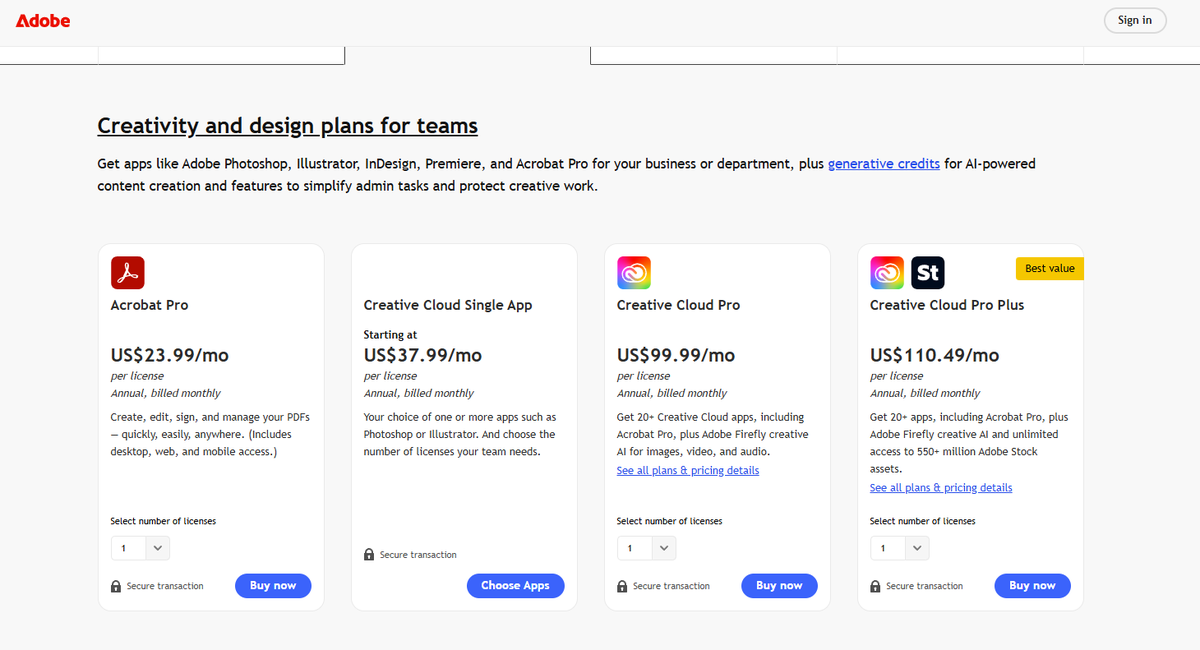
Adobe settled with the US for $150M in March.
Less than a week later, the UK opened a brand new investigation into the exact same fee - not a follow-up to the American case, a fresh one.
Amazon got hit with $2.5B for breaking the identical law. Adobe's number works out to about one day of its own revenue.
Same statute. A 16x smaller penalty. A second country already circling the same fee before the first settlement finished paying out.
Full math below.
Adobe's CEO made $51.2M this year.
The whole company paid $150M for deceiving subscribers with a fee he signed off on the design of.
His pay alone is a third of the penalty. The fee's still live. Someone got hit with it in public yesterday.
Full math below.