Maintain your A to HI: A for Attitude, B for Behavior, C for Cool, Calm, Composure & Clarity, D for Discipline, E for Energy, F for Focus, G for Gratitude, and H I for Hunger for Improvement. Master these, and you’re not just moving forward — you’re leveling up. #Mindset
All Paid Courses (Free for First 4500 People)
𝗣𝗮𝗶𝗱 𝗖𝗼𝘂𝗿𝘀𝗲 𝗙𝗥𝗘𝗘 (PART - 1)
1. Artificial Intelligence
2. Machine Learning
3. Prompt Engineering
4. Claude,Chatgpt,Grok
5. Data Analytics
6. AWS Certified
7. Data Science
8. BIG DATA
9. Python
10. Ethical Hacking
(72 Hours only )
Like + RT + comment ' Drive '
Must Follow me so I can DM you.
All Paid Courses (Free for First 4500 People)
𝗣𝗮𝗶𝗱 𝗖𝗼𝘂𝗿𝘀𝗲 𝗙𝗥𝗘𝗘 (PART - 1)
1. Artificial Intelligence
2. Machine Learning
3. Prompt Engineering
4. Claude,Chatgpt,Grok
5. Data Analytics
6. AWS Certified
7. Data Science
8. BIG DATA
9. Python
10. Ethical Hacking
(72 Hours only )
Like + RT + comment ' Drive '
Must Follow me so I can DM you.
🚨BREAKING: Hugging Face just open-sourced an AI intern that reads ML papers, trains models, and ships the final model for you.
It’s called ML Intern.
And this is not another AI coding demo that prints a broken PyTorch script and disappears.
You give it the goal.
It researches.
Writes code.
Runs experiments.
Uses Hugging Face datasets.
Launches jobs.
Pushes the final model.
All from your terminal.
`ml-intern "fine-tune llama on my dataset"`
That’s the entire command.
The crazy part is how deep this goes:
→ reads HF docs and research
→ searches papers and datasets
→ uses Hugging Face jobs
→ searches GitHub code
→ runs local and sandbox execution
→ streams every step back to you
→ asks approval before risky actions
→ keeps working for up to 300 iterations
This is the first open-source AI intern I’ve seen that feels built for actual ML work.
Not chat.
Execution.
4K stars already.
100% Open Source.
https://t.co/qCWxeGOr6I
NEW paper from Meta.
(bookmark this one)
What if the model wasn't just using the computer, but became the computer?
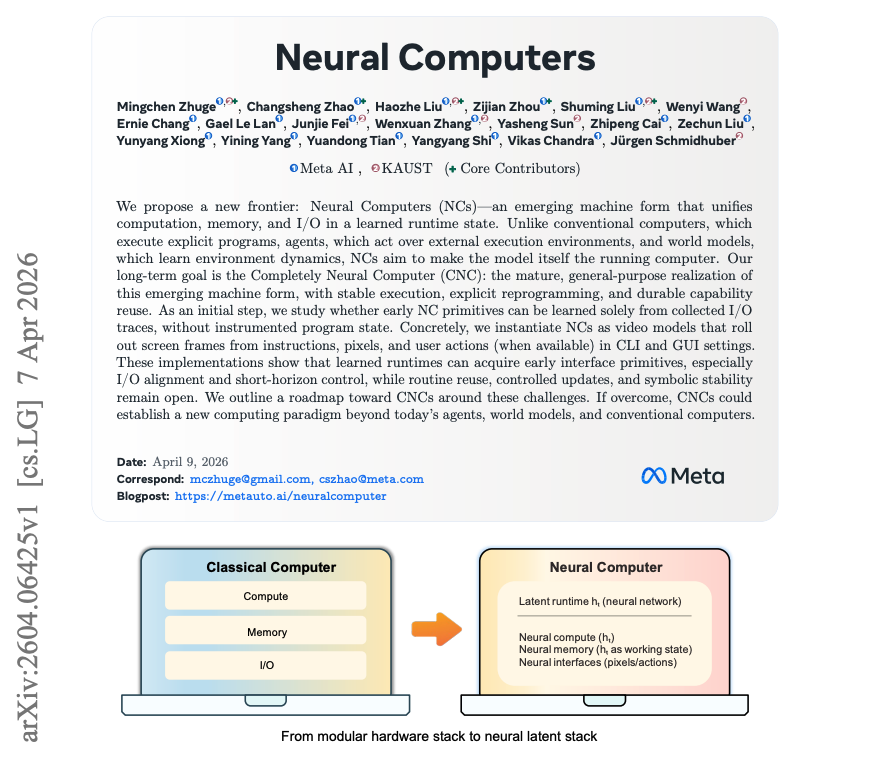
New research from Meta AI and KAUST makes a serious case for Neural Computers (NCs).
The paper proposes NCs as learned runtimes where computation, memory, and I/O live inside a single latent state. Their first prototypes use video models to roll out terminal and GUI interfaces from prompts, pixels, and user actions.
Why does it matter?
Today's agents still depend on external computers to store state, execute actions, and enforce system contracts. Neural Computers point to a different machine form: one where interface dynamics, working memory, and execution are learned together.
The early results are promising but grounded. CLI rendering improves, GUI cursor control reaches 98.7% with explicit visual supervision, and reprompting boosts arithmetic-probe accuracy from 4% to 83%. But symbolic reliability, stable reuse, and runtime governance remain open.
This is less "agents got better" and more "what comes after agents as a computing substrate?"
Paper: https://t.co/CKdclokmer
Learn to build effective AI agents in our academy: https://t.co/1e8RZKs4uX
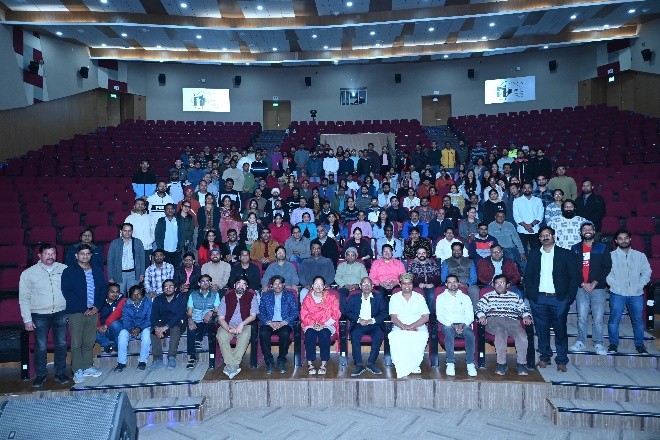
Honoured to have Prof. Oussama Khatib @Stanford with us as the Distinguished Guest at the 17th Foundation Day @iit__mandi .
His reflections on IIT Mandi’s unique setting and its growing emphasis on research, innovation, and real-world impact highlight the institute’s potential to emerge as a globally recognised hub, particularly in advanced domains such as robotics and AI.
@PMOIndia@EduMinOfIndia@PIB_India@PIB_Edu@TinyDhillon@iit__mandi
Seeking Solutions for Technological Challenges
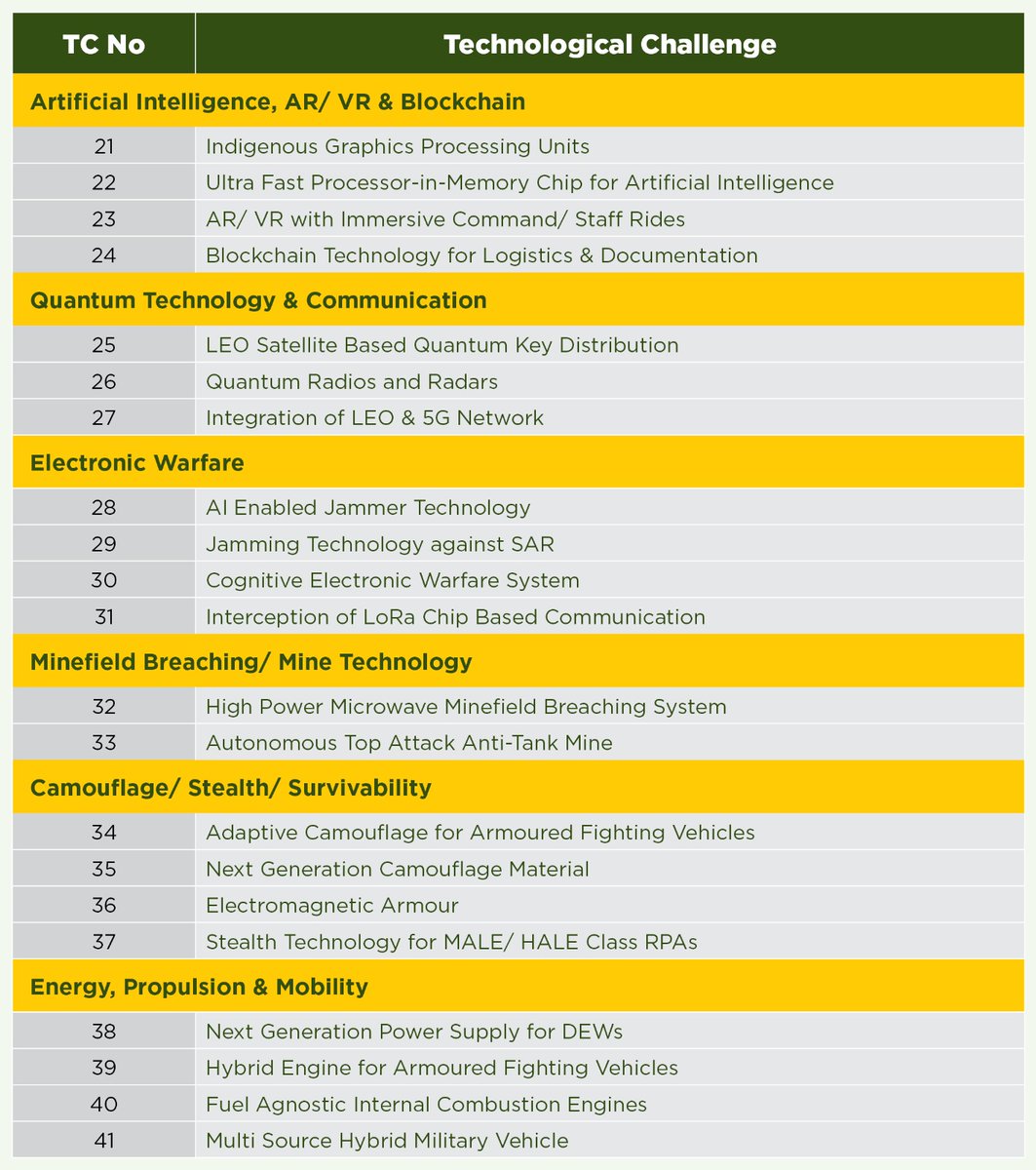
The Indian Army had released the Compendium of Technological Challenges (#CTC 2025) on 23 September 2025, outlining 41 futuristic challenges across domains such as Unmanned Systems, AI, Quantum Technologies and Directed Energy Weapons. The index of the compendium is available on the Army Design Bureau (ADB) webpage.
Interested agencies may request detailed information by emailing [email protected] to obtain the relevant sections of the compendium.
The last date to request details is 20 April 2026, and solutions may be submitted by 31 May 2026.
Further updates are available on the ADB webpage.
🚨 Google DeepMind + Meta + Amazon just dropped a 100 page roadmap that redefines what AI agents actually are.
They analyzed every major agentic reasoning framework across planning, tool use, memory, and multi-agent coordination.
Single-agent in stable environments: works great.
Multi-agent in dynamic environments: falls apart.
The problem isn't intelligence. It's how agents reason under uncertainty.
Three layers they found that actually matter:
→ Foundational reasoning (planning + tool use in stable settings)
→ Self-evolving reasoning (agents that adapt through feedback and memory)
→ Collective reasoning (multiple agents coordinating toward shared goals)
Even the best models struggle in open-ended environments.
Closed-world benchmarks are lying to you.
Reinforcement learning helps post-training. But in-context reasoning at test time? Still broken for long-horizon tasks.
The real finding: most AI agent tutorials you've seen are built on single-task, static benchmarks.
Real-world deployment robotics, healthcare, autonomous research breaks every framework on the market.
And almost nobody is building for that gap.
The future isn't smarter models. It's agents that plan, act, and learn across dynamic environments without falling apart mid-task.
This survey is the closest thing to a unified blueprint for that.
100% free on arXiv.
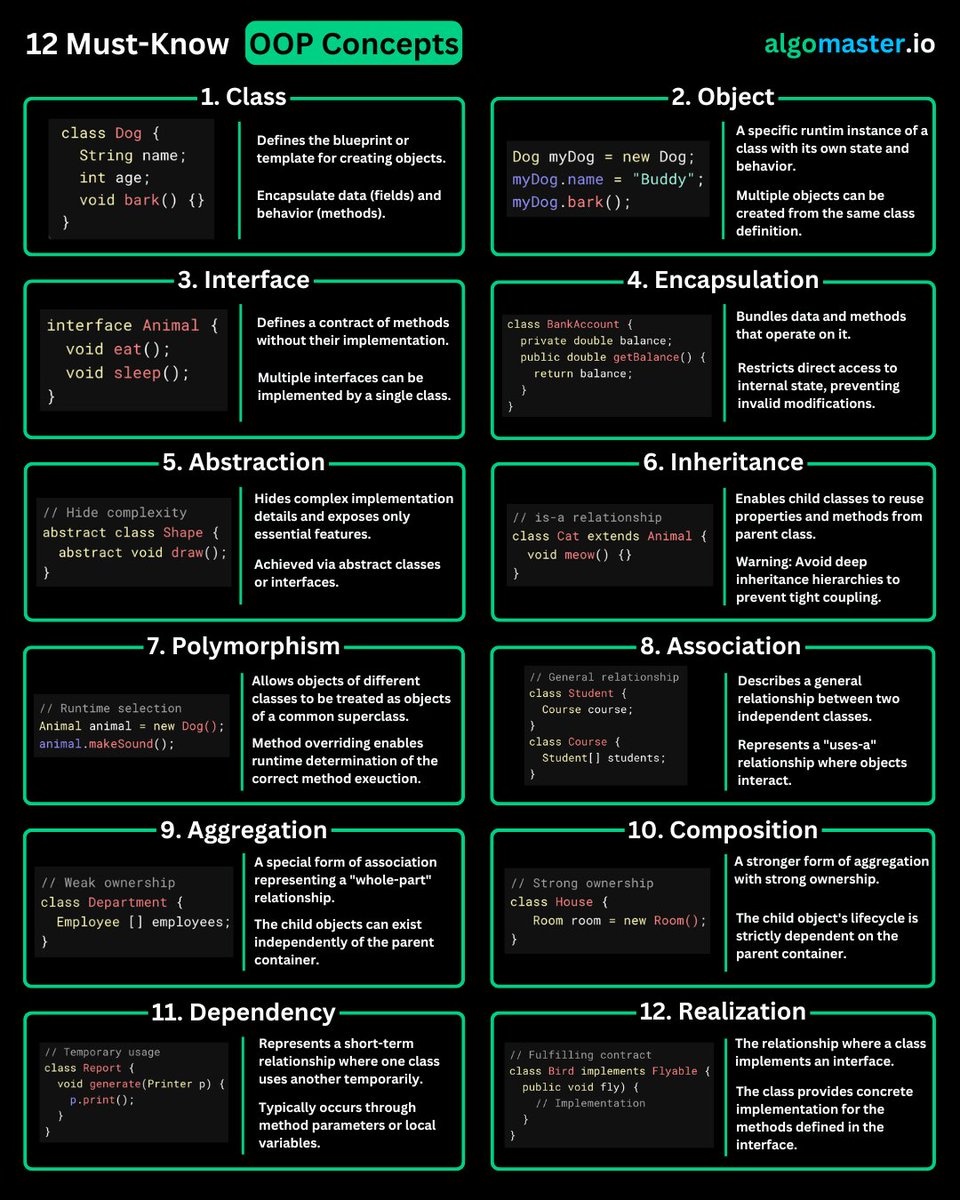
If you want to master Object-Oriented Programming (OOP), consider learning these 12 concepts:
1. 𝐂𝐥𝐚𝐬𝐬
2. 𝐎𝐛𝐣𝐞𝐜𝐭
3. 𝐈𝐧𝐭𝐞𝐫𝐟𝐚𝐜𝐞
4. 𝐄𝐧𝐜𝐚𝐩𝐬𝐮𝐥𝐚𝐭𝐢𝐨𝐧
5. 𝐀𝐛𝐬𝐭𝐫𝐚𝐜𝐭𝐢𝐨𝐧
6. 𝐈𝐧𝐡𝐞𝐫𝐢𝐭𝐚𝐧𝐜𝐞
7. 𝐏𝐨𝐥𝐲𝐦𝐨𝐫𝐩𝐡𝐢𝐬𝐦
8. 𝐀𝐬𝐬𝐨𝐜𝐢𝐚𝐭𝐢𝐨𝐧
9. 𝐀𝐠𝐠𝐫𝐞𝐠𝐚𝐭𝐢𝐨𝐧
10. 𝐂𝐨𝐦𝐩𝐨𝐬𝐢𝐭𝐢𝐨𝐧
11. 𝐃𝐞𝐩𝐞𝐧𝐝𝐞𝐧𝐜𝐲
12. 𝐑𝐞𝐚𝐥𝐢𝐳𝐚𝐭𝐢𝐨𝐧 (𝐈𝐦𝐩𝐥𝐞𝐦𝐞𝐧𝐭𝐚𝐭𝐢𝐨𝐧)
Which other OOP concept would you add to this list?
♻️ Repost to help others learn this
Meta just solved the biggest problem in RAG!
Most RAG systems waste your money. They retrieve 100 chunks when you only need 10. They force the LLM to process thousands of irrelevant tokens. You pay for compute you don't need.
Meta AI just solved this.
They built REFRAG, a new RAG approach that compresses and filters context before it hits the LLM. The results are insane:
- 30.85x faster time-to-first-token
- 16x larger context windows
- 2-4x fewer tokens processed
- Outperforms LLaMA on 16 RAG benchmarks
Here's what makes REFRAG different:
Traditional RAG dumps everything into the LLM. Every chunk. Every token. Even the irrelevant stuff.
REFRAG works at the embedding level instead:
↳ It compresses each chunk into a single embedding
↳ An RL-trained policy scores each chunk for relevance
↳ Only the best chunks get expanded and sent to the LLM
↳ The rest stay compressed or get filtered out entirely
The LLM only processes what matters.
The workflow is straightforward:
1. Encode your docs and store them in a vector database
2. When a query arrives, retrieve relevant chunks as usual
3. The RL policy evaluates compressed embeddings and picks the best ones
4. Selected chunks are expanded into full token embeddings
5. Rejected chunks stay as single compressed vectors
6. Everything goes to the LLM together
This means you can process 16x more context at 30x the speed with zero accuracy loss.
I have shared link to the paper in the next tweet!
Multi-vector embeddings (ColBERT, ColPali) are budget killers.
But MUVERA can cut your memory footprint by 70%.
Multi-vector models offer incredible retrieval but suffer from massive memory overhead and slow indexing. MUVERA (Multi-Vector Retrieval via Fixed Dimensional Encodings) compresses these into single, fixed-dimensional vectors.
How it works:
MUVERA condenses a sequence of vectors (e.g., 100x96d) into one vector via:
1️⃣ Space Partitioning: Groups vectors into buckets using SimHash or k-means clustering.
2️⃣ Dimensionality Reduction: Applies random linear projection to compress each sub-vector while preserving dot products.
3️⃣ Repetitions: Repeats the process multiple times and concatenates results to improve accuracy.
4️⃣ Final Projection: Optional final compression (not used in Weaviate's implementation).
The impact (LoTTE benchmark):
- Memory: 12GB → <1GB.
- Indexing: 20+ mins → 3-6 mins.
- HNSW Graph: 99% smaller.
There’s a trade-off:
You trade a slight dip in raw recall for massive efficiency gains. However, by tuning the HNSW `ef` parameter (e.g., `ef=512`), you can recover 80-90%+ recall while keeping costs low.
When should you use MUVERA?
→ Large-scale production RAG
→ Systems where memory/infrastructure costs are the direct bottleneck
→ Use cases requiring fast indexing
MUVERA in @weaviate_io 1.31+ takes just a couple of lines of code. You can tune three parameters (k_sim, d_proj, r_reps) to balance memory usage and retrieval accuracy for your specific use case.
Read the full technical deep-dive here: https://t.co/Umn6gPQMuh
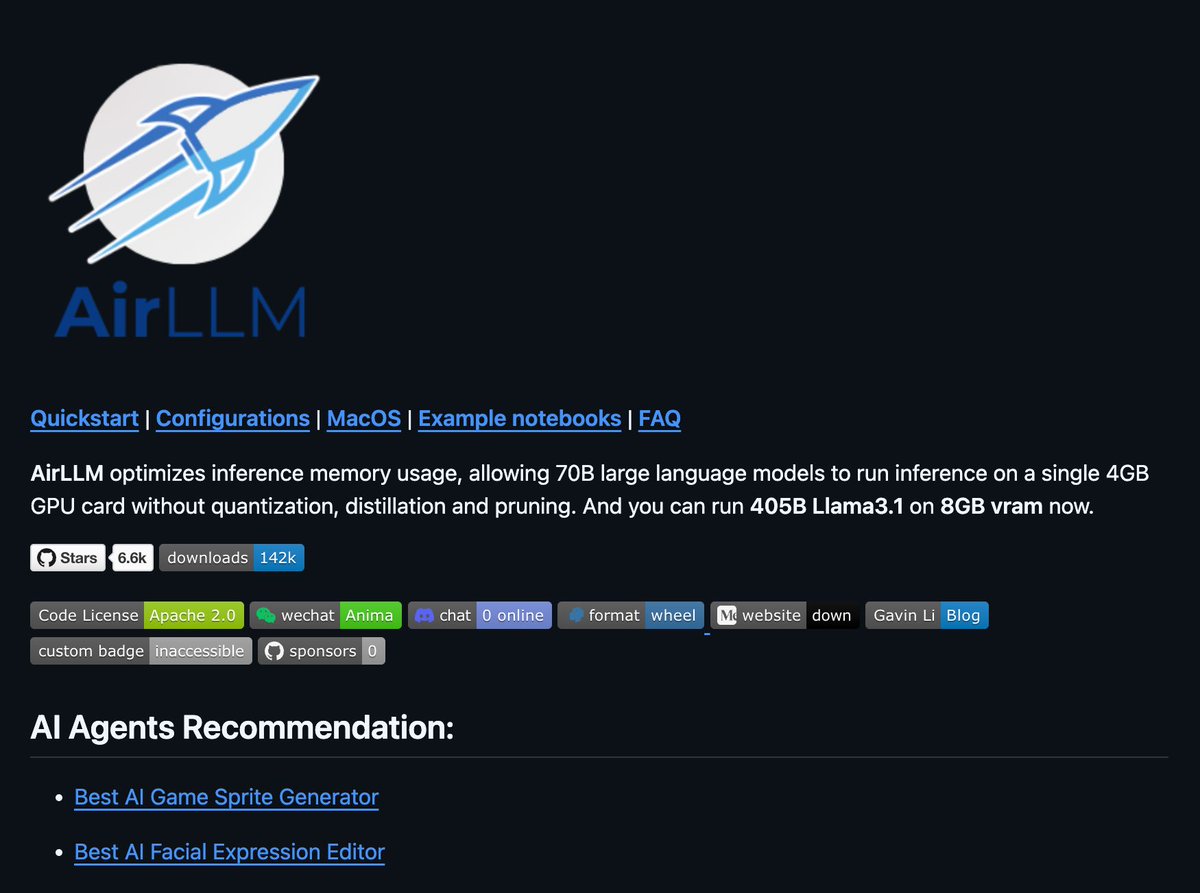
🚨BREAKING: You can now run 70B LLMs on a 4GB GPU.
AirLLM just killed the "you need expensive hardware" excuse.
It runs 70B models on 4GB VRAM.
It loads models one layer at a time, runs 405B Llama 3.1 on 8GB VRAM.
→ No quantization needed by default
→ Run Llama, Qwen, Mistral, Mixtral locally
→ Works on Linux, Windows, and macOS
100% Opensource.