A video that is currently going viral online: the groom’s friends created an incredible clip for a couple from Kazakhstan using AI.
It shows the lovers as if they had met in different eras and, across centuries, kept finding each other again and again.
The bride’s reaction is priceless.
Sweden got rich under laissez-faire and nearly wrecked itself trying to forget it. Between 1870 and 1970, Sweden ran one of the freest economies in Europe: low taxes, open trade, sound money, and entrepreneurs like the Wallenbergs and Ingvar Kamprad building world-class firms. By 1970 Sweden ranked fourth in OECD per capita income. Then the social democrats decided prosperity was automatic and started spending it.
You know what happened next if you understand incentives. Government spending blew past 60 percent of GDP by the late 1980s. Marginal tax rates crossed 85 percent. In 1976 Astrid Lindgren, the children's author, calculated her effective marginal rate at 102 percent and wrote a satirical fairy tale about it in Expressen. She paid the state more than she earned. Not a single new net private-sector job appeared between 1950 and 1990. Every job added came from the public payroll. Capital fled, IKEA's ownership moved offshore, and by 1993 Sweden had slid to roughly 14th in the OECD income rankings.
The 1991-93 crisis forced honesty. The krona collapsed, interest rates briefly hit 500 percent, and the political class ran out of other people's money in real time. What followed was one of the sharpest market-oriented turnarounds in modern history. Carl Bildt's government introduced universal school vouchers in 1992, letting for-profit schools compete for every student. Sweden partially privatized pensions in 1998 with individual investment accounts. It deregulated taxis, rail, telecom, postal services, and electricity. It abolished the inheritance tax in 2004 and the wealth tax in 2007. Corporate tax fell from 52 percent to 20.6 percent. Spending dropped nearly 20 points of GDP.
Notice what you never hear from the "democratic socialism" crowd: Sweden's welfare state produced stagnation. Its recovery came from cutting, privatizing, and deregulating. Bernie Sanders praises a country that killed its estate tax while he campaigns to raise yours. The lesson free market economists have taught for a century holds here perfectly. Wealth comes from capital accumulation and voluntary exchange. Redistribution consumes it. Sweden ran the experiment twice, in both directions, on live television.
The Swedes learned. The question is whether you will before your own government runs the same experiment.
This is what the destruction of Russian tankers in the Sea of Azov looks like
The “genocide” of Russia’s shadow fleet continues: Ukrainian drones struck 29 ships in the Sea of Azov in just one night. And over six days, 77 tankers have been hit.
Russian ports of Rostov, Azov, and Taganrog have stopped accepting wheat and other agricultural products. The Sea of Azov is under Ukraine’s fire control — Russia is halting navigation through the canal connecting the Don River with the Sea of Azov.
According to Reuters, traffic through the Kerch Strait has also been suspended.
📈 54 of 60 measured positions landed left of center.
Across the current 18 models tested from 12 labs, the average position is −0.41, a progressive lean. Strongest on environment (−0.82 average, every single model goes green) and social values (−0.69). Weakest on foreign policy (−0.11, almost exactly neutral) and economics (−0.16).
But the story that actually matters is that the progressive lean is no longer universal. For the first time, we have models sitting at center.
https://t.co/DqpcUx60E5
The most devastating thing in Apple's lawsuit against OpenAI is a name that does not appear in it. Jony Ive, Apple's former chief design officer, the guy who shaped the look of your iPhone, co-founded the hardware startup at the center of this entire case, and Apple did not sue him. Not named. Not accused. That omission is not mercy. It is the trap.
Apple filed Friday against OpenAI, its hardware arm, its chief hardware officer, and one engineer.
It alleges the hardware chief, a 24-year Apple veteran who led product design for the iPhone and Watch, told Apple staff interviewing at OpenAI to bring actual parts with them, batteries and logic boards, for show and tell.
It also alleges an engineer kept his Apple laptop, exploited a particular bug that still let him into Apple's file storage, and pulled dozens of highly confidential documents after joining OpenAI.
It then alleges OpenAI got one of Apple's own suppliers to run a proprietary metal-finishing process by letting it believe Apple had approved.
Apple's phrase for the hardware business: “rotten to its core”. OpenAI says it has no interest in other companies' trade secrets. Nothing is proven as of yet.
Take a close look at the line Tim & his team drew. U.S. California law protects your right to quit, compete, and carry your skills with you.
Taste, judgment, genius, they leave when you leave. That rule is why Silicon Valley exists, and Apple just conceded it in writing by letting Ive walk untouched.
What Tim / Apple says is not yours is the file. The part. The supplier. The process.
And that is why sparing Ive is quite lethal. Think about it…
Sam Altman’s only real defense now is to prove its device came from Ive's legitimate brilliance, not from Apple's schematics.
Apple has forced OpenAI to rest its entire case on the shoulders of the one man Apple chose not to sue, while demanding an injunction, the return of every file, discovery inside the hardware unit, and, per the complaint, the redesign of unreleased products. Before a jury. Against a device due in 2027 and an IPO in preparation.
Apple is not trying to win money here in this case. It is forcing OpenAI to prove, component by component, that the machine it is about to sell contains nothing but Jony Ive's mind, and no part of Apple's factory.
MAG7 returns year to date:
🪟 $MSFT: -20.37%
🚗 $TSLA: -9.33%
📘 $META: +1.38%
📦 $AMZN: +6.29%
🧠 $NVDA: +13.12%
🔍 $GOOG: +13.14%
🍎 $AAPL: +15.99%
Which will stock will end up being the best performer in 2026?
He went to prison. His company is worth $1 trillion.
SK Hynix stock once traded at 125 won. A penny stock bailed out by the Korean government. No buyer for over a decade.
Today it listed on Nasdaq. Priced at $149. Opened above $170.
The man who bought it, Chey Tae-won, paid ~$3 billion in 2012 when the industry called the deal a "terrible purchase." A year later, he was sentenced to four years for embezzlement.
His team kept building. In 2013, they produced the first HBM chip ever made. High Bandwidth Memory. The component inside every NVIDIA AI GPU.
SK Hynix now holds over 50% of the global HBM market. NVIDIA pays upfront to lock supply. No HBM, no AI training, no ChatGPT.
R&D started in 2009. AI demand didn't show up until 2022. Thirteen years of building before the wave arrived.
Chey was pardoned in 2015. Came back. Went all-in on AI memory.
Today's IPO: second-largest in US history. Biggest ever by a foreign company. Oversubscribed 7x.
Buy the thing nobody wants at the price nobody will pay. Build what nobody needs yet. Wait.
$3 billion became $1 trillion.
Thomas Sowell: ”Slavery was much bigger and involved infinitely more people than people have realized. It was not confined by race. It was not defined or created by race. It existed for thousands of years.
A history professor once had a student come up to him and ask, ‘When did slavery begin?’ The real question is: when did freedom begin? Cause slavery existed as long as we have any records. From archaeological findings, we know that people were enslaving other people before they could read or write. It has always existed and has existed all over the world.
The number of White people enslaved by pirates in North Africa was greater than the number of Africans brought to the United States.
And yet, that’s not even mentioned.”
⚡️ Ukraine carried out a successful series of overnight strikes on Russia, targeting the Borisoglebsk air base and the Saratov and Nizhnekamsk oil refineries
The Nizhnekamsk refinery in Tatarstan — one of Russia's largest and most modern oil-processing facilities — appears to have sustained the heaviest damage, with major fires reported at the site.
The refinery produces gasoline, Euro-5 diesel fuel, and other petroleum products.
Well, it was inevitable, and it happened.
Time and again, Russia brings down another Ukrainian apartment building with a missile in the middle of the night, burying entire families beneath the rubble.
Ukraine strikes one of Russia’s largest and most strategically important oil refineries, around 3,000 kilometres from its own borders.
One side deliberately targets civilians. The other targets the infrastructure that fuels the war.
If anyone still struggles to see the difference, they’re choosing not to.
Warren Buffett saved his $700M investment and rescued $9B Salomon Brothers in 4 hours - by firing the CEO and personally calling the US Treasury
this is the only time Warren Buffett ever sat before Congress - under oath
"the only time in my life I had trouble sleeping" - their traders rigged the Treasury market - the CEO hid it for 4 months
payphone in Reno - found out his $700M was burning - flew to New York - by Monday he was CEO
their trader bought 94% of a Treasury auction -limit was 35% - the CEO knew for 4 months and said nothing - Buffett fired him the day he walked in
"lose money - I will be understanding - lose a shred of reputation - I will be ruthless "
saved 8,000 jobs in one weekend and his investment - still files his own taxes since age 13
bookmark & watch today ↓
We now believe the S&P 500 is setting up for 8,000+. Here's why:
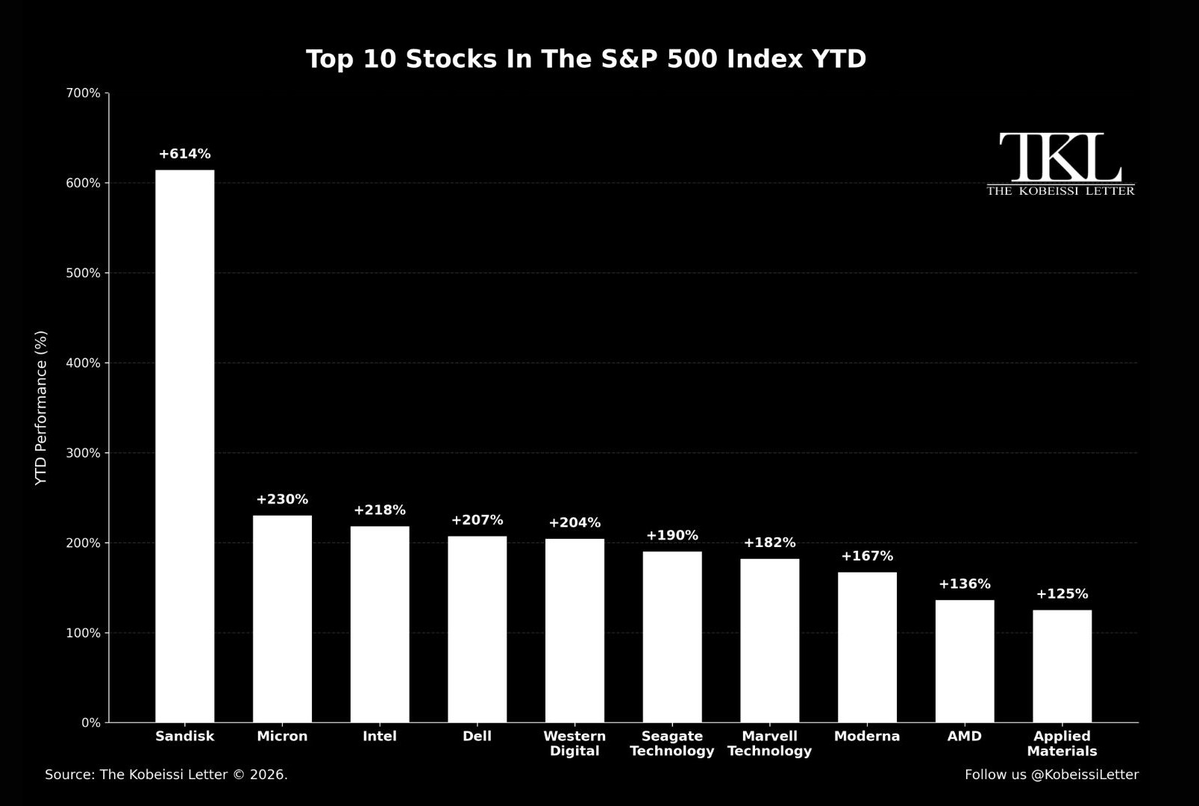
Chip stocks have quietly become the new leaders of this bull market.
While many of the Magnificent 7 stocks have declined 20%+ from their recent highs, semiconductor names have taken over.
In fact, 8 of the 10 best-performing S&P 500 stocks this year are in the chip industry.
As a result, the S&P 500 now sits just ~1% below a record high despite weakness the big tech stocks which have led the market since 2022.
This marks the first time since 2022 that the market traded highly with leadership outside of the Magnificent 7, while the Magnificent 7 traded in the opposite direction.
In our view, this rotation is constructive as the Magnificent 7 prepares to "sub back in."
As large-cap tech begins to regain leadership while semiconductors continue to outperform or even cool-off, the S&P 500 is poised for 8,000+.
Asset owners will continue to win.
⚡️ It has happened! Drones have finally attacked the Omsk oil refinery, which had remained untouched all this time
This is one of the largest oil refineries in Russia, which supplies fuel, including for the army.
It is more than 2,000 km from the border with Ukraine.
The Omsk oil refinery is considered a key enterprise for supplying fuel to Siberia and a significant part of Russia.
Every defender of money printing pictures himself holding the printer, never standing at the end of the line where the new money arrives worthless.
This is the same fantasy the socialist runs. He imagines himself the commissar deciding who eats, never the peasant waiting for bread that never comes.
You do this too if you cheer for the Fed. You imagine yourself the beneficiary.
The banks get them first. The Treasury gets them first. The hedge funds holding assets the central bank buys get them first. By the time the money reaches your wages, prices already climbed.
Richard Cantillon spelled this out in the 1730s. New money does not raise all prices at once. It enters at a point and spreads outward, enriching whoever spends it before the rise, robbing whoever holds it after.
The Fed expanded its balance sheet from $900 billion in 2008 to $8.9 trillion by 2022. Asset holders got richer. Wage earners watched grocery bills jump 11 percent in 2022 alone.
You were never the commissar. You were the peasant.
Jerome Powell never lost any sleep over your savings account. You do not control the printer, you are standing in the bread line. Stop defending the people who are stealing from you.
Stop imagining yourself next to the machine. You stand at the back of the line, and the line only gets longer.
Taiwan solved tax evasion in 1951 with a trick so cheap it should embarrass every tax authority on the planet.
The problem was an all-cash economy full of small shops. A merchant pockets the cash, skips the receipt, and the sale never existed. Auditors can't catch what was never recorded, and hiring enough of them to watch every noodle stand costs more than the missing tax.
So finance chief Ren Xianqun flipped the incentive. Print a lottery number on every receipt. Draw winners every two months on live TV. Top prize today: NT$10 million, about $310K.
Suddenly the customer and the shopkeeper want opposite things. The merchant wants the sale off the books. The customer wants the ticket. And there are millions more customers than merchants. Every transaction now carries a built-in witness demanding the paper trail.
Year one, reported tax revenue jumped 75%, from NT$29 million to NT$51 million. Seventy-five years later, roughly 70% of Taiwanese still play. Convenience stores redeem the smallest NT$200 prizes at the register, so even a coffee receipt feels like a scratch card.
The elegant part is what the audit force costs. The prize pool runs about NT$7 billion a year, roughly $20 million. In exchange, the government gets 23 million unpaid auditors working every checkout line in the country, forever. No inspector general on earth delivers that coverage at that price.
Greece, Italy, Portugal, and Slovakia all copied it. The most effective compliance tool ever built looks like a game, and that's exactly why it works.
Pinochet dropped 30,000 communists out of helicopters and created the most peaceful, prosperous society in South America.
Would you rather live in a free-market dictatorship or a communist democracy?
Would you rather live in Singapore or Venezuela?