Un estudiante mexicano inventó una carretera que se repara sola cuando llueve.
Israel Antonio Briseño Carmona estudiaba ingeniería civil en Coahuila cuando se hizo una pregunta simple, por qué los baches siempre aparecen justo después de que llueve. Así que en vez de pelear contra el agua, decidió aprovecharla, y creó un material llamado PAFLEC, hecho con goma de llantas recicladas mezclada con asfalto.
Lo interesante es que cuando el agua entra en contacto con esa mezcla, en lugar de dañar la carretera, ayuda a sellar las pequeñas grietas antes de que se conviertan en baches grandes. Con esta idea ganó el Premio James Dyson de México en 2019, y su invento no se quedó solo en el papel, algunos gobiernos municipales ya lo han probado en calles reales, con buenos resultados.
No es magia, no arregla baches enormes de la noche a la mañana, pero sí ayuda a que las calles duren más tiempo sin necesitar reparaciones grandes.
@EsdeProfugos América del sur, Europa y Africa ya habrán tenido su mundial en el 2030 y Asia en el 2034. Después qué toca? Oceanía? 🧐 O América del norte nuevamente? Porque Antártida no creo.
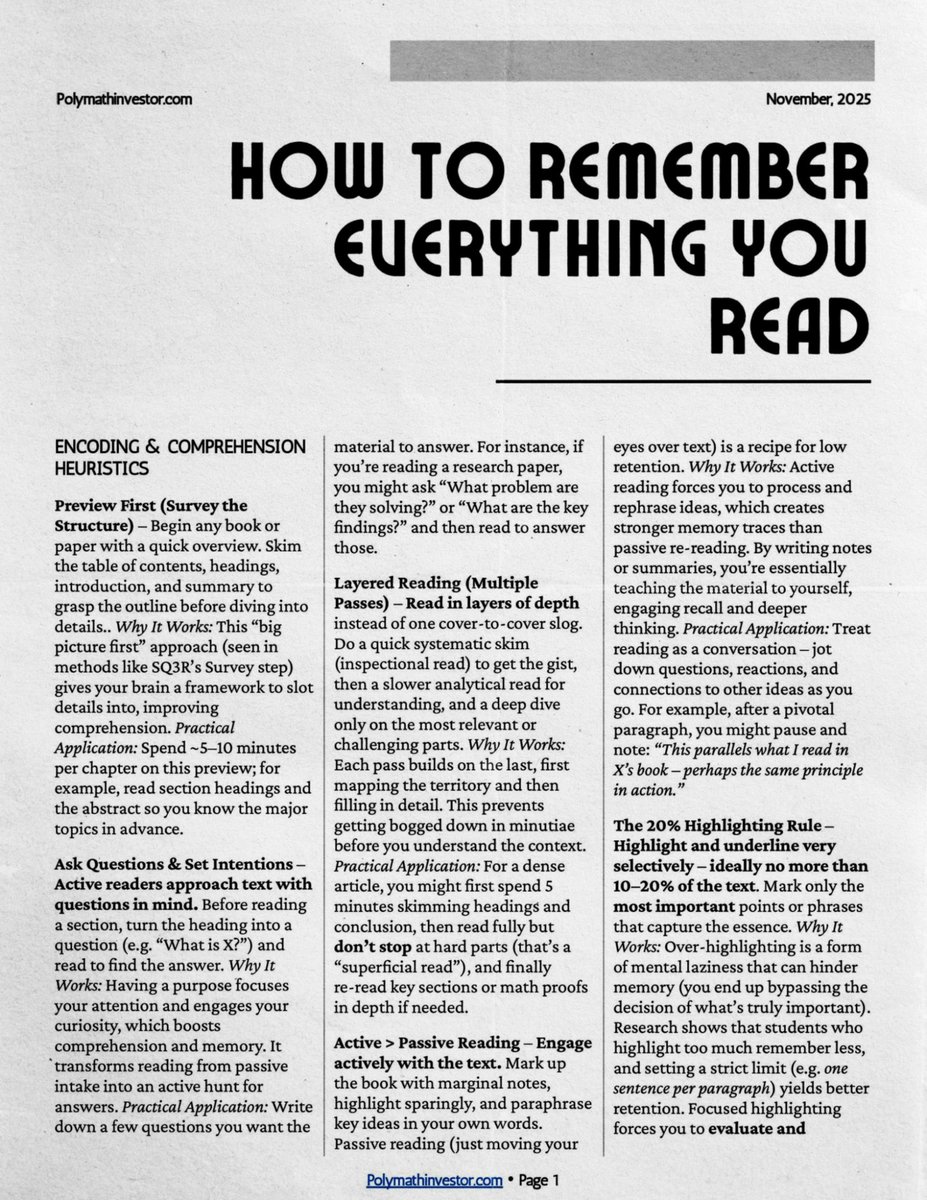
A few months back, I published this guide on how to remember everything you read.
Re-sharing it here for anyone who finds these protocols useful.
(1/11)
A dog was diagnosed with depression after suffering a miscarriage, and vets decided that working with kids at a local school would be good for her.
She has never been happier.
This video shows British illustrator and amateur naturalist Jo Brown flipping through her mushroom-themed notebook, which contains detailed illustrations and descriptions of various mushrooms she has observed in the wilds of Devon.
Spengler's take on art (and why western art is in terminal decline) is fascinating.
For all cultures, the first true art form is architecture. This is the most immediate expression of a culture's "world-feeling". All other art forms then spring out from the architecture...
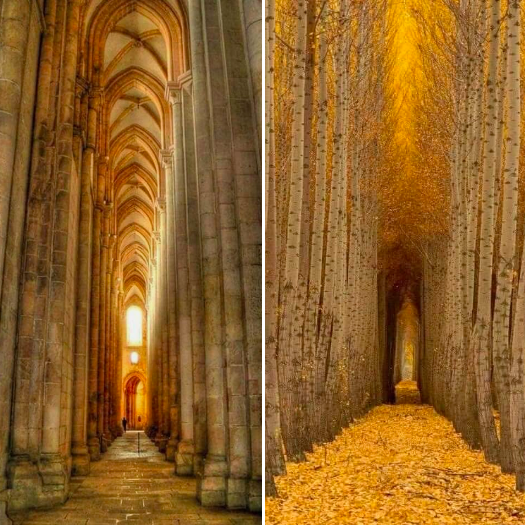
For Western culture, upward-reaching cathedrals were inspired by the forests of Northern Europe.
The prime symbol of Western culture is the perception of infinite space — a yearning to reach out of the darkness of the trees to the light beyond.
Later art forms all came from the cathedrals. Notice how sculptures of saints were originally attached to the cathedral, but later stepped out of the architecture to stand on their own feet.
Likewise, fresco paintings became detached from the walls as standalone oil paintings, and even classical music came from Gregorian chant, for which the cathedral was designed to carry and amplify.
Even western drama came from religious ceremonies (Spengler talks about how western drama is confessional in nature).
This is because all art forms (and all non-natural expressions of life) originate from religion. They may separate themselves physically from the church over time, but are still fundamentally tied to that metaphysical expression.
You cannot define individual art forms because they all blend into each other. Sculpture, painting, and music are merely words, and they are nothing without the prime urge that created them. This is why to define what art is you have to extract the cultural form, or the "inner form-language".
The artists of the present (in the Western culture) aren't really engaged in "art" at all, but merely a kind of craftsmanship. It lacks the spontaneity and necessity of the word-feeling that birthed the culture’s artistic expression.
"Of great painting or great music there can no longer be, for Western people, any question. Their architectural possibilities have been exhausted these hundred years. Only extensive possibilities are left to them."
The Batman effect.
A female experimenter, appearing pregnant, boarded the train. In the experimental condition, an additional experimenter dressed as Batman entered from another door. Passengers were significantly more likely to offer their seat when Batman was present (67.21% vs. 37.66%).
[Francesco Pagnini et al.,"Unexpected events and prosocial behavior: the Batman effect", Nature, 2025]






![Rainmaker1973's tweet photo. The Batman effect.
A female experimenter, appearing pregnant, boarded the train. In the experimental condition, an additional experimenter dressed as Batman entered from another door. Passengers were significantly more likely to offer their seat when Batman was present (67.21% vs. 37.66%).
[Francesco Pagnini et al.,"Unexpected events and prosocial behavior: the Batman effect", Nature, 2025]](https://pbs.twimg.com/media/G6V-z4rWIAAaGSm.jpg)
![Rainmaker1973's tweet photo. The complexity of the human brain and its functions in a neat infographic map
[zoomable version: https://t.co/4KyqZPcgRB] https://t.co/HBqFEFYO4S](https://pbs.twimg.com/media/G0Qac-_XwAALzZ0.jpg)




